

High write-off mortgage qualification is the process of meeting IRS deduction rules and lender income standards to maximize deductible mortgage interest while still securing loan approval. Self-employed borrowers and real estate investors face a specific challenge: the same tax write-offs that reduce their IRS bill also shrink the income figure lenders use to approve loans. This guide covers the IRS debt limits that govern deductions, the alternative documentation methods that solve the income gap, and the loan programs built for borrowers with complex tax situations. Understanding all three gives you a real path forward.
What are the IRS rules on mortgage interest deductions?
The IRS mortgage interest deduction is the foundation of any high write-off mortgage qualification guide. Knowing the exact limits prevents costly mistakes at tax time and during underwriting.
Debt limits that control your deduction
For mortgage debt originated after december 15, 2017, the IRS caps deductible interest at the first $750,000 of combined mortgage debt. Debt originated before that date carries a higher limit of $1,000,000. If your total mortgage balance exceeds the applicable limit, only the proportional share of interest qualifies for the deduction.
These limits apply across your primary residence and one secondary home combined. A $900,000 mortgage originated in 2023 means you can only deduct interest on $750,000 of that balance. The remaining $150,000 generates interest that produces no tax benefit.
What counts as a qualified home
The deduction applies only to loans secured by a qualified home used as your primary or secondary residence. Qualified homes include houses, condominiums, cooperatives, mobile homes with sleeping and bathroom facilities, and houseboats. A loan secured by a property you use purely for investment does not qualify for the personal mortgage interest deduction.
Loan proceeds must also be used to buy, build, or substantially improve the home. The IRS disqualifies interest on home equity loans used for unrelated purposes such as paying off credit cards or funding a business. This distinction matters for real estate investors who pull equity from one property to fund another.
Itemizing versus taking the standard deduction
Over 90% of U.S. tax filers claim the standard deduction since 2018, when the Tax Cuts and Jobs Act nearly doubled standard deduction amounts. That shift means most homeowners no longer benefit from the mortgage interest deduction at all. Self-employed borrowers and investors with large loan balances, significant business deductions, and multiple properties are the group most likely to clear the itemization threshold.
| Filing Status | 2025 Standard Deduction | Mortgage Interest Needed to Benefit from Itemizing |
|---|---|---|
| Single | $15,000 | More than $15,000 in total itemized deductions |
| Married Filing Jointly | $30,000 | More than $30,000 in total itemized deductions |
| Head of Household | $22,500 | More than $22,500 in total itemized deductions |
Rental and business use of a property changes the tax form you use. Itemizing personal deductions requires Schedule A on Form 1040. Rental income and expenses go on Schedule E. Business use of a home goes on Schedule C. Getting the form right determines whether the deduction survives an audit.
How can self-employed borrowers document income for mortgage qualification?
Self-employed borrowers and real estate investors face a documentation problem that conventional underwriting was not designed to solve. Tax returns show taxable income after write-offs, which is often far below actual cash flow. The solution is alternative income documentation.
Bank statements as proof of income
Bank statement loans use 12–24 months of business or personal bank deposits to calculate qualifying income instead of tax returns. The lender applies an expense factor to the gross deposits to estimate net income. At 1st Nationwide Mortgage, the standard expense factor on business accounts is 50%. That means $20,000 per month in deposits produces $10,000 in qualifying income. With a CPA-certified profit and loss statement, that expense factor can drop to 35–40%, which meaningfully increases the qualifying income figure.

This approach works because it reflects actual cash flow rather than the taxable income number your accountant minimized. A freelance consultant depositing $180,000 per year might show $40,000 in taxable income after write-offs. A bank statement loan sees the $180,000 and works from there.
Pro Tip: Ask your CPA to prepare a certified profit and loss statement before you apply. That single document can reduce your expense factor by 10–15 percentage points and increase your qualifying income significantly.
1099 forms and profit and loss statements
1099 mortgage loans use contractor income forms instead of W-2s or tax returns. Lenders average two years of 1099 income and apply their own expense ratio to arrive at qualifying income. This works well for independent contractors, consultants, and gig workers who receive consistent 1099 income but write off substantial business expenses.
Key documentation lenders typically require for alternative income qualification:
- 12–24 months of business or personal bank statements
- A CPA-certified profit and loss statement (current year and prior year)
- 1099 forms for the past two years if applicable
- Business license or proof of self-employment for at least two years
- A minimum 620 credit score for most alternative loan programs
- 10–20% down payment depending on the loan program and property type
Business write-offs do not automatically disqualify a self-employed borrower. Careful documentation is what separates a declined application from an approved one. The goal is to show a lender your real cash flow, not the number your tax return was designed to minimize.
What mortgage types best support high write-off qualifications?
Not every loan program handles complex income the same way. The right loan type depends on your income source, property type, and how you hold title.
Bank statement loans
Bank statement loans are the primary tool for self-employed borrowers who maximize write-offs. They replace tax return income with deposit-based income. At 1st Nationwide Mortgage, these loans require a minimum 620 credit score and 10–20% down. They are available for primary residences, second homes, and investment properties. A bank statement mortgage is the most direct solution for a borrower whose Schedule C shows minimal taxable income.
DSCR loans for real estate investors
Debt Service Coverage Ratio loans qualify the property, not the borrower. The lender compares the property’s rental income to its monthly mortgage payment. If the rent covers the debt service, the loan qualifies. The borrower’s personal income, tax returns, and write-offs are not part of the equation. DSCR loans at 1st Nationwide Mortgage work for LLCs and carry no limit on the number of financed properties. This makes them the best write-off mortgage strategy for investors building a portfolio.
Mortgage without tax returns
A mortgage without tax returns covers several program types beyond bank statement and DSCR loans. These include asset depletion loans, which calculate income from liquid assets, and NONI programs for borrowers with no documentable income. Foreign nationals and borrowers with offshore income structures often use these programs.
| Loan Type | Qualifying Income Source | Best For |
|---|---|---|
| Bank Statement Loan | 12–24 months of deposits | Self-employed with high write-offs |
| DSCR Loan | Property rental income | Real estate investors, LLCs |
| 1099 Loan | Contractor income forms | Freelancers, consultants |
| Mortgage Without Tax Returns | Assets or alternative docs | Complex income, foreign nationals |
| Conventional Loan | Tax return income (2-year average) | W-2 earners with stable income |
Rental property mortgage interest is deductible as a rental expense on Schedule E, separate from the personal mortgage interest deduction. A second home rented out must meet personal use tests to qualify for the personal deduction. If you rent it out more than 14 days per year and do not use it personally for the required number of days, it becomes a rental property for tax purposes.
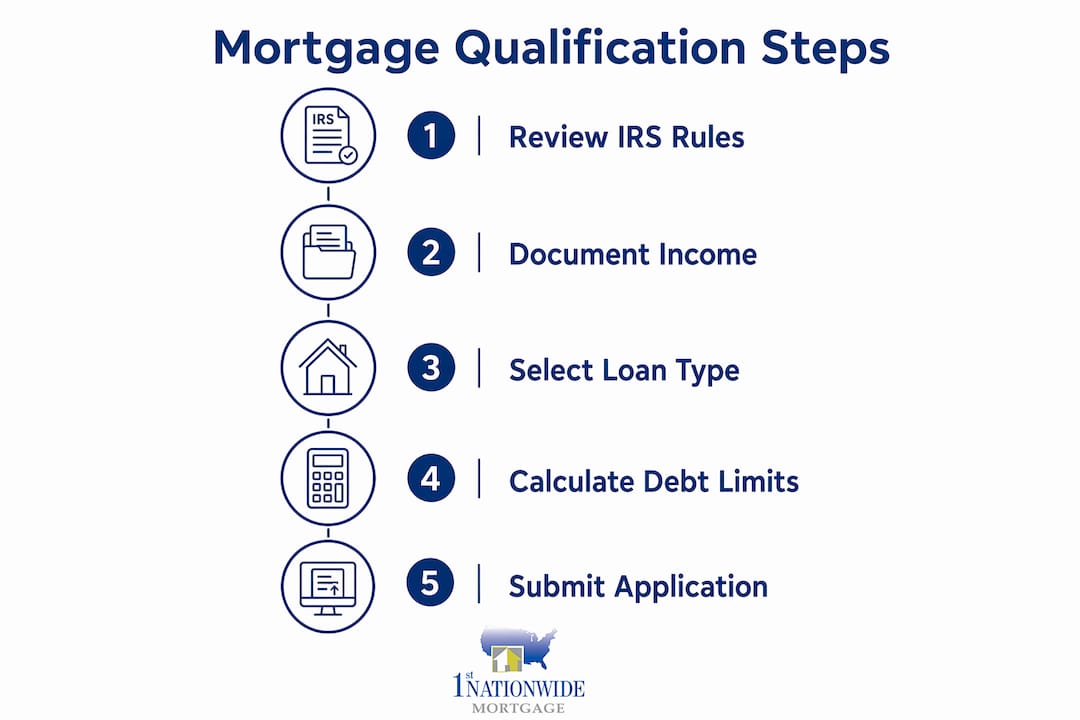
Step-by-step process to qualify for a high write-off mortgage
A successful application requires preparation before you contact any lender. Rushing the process without the right documents is the most common reason self-employed borrowers get declined.
-
Assess your income documentation. Determine whether your tax returns show enough income to qualify conventionally. If your adjusted gross income after write-offs is too low, identify whether bank statements, 1099 forms, or a CPA-certified P&L will better represent your cash flow.
-
Pull and review your credit report. Most alternative loan programs require a minimum 620 credit score. Review your report at least 60 days before applying so you have time to correct errors or pay down balances that affect your score.
-
Gather 12–24 months of bank statements. Separate business and personal accounts. Lenders will flag large irregular deposits, so prepare explanations for any non-recurring income. Consistent monthly deposits strengthen your file.
-
Get a CPA-certified profit and loss statement. This document is not optional if you want the lower expense factor. It must be prepared and signed by a licensed CPA, not self-generated. A lower expense factor means higher qualifying income.
-
Shop multiple lenders and compare APRs. Comparing APRs from multiple lenders is the most effective way to secure a mortgage that balances rate, tax strategy, and monthly payment. No single lender consistently offers the lowest rate for alternative income borrowers.
-
Decide whether to itemize on your tax return. If your mortgage interest, state and local taxes, and charitable contributions exceed your standard deduction, file Schedule A. Work with your CPA to confirm this before filing, since the decision affects your after-tax cost of the mortgage.
-
Time your write-offs carefully. If you are planning to apply for a mortgage in the next 12–24 months, discuss with your CPA whether maximizing write-offs in the current tax year will hurt your qualifying income. Bank statement loans reduce this tension, but conventional and jumbo loans still use tax return income.
Pro Tip: If you are close to the $750,000 debt limit, consider structuring a purchase with a larger down payment to keep the deductible balance below the cap. That keeps 100% of your interest deductible.
Key takeaways
Self-employed borrowers and real estate investors qualify for mortgages by using alternative income documentation, choosing the right loan program, and understanding IRS deduction limits before they apply.
| Point | Details |
|---|---|
| IRS debt limit is $750,000 | Mortgage interest is only deductible on the first $750,000 of debt for loans originated after december 15, 2017. |
| Bank statement loans solve the write-off gap | Lenders use 12–24 months of deposits instead of tax returns, making write-offs irrelevant to qualification. |
| DSCR loans ignore personal income | Real estate investors qualify based on rental income alone, with no limit on financed properties. |
| Itemizing is required to claim the deduction | You must file Schedule A to deduct mortgage interest; over 90% of filers now take the standard deduction instead. |
| Shop at least 3–5 lenders | No single lender consistently offers the best rate for alternative income borrowers; comparing APRs is non-negotiable. |
What I’ve learned after years of working with high write-off borrowers
The biggest mistake I see is borrowers treating their tax strategy and their mortgage strategy as two separate conversations. They are not. Your CPA is optimizing for the lowest possible tax bill. That is exactly the right goal for April 15. But that same optimization can make your income look too low for a conventional lender in October when you want to buy a property.
The fix is not to stop taking write-offs. The fix is to choose a loan program that does not penalize you for them. Bank statement loans and DSCR loans exist precisely because the tax code rewards business owners for reducing taxable income. The mortgage market caught up.
What I also see is borrowers who assume the mortgage interest deduction is automatic. It is not. You have to itemize, your loan has to be secured by a qualified home, and the proceeds have to have been used to buy or improve that home. A home equity line used to fund a business does not qualify. These details matter, and most borrowers do not find out until they are sitting with their CPA after closing.
My advice: have the mortgage conversation before you finalize your tax return for the year you plan to buy. One conversation between your CPA and your loan officer can save you from a declined application or a missed deduction worth thousands of dollars.
— Chris Arco, NMLS #1281
Specialized loan programs for self-employed borrowers and investors
Self-employed borrowers and real estate investors have more financing options than most conventional lenders suggest. 1st Nationwide Mortgage is a direct mortgage banker, not a broker, licensed in 18 states with a BBB A+ rating. The programs available include bank statement loans, DSCR loans for investment properties, and mortgage options without tax returns for borrowers with complex income structures.
If you are building a rental portfolio or running a business with significant write-offs, the right loan program changes the entire qualification picture. Explore the full range of loan programs at 1st Nationwide Mortgage or use the mortgage calculators to estimate payments across different loan structures before you apply.
FAQ
What is a high write-off mortgage qualification?
High write-off mortgage qualification is the process of securing a home loan when significant business or tax deductions reduce your reported income below conventional lender thresholds. Alternative programs like bank statement loans and DSCR loans solve this by using actual cash flow or rental income instead of tax return figures.
Can I still get a mortgage if my tax returns show low income?
Yes. Bank statement loans use 12–24 months of deposits to calculate qualifying income, bypassing tax returns entirely. DSCR loans for investment properties qualify based on rental income, with no reference to your personal tax return.
What is the IRS limit on mortgage interest deductions?
The IRS limits deductible mortgage interest to the first $750,000 of debt for loans originated after december 15, 2017, and $1,000,000 for older debt. Interest on balances above these limits is not deductible.
Do I need to itemize to claim the mortgage interest deduction?
Yes. You must file Schedule A on Form 1040 to claim the personal mortgage interest deduction. With the standard deduction now at $30,000 for married filers, you need total itemized deductions above that threshold to benefit.
Are DSCR loans a good option for real estate investors with write-offs?
DSCR loans are the strongest option for investors because personal income and tax returns are not part of the qualification. The property’s rental income covers the debt service, and the loan can be held in an LLC with no cap on the number of properties financed.