
Category: Uncategorized

  • What Credit Score Do You Need for a DSCR Loan?

    What Credit Score Do You Need for a DSCR Loan?

    Most DSCR programs advertise a floor of 620 to 640, but the score that actually gets your loan approved in this market runs higher. If you want the smoothest path to approval, treat 660 to 680 as your realistic minimum and 720+ as the tier where you start unlocking the best terms available. That gap between the advertised number and the real number trips up a lot of investors who assume the marketing floor is what underwriting will actually accept.

    The Consumer Financial Protection Bureau recommends pulling your credit reports and correcting errors before you apply for any secured lending product, and that advice matters even more here, since DSCR pricing tiers move in narrow bands. A ten-point swing near a cutoff can change your available loan-to-value or your required down payment.

    Here’s the quick version before we get into the mechanics:

    • Program floor: 620 to 640 (what gets advertised)
    • Effective underwriting minimum: 660 to 680 (what actually closes in today’s market)
    • Best-pricing tier: 720 and above

    Program floors versus practical approval: advertised minimums are a marketing number, not a promise. Underwriting overlays in 2026 commonly push the real threshold to the 660 to 680 range, even though plenty of lender websites still list 620 as the starting point.

    Key Takeaways

    DSCR loan approval depends on the gap between your actual FICO score and the lender’s effective underwriting threshold, not the advertised program floor.

    Point Details
    Know the real minimum Program floors of 620 to 640 rarely reflect the 660 to 680 effective threshold most lenders apply.
    Credit and DSCR interact A stronger DSCR ratio can offset a lower credit score, and vice versa, within limits.
    Pull your actual FICO Free app scores are usually VantageScore, not the FICO number underwriters pull for mortgages.
    Time your improvements Utilization paydowns and dispute corrections can move a score in 30 to 90 days; derogatory marks take longer.
    Work with a direct lender 1st Nationwide Mortgage underwrites DSCR loans on rental income in house, without shopping your file to a third party.

    This article is general information, not a substitute for advice from a qualified financial advisor. Consult a qualified financial professional about your own circumstances before acting on anything here.

    Table of Contents

    Understanding DSCR Credit Score Brackets and What They Mean for Approval

    Two numbers matter in DSCR underwriting, and confusing them is the most common mistake investors make. The program floor is the lowest score a lender’s guidelines technically permit. The effective underwriting threshold is the score that actually gets a file through underwriting without exceptions, extra documentation, or a flat decline. In 2026’s lending environment, those two numbers sit further apart than most borrowers expect.

    Here’s how the brackets typically play out in practice:

    1. Below 660. This is where things get difficult. Some lenders will still consider a file here, but expect a lower maximum LTV, a larger down payment requirement, and often a stronger DSCR ratio to offset the credit risk. Approval isn’t impossible, but it’s the exception rather than the rule, and pricing reflects the added risk.
    2. 660 to 699. This is the workable middle. Most DSCR programs will approve here, typically with a maximum LTV in the 70% to 75% range depending on property type and DSCR. You’re not getting the best terms available, but you’re a legitimate applicant rather than an exception case.
    3. 700 to 719. This bracket usually opens up more favorable LTV tiers and reduces the scrutiny on reserves and documentation. Underwriters treat borrowers here as lower risk, which shows up in smoother processing as much as in pricing.
    4. 720 and above. This is where DSCR loans get genuinely attractive. Higher LTV ceilings, more flexible down payment structures, and generally the smoothest underwriting path. If you’re close to this line and can wait a billing cycle or two, it’s often worth it.

    Before you assume where you land, pull your actual scores. The CFPB’s guidance on credit reports is a good starting point for understanding what’s on file and disputing anything inaccurate. One detail catches investors off guard constantly: the free score you see in a banking app or credit card portal is usually a VantageScore, not the FICO score your lender will actually pull. Mortgage underwriting relies on FICO, and the two models can differ by a meaningful margin. If you’re sitting near a bracket cutoff, that difference isn’t academic. It’s the line between qualifying at 70% LTV and getting quoted a smaller loan amount.

    A tri-merge credit report, the kind a lender pulls during underwriting, combines data from all three bureaus and reports the middle score for qualification purposes on most files. That’s the number to focus on, not whatever your credit monitoring app shows you on a Tuesday morning.

    How Credit Score and DSCR Ratio Work Together to Set Your Terms

    Your credit score doesn’t operate in isolation. It works alongside your DSCR financial ratio, which measures the property’s gross rental income against its total debt obligation (principal, interest, taxes, insurance, and any association dues). The formula is simple: divide monthly rental income by monthly PITIA. A ratio of 1.00 means the property’s rent exactly covers its debt payment. A ratio of 1.25 means it generates 25% more income than the obligation requires.
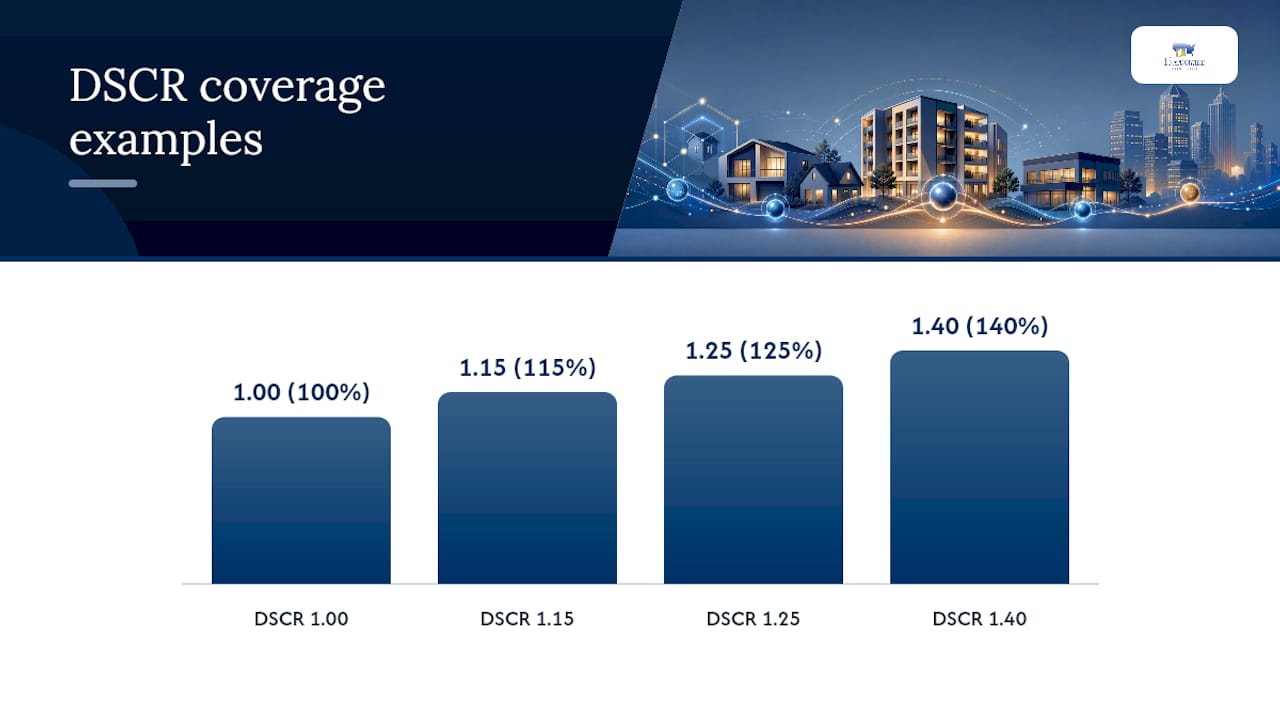
    Diagram of DSCR ratio income versus debt payments

    These two numbers, credit score and DSCR, interact directly in how a lender structures your loan. A strong score can offset a merely adequate DSCR, and a strong DSCR can sometimes offset a weaker score. Neither factor works entirely alone.

    Consider two hypothetical scenarios on similar $400,000 investment properties:

    • Investor A has a 740 credit score and a property with a 1.15 DSCR. That combination likely qualifies for a higher LTV tier and a standard down payment, since the strong credit profile offsets the modest cash flow cushion.
    • Investor B has a 665 credit score and a property with a 1.15 DSCR. The same cash flow now carries more perceived risk in the underwriter’s eyes, and the file typically needs a larger down payment or a lower maximum LTV to balance that out.
    • Investor C has a 665 credit score but a property with a 1.40 DSCR. The stronger cash flow buffer here can offset some of the credit-related caution, sometimes bringing the terms closer to what Investor A receives.

    The pattern holds across most DSCR files: weaker credit typically gets compensated for with a stronger DSCR, more reserves, or a bigger down payment, never with a loan that simply ignores the risk.

    • Higher credit scores generally support higher maximum LTV for the same DSCR.
    • Lower credit scores generally require a lower LTV, larger down payment, or higher DSCR to qualify at all.
    • Reserves requirements often scale with credit tier, tightening as scores drop.

    Pro Tip: Before you shop for a property, run your numbers both ways. If your DSCR is borderline (say, 1.05 to 1.10), a 20-point credit improvement can sometimes do more for your terms than negotiating $10,000 off the purchase price.

    Why 2026 Underwriting Standards Differ From Advertised Minimums

    Overlays are the reason a lender’s website says one thing and its underwriting desk does another. An overlay is simply a stricter internal standard a lender applies on top of the baseline program guidelines, usually adopted in response to investor demand from the entities buying these loans on the secondary market, or in response to a lender’s own recent loss experience.

    Mortgage-rate volatility plays a role here too. When broader financing costs shift, tracked over time by the Federal Reserve’s 30-year mortgage series, lenders often respond by tightening credit-related overlays rather than adjusting pricing alone. It’s a risk-management lever that’s faster to pull than repricing an entire product line.

    What does an overlay actually cost you in practice? A few common consequences:

    • A borrower at 655 who expected 75% LTV gets quoted 65% instead, because the lender’s overlay treats sub-660 files more conservatively than the base program guideline allows.
    • A file that would qualify with two months of reserves under program guidelines gets asked for six months instead, because the lender’s overlay adds a reserve cushion for anything under 700.
    • A DSCR of 1.05 that meets the stated program floor still gets flagged for additional review or a slightly reduced LTV, because the overlay treats anything below 1.15 as needing extra scrutiny.

    None of this means the program floor is fictional. It means the floor is the starting point for a conversation, not the guaranteed outcome. The practical move is to ask a direct-lender’s underwriting desk, before you apply, whether their advertised minimums reflect what they’re actually approving right now. A partner breakdown of DSCR underwriting mechanics is a useful outside read if you want a second explanation of how these overlays get applied in practice. Treat any number you see online as a starting point for a conversation with an actual underwriter, not a locked-in outcome.

    Your Pre-Application Checklist for DSCR Qualification

    Before you submit anything, run through this list. It’s built to catch the issues that slow down or sink a DSCR file.

    1. Confirm your DSCR calculation. Divide the property’s gross monthly rental income (from a lease or an appraiser’s rent schedule) by total monthly PITIA. A ratio of 1.00 is generally the minimum floor; most lenders want to see 1.25 or higher for the smoothest approval and best available terms.
    2. Verify property eligibility. DSCR loans apply only to non-owner-occupied investment properties, never a primary residence. Single-family rentals, small multifamily (2 to 4 units), condos, and some short-term rental properties are typically eligible; owner-occupied properties are not.
    3. Line up your appraisal and rent documentation. You’ll need a standard appraisal along with a rent schedule (Form 1007 for single-family, Form 1025 for multifamily), which the appraiser completes to establish market rent for underwriting.
    4. Confirm reserve requirements. Most DSCR lenders want proof of liquid reserves covering several months of PITIA, and that requirement often scales up as credit scores drop or DSCR tightens.
    5. Check your entity setup. Many investors close DSCR loans in an LLC. Confirm your lender’s requirements around entity documentation, operating agreements, and personal guarantees before you’re mid-application.
    6. Scan for public-record red flags. Recent bankruptcies, open judgments, or unresolved liens can derail a file even when the credit score itself is acceptable. Clear these up, or at least document them, before applying.
    Credit Bracket Typical DSCR Expectation General Down Payment Range
    Below 660 1.25+ often required Larger down payment typical
    660–699 1.15–1.25 Standard-to-moderate down payment
    700–719 1.00–1.15 acceptable Moderate down payment
    720+ 1.00–1.15 acceptable Most favorable terms available

    For a deeper walk-through of these requirements, the DSCR loan requirements guide breaks down documentation expectations property type by property type.

    How to Improve Your Credit Score Before You Apply

    If your score sits in a gap between brackets, close it before you submit your file. Here’s the order of operations that tends to produce the fastest results.

    1. Pull your reports and dispute errors immediately. This is the single fastest lever available, and it’s the first thing the CFPB recommends for anyone preparing to apply for credit. An erroneous late payment or an account that isn’t yours can drag a score down by 20 points or more, and disputes can resolve in as little as 30 days.
    2. Pay down revolving balances, targeting utilization under 30%, and ideally under 10%. This moves faster than almost anything else in the FICO model, often within one billing cycle once the balance reports.
    3. Avoid new hard inquiries for at least 90 days before applying. Shopping for a car loan or opening a new credit card right before your mortgage application can cost you points at exactly the wrong moment.
    4. Resolve recent derogatory items where practical. A paid collection is better than an open one, and some lenders view it more favorably even though it still appears on the report.
    5. Give older negative marks time. Late payments and collections carry less weight the further in the past they occurred; there’s no shortcut here beyond time and a clean recent history.

    Pro Tip: If you’re sitting at 690 and a 30-point jump would move you into the 720+ tier, it’s often worth waiting 60 to 90 days to pay down balances and let a dispute resolve. But if you’re closing on a time-sensitive deal, apply now with the DSCR and reserves you have, and revisit refinancing once your score improves.

    The decision rule is straightforward: if the projected tier jump meaningfully improves your LTV or down payment requirement, and you have 60 to 90 days of runway, waiting usually pays off. If the deal is time-sensitive, apply with what you have and structure around a stronger DSCR or larger reserves instead.

    Common Myths About DSCR Credit Scores and Down Payments

    “Can I get a DSCR loan with a 500 credit score?” Realistically, no. Standard DSCR programs are built around the 620+ range as an absolute floor, and effective approvals generally sit well above that. A 500 score falls outside what most direct lenders will consider for a conventional DSCR structure.

    Hands using calculator with credit score papers

    Your actual down payment depends on your credit tier, your DSCR ratio, and the specific property type. Stronger files sometimes see lower down payment requirements; weaker files often see more.

    “Can I use a DSCR loan for my primary residence?” No. DSCR loans exist strictly for non-owner-occupied investment properties. If you’re financing a home you plan to live in, this isn’t the right product category.

    Why This Guidance Comes From a Direct Lender, Not a Broker

    This guidance comes from Christopher Arco, NMLS #1281, founder of 1st Nationwide Mortgage Corporation, a direct mortgage banker rather than a broker, meaning underwriting decisions happen in house rather than being shopped to a third party.

    1st Nationwide Mortgage’s DSCR program qualifies borrowers on the property’s rental income, not personal income, and is available exclusively for non-owner-occupied investment properties. The firm applies its own minimum credit score standard within its DSCR underwriting guidelines, with programs available across a multi-state footprint.

    1st Nationwide Mortgage is rated A+ by the BBB. For illustration only. Not a commitment to lend. Rates and terms subject to change and qualification. 1st Nationwide Mortgage Corporation, NMLS #1281. Equal Housing Lender.

    Should You Apply Now or Wait to Improve Your Credit First?

    If your DSCR is comfortably above 1.25, your reserves are solid, and the deal has a closing timeline you can’t push, apply now. Waiting on a marginal credit improvement while a good property slips away rarely makes financial sense, and a strong DSCR already does a lot of the work a slightly higher score would otherwise do.

    Wait if you’re realistically 60 to 90 days from crossing a bracket line that changes your LTV or down payment in a meaningful way. The math has to justify the delay: a jump from 695 to 725 that unlocks a materially better LTV tier is usually worth the wait. A jump from 705 to 715 rarely is.

    When you’re unsure which situation you’re in, the fastest way to find out is a direct conversation. Ask an underwriting desk to run a pre-application scenario against your actual numbers instead of guessing from published guidelines alone.

    Get a Straight Answer on Your DSCR Eligibility

    1st Nationwide Mortgage qualifies you on what your property earns, not what your tax returns show. That distinction matters more than most credit-score guidance lets on: a borrower with a middling score but a well-cash-flowing rental can often structure a deal that a personal-income-based lender would never consider.
    1st Nationwide Mortgage

    As a direct lender rather than a broker, decisions happen in house, which tends to mean fewer surprises between your initial conversation and your closing table. If you want a realistic read on where your credit score and DSCR ratio actually put you, run your numbers through the DSCR loan calculator to check your property’s cash flow before you apply. If you’re self-employed and also weighing a bank-statement path for a different property, the bank statement income calculator is worth a look too.

    Start by visiting the DSCR loans page to see program details, or reach out directly for a pre-application scenario review based on your actual credit score, DSCR, and property type. For illustration only. Not a commitment to lend. Rates and terms subject to change and qualification. 1st Nationwide Mortgage Corporation, NMLS #1281. Equal Housing Lender.

    Sources

  • What Is a Temporary Buydown Mortgage and How Does It Work?

    What Is a Temporary Buydown Mortgage and How Does It Work?

    A temporary buydown mortgage uses upfront funds, usually deposited into an escrow account, to lower your monthly payment for the first one to three years of the loan. The note rate on your mortgage never changes. Only the payment you actually write each month is reduced, subsidized out of that escrow account until the funds run out.

    Sellers, builders, lenders, or you as the borrower can fund the buydown. The two most common structures are the 2-1 buydown (rate effectively drops 2 percentage points in year one, 1 point in year two, then reverts) and the 3-2-1 buydown (a 3-point reduction stepping down over three years). Investopedia’s breakdown of 2-1 buydown mechanics confirms either the buyer or seller can fund it.

    Here’s the immediate takeaway: a temporary buydown works best when you have a solid reason to expect your income to climb in the next few years, or when you need breathing room in month one without changing your long-term rate. It is not a way around qualifying for the loan.

    • The note rate stays fixed for the life of the loan; only your payment is temporarily subsidized.
    • Funds typically sit in a custodial escrow account, separate from the lender’s own money.
    • Underwriters still qualify you using the full note-rate payment, not the reduced one.
    • Best fit: rising income, seller incentives in a slow market, or short-term cash-flow cushioning after a big move.

    Key Takeaways

    A temporary buydown lowers your monthly payment for one to three years using escrowed funds while your note rate and underwriting qualification stay unchanged.

    Point Details
    Note rate never moves Only your monthly payment is subsidized; qualification always uses the full note-rate payment.
    Common structures 2-1 buydowns cut the rate 2 points then 1 point; 3-2-1 buydowns step down over three years.
    Leftover funds go to principal If you sell or refinance early, unused escrow funds apply to your outstanding balance, not a refund.
    Program rules restrict eligibility Fannie Mae caps buydown duration at three years; VA and Freddie Mac list specific eligible loan types.
    Direct lender handles it in-house 1st Nationwide Mortgage underwrites buydown agreements and custodial escrow directly as a mortgage banker, not a broker.

    Table of Contents

    How Does a Temporary Buydown Work Mechanically?

    The mechanics come down to one distinction: what you pay each month versus what the loan actually charges. Your mortgage note fixes an interest rate at closing, and that number does not move because of a buydown. What moves is the payment you’re billed, because someone deposited enough cash upfront into a dedicated escrow account to cover the difference for a set period.

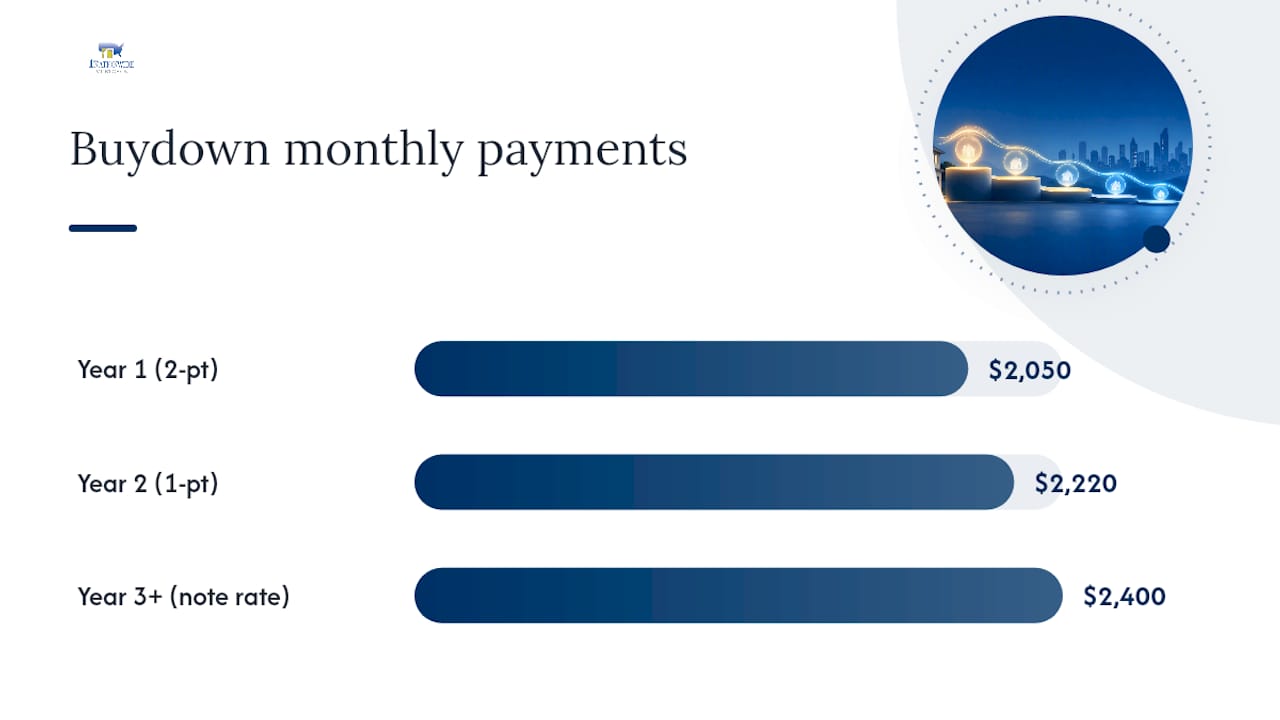
    Say your note rate would produce a $2,400 monthly payment. With a 2-1 buydown, your actual bill in year one reflects a rate 2 percentage points lower, maybe $2,050. In year two, it reflects a rate 1 point lower, maybe $2,220. From year three onward, you pay the full $2,400. The lender pulls the difference from escrow every month and applies it toward your bill. You never touch that money directly.

    Three things happen behind the scenes that most buyers never think to ask about:

    1. The buydown account gets fully funded and verified before the loan can be delivered for sale to an investor.
    2. Fannie Mae’s selling guide on temporary buydowns requires the funds be held custodially, meaning segregated from the lender’s own operating accounts.
    3. A written buydown agreement spelling out the schedule, amount, and duration becomes part of your closing package and loan file.

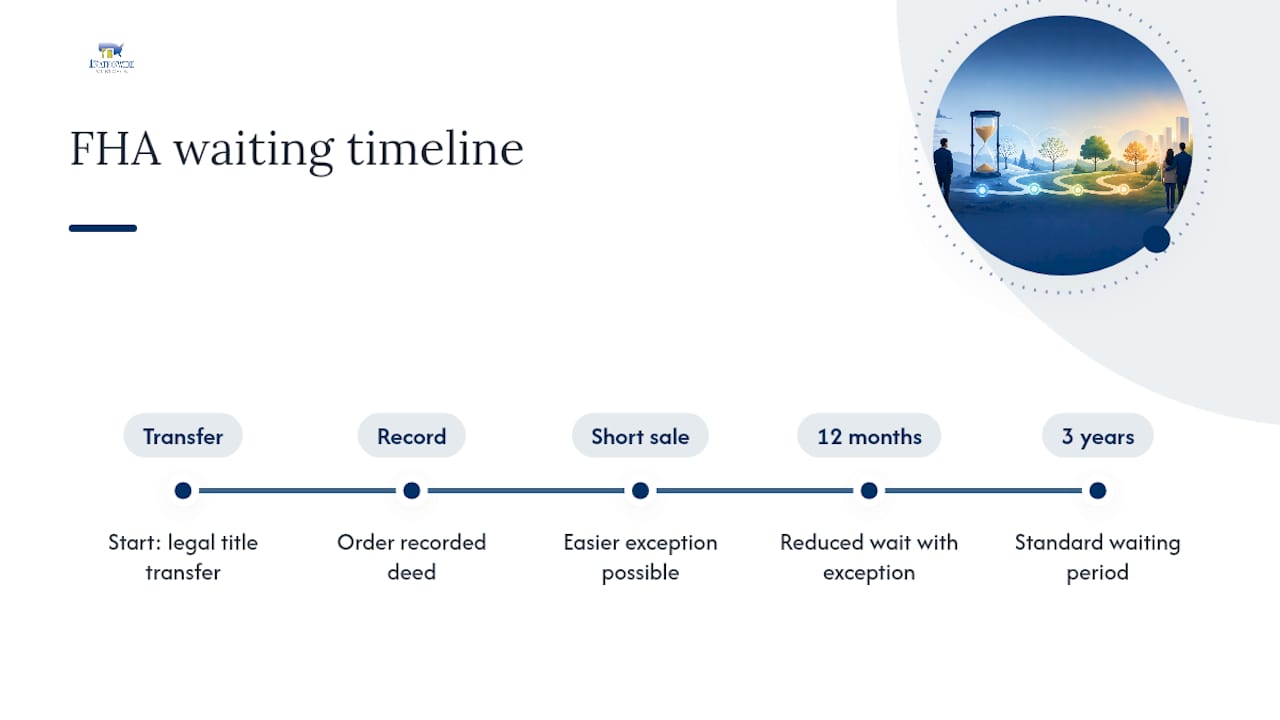
    Here’s a detail buyers often miss: if you sell the home or refinance before the buydown period ends, the leftover escrowed money doesn’t come back to you as cash. VA guidance on temporary buydowns states that remaining funds get applied to your outstanding loan balance, effectively acting as a principal curtailment rather than a refund. If your loan gets paid off, foreclosed, or handled through a short sale, the same rule applies.

    That rule exists for a reason that protects you as much as it protects the lender. Because the money is contractually tied to the mortgage, it can’t be diverted or double dipped, and it can’t disappear if the loan changes hands. It also explains why underwriters ignore the discounted payment entirely when deciding whether you qualify. The mortgage itself, structurally, never became cheaper. Only your monthly cash outlay did, temporarily, so it would be reckless to approve someone based on a payment that expires on a fixed schedule.

    How Does a Temporary Buydown Work Mechanically? — overview diagram

    What Do 2-1 and 3-2-1 Buydown Structures Look Like in Practice?

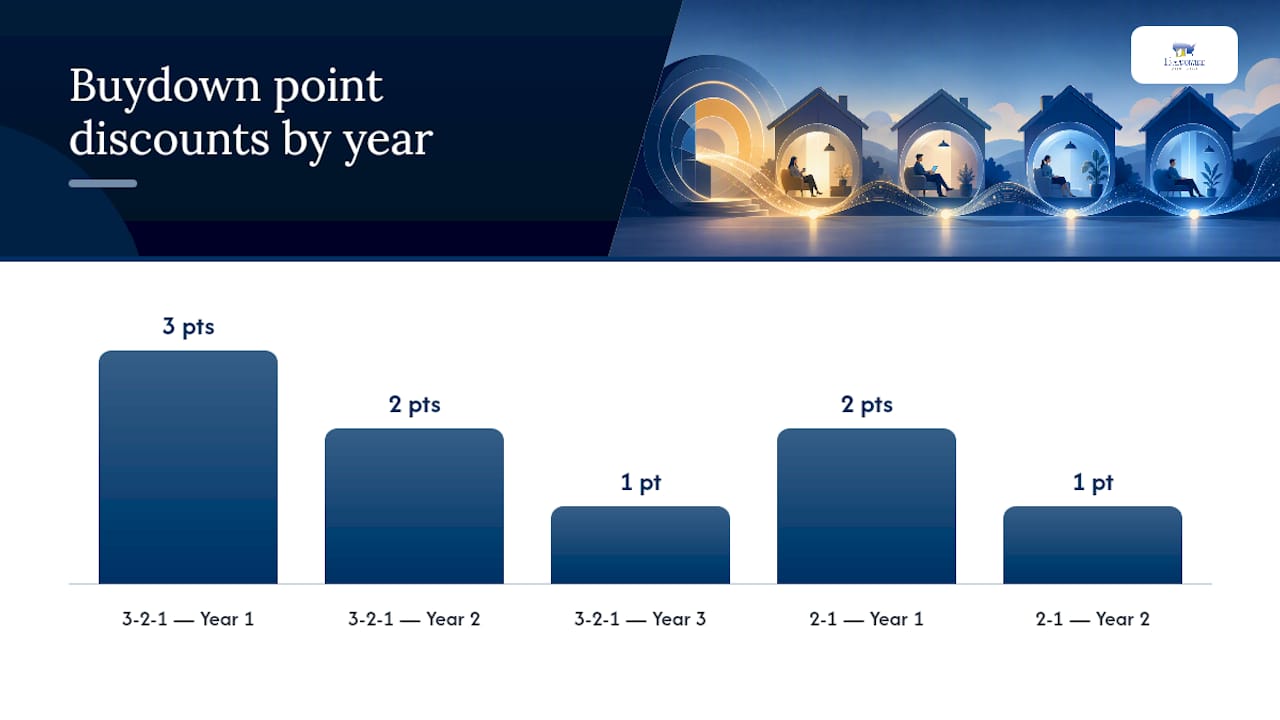
    The names describe the percentage-point discount applied in each year, stepping down until you land on the permanent rate. A 2-1 buydown gives you 2 points off in year one and 1 point off in year two. A 3-2-1 buydown stretches that relief across three years: 3 points off, then 2, then 1, before you hit the note rate in year four.

    Picture a $450,000 loan. Using round numbers for illustration only, not a quoted rate:

    • 2-1 structure: Year one payment reflects roughly 2 points below the note rate. Year two reflects roughly 1 point below. Year three onward, you’re at the full note-rate payment.
    • 3-2-1 structure: Year one is roughly 3 points below the note rate, year two is 2 points below, year three is 1 point below, and year four settles at the note rate permanently.

    On a loan that size, even a temporary 2 point discount can mean several hundred dollars a month in relief during year one alone, though the exact figure depends entirely on your specific note rate and loan term.

    The real question is whether the buydown fee is worth paying for that early relief. If a seller is covering the cost as an incentive, the math is simple: you get free breathing room. If you or your builder are funding it out of pocket, compare the total buydown cost against how many months of reduced payments you’ll actually enjoy, and weigh that against how long you plan to stay in the house. Someone planning to sell in 18 months captures less benefit from a 3-2-1 structure than someone settling in for a decade.

    Pro Tip: Run the numbers with a loan officer using your actual note rate before assuming a buydown is worth the cost. A buydown mortgage calculator with real rate inputs, not just percentage-point assumptions, is the only way to see whether the seller credit or your own cash is better spent on a rate buydown versus points that permanently lower your rate.

    What Do 2-1 and 3-2-1 Buydown Structures Look Like in Practice? — overview diagram

    Who Pays for a Buydown and How Is It Documented?

    Four parties can fund a temporary buydown: the seller, the builder, the lender, or you. Each shows up for a different reason, and understanding the motivation behind the offer helps you negotiate smarter.

    Sellers in a slower market often prefer funding a buydown over cutting their asking price, because a price cut becomes a permanent comparable that drags down neighborhood values, while a buydown is a one-time, disappearing incentive. Investopedia’s overview of buydown mechanics notes this exact dynamic: builders and sellers frequently treat a buydown as a cleaner marketing tool than a discount.

    Builders use the same logic on new construction, often pairing a buydown with their in-house lender to move unsold inventory without touching list price. Lenders occasionally fund a smaller buydown as a competitive incentive. And you, the borrower, can pay for your own buydown at closing if you want the early relief and nobody else is offering to cover it.

    Whoever pays, insist on these three things before you sign anything:

    • A written buydown agreement, separate from the note, spelling out the amount, duration, and step-down schedule.
    • Confirmation that funds are deposited into a custodial escrow account, not simply promised.
    • Clear language on what happens to unused funds if you sell, refinance, or pay off the loan early.

    If you’re negotiating with a seller, ask how the concession compares to a straight price reduction. Seller concession caps vary by loan program, and how much sellers can contribute on an FHA loan is capped as a percentage of the purchase price, which limits how much buydown a seller can actually fund alongside other closing cost credits.

    Why Do Lenders Qualify You at the Note Rate, Not the Bought-Down Payment?

    This is the rule that surprises almost every first-time buydown shopper: your reduced year-one payment plays no role in whether you get approved. Fannie Mae’s guidance is explicit that borrowers must be underwritten at the note rate, meaning your debt-to-income ratio gets calculated using the full, permanent payment, not the discounted one you’ll actually write checks for in year one.

    The logic protects everyone in the transaction. If lenders qualified borrowers at the temporary payment, plenty of buyers would stretch into homes they can’t afford once the subsidy expires. Freddie Mac frames temporary subsidy buydowns as a tool for borrowers who reasonably expect their income to grow, not a device to squeeze into a payment that only works today.

    Here’s what that means for your file:

    • Your DTI ratio is calculated against the full note-rate payment, every time, regardless of the buydown schedule.
    • Reserve requirements, when applicable, are also based on the note-rate payment, not the reduced one.
    • Documentation for a buydown loan looks the same as any other purchase: income verification, asset statements, and credit review, plus the buydown agreement itself added to the file.

    A buydown can still function as a compensating factor in a borderline file. If your DTI sits right at a program limit, a lender may view a seller-funded buydown favorably because it shows extra cash cushion in the early years, but it will never substitute for insufficient income or a thin credit profile. If your qualification is genuinely tight, look at whether a non-occupying co-borrower or a different loan program fits your situation better than trying to engineer around underwriting with a temporary rate reduction.

    What Do Fannie Mae, Freddie Mac, and VA Rules Actually Restrict?

    Agency rules govern almost everything about whether a buydown loan is even eligible for sale on the secondary market, and the restrictions vary enough between programs that it’s worth checking before you fall in love with a structure.

    Fannie Mae caps buydown plans at a maximum three-year duration, with controlled annual increases, meaning you can’t structure an aggressive five-year step-down even if a seller wanted to fund one. Freddie Mac’s guidance on temporary subsidy buydown plans lists specific eligible and ineligible mortgage types, so not every loan product on the shelf qualifies for this treatment.

    VA loans allow temporary buydowns too, but the interaction with seller concessions gets more complicated because VA already caps total seller contributions. A seller funding both a rate buydown and standard closing costs can bump against that combined limit faster than buyers expect.

    A temporary buydown is not automatically available on every loan type. Investment properties, certain cash-out refinances, and some adjustable-rate products carry exclusions or extra restrictions under agency guidance, which is exactly why lenders vet buydown eligibility before pooling and delivering the loan.

    Common restrictions worth knowing before you ask for one:

    • Investment properties often face tighter or excluded eligibility for agency-backed buydown programs, since investment property financing runs under different underwriting standards entirely.
    • Cash-out refinances are frequently excluded or restricted from buydown eligibility under agency rules.
    • All buydown loans require the written agreement and custodial funding documented before delivery for agency purchase, per Fannie Mae’s guide.

    Is a Temporary Buydown Actually Worth It for You?

    The upside is real, but so is the risk if your income doesn’t move the way you expected. Weighing both sides against your own situation matters more than any generic recommendation.

    Advantages:

    1. You get genuine cash-flow relief in the exact years when moving costs, furniture, and new-home expenses hit hardest.
    2. A seller-funded buydown effectively lowers your total cost without touching the purchase price or your loan amount.
    3. It can help you afford a slightly larger home in year one if you’re confident income will rise to meet the note-rate payment later.

    Drawbacks:

    1. Payment shock is real: your bill jumps every year the buydown steps down, and jumps again to full price when it ends.
    2. If your income doesn’t grow as planned, you could find yourself stretched once the subsidy disappears.

    Before committing, run through this checklist: How long do you realistically expect to stay in this home? Is your income trajectory backed by something concrete, a scheduled raise, a partner returning to work, a bonus structure, rather than just hope? Do you have emergency reserves that could cover the payment jump if your income plan slips by a year?

    Pro Tip: Build a one-year buffer into your budget assuming the buydown ends on schedule but your raise arrives late. If you can absorb that gap comfortably, the buydown is low-risk. If you can’t, treat that as your answer.

    How Do You Request and Close a Temporary Buydown?

    Getting a buydown into your deal starts at the negotiating table, not at closing. If you’re buying from a builder or a motivated seller, ask directly whether they’ll fund a rate buydown instead of, or in addition to, other concessions. Frame it as a trade: you may accept a slightly higher price in exchange for the seller covering the buydown cost, which is often more valuable to you than an equivalent price reduction spread across a 30-year loan.

    1. Negotiate the buydown into your purchase contract in writing, specifying who pays and how much.
    2. Confirm the buydown agreement includes the schedule, dollar amount, escrow custodian, and what happens to leftover funds.
    3. At closing, verify the buydown funds were actually deposited into the custodial account, not just promised on paper.
    4. Ask your loan officer to confirm in writing how your servicer will apply the monthly subsidy, and get a written payment schedule for all affected years.

    Questions worth asking your loan officer before you sign: Is this loan program eligible for a buydown under its specific agency guidelines? What’s the total dollar cost of the buydown, and who’s paying it? What’s my note-rate payment, the number underwriting is actually using to qualify me?

    Pro Tip: Request an amortization schedule showing all three payment tiers, side by side, before closing. Seeing the exact dollar jump in year two and year three on paper is far more useful than trusting a verbal estimate.

    How 1st Nationwide Mortgage Approaches Buydown Requests

    As a direct mortgage banker, not a broker, 1st Nationwide Mortgage Corporation underwrites and funds loans in-house, which means buydown agreements, custodial escrow setup, and note-rate qualification all get handled under one roof rather than passed between parties. Founded by Christopher Arco, NMLS #1281, and BBB A+ rated, the firm works across conventional, FHA, VA, and non-QM programs including bank statement loans and DSCR financing for investors.

    • Owner-occupied buydown-eligible programs (conventional, FHA, VA) are available where 1st Nationwide serves consumer lending markets: California, Colorado, Oregon, Washington, Texas, and Idaho.
    • In other states, the firm focuses on business-purpose lending, including DSCR loans for investment properties, where buydown structures follow separate investor-property rules.
    • If you’re preparing to request a buydown, gather two years of income documentation or 12 to 24 months of bank statements if you’re self-employed, since your qualification still runs on the note-rate payment regardless of any subsidy.

    A Lender’s Honest Take on When a Buydown Makes Sense

    Buydowns fit best for two kinds of borrowers: someone early in a career with documented raises ahead, or someone accepting a seller-funded incentive that costs them nothing extra. They fit poorly for anyone hoping income growth will simply materialize on schedule. If your qualification is already tight at the note rate, a buydown won’t fix that. Talk to a loan officer about your specific file before assuming the structure solves a problem it wasn’t designed to solve.

    Get Buydown-Ready With a Direct Lender

    Because 1st Nationwide Mortgage underwrites in-house as a direct mortgage banker, you get one point of contact confirming buydown eligibility, custodial escrow setup, and note-rate qualification, instead of shuffling between a broker and a separate underwriting shop. That matters most for self-employed borrowers and investors, whose income documentation already requires extra scrutiny before a buydown conversation even starts.

    1st Nationwide Mortgage

    If your income comes from a business rather than a W-2, run your numbers through the bank statement income calculator before you negotiate a buydown, so you know your qualifying income and DTI going into the conversation. Real estate investors evaluating a rental purchase can check cash flow first with the DSCR loan calculator, since DSCR loans qualify on rental income rather than personal income and follow different buydown eligibility rules than owner-occupied programs. Whichever program fits your file, reach out to discuss your specific note rate, buydown cost, and closing timeline before you sign a purchase contract.

    Sources

    Verify program specifics directly: Fannie Mae’s temporary buydown guidance, Freddie Mac’s subsidy buydown plans, VA’s official buydown page, and Investopedia’s buydown explainer.

    For illustration only. Not a commitment to lend. Rates and terms subject to change and qualification. 1st Nationwide Mortgage Corporation, NMLS #1281. Equal Housing Lender.

    This article is general information, not a substitute for advice from a qualified financial advisor. Consult a qualified financial professional about your own circumstances before acting on anything here.

  • Overseas Income US Property Loan: What Expats Must Prove

    Overseas Income US Property Loan: What Expats Must Prove

    Yes, you can qualify for a U.S. property loan using overseas income, provided you can document it the way Fannie Mae and FHA underwriting expect. That means signed tax returns, translated documents, and proof the income will keep coming. If you used IRS Form 2555 to exclude foreign earnings, expect underwriters to reconcile that exclusion before counting the income.

    Three moves put you ahead of most applicants:

    • Pull two years of signed federal tax returns (or the program-specific alternative documents your lender requests).
    • Get certified English translations done now, along with USD conversions dated to a specific exchange rate.
    • Call a lender comfortable with foreign income or non-QM underwriting before you submit anything.

    The entire approval hinges on two things: documentation depth and proof the income continues. Everything else in this guide supports those two points.

    Key Takeaways

    Overseas income can qualify you for a U.S. property loan when you document a two-year history, prove continuance, and convert everything to USD accurately.

    Point Details
    Two-year documentation is standard Fannie Mae and FHA both expect two years of signed tax returns showing foreign income.
    Continuance proof matters as much as history FHA requires evidence income will continue for at least three years past closing.
    Translation and conversion are gating items Every foreign document needs certified English translation and a dated USD conversion.
    Down payment funds need a paper trail Lenders typically review 60 days of account history for foreign funds used at closing.
    Non-QM fills the gaps agency rules leave 1st Nationwide Mortgage’s bank statement, DSCR, and NONI programs serve borrowers whose foreign income doesn’t fit conventional underwriting.

    Table of Contents

    Who Can Use Foreign Income for a US Property Loan

    U.S. citizens living and working abroad, lawful permanent residents, and many non-permanent residents with visa status can typically use overseas income to qualify. Some foreign-national programs extend financing to non-U.S. residents too, though they run on different rules entirely.

    Agency lenders want a two-year documented history of receiving the income, plus reasonable evidence it will continue. Fannie Mae’s guidance on employment-related income requires signed federal tax returns covering the most recent two years that show the foreign earnings, and general income standards tie this back to non-U.S. citizen borrower eligibility rules. FHA follows a similar two-year window but adds its own continuance test, covered below.

    A few real-world shapes this takes:

    • A salaried expat working for a multinational employer submits pay stubs and an employer verification letter.
    • A self-employed business owner running a company overseas submits translated business tax returns and a CPA letter.
    • A foreign national with no U.S. tax history uses a NONI or portfolio program built around assets and property cash flow instead.

    Two years of history plus a credible continuance story is the underwriting bar almost every program shares, agency or not.

    How Lenders Verify Overseas Income and Convert Currency

    Underwriters treat foreign income like a puzzle that needs the same pieces every time, just sourced from a different country. Here’s the sequence most lenders follow:

    1. Collect signed tax returns covering the required period, plus a written employment verification (VOE) from the employer.
    2. Translate every foreign-language document into English using a certified translator.
    3. Convert income and asset figures to U.S. dollars using a documented exchange rate tied to a specific date.
    4. Average the two-year income history when the loan program requires averaging rather than a point-in-time figure.
    5. Confirm continuance with employer letters, active contract terms, or, for self-employed borrowers, multi-year client agreements and forward-looking business projections.

    Self-employed applicants get extra scrutiny because tax returns from another country don’t always map cleanly onto U.S. underwriting categories. Rental income and investment income overseas go through a similar translation and averaging process, though lenders may ask for additional context on property management or investment account custodianship.

    Pro Tip: Ask every lender you’re considering how they handle exchange-rate volatility before you apply. Some apply a conservative haircut to foreign income, others don’t, and there’s no single industry standard, so the difference between lenders can change your qualifying number substantially.

    Hand holding globe illustrating currency exchange

    Which Loan Programs Accept Foreign Income

    Not every program treats overseas income the same way, and the differences matter more than most borrowers expect.

    • Fannie Mae requires the most recent two years of signed federal tax returns showing the foreign employment-related income, with every foreign document translated and converted to USD.
    • Freddie Mac generally accepts foreign income too, though documentation specifics can differ from Fannie Mae’s, often accepting the most recent single signed return depending on the seller/servicer guide in play.
    • FHA requires a two-year history and documentation that the income will reasonably continue for at least three years. HUD’s Handbook 4000.1 directs lenders to average tax-return income rather than lean on pay stubs alone when foreign earnings are involved.
    • VA and USDA can accept foreign income in specific scenarios, but occupancy requirements narrow the field fast. VA loans in particular require owner-occupancy, which rules out using the program for a rental property abroad or in the U.S.
    • Non-QM, portfolio, and foreign-national programs exist precisely for the borrowers agency underwriting can’t accommodate, whether that’s a lack of U.S. tax history or income structured in a way GSE guidelines don’t recognize.

    When agency rules and your income documentation don’t line up, that’s not a dead end. It’s a signal to look at a program built for exactly your situation.

    Documents You Need for a Foreign-Income Mortgage

    Assembling the right file before you apply saves weeks of underwriting back-and-forth. Here’s what to gather:

    • Signed U.S. federal tax returns for the most recent two years showing the foreign income, or equivalent business returns if you’re self-employed.
    • Form 2555, if you used it to exclude foreign earned income, along with any documentation showing how underwriting should treat the excluded amount.
    • Employer verification letters in English, translated tax forms, pay stubs where available, and bank statements showing regular deposits.
    • 60 days of account history for any funds you plan to use toward your down payment.
    • Certified English translations attached to every foreign-language document, plus a currency-conversion worksheet showing the exchange rate and date used.

    A practical way to speed things up:

    1. Build one consolidated file rather than sending documents piecemeal.
    2. Put signed tax returns first, translations directly behind their source documents, and the USD-conversion worksheet at the end.
    3. Add a one-page summary letter from your employer or CPA addressing continuance.
    4. Name your files clearly (for example, “2024_TaxReturn_Signed_Translated.pdf”) so underwriting doesn’t have to guess what they’re looking at.

    The Radian foreign-income job aid lays out this same document logic and is worth reviewing if you want to see how lenders internally process these files.

    Using Overseas Assets for Down Payment and Reserves

    Foreign funds can absolutely cover your down payment, closing costs, and reserve requirements, but the path from a foreign bank account to a closing table has a few required stops.

    1. Convert the currency and transfer the funds into a U.S. bank account well before your closing date.
    2. Document the source of funds with 60 days of account statements from the originating account.
    3. Keep your wire receipts and exchange-rate records, since underwriting will want to trace the money’s full path.
    4. Confirm how many months of reserves your program requires and how you’ll document assets still held overseas.

    Funds coming from certain jurisdictions trigger heightened scrutiny under OFAC and sanctions screening. Build extra time into your timeline if your money is moving from a higher-risk country, and disclose the source early rather than letting underwriting discover it mid-file.

    What Trips Up Foreign-Income Mortgage Applications

    Most delays come down to the same handful of mistakes:

    • Missing or uncertified translations on foreign documents.
    • Incomplete tax returns that don’t show the full picture of foreign income.
    • USD conversions that don’t match across different parts of the file.
    • Large, undocumented deposits in a U.S. account with no clear paper trail.
    • No real proof the income will continue past closing.

    The fixes are just as straightforward. Pre-translate everything before you apply, get a signed continuance letter from your employer or CPA, and build a clean funds trail for your down payment before you request pre-approval.

    Pro Tip: Bring up currency haircut assumptions with your lender during your first conversation, not after your loan estimate arrives. It changes your qualifying income enough to affect which properties you should even be looking at.

    How Long Foreign-Income Underwriting Takes and What It Costs

    Plan for 2 to 6 extra weeks beyond a standard timeline, mostly from translations, employer verification, and funds transfer documentation. The exact delay depends on how complex your income structure is and how responsive your foreign employer or accountant turns out to be.

    Extra costs tend to show up in a few predictable places: certified translation fees, currency-conversion documentation, international wire fees, and occasionally additional appraisal or verification charges tied to the extra underwriting layers.

    Disclose your foreign income at pre-approval, not at the purchase contract stage. Starting the documentation process early is the single biggest lever you have over your own timeline.

    When Agency Rules Don’t Fit: Alternative Loan Paths

    Agency underwriting works well when your income history is clean and your documentation lines up with GSE expectations. It works less well for self-employed borrowers whose foreign tax returns show heavy write-offs, or for foreign nationals with no U.S. tax footprint at all. That’s where non-QM programs earn their keep.

    1st Nationwide Mortgage, as a direct lender rather than a broker, underwrites several programs built for exactly these situations:

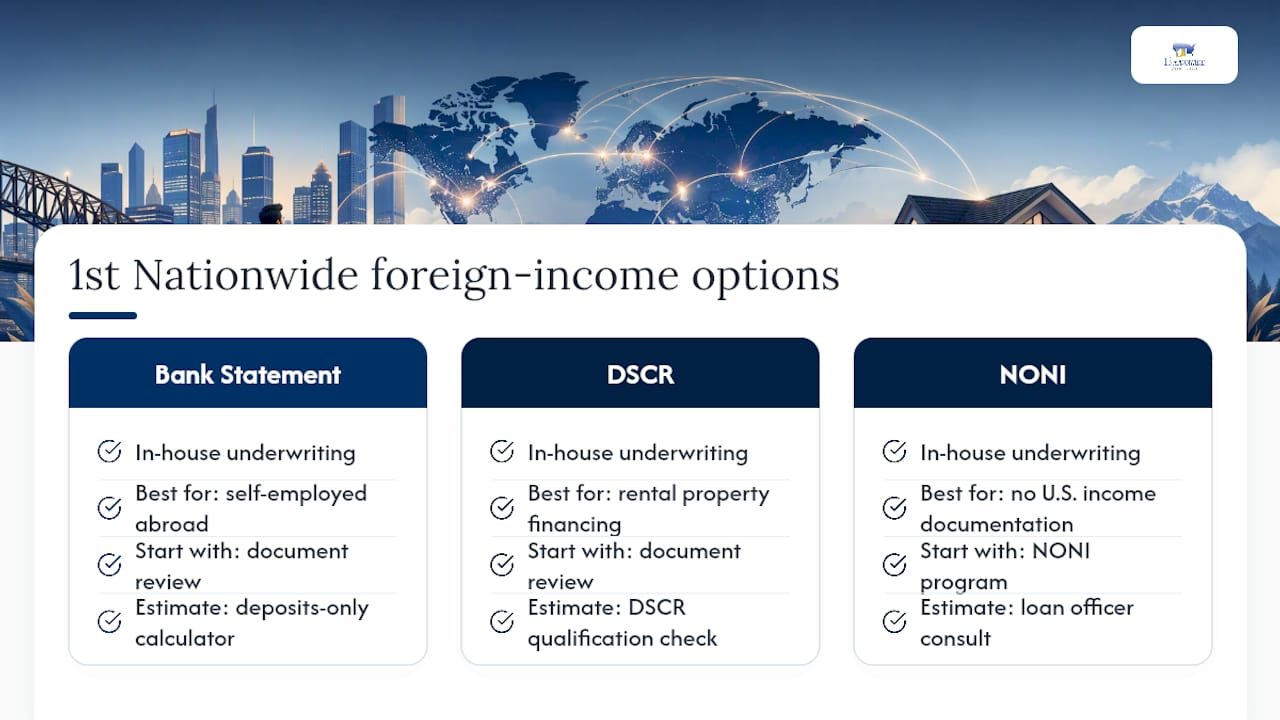
    • Bank statement loans use 12 to 24 months of deposits to calculate qualifying income instead of tax returns, which matters if your foreign business’s write-offs suppress your taxable income below what conventional lenders will count.
    • DSCR loans qualify investment properties on the property’s own rental income rather than the borrower’s personal income, which sidesteps the entire foreign-income documentation question for non-owner-occupied purchases.
    • NONI (no income, no asset) loans serve foreign nationals and borrowers who simply can’t produce the documentation agency programs require.
    Consideration Agency programs (Fannie/FHA) Non-QM alternatives
    Documentation burden High: two years of tax returns, translations, continuance proof Lower: bank deposits or property cash flow instead of tax returns
    Occupancy requirement Owner-occupied for most agency products DSCR is investment/non-owner-occupied only
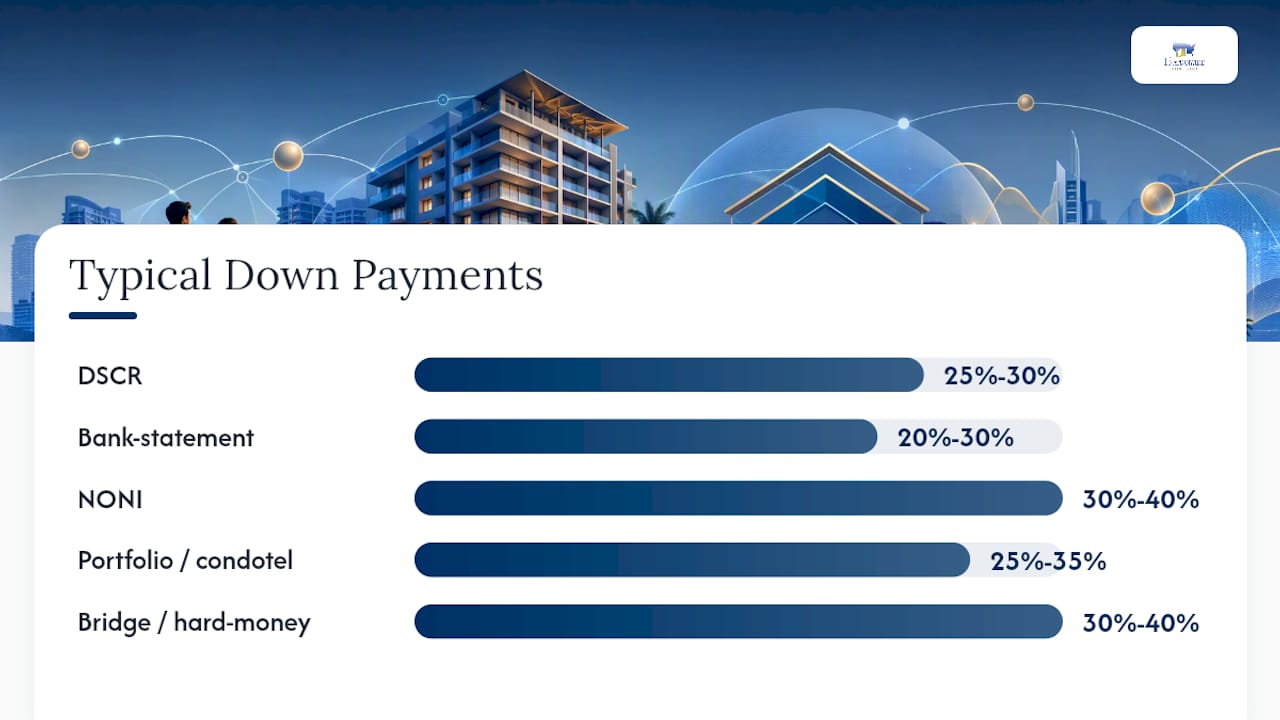
    Down payment shape Varies by program, often lower with strong documentation Typically higher, reflecting reduced income documentation

    DSCR loans are never available for a primary residence, only investment property. Consumer-purpose programs like FHA and conventional financing are offered through 1st Nationwide Mortgage in California, Colorado, Oregon, Washington, Texas, and Idaho; elsewhere, business-purpose options such as DSCR and NONI are the paths available. Christopher Arco, NMLS #1281, leads 1st Nationwide Mortgage as a direct mortgage banker, meaning your file gets underwritten in-house rather than shopped to a third party.

    A banker’s take on foreign-income files

    The borrowers who move fastest through underwriting are the ones who translate everything before the lender asks. I’d rather see a complete file on day one than a fast one that’s missing continuance proof. When agency rules don’t fit your income shape, a non-QM program is often the more direct route, not a fallback.

    How 1st Nationwide Mortgage Handles Foreign-Income Files

    Foreign income doesn’t have to mean a slower, more frustrating loan process. As a direct lender, 1st Nationwide Mortgage underwrites bank statement, DSCR, and NONI files in house, which cuts out the extra layer of back-and-forth that happens when a broker has to relay every question to a separate underwriting shop.

    1st Nationwide Mortgage

    If your foreign income doesn’t fit neatly into agency guidelines, or you’re self-employed abroad and your tax returns understate what you actually earn, start with a document review rather than a formal application. Use the bank statement income calculator to get a rough qualifying number from deposits alone, or check DSCR qualification if you’re financing a rental property instead of a primary home. For borrowers with no U.S. income documentation at all, the NONI loan program may be the more practical starting point. Reach out and a loan officer will walk through which program fits your specific income structure before you commit to a full application.

    For illustration only. Not a commitment to lend. Rates and terms subject to change and qualification. 1st Nationwide Mortgage Corporation, NMLS #1281. Equal Housing Lender.

    How 1st Nationwide Mortgage Handles Foreign-Income Files — overview diagram

    Frequently Asked Questions

    Can I use overseas income to qualify for a US property loan without a Social Security number?
    Some foreign-national and non-QM programs allow qualification without a Social Security number, though they typically require larger down payments and alternative documentation like passport identification and international credit references.

    Does Form 2555 hurt my mortgage application?
    Not necessarily, but excluded income reported on Form 2555 needs reconciliation during underwriting, so bring documentation explaining what was excluded and why.

    How many years of tax returns do I need for foreign income?
    Most agency programs, including Fannie Mae and FHA, require two years of signed federal tax returns showing the foreign income.

    Can I use foreign assets for my down payment on a US property?
    Yes, but plan to document the source with 60 days of account history and keep wire transfer records showing the funds moving into a U.S. account.

    What if my foreign income doesn’t fit conventional underwriting?
    Bank statement, DSCR, and NONI loans through a direct lender like 1st Nationwide Mortgage offer alternative paths that don’t rely on traditional U.S. tax return documentation.

    This article is general information, not a substitute for advice from a qualified financial advisor. Consult a qualified financial professional about your own circumstances before acting on anything here.

    Sources

  • How Schedule C Income Mortgage Calculation Actually Works

    How Schedule C Income Mortgage Calculation Actually Works

    The formula lenders use is simpler than it looks: take your Schedule C net profit (Line 31), add back non-cash deductions like depreciation and business-use-of-home, subtract anything nonrecurring, then divide by 12 for a monthly number (or average two years and divide by 24). That adjusted figure, not your tax return’s bottom line, is what an underwriter uses to qualify you.

    • Formula: Net profit + allowable add-backs − disallowed/nonrecurring items = adjusted annual income
    • Fastest tools: the Fannie Mae Income Calculator and Freddie Mac’s Income Calculator both automate this
    • Save this: the Findings Report or worksheet output belongs in your loan file

    Pro Tip: Run your last two years of Schedule C data through the Fannie Mae Income Calculator before you apply. It takes ten minutes and tells you exactly what number an underwriter will see.

    Key Takeaways

    Schedule C income mortgage calculation depends on turning tax-driven net profit into a documented, add-back-adjusted cash flow figure that reflects what an underwriter can verify as stable and continuous.

    Point Details
    The core formula Net profit + add-backs (depreciation, home office, amortization) − nonrecurring items, divided by 12 or 24.
    Trend determines averaging Rising or flat income gets averaged over two years; declining income often defaults to the lower recent year.
    Documentation drives approval Two years of returns, YTD P&L, and bank statements should reconcile before you submit.
    Use the official tools The Fannie Mae Income Calculator and comparable worksheets produce a lender-ready number in minutes.
    When Schedule C falls short 1st Nationwide Mortgage’s bank statement, DSCR, and NONI programs offer paths that don’t hinge on tax-return net profit.

    This article is general information, not a substitute for advice from a qualified financial advisor. Consult a qualified financial professional about your own circumstances before acting on anything here.

    Table of Contents

    What Schedule C Income Mortgage Calculation Means to Underwriters

    Your tax preparer and your loan officer look at the same Schedule C and see two different numbers. Your preparer wants net profit low to minimize your tax bill. Your underwriter wants to know what cash your business actually generates, because that’s what will pay a mortgage. Schedule C income mortgage calculation exists to close that gap.

    The underwriting objective isn’t “what did you report to the IRS.” It’s whether your income is what agency guidelines call stable and continuous. A business showing a paper loss because of heavy depreciation might still throw off plenty of real cash flow.

    • Net profit (Line 31) is a tax construct, shaped by deductions you elected for tax savings
    • Qualifying income is a cash-flow construct, shaped by what a lender can add back or must exclude
    • The two rarely match, and the difference usually favors the borrower once add-backs are applied

    Pro Tip: Don’t panic if your Schedule C shows a thin net profit. The number that matters comes after add-backs, and it’s often meaningfully higher.

    Step-by-Step Calculation for Self-Employed Mortgage Qualifying

    Here’s the exact sequence a loan officer or automated underwriting engine follows when calculating mortgage income from a Schedule C:

    1. Start with net profit from Line 31 of Schedule C.
    2. Add back non-cash and one-time items the IRS lets you deduct but that don’t represent real cash leaving the business.
    3. Subtract nonrecurring or disallowed items that inflated the number but won’t repeat.
    4. Total the adjusted figure, then average it with the prior year (or use the most recent year alone, depending on the trend).
    5. Divide by 12 (or by 24 if averaging two years) to get monthly qualifying income.

    Fannie Mae’s Selling Guide spells out the standard add-backs and subtractions lenders apply:

    • Add back: depreciation, depletion, amortization, casualty losses, and the business-use-of-home deduction
    • Subtract: nonrecurring income, non-deductible meals and entertainment, and in some cases mortgages or notes payable in less than one year

    Self-employment tax deductions get handled differently. The deduction for one-half of self-employment tax that shows up on Schedule 1 doesn’t touch your Schedule C net profit, so it typically doesn’t factor into the add-back calculation at all. What matters is what’s non-cash on the Schedule C itself, not what’s happening elsewhere on your 1040.

    One caveat: averaging isn’t automatic. If your income dropped noticeably from one year to the next, or your business changed structure, an underwriter will often set aside the average and use the lower, more recent year instead, since that better reflects your current earning capacity.

    Hands calculating with depreciation schedule

    Pro Tip: Depreciation is usually the single biggest add-back for self-employed borrowers with vehicles, equipment, or a home office. Pull your depreciation schedule before you apply so you know your real number.

    Two-Year Average vs. Most Recent Year: Which Applies to You

    When income is flat or trending up, lenders average both years and divide by 24. When income is trending down, that average usually goes out the window in favor of the lower, more recent year.

    A few things push an underwriter toward the most-recent-year method instead of averaging:

    • A clear year-over-year decline in net profit
    • A change in business structure (sole proprietorship to LLC, for example)
    • Schedule Cs that were merged or restated between years
    • Less than two full years of self-employment history in the same line of work

    If your last two years look similar or your revenue climbed, expect averaging. If Year 2 looks noticeably worse than Year 1, plan around the lower figure and build your budget from there.

    Pro Tip: If a slow year was genuinely a one-time dip, an accountant/CPA letter explaining the cause can sometimes support using the stronger year instead. It won’t always work, but it’s worth asking your loan officer.

    Documentation Checklist for Schedule C Income Verification

    Underwriters move faster when the paperwork matches the math. Here’s what to gather before you apply:

    1. Two years of federal tax returns, including Form 1040 and every Schedule C page.
    2. Year-to-date profit and loss statement, signed by you or your CPA, covering the period since your last filed return.
    3. Business bank statements, typically three to six months, to reconcile against reported income.
    4. A depreciation schedule if your add-backs are significant.

    A few extras speed things along: an accountant/CPA letter addressing any unusual item, documentation for a nonrecurring gain you’re excluding, and, if you ran your numbers through an automated tool, the Income Calculator Findings Report.

    • Avoid mismatched deposits that don’t reconcile with reported revenue
    • Avoid unsupported adjustments a tax preparer made without backup documentation
    • Keep your business name and structure consistent across both years of returns

    Pro Tip: If your bank deposits run higher than your reported Schedule C income, have an explanation ready. Underwriters notice the gap immediately, and an unexplained one raises questions.

    Common Mistakes That Shrink Your Qualifying Income

    Most borrowers who get a disappointing income number made one of a handful of avoidable errors:

    • Relying only on net profit instead of applying legitimate add-backs, which understates real qualifying income.
    • Skipping documentation for add-backs, leaving an underwriter no choice but to disallow them.
    • Treating a one-time payment as recurring revenue, which gets flagged and removed during review.
    • Missing YTD P&L reconciliation, which stalls the file while underwriting requests clarification.

    Large, unexplained deposits, heavy discretionary write-offs, and a business name that shifts between tax years are the fastest way to trigger manual underwriter review. Fix each one before submission: gather your depreciation schedule, get a signed YTD P&L, and make sure every deposit has a plausible source.

    Pro Tip: If you took a large one-time client payment last year, flag it upfront in your loan application narrative. Volunteering the explanation beats an underwriter finding it and asking.

    Fannie Mae Income Calculator and Other Tools Worth Using

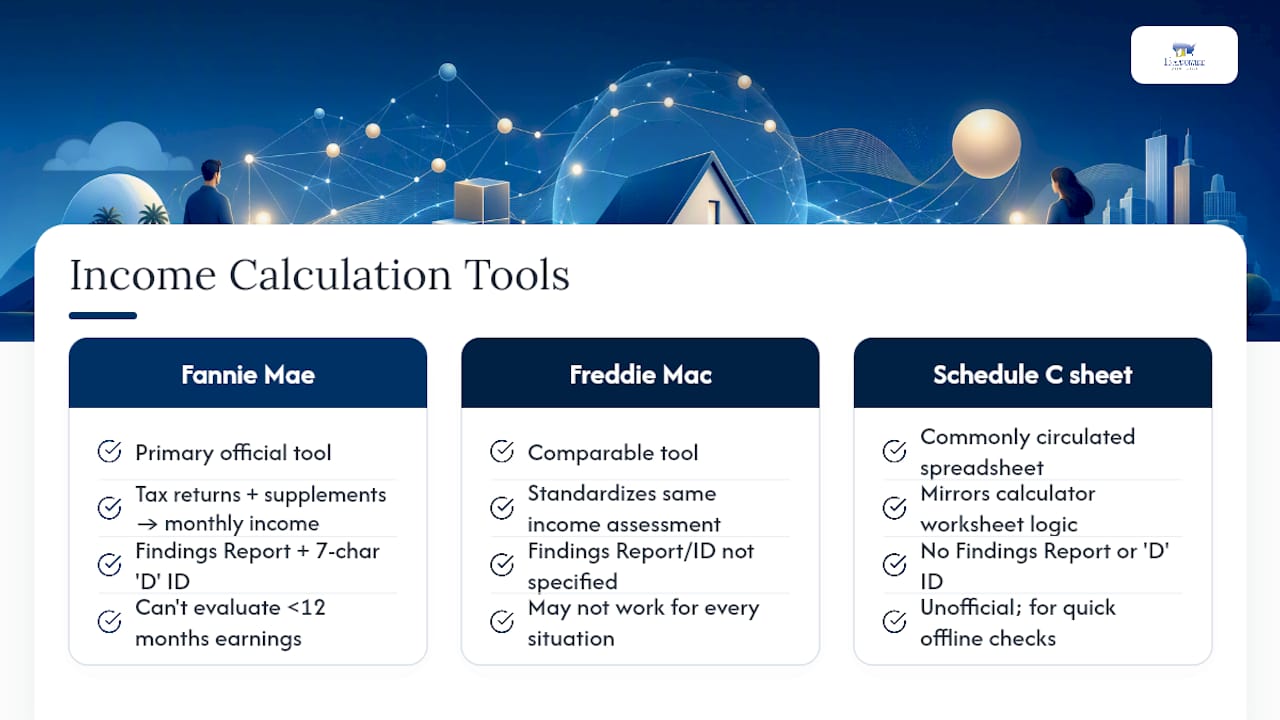
    The Fannie Mae Income Calculator is the primary official tool for this job. Feed it your tax return data and supplemental inputs, and it returns a qualifying monthly income figure along with a downloadable Findings Report, plus a unique 7-character identifier starting with “D” that lenders can save for rep-and-warrant relief.

    Freddie Mac runs a comparable Income Calculator that standardizes the same kind of income assessment. Neither tool works for every situation. Fannie Mae’s calculator can’t evaluate less than 12 months of earnings history or certain business-structure changes.

    For a quick offline check, insurers and lenders commonly circulate Schedule C calculator spreadsheets that mirror the same worksheet logic.

    Fannie Mae Income Calculator and Other Tools Worth Using — overview diagram

    A Worked Example: Two Years of Schedule C Into Monthly Income

    Here’s how the math plays out for a self-employed consultant:

    1. Add each year’s net profit, add-backs, and subtractions to get the adjusted annual total.
    2. Sum both years: $64,700 + $65,200 = $129,900.
    3. Divide by 24 (two years, monthly average): $129,900 divided by the number of months in the period gives the monthly qualifying income.

    If Year 2 had shown a decline instead of growth, the underwriter would more likely use Year 2 alone divided by 12, not the blended average. Keep the Fannie Mae tax return pages, your Income Calculator Findings Report, and your YTD P&L together. That’s the documentation trail underwriting will ask to see.

    What “Stable and Continuous” Income Really Means to Underwriters

    Underwriters aren’t just running math. They’re forming a judgment about whether your business is viable and likely to keep producing income at a similar or better level. Consistency and documentation matter as much as the number itself.

    When Schedule C qualifying income comes up short, or your write-offs have pushed your reported income too low to qualify, other paths exist. 1st Nationwide Mortgage offers bank statement loans that qualify off deposits instead of tax returns, DSCR loans for investment properties that qualify off rental cash flow, and NONI programs for borrowers without documentable income.

    • DSCR loans apply to investment or non-owner-occupied properties only, never a primary residence
    • Program availability varies by state and specific loan product

    Pro Tip: If your write-offs are aggressive enough to hurt your Schedule C number every year, a bank statement loan may qualify you off actual deposits instead of tax-adjusted income.

    A Mortgage Banker’s View on Getting This Calculation Right

    Getting the Schedule C calculation right the first time is the difference between a file that clears underwriting in weeks and one that bounces back for clarification three times. The borrowers who move fastest are the ones who show up with reconciled bank statements, a signed YTD P&L, and a saved Income Calculator Findings Report already in hand. That preparation doesn’t just speed approval. It often changes the loan amount you qualify for, because a well-documented add-back can add meaningfully more purchasing power than a bare tax return ever shows.

    How 1st Nationwide Mortgage Helps Self-Employed Borrowers Qualify

    If your Schedule C math still leaves you short of the loan amount you need, that’s not the end of the road. As a direct mortgage banker, not a broker, 1st Nationwide Mortgage built programs specifically for borrowers whose tax returns don’t tell the full income story. DSCR loans qualify investment properties on rental income alone, with no cap on the number of financed properties. NONI programs work for borrowers who can’t document income through conventional means at all.

    1st Nationwide Mortgage

    None of these require rates or approval terms quoted in advance, and availability varies by state and product. What we can tell you now is which program fits your file. Run your numbers through the bank statement loan calculator or review the 12-month bank statement program to see where you land, then talk to a loan officer for a full file review.

    For illustration only. Not a commitment to lend. Rates and terms subject to change and qualification. 1st Nationwide Mortgage Corporation, NMLS #1281. Equal Housing Lender.

    Sources

  • How to Get VA Form 26-1880 and Request a Certificate of Eligibility

    How to Get VA Form 26-1880 and Request a Certificate of Eligibility

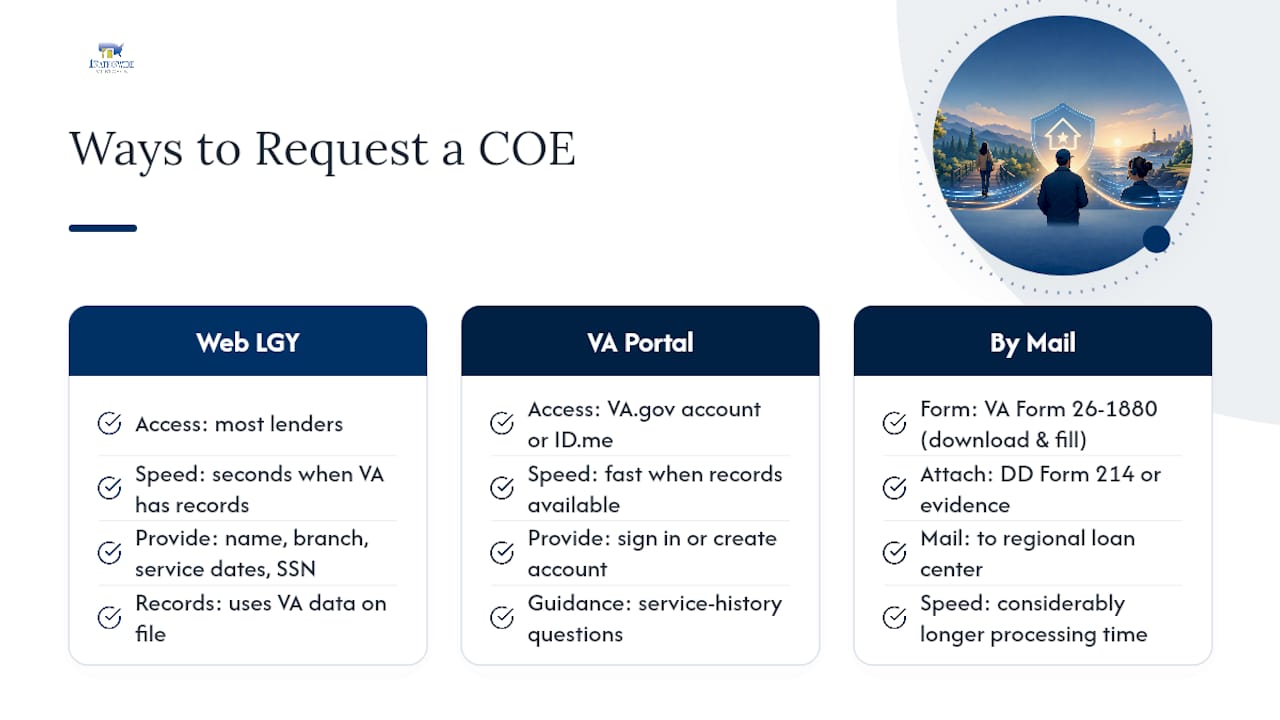
    You can get your Certificate of Eligibility (COE) right now by requesting it through the VA online portal, asking your lender to pull it through the Web LGY system, or mailing in VA Form 26-1880, the Request for a Certificate of Eligibility. For most borrowers, asking a lender to try Web LGY first is the fastest path since it can return a result in seconds. The paper form still matters when VA records are incomplete or your situation needs supporting documents attached.

    Here’s the fastest route for each method:

    • VA online portal: Sign into VA.gov and request your COE electronically. No paper form needed.
    • Lender via Web LGY: Give your loan officer your name, service branch, and Social Security number. Many lenders can generate a COE while you’re on the phone.
    • Mail: Complete VA Form 26-1880 by hand, attach your DD Form 214 or equivalent, and mail it to your regional loan center.

    If your service records are complete and match VA’s database, you likely never need to touch the paper form. Save it for cases involving name changes, restored entitlement, or gaps in your service record.

    Key Takeaways

    Requesting a COE through your lender’s Web LGY access or the VA online portal is almost always faster than mailing VA Form 26-1880, and the COE only proves entitlement, not loan approval.

    Point Details
    Fastest method Ask your lender to try Web LGY first since it can issue a COE in seconds when VA records are complete.
    Paper form has a place Use VA Form 26-1880 by mail when records are incomplete or entitlement needs restoration.
    Documents vary by category DD Form 214 covers most Veterans, while Guard and Reserve members need NGB Form 22.
    COE isn’t loan approval Lenders still verify credit, income, and occupancy after the COE confirms entitlement.
    Where to start 1st Nationwide Mortgage can attempt a Web LGY pull as a direct lender before you touch the paper form.

    This article is general information, not a substitute for advice from a qualified financial advisor. Consult a qualified financial professional about your own circumstances before acting on anything here.

    Table of Contents

    What Is VA Form 26-1880 and Why Does the COE Matter?

    VA Form 26-1880, officially titled Request for a Certificate of Eligibility, is the paper application Veterans and service members use to ask the VA to verify their eligibility for a VA-backed home loan. The Certificate of Eligibility itself is the document your lender needs to confirm you meet the service requirements for the VA loan program.

    A COE is not a loan approval. It proves military service entitlement, nothing more. Your lender still runs a full underwriting review covering:

    • Credit history and score
    • Income and employment documentation
    • Debt-to-income ratio
    • Occupancy intent, since the home must be your primary residence

    The current version of VA Form 26-1880 carries a December 2025 revision date, and the VA publishes it directly on its official forms page. Using an outdated version can slow processing, so always pull the current form from VA.gov rather than a saved copy from a previous application.

    What Are the Three Ways to Request a COE?

    Diagram showing three COE request methods

    Try lender-assisted Web LGY or the VA online portal before you touch a paper form. Both can deliver a result in a fraction of the time mail submission takes.

    1. Through your lender (Web LGY). Most lenders, including direct lenders, have access to the Web LGY system. Give your loan officer your full legal name, branch of service, service dates, and Social Security number. When VA has sufficient data on file, Web LGY can issue a COE in seconds. Not every case qualifies for instant processing, particularly for Guard and Reserve members or those with prior VA loans still active.

    2. Through the VA online portal. Create or sign into your VA.gov account using your existing credentials or a verified ID.me login. Once inside, navigate to the home loan benefits section and submit your COE request directly. The portal walks you through service history questions and pulls existing records automatically.

    3. By mail using VA Form 26-1880. Download the current form, fill in your personal information, service history, and the purpose of your COE request. Attach your DD Form 214 or other required evidence, then mail it to the regional loan center listed on the last page of the form. Mail requests take considerably longer than the other two options.

    Pro Tip: If VA records show a different name than your service paperwork, such as a maiden name or a name change after marriage, attach a copy of your marriage certificate, divorce decree, or court document. Never mail originals. VA accepts copies, and originals sent by mail are not returned.

    What Documents Do You Need by Service Category?

    The evidence VA requires depends entirely on how you served. Sending the wrong document type is one of the most common reasons requests stall.

    • Separated or discharged Veterans: Attach your DD Form 214, showing character of service. If you served under a different name, include a certified copy of the supporting legal document (marriage certificate, divorce decree, or court order).
    • Active duty members: Provide a statement of service signed by your commander, adjutant, or personnel officer, listing your name, Social Security number, date of birth, entry date, and any lost time.
    • National Guard and Reserve members: Submit NGB Form 22 or an equivalent unit record documenting your service history and discharge type, if applicable.
    • Spouses and surviving spouses: Additional documentation may be required to establish entitlement, particularly for benefits tied to a deceased or missing service member.
    • Entitlement restoration cases: Include any prior COE information and loan payoff documentation if you’re restoring used entitlement.

    Include your VA claim number or Social Security number wherever the form requests it. A missing identifier is a quick way to get your file kicked back for correction.

    How Long Does It Take to Get a Certificate of Eligibility?

    Timing varies dramatically by method, and it’s worth planning around the slowest possibility rather than hoping for the fastest.

    • Lender Web LGY or VA portal: Often instant, sometimes within seconds, when your service records are complete and match VA’s system.
    • Mail submission: Can take several weeks, since a VA employee has to manually process the paperwork and verify your service documents.
    • Manual review cases: Add extra time if you have a name mismatch, missing service records, or a request involving restored entitlement.

    Timing estimate: Start your COE request the same week you begin working with a lender, not after you find a house. Running it parallel with income and asset documentation prevents it from becoming the bottleneck in your file.

    Where Do You Get the Official Form and Where Does It Go?

    Download VA Form 26-1880 directly from VA.gov’s official forms page rather than a third-party site, since the version and instructions change periodically. The current PDF carries OMB control number 2900-0086, valid through December 31, 2028, with an estimated completion time of about 15 minutes.

    Fields that cause the most delays:

    • Name field: Must match your service records exactly, or include supporting documentation if it doesn’t.
    • Item 12 (purpose of COE): Check the correct box, whether it’s for a purchase, refinance, or entitlement restoration.
    • Items 13 through 16 (prior VA loan info): Incomplete answers here are a common reason files bounce back for clarification.

    Mail your completed form to the regional loan center address printed on the form itself. Do not email it to the VA’s Reports Clearance Officer, that address is reserved for comments about the form’s paperwork burden, not for processing applications.

    What Mistakes Slow Down a COE Request?

    A handful of errors account for most of the delays borrowers run into.

    • Name on the form doesn’t match VA’s records or your service documents
    • Missing or incorrect service documents for your category (DD 214 versus NGB Form 22)
    • Leaving the purpose of the COE request blank or checking the wrong box
    • Mailing original documents instead of copies
    • Skipping the entitlement restoration box when it applies to your situation

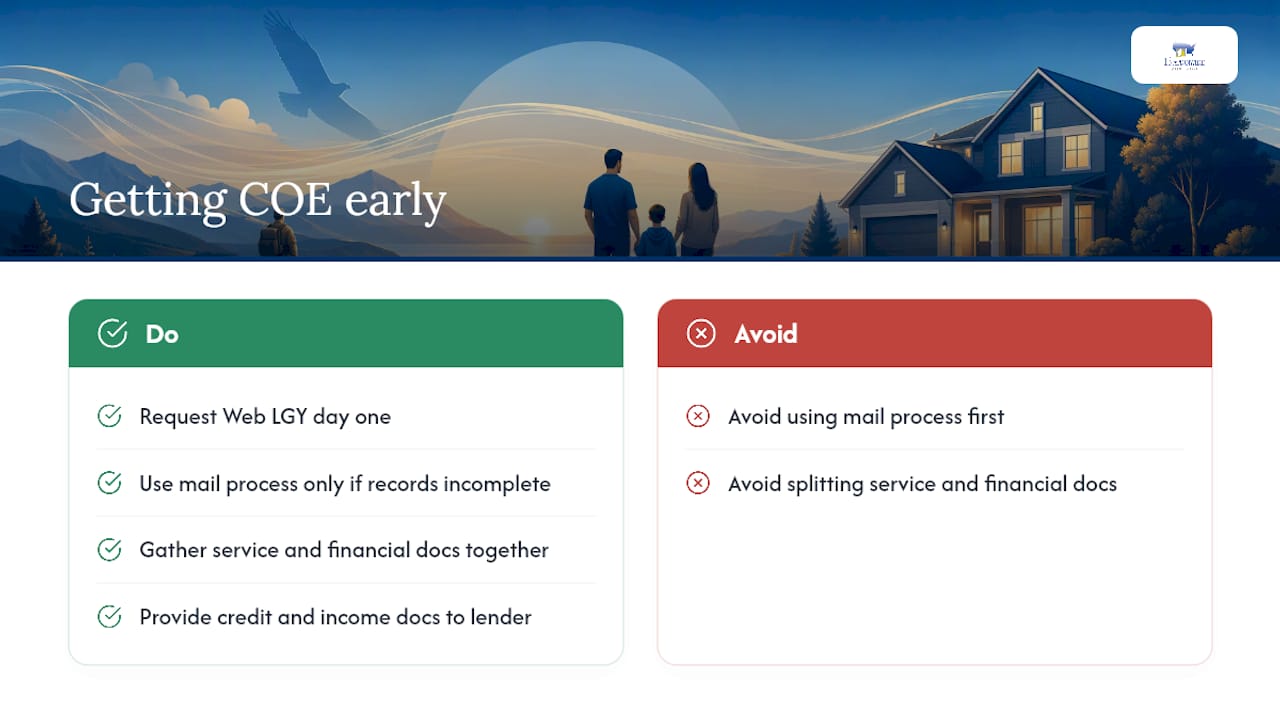
    Fix these before submitting: attach clean, legible copies, include name-change documentation upfront if it applies to you, and double check your Social Security or VA claim number before mailing anything. If you’re going through a lender, ask them to attempt Web LGY first, it eliminates most of these errors automatically since the system pulls directly from VA’s records.

    Pro Tip: If you’re submitting scanned documents to a lender, name your files clearly, such as “DD214_JohnSmith.pdf” instead of “scan001.pdf.” It sounds minor, but a well-labeled file gets processed faster by whoever is reviewing your loan file.

    What Should You Do After You Receive Your COE?

    Getting the COE isn’t the finish line, it’s the document that lets your lender start real underwriting.

    1. Deliver your COE to your lender immediately so they can attach it to your loan file.
    2. Continue the financial underwriting process, including credit review, income verification, and asset documentation.
    3. Confirm your occupancy intent in writing, since VA loans require the property to be your primary residence.
    4. Schedule your appraisal once your loan application is formally in process.
    5. Review your COE for accuracy, checking your name, entitlement amount, and service dates.

    If you spot an error on your COE, contact the VA Eligibility Center and your lender right away. Corrections are possible, but expect additional processing time while VA manually reissues the document.

    A Lender’s View on Getting Your COE Early

    The COE proves you’re entitled to a VA loan, but it doesn’t replace the credit and income documentation your lender still needs. In my experience reviewing files, the smoothest closings happen when borrowers ask their lender to try Web LGY on day one, then follow the mail process only if records come back incomplete. Gathering service and financial paperwork together, rather than one after the other, is what actually keeps a VA purchase on schedule.

    A Lender's View on Getting Your COE Early — overview diagram

    Get Help Requesting Your COE and Moving Toward Preapproval

    As a direct lender, 1st Nationwide Mortgage can attempt to pull your Certificate of Eligibility through Web LGY the moment you start your application, often skipping the paper form entirely. That means less back and forth between you, the VA, and a middleman, since we underwrite your file in house from the first phone call.

    1st Nationwide Mortgage

    If your VA records are straightforward, we can often confirm eligibility the same day we run your file. If they’re not, we’ll walk you through exactly which documents to attach to VA Form 26-1880 so your mail request doesn’t bounce back. Once your COE is in hand, our team can move you straight into preapproval and help you map out what a VA purchase looks like with your specific income and credit picture. Start by exploring our VA home loan program to see how the process works from COE to closing.

    For illustration only. Not a commitment to lend. NMLS #1281. Equal Housing Lender.

    Sources

  • US Investment Property Ownership: Why Foreign Buyers Benefit

    US Investment Property Ownership: Why Foreign Buyers Benefit

    Foreign nationals can legally buy and own U.S. investment property, and the primary payoff comes down to three things: portfolio diversification, exposure to a dollar-denominated asset, and steady income potential from a deep, liquid market. Non-U.S. citizens face no visa or Green Card requirement to purchase residential or commercial real estate here, and ownership rights match what a domestic buyer gets.

    The three benefits that matter most:

    • Diversification and currency exposure: a dollar-based asset that moves independently of your home market and currency.
    • Cash flow and appreciation: rental income plus long-term price growth in one of the world’s most transparent property markets.
    • Stability and depth: strong legal protections, transparent title systems, and enough transaction volume to exit a position when you need to.

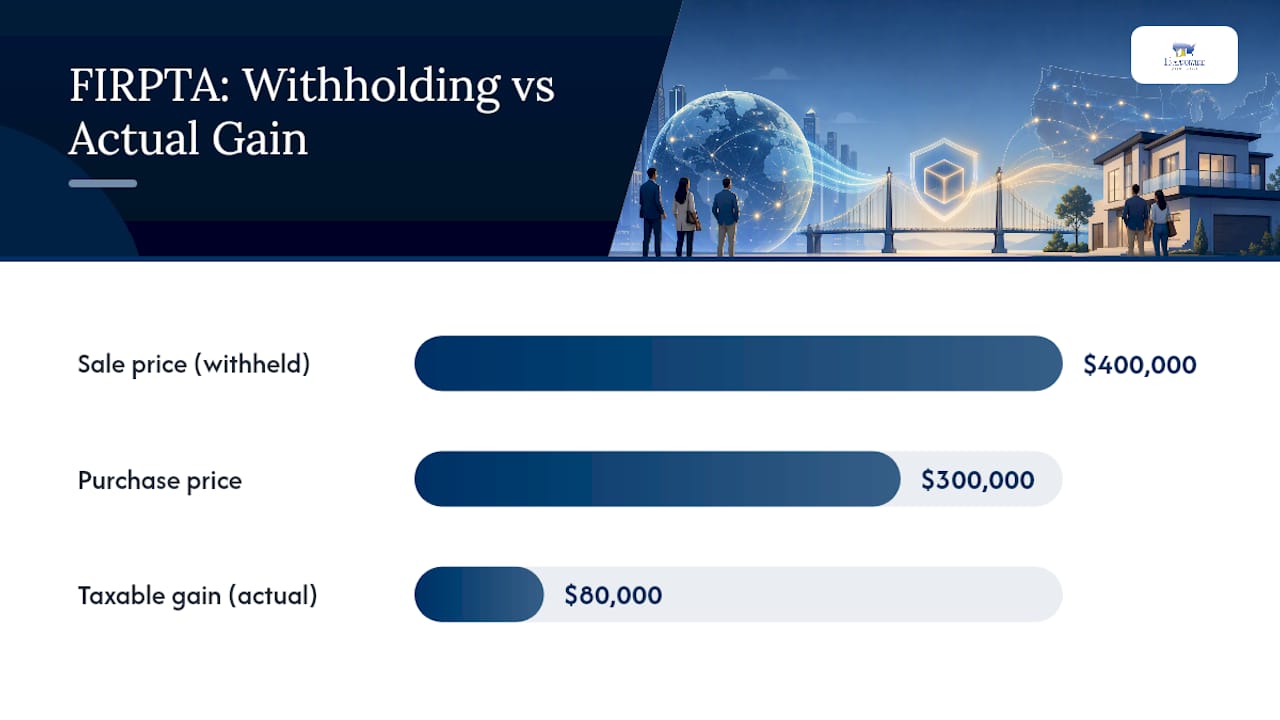
    The catch that trips up almost every first-time foreign buyer: U.S. tax law treats nonresident aliens differently on rental income, sale proceeds, and even death. FIRPTA withholding, a roughly $60,000 estate tax exemption, and FDAP withholding rules can quietly erase returns if you buy without a plan. Structure and tax elections aren’t optional paperwork here. They’re the difference between a profitable holding and a compliance headache.

    Key Takeaways

    Foreign investors benefit most from U.S. property when they pair the market’s genuine advantages, diversification, income, and liquidity, with proactive tax structuring and the right financing program from the start.

    Point Details
    Ownership is unrestricted Non-U.S. citizens can buy residential or commercial property in every state without a visa or Green Card.
    FIRPTA hits the sale price Buyer withholding applies to gross sale proceeds, not your actual gain, so file Form 8288-B early to reduce it.
    Elect ECI over FDAP The IRC 871(d) election lets you deduct expenses instead of paying flat 30% withholding on gross rent.
    Estate exposure is real The roughly $60,000 nonresident alien exemption makes early estate planning essential above modest property values.
    Financing exists without U.S. income DSCR and NONI programs from 1st Nationwide Mortgage qualify foreign investors on property cash flow or reserves, not domestic income documentation.

    Table of Contents

    Concrete Advantages Of US Investment Property Ownership For Foreign Buyers

    The benefits of US investment property ownership for foreigners start with something simple: most investors are overweight their home country by default. Your salary, your business, your pension, and your other real estate are all likely denominated in the same currency and exposed to the same local political and economic cycles. A rental property in Dallas or Tampa breaks that correlation. When your home currency weakens, a dollar-denominated asset often becomes worth more in local-currency terms, even before you factor in rent or appreciation.

    Rental yield tells a similarly compelling story, though it depends heavily on market selection. A single-family rental in a landlord-friendly Sun Belt metro can produce gross yields that outperform what many foreign investors get from residential property back home, particularly in dense global cities where price-to-rent ratios have climbed for a decade. A $350,000 rental generating $2,400 a month in gross rent works out to roughly 8.2% gross yield before expenses, a figure that’s difficult to find in London, Toronto, Sydney, or most of Western Europe. That gap is exactly why foreign nationals prefer investment properties in secondary and tertiary U.S. metros over trophy assets in coastal cities.

    Sun Belt rental home exterior sunny day

    Capital appreciation adds a second return stream on top of yield. U.S. residential real estate has historically appreciated over long holding periods, and unlike many emerging markets, the legal infrastructure around title insurance, escrow, and property records means a foreign owner’s claim to that appreciation is well protected. Foreign buyers purchased $56 billion in U.S. residential property in the most recent reporting period tracked by the National Association of Realtors, up 33.2% year over year. That volume signals a market where a foreign investor is not a novelty transaction. Title companies, lenders, and property managers all have established playbooks for it.

    Market depth matters more than most first-time buyers realize. The U.S. has thousands of active MLS markets, a standardized title and escrow process, and enforceable landlord-tenant law in every state. Selling a property in six months if your plans change is realistic in most U.S. metros. That same liquidity is far rarer in many foreign real estate markets, where finding a qualified buyer can take years.

    Pro Tip: Don’t let currency swings erode a good deal on paper. If your home currency strengthens right when you’re ready to sell and repatriate proceeds, you can lose several points of return to the exchange rate alone. Consider staging repatriation over a few transfers instead of moving all proceeds at once, and talk to your bank about forward contracts if you’re converting a large sum.

    Can Foreigners Legally Buy US Property? Clearing Up The Myths

    Yes, without qualification. Every state permits non-U.S. citizens to buy residential and commercial property, and there’s no federal law requiring citizenship, a Green Card, or even U.S. residency to hold title. Ownership rights, including the ability to rent, sell, or will the property, are identical to what a U.S. citizen gets.

    A few misconceptions keep circulating anyway:

    • “You need a visa to buy property.” False. Buying real estate creates no immigration status and requires none.
    • “Foreign ownership is capped or restricted in most states.” False for the vast majority of residential and commercial transactions. A handful of states restrict foreign ownership of agricultural land, but that’s a narrow carve-out, not a general rule.
    • “You must be physically present at closing.” False. Remote closings using a power of attorney are common for international buyers.

    What you do need is a specific set of documents, and gathering them early avoids the delays that trip up most first-time foreign buyers:

    1. Valid passport for identity verification.
    2. Proof of funds, typically bank statements or a letter from your home-country bank showing the source of the down payment.
    3. ITIN or EIN application, depending on whether you’re buying as an individual or through an entity. This matters for tax filing and eventual FIRPTA processing.
    4. Form W-8BEN or W-8ECI, which tells U.S. payers (like a property manager collecting rent) how to withhold tax on your income.
    5. A title search and title insurance policy, arranged through escrow, confirming clean ownership before you close.

    One clarification worth stating plainly: buying property is a tax and property law matter, not an immigration matter. If you want to spend extended time in the U.S. or eventually pursue residency, that’s a separate track entirely, and you should talk to an immigration attorney rather than assume the closing table gets you there.

    Ownership Structures: Direct, LLC, Corporation, Or Trust?

    How you title a U.S. investment property changes your tax bill, your liability exposure, and what happens to the property when you die. Structuring decisions materially affect tax exposure, estate exposure, and repatriation outcomes for foreign investors, and there’s no single right answer. It depends on property value, whether you plan to hold long term or sell within a few years, and how much complexity you’re willing to manage.

    Structure Income tax treatment Estate tax exposure Repatriation & liquidity Compliance burden
    Direct ownership Simplest; FDAP or ECI election applies directly to you Full exposure to the roughly $60,000 nonresident alien exemption Straightforward; sale proceeds go directly to you Low; annual 1040-NR filing
    U.S. single-member LLC Passes through to owner; same tax treatment as direct ownership Still exposed at the individual level unless paired with other planning Simple distributions, but adds liability protection Moderate; LLC filings plus personal return
    U.S. corporation Corporate tax rate on income; dividends taxed again on distribution Shares may still be part of the individual’s estate Double taxation on distributions can reduce net proceeds Higher; corporate returns and formalities
    Foreign holding company owning US corp Corporate-level U.S. tax; distributions to the foreign parent often reduce estate exposure Often removes property from the individual’s taxable estate Can enable more tax-efficient repatriation at the holding-company level Highest; cross-border filings on both sides
    Trust (varies by type) Depends on trust type; often flows through similarly to direct ownership Can reduce or eliminate estate exposure with proper drafting Depends on trust terms; can complicate liquidity High; requires specialized drafting and administration

    A buyer picking up a single rental in Orlando for personal cash flow usually doesn’t need anything more complex than a U.S. LLC. It offers liability protection and clean bookkeeping without the double taxation or added filings that come with a corporation. A portfolio-level investor planning to acquire multiple properties, hold for a decade, and eventually sell and repatriate a large sum has a very different calculus. A multi-tier structure using a foreign holding company that owns a U.S. corporation can allow the eventual sale to happen at the holding-company level, which sometimes produces a cleaner tax outcome on exit, though it adds real complexity and can limit the ability to offset losses across properties.

    • Direct ownership works best for a single, modest-value property with no major estate concerns.
    • LLCs suit most buy-and-hold investors who want liability protection without corporate-level tax friction.
    • Layered corporate or trust structures make sense once portfolio value climbs high enough that estate exposure or repatriation efficiency starts to outweigh added complexity.

    Pro Tip: Don’t default to an LLC just because it’s the most commonly recommended structure. If you’re buying a $150,000 rental and plan to hold it for cash flow only, a corporate layer can cost more in annual compliance than it saves in tax. Match the structure to the property value and your exit horizon, not to what worked for someone else’s portfolio.

    Any structure involving a foreign holding company, a trust, or a decision about estate exposure deserves a conversation with a cross-border tax attorney and a CPA who has handled nonresident alien clients before. This isn’t a spot to guess.

    How Us Investment Property Laws Affect Foreigners At Tax Time

    This is where most of the real financial risk lives, and it’s also where the benefits of US investment property ownership for foreigners can quietly shrink if you don’t plan around it.

    FDAP versus ECI. Rental income earned by a nonresident alien is generally classified as FDAP income and taxed at a flat 30% of gross rent, with no deductions allowed for mortgage interest, property tax, repairs, or depreciation. That’s a brutal outcome for a leveraged rental property where expenses might eat up half the gross income. The fix is the IRC 871(d) election, which lets you treat the rental activity as effectively connected income (ECI). Once you elect ECI treatment, you’re taxed at the same graduated rates as a U.S. taxpayer, and you can deduct mortgage interest, depreciation, property management fees, and repairs against the income. For almost any leveraged or actively managed rental, the 871(d) election produces a dramatically lower tax bill than the default FDAP treatment.

    FIRPTA on sale. When you eventually sell, the Foreign Investment in Real Property Tax Act requires the buyer to withhold and remit a portion of the gross sale price to the IRS, not a portion of your gain. That distinction catches people off guard constantly.

    How Us Investment Property Laws Affect Foreigners At Tax Time — overview diagram

    Here’s the math that illustrates why: say you bought a property for $300,000, sold it for $400,000, and your actual taxable gain after basis and selling costs is $80,000. FIRPTA withholding applies to the $400,000 sale price, not the $80,000 gain, which can mean tens of thousands of dollars gets withheld and sent to the IRS at closing, even though your real tax liability is much smaller. You get that overwithheld amount back, but only after filing a return, and that can take months. The workaround is Form 8288-B, which lets you apply for a withholding certificate before closing to reduce the amount withheld to something closer to your actual expected tax liability, rather than waiting to claim a refund after the fact.

    Filing obligations. Foreign owners with U.S. rental income file Form 1040-NR annually, and should keep either a W-8ECI on file with their property manager (if electing ECI treatment) or a W-8BEN (if accepting default FDAP withholding). Proper documentation and timely elections are often the single factor that determines whether an investor pays 30% gross withholding or a much smaller net tax bill after deductions.

    • File the 871(d) election in the year you first want ECI treatment. It generally applies going forward once made.
    • Keep a valid W-8 form on file with anyone paying you U.S.-source rental income.
    • Apply for an ITIN well before any planned sale. Missing this step delays your FIRPTA refund significantly.
    • Budget for state-level income tax withholding on top of federal FIRPTA in states that impose one.

    Pro Tip: File your 871(d) election the year you close, not years later after you’ve already paid gross FDAP withholding on rental income. The election is far easier to make proactively than to unwind retroactively, and your CPA should build it into your very first tax filing on the property.

    Financing Options For Foreign Buyers Purchasing US Property

    Cash remains the most common route for foreign buyers, and nearly half of foreign purchasers pay cash rather than financing, largely because it simplifies underwriting and avoids the extra documentation that comes with a mortgage. Financing is still very much available, though, and understanding your realistic options before you start shopping saves weeks of back-and-forth with a lender.

    DSCR loans are the workhorse for foreign real estate investors because they underwrite the property, not the person. The lender looks at whether the property’s rental income covers the mortgage payment, rather than requesting your foreign tax returns, pay stubs, or employer verification. Foreign national DSCR files typically require larger down payments, often in the 25% to 35% range, along with proof of funds and, in many cases, an existing lease or a market rent analysis. There’s no cap on how many financed properties you can hold under DSCR programs, and LLC ownership is standard.

    NONI programs (no income, no asset documentation) exist specifically for foreign nationals and other borrowers who can’t produce U.S.-style income documentation at all. These programs lean more heavily on credit history, down payment size, and property value than on any income paperwork, making them a fit for investors whose income is generated entirely outside the U.S.

    Bank statement loans, while more common among self-employed domestic borrowers, occasionally fit foreign nationals who maintain U.S. bank accounts and can show consistent deposit activity in lieu of tax returns.

    • All-cash: fastest close, no underwriting friction, no ongoing loan servicing.
    • DSCR loans: qualifies on property income, works for LLC ownership, no limit on the number of financed properties.
    • NONI loans: designed for foreign nationals with no documentable U.S. income.
    • Hard money or bridge loans: short-term, higher-cost financing useful for a quick close or a value-add renovation before refinancing into a longer-term DSCR loan.

    Documentation differs from a standard U.S. mortgage. Expect to provide your passport, proof of funds sourced from your home country, sometimes foreign credit references, and an ITIN or EIN depending on how you’re taking title. Lenders working with foreign nationals also tend to prefer LLC ownership over individual borrowing, since it simplifies title and liability going forward.

    Pro Tip: Have your proof of funds translated and formatted the way U.S. underwriters expect before you apply. A clean funds letter, a signed LLC operating agreement, and a property manager already lined up are the three things that most consistently speed up approval on a foreign national file. A resource like 1st Nationwide Mortgage’s investment property loan programs walks through what DSCR, NONI, and bank statement products each require.

    Step-By-Step Timeline For Buying US Property As A Foreign Investor

    A typical foreign national purchase moves through a fairly predictable sequence, though timelines stretch when ITIN processing or FIRPTA paperwork gets involved.

    1. Property search and offer (1 to 4 weeks): work with a local agent familiar with international buyers.
    2. Inspection and appraisal (1 to 2 weeks): standard due diligence, same as for domestic buyers.
    3. Title search and escrow opening (concurrent with inspection): confirms clean title before funds move.
    4. Financing approval, if applicable (2 to 4 weeks for DSCR or NONI programs): documentation review and property underwriting.
    5. ITIN or EIN application, if not already in place (can take 6 to 11 weeks through the IRS, so start this immediately if it isn’t done): this is the step most likely to cause delays.
    6. Closing (1 day, often remote via power of attorney): funds transfer and title records.
    7. Post-closing tax setup: file W-8 forms with your property manager, register with a CPA for annual 1040-NR filing.

    Budget beyond the purchase price itself. Earnest money typically runs 1% to 3% of the purchase price, closing costs (title, escrow, recording fees, attorney fees) commonly land between 2% and 5%, and if you’re financing, expect lender fees on top of that. At the eventual sale, plan for FIRPTA withholding on the gross sale price, even though your actual tax liability will likely be lower.

    Engage your team roughly in this order: a local real estate agent first, a cross-border CPA and real estate attorney before you make an offer, a lender early if financing, and a property manager before closing so they’re ready to take over immediately. Remote closings using power of attorney are routine for international buyers. Your attorney or escrow company can walk you through the notarization requirements for executing documents from abroad.

    Managing And Repatriating Income As A Remote Property Owner

    Owning from a distance works well when the operational basics are handled early, and falls apart quickly when they aren’t.

    Hiring a property manager. Vet at least two or three candidates, ask for references from other out-of-country owners specifically, and get clarity on fee structure (usually a percentage of collected rent plus leasing fees) and reporting cadence before signing. Monthly statements and a direct line of communication matter more once you’re managing a time zone gap.

    U.S. banking. Most foreign owners open a U.S. bank account to receive rent and pay property expenses, which avoids repeated international wire fees. Some U.S. banks accept a foreign national with an ITIN and a U.S. property address; others require an in-person visit, so confirm requirements before you fly over expecting to open an account same-day.

    • Vet property managers on fee transparency, communication frequency, and references from other foreign owners.
    • Open a U.S. account early. Some banks won’t let you open one remotely.
    • Keep every receipt tied to the property. Depreciation and expense records matter enormously if you’ve elected ECI treatment.
    • Work with a CPA who has handled nonresident alien returns before, not a generalist.

    Pro Tip: Don’t repatriate every dollar of rental income every month. Staged repatriation, moving funds a few times a year rather than monthly, gives you more flexibility to time currency conversion when the exchange rate favors you, and it reduces the wire fees that eat into smaller, more frequent transfers.

    Estate Tax Exposure For Nonresident Property Owners

    This is the benefit-eroding surprise that catches otherwise well-informed foreign investors off guard, because it has nothing to do with income tax at all.

    Nonresident aliens face a federal estate tax exemption of roughly $60,000, compared to a multi-million-dollar exemption for U.S. citizens. That gap means a rental property held directly by a foreign individual at death could trigger estate tax exposure on the value above the modest exemption threshold, which a domestic owner with the same property would not face.

    Mitigation strategies exist, and they’re worth exploring before you close, not after a health scare:

    • Holding property through a foreign corporation, which removes U.S. real property from the individual’s taxable estate (shares of a foreign corporation are generally not considered U.S.-situs property).
    • Life insurance sized to cover the projected estate tax liability, held outside the estate.
    • Cross-border trusts drafted specifically to address nonresident alien estate exposure.
    • Reviewing whether an estate tax treaty between the U.S. and your home country changes the exemption or credit available to you.

    Each of these comes with tradeoffs. Corporate structures generally forfeit the step-up in basis that heirs would otherwise get on inherited property, meaning built-in gains carry forward instead of resetting. Corporate ownership also adds ongoing compliance and, in some states, additional filing requirements. None of this is a reason to avoid U.S. property. It’s a reason to plan the structure before you buy rather than after a health scare forces the issue. Talk to a cross-border estate attorney and your CPA together, early, especially once property values start climbing past a few hundred thousand dollars.

    Common Mistakes Foreign Investors Make And How To Avoid Them

    Most costly mistakes are avoidable with a little foresight:

    • Ignoring FIRPTA until the sale. Apply for Form 8288-B before closing on the sale, not after withholding already happened.
    • Choosing the wrong ownership structure. Match structure to property value and holding horizon, not to generic advice you found online.
    • Missing the ITIN timeline. Apply for your ITIN months before you need it for a sale, since IRS processing routinely takes 6 to 11 weeks.
    • Under-budgeting for withholding. Remember FIRPTA withholds against the sale price, not your actual gain, so your available cash at closing will be lower than the math on paper suggests.
    • Skipping property manager vetting. A bad manager erodes returns quietly through neglect and poor tenant screening.
    • Ignoring currency timing on repatriation. Moving all proceeds home at once, at the wrong moment in the exchange rate cycle, can cost real money.

    One more thing worth flagging clearly: U.S. lenders and title companies are required to verify source of funds and comply with anti-money laundering rules for foreign buyers, particularly on higher-value cash transactions. Expect to document exactly where your down payment or purchase funds originated. This isn’t optional paperwork, and trying to shortcut it will stall your closing.

    Lender Requirements: DSCR, NONI, And Bank Statement Programs

    From the lending side, the paperwork foreign investors need falls into a predictable pattern once you understand what each program is actually underwriting.

    DSCR loans evaluate the property’s projected or actual rental income against the proposed mortgage payment. The borrower’s personal income never enters the equation, which is exactly why it works for someone earning income entirely outside the U.S. Lenders will still want a valid passport, proof of funds for the down payment and reserves, an LLC operating agreement if the property is being purchased under an entity, and either an existing lease or a market rent survey.

    NONI loans go a step further for foreign nationals who can’t produce any U.S.-recognizable income documentation, relying instead on credit profile, reserves, and loan-to-value ratio.

    Bank statement programs occasionally apply to foreign nationals who maintain active U.S. deposit accounts and can show 12 to 24 months of consistent activity.

    Files stall for predictable reasons: missing or unclear proof-of-funds documentation, an LLC operating agreement that hasn’t been finalized, or a property manager contract that isn’t yet signed when the lender needs to verify projected rental income. Foreign national files also stall when a borrower’s home-country bank statements arrive in a format U.S. underwriters can’t easily verify, so getting documents translated and notarized ahead of time saves real time.

    • Passport and visa status (for identification purposes only, not eligibility).
    • Proof of funds with a clear source-of-funds trail.
    • LLC formation documents and operating agreement, if buying under an entity.
    • Signed property management agreement or lease, supporting the DSCR calculation.
    • ITIN or EIN application status.

    Pro Tip: Get your LLC operating agreement and property manager contract finalized before you submit a loan application, not during underwriting. Those two documents alone account for a large share of the delays lenders see on foreign national files. A foreign national mortgage qualification breakdown covers the specific factors underwriters weigh most heavily.

    No state license or number is claimed here; programs are available across a multi-state footprint, and business-purpose investment financing like DSCR is available broadly, since it doesn’t fall under owner-occupied lending restrictions.

    A Lender’s Perspective On Foreign Investor Files

    The questions I hear most from foreign investors aren’t about interest rates. They’re about which structure to use and whether their income even counts for underwriting. My advice is always the same: get your LLC formed, your proof of funds documented, and your CPA conversation started before you make an offer, not after. Files move fastest when that groundwork is already done. I’ve built our foreign national process around exactly those pain points, which is part of why I hold NMLS #1281 to this day.

    Get Your Investment Property Financing Questions Answered

    Most foreign investors don’t need another generic mortgage conversation. They need a direct lender who already understands DSCR underwriting, NONI documentation, and the specific paperwork that comes with buying through an LLC from overseas. 1st Nationwide Mortgage originates these loans directly rather than shopping your file to outside investors, which means fewer handoffs and a process built around foreign national files from the start.

    1st Nationwide Mortgage

    Before reaching out, have these ready so your conversation moves quickly:

    • Your passport, proof of funds with a clear source trail, and the target property address.
    • LLC formation documents and operating agreement, if you’re purchasing under an entity.

    If a DSCR loan sounds like the right fit for your next rental purchase, explore 1st Nationwide Mortgage’s DSCR loan programs or run the numbers yourself with the DSCR loan calculator before your next call with an agent. If your income comes entirely from outside the U.S., the NONI loan program may fit better, and it’s worth asking about directly.

    For illustration only. Not a commitment to lend. Rates and terms subject to change and qualification. 1st Nationwide Mortgage Corporation, NMLS #1281. Equal Housing Lender.

    Frequently Asked Questions

    Do I need to be a U.S. resident to own investment property here?
    No. Ownership requires no visa, Green Card, or residency status of any kind.

    What’s the biggest tax mistake foreign investors make?
    Missing the IRC 871(d) election and defaulting into 30% gross FDAP withholding on rental income instead of net taxation with deductions.

    Can I get a mortgage as a foreign national with no U.S. income?
    Yes, through DSCR loans that qualify on the property’s rental income, or NONI programs designed specifically for borrowers without documentable U.S. income.

    How much of the sale price does FIRPTA withhold?
    Withholding applies to a portion of the gross sale price, not your actual gain, though you can apply for a withholding certificate via Form 8288-B to reduce it toward your real tax liability.

    Should I buy in my own name or through an LLC?
    For a single buy-and-hold rental, most foreign investors use a U.S. LLC for liability protection. Larger portfolios or estate concerns may call for a more layered structure, best confirmed with cross-border tax counsel.

    This article is general information, not a substitute for advice from a qualified financial advisor. Consult a qualified financial professional about your own circumstances before acting on anything here.

    Sources

  • FHA Loan After Foreclosure: Eligibility and Next Steps

    FHA Loan After Foreclosure: Eligibility and Next Steps

    Yes, you can qualify for an FHA loan after a foreclosure, and in most cases you don’t have to wait as long as you think. FHA’s standard waiting period runs three years from the date the property title actually transferred out of your name, not from the day you got the notice of default or missed your first payment. If your foreclosure was tied to a documented financial hardship, that window can shrink to as little as 12 months under HUD’s extenuating circumstances rules.

    Here’s what to do right now, before you worry about anything else:

    • Pull the recorded deed or foreclosure sale document and confirm the exact transfer date. This single date determines your entire eligibility timeline.
    • Start rebuilding credit immediately. Lenders want to see at least 12 months of on-time payments on new accounts.
    • Ask a HUD-approved housing counseling agency about a one-on-one session, especially if you plan to argue extenuating circumstances.
    • Gather paperwork tied to whatever caused the foreclosure. Layoff letters, medical bills, divorce decrees, and death certificates all carry weight if they connect directly to the missed payments.

    The rest of this guide walks through exactly how the waiting period is calculated, how the extenuating circumstances exception works, and what a lender will actually ask you to prove before approving a new FHA-insured mortgage.

    Key Takeaways

    An FHA loan after foreclosure is achievable in most cases within three years, or as early as 12 months with documented extenuating circumstances and completed housing counseling.

    Point Details
    Standard wait is 3 years Measured from the foreclosure sale or deed-transfer date, not the notice of default.
    Extenuating circumstances can cut it to 12 months Requires a documented Economic Event, 12 months of re-established credit, and HUD-approved counseling.
    Verify your transfer date first Pull the recorded deed or sale document from public records before calculating your eligibility date.
    Rebuild credit actively Twelve months of on-time payments on new tradelines is the clearest signal lenders look for.
    1st Nationwide Mortgage supports manual underwriting cases As a direct lender, it reviews documentation and coordinates counseling timing for post-foreclosure borrowers.

    Table of Contents

    What Is an FHA Loan and Why Does It Matter After Foreclosure?

    An FHA loan is a mortgage insured by the Federal Housing Administration, a division of the U.S. Department of Housing and Urban Development. The government doesn’t lend you the money directly. Instead, it insures the lender against loss, which lets approved lenders extend credit to borrowers who wouldn’t clear the bar at a conventional bank.

    That insurance backing is exactly why FHA tends to be the fastest legitimate path back into homeownership after a foreclosure. Conventional loans backed by Fannie Mae or Freddie Mac typically enforce a seven-year waiting period unless a borrower documents extenuating circumstances, and even then the exceptions are narrower than FHA’s. Comparative program data shows VA loans often use a two-year window for eligible veterans, while FHA sits at three years standard, with real flexibility built into the rules for hardship cases.

    Lenders don’t make these decisions on a whim. They follow specific written guidance:

    • HUD Handbook 4000.1, the FHA Single Family Housing Policy Handbook, sets the baseline underwriting framework every FHA-approved lender must follow, including foreclosure-related updates.
    • HUD Mortgagee Letters amend or clarify handbook policy, and the one that matters most here, Mortgagee Letter 2013-26, defines the extenuating circumstances exception in detail.
    • HUD-approved housing counseling agencies provide the one-on-one counseling FHA requires when a borrower is trying to qualify early under that exception.

    Once you understand that FHA runs on a documented, written rulebook rather than lender discretion, the rest of this process becomes a lot less mysterious. It’s a checklist, not a guessing game.

    How Long Do You Have to Wait for an FHA Loan After Foreclosure?

    FHA’s standard waiting period is several years, and the clock starts on a very specific date: the day title to the property legally transferred out of your name. That’s either the foreclosure sale date or, in deed-in-lieu and short sale situations, the recording date on the deed transfer.

    Timeline of FHA loan waiting periods after foreclosure

    This trips up a lot of borrowers. The wait does not start when you got a notice of default. It does not start when you stopped making payments. It does not even start when the foreclosure process technically began in court. It starts on the day the property changed ownership, and that date lives in your county’s public property records.

    Short sales and deeds-in-lieu of foreclosure get treated a little differently in practice, even though the standard three-year clock still generally applies. Because both involve the borrower’s cooperation rather than a forced sale, lenders sometimes have an easier time approving an extenuating circumstances exception for these cases, since the paper trail showing hardship and cooperation tends to be cleaner.

    Pro Tip: Don’t rely on memory or a loan servicer’s letter for your transfer date. Order the actual recorded deed or trustee’s sale document from the county recorder’s office. An error of even a few weeks in this date can mean an automatic denial when a lender runs your file.

    Here’s how the math typically works out:

    The right column assumes you meet every condition of the extenuating circumstances exception, which is a considerably higher bar than simply waiting out the standard clock. The next section covers exactly what that bar requires.

    Can Extenuating Circumstances Shorten the FHA Waiting Period?

    Yes, and this is the part most borrowers never hear about until they’re already deep into rebuilding. HUD Mortgagee Letter 2013-26 created a formal exception for foreclosures caused by what HUD calls an “Economic Event,” a documented, sudden loss of household income tied to conditions outside the borrower’s control.

    HUD defines an Economic Event specifically as a reduction in household income lasting six months or longer by a measure set by the agency. That’s not a vague hardship standard. It’s a measurable threshold, and lenders will ask you to prove it with real documentation, not a written explanation alone.

    If your foreclosure fits that definition, the waiting period can drop to as little as 12 months from the foreclosure completion date, rather than three years. But shortening the wait requires clearing several conditions at once:

    • At least 12 months must have elapsed since the foreclosure or deed-in-lieu, with documentation tying the loss directly to the Economic Event.
    • You need a minimum of 12 months of re-established, satisfactory credit after the event resolved.
    • You must complete HUD-approved housing counseling, including at least one hour of one-on-one counseling, no earlier than 180 days and no later than 30 days before you submit your loan application.

    A single sentence explaining hardship rarely satisfies an underwriter. Lenders want documents that draw a direct, dated line between the event and the missed payments: an employer separation or layoff letter, medical billing records, a death certificate, divorce decrees, unemployment benefit statements, or tax returns showing the income drop. A vague note that says “I lost my job and fell behind” without supporting paperwork tends to get treated as a standard foreclosure, which means the full three-year clock applies.

    The timing on housing counseling matters more than most borrowers realize. Complete it too early, and it falls outside the 180-day window by the time you apply. Complete it too late, and you miss the 30-day minimum. Coordinate that appointment with your target application date, not the other way around.

    How Do Lenders Actually Evaluate a Post-Foreclosure FHA Application?

    Once you’re past the waiting period, or you qualify under the extenuating circumstances exception, the application still has to clear underwriting. Lenders look at several factors together, and no single number guarantees approval or denial.

    FHA’s own minimum credit score requirements are fairly permissive, generally 500 to 580 depending on your down payment. In practice, most FHA-approved lenders want to see scores meaningfully higher than that after a foreclosure, since the foreclosure itself will have already knocked your score down before you even started rebuilding. Real-world approvals after foreclosure tend to cluster among borrowers who’ve pushed their scores back into the mid-600s or better.

    Payment history since the foreclosure carries significant weight. Underwriters want roughly 12 months of clean, on-time payments on new tradelines, whether that’s a secured credit card, an auto loan, or another installment account. This is the evidence that your finances have actually stabilized, not just that time has passed.

    Beyond credit, lenders weigh:

    • Debt-to-income ratio, with lower ratios giving you more room to absorb underwriting scrutiny.
    • Employment and income stability, especially continuous employment in the same field or with the same employer.
    • Cash reserves, which function as a compensating factor when other parts of your file are thinner than a lender would like.
    • Federal debt flags, which lenders check through HUD’s CAIVRS system to catch any outstanding federal debt or prior government loan defaults that could block approval regardless of your credit score.

    Most FHA applications run through an automated system called the TOTAL Scorecard, which weighs your credit, income, and assets against HUD’s risk parameters and returns an approve or refer decision. If your file gets referred, or if you’re applying inside the extenuating circumstances window, it typically moves to manual underwriting. Manual underwriting means a human reviews your full file line by line, and it usually demands stronger compensating factors: larger reserves, a lower DTI, and more thorough documentation than an automated approval would require.

    Pro Tip: During your seasoning period, resist the urge to open new credit cards or take on a car loan you don’t need. Every new inquiry and every new balance shows up in underwriting, and a thin, clean credit file consistently outperforms a busy one with a few late payments buried in it.

    What Should You Do During the Waiting Period to Improve Your Odds?

    Treat the waiting period as active work, not a countdown clock you’re just waiting to expire. Borrowers who use this time deliberately tend to walk into underwriting with a much stronger file than those who simply wait.

    1. Pull your credit reports and dispute errors. Foreclosure files are notoriously messy, and incorrect late-payment marks or duplicate collection entries are common. Fixing these can lift your score meaningfully.
    2. Open one or two new tradelines and pay them on time, every month. A secured card or small installment loan, paid consistently for 12 months, is the single clearest signal to an underwriter that your finances have stabilized.
    3. Keep balances low relative to your limits. Credit utilization under 30% helps your score recover faster than simply making minimum payments.
    4. Schedule your HUD-approved housing counseling appointment strategically, timed to fall within that 30 to 180 day window before you plan to apply, if you’re pursuing the extenuating circumstances path.
    5. Build cash reserves. Two to six months of mortgage payments held in reserve gives underwriters a compensating factor to offset a still-recovering credit profile.
    6. Gather your documentation now, not later. Collect the recorded deed or foreclosure sale paperwork, any bankruptcy discharge papers if you filed, and every piece of evidence tying your foreclosure to a specific hardship, whether or not you plan to use the extenuating circumstances exception.

    If you know you’re heading toward manual underwriting, expect the lender to ask for more than the standard document list. That commonly means two years of tax returns instead of one, a detailed written explanation of the foreclosure with supporting paperwork, and proof of reserves beyond the minimum FHA requires.

    Pro Tip: If you’re self-employed and rebuilding credit at the same time, tax write-offs from your recovery years can suppress your reported income right when you need it to look strongest. A bank statement loan program that qualifies you on deposits rather than tax returns can sometimes make more sense than waiting for a “clean” tax return to show up.

    Self-employed person calculating finances manually

    Can Property Condition Issues Block Your FHA Loan After Foreclosure?

    A strong borrower file doesn’t help you if the house itself fails FHA’s standards. This catches people off guard because after everything spent rebuilding credit, the property, not the borrower, becomes the obstacle.

    FHA requires every financed home to pass an FHA appraisal that checks against HUD’s minimum property standards, not just market value. Common disqualifiers include:

    • Active safety hazards, such as exposed wiring, missing handrails, or a failing roof.
    • Unpermitted additions or structural work that wasn’t properly inspected.
    • Major deferred maintenance, including nonfunctioning heating systems or serious water damage.
    • Unresolved title issues, including liens that weren’t cleared during a prior sale.

    If you’re buying a foreclosure or distressed property yourself, request repair estimates and a title search early, before you’re deep into the loan process. Some of these issues can be resolved with seller-paid repairs or by renegotiating seller concessions to cover the fix. Others, particularly title problems, need to be cleared well before your closing date to avoid delays.

    How Does 1st Nationwide Mortgage Evaluate Post-Foreclosure Applications?

    Every post-foreclosure file is different, and the details matter more than the headline waiting period. 1st Nationwide Mortgage Corporation approaches these applications by working through the documentation first: confirming the exact foreclosure completion date against public records, reviewing whether an extenuating circumstances argument is realistic based on the paperwork available, and coordinating with HUD-approved housing counseling agencies when a borrower is trying to qualify inside that 12-month window.

    A foreclosure in your history isn’t a permanent disqualifier. It’s a documentation problem and a timing problem, and both are solvable with the right paperwork and a lender who knows how to build a manual underwriting file that actually holds up.

    As a direct mortgage banker rather than a broker, 1st Nationwide Mortgage underwrites and funds loans in house, which matters most in exactly these cases, where manual underwriting and compensating-factor documentation make the difference between an approval and a denial. The company is founded and operated by Christopher Arco, NMLS #1281, and holds a BBB A+ rating.

    • Document review focused on the specific transfer date and any extenuating circumstances evidence.
    • Coordination support for HUD-approved housing counseling timing.
    • Manual underwriting experience for files that don’t fit the automated TOTAL Scorecard path.

    This section is educational information about how post-foreclosure applications are reviewed, not a commitment to lend or an offer of specific terms.

    The Real Gap Between FHA’s Rulebook and How Borrowers Prepare

    Most advice about FHA loans after foreclosure stops at “wait three years,” and that’s where it fails borrowers. The extenuating circumstances exception in Mortgagee Letter 2013-26 has existed for over a decade, yet it remains one of the most underused paths back into homeownership because it demands something most people don’t have ready: a documented, dated connection between a specific hardship and the missed payments.

    The conventional wisdom treats the waiting period as passive, something you simply survive. That’s backwards. The borrowers who come out ahead treat those months as a documentation project. They pull their foreclosure paperwork early. They request counseling at the right time instead of whenever is convenient. They build tradeline history deliberately instead of hoping their score recovers on its own.

    If there’s one thing worth prioritizing above all else, it’s verifying your transfer date before you do anything else. I’ve seen the assumption that “the foreclosure happened last spring” turn into a six-month scheduling error once someone actually pulled the recorded deed. Get that date right first. Everything else, credit rebuilding, counseling, documentation, only matters once you know which calendar you’re actually working against.

    How 1st Nationwide Mortgage Can Help You Move Forward

    Rebuilding after a foreclosure often means your income doesn’t look the way it used to on paper, especially if you’re self-employed and your tax returns from the recovery years are thinner than your actual cash flow. That’s the exact gap 1st Nationwide Mortgage was built to close: as a direct mortgage banker, not a broker, the company reviews your documentation in house, helps you understand whether an extenuating circumstances case is realistic, and works through manual underwriting when your file needs a human, not just an algorithm, to see the full picture.

    1st Nationwide Mortgage

    If your income comes from self-employment and your tax returns understate what you actually earn, a bank statement mortgage using 12 to 24 months of deposits may qualify you sooner than waiting for a “clean” tax year to materialize. And if you’re rebuilding through real estate investment rather than a primary residence purchase, DSCR loan programs qualify you on the property’s rental income rather than your personal financial history. Programs are available in California, Colorado, Oregon, Washington, Texas, and Idaho for owner-occupied FHA and related consumer products; investment-property financing through business-purpose lending programs is available more broadly. Prepayment penalty availability and structure vary by state, and penalties are prohibited or restricted in several; terms are confirmed at application.

    The next step is simple: reach out to a loan officer, walk through your foreclosure timeline together, and find out exactly which path, waiting it out, the extenuating circumstances exception, or an alternative documentation program, fits your situation. Start with the FHA home loan program page to see what’s available.

    For illustration only. Not a commitment to lend. Rates and terms subject to change and qualification. 1st Nationwide Mortgage Corporation, NMLS #1281. Equal Housing Lender.

    Where to Verify These Rules Yourself

    Every rule covered in this guide traces back to a specific piece of federal guidance, and it’s worth reading the primary sources directly rather than relying on secondhand summaries, including this one.

    This article provides general information, not professional legal or financial advice. Confirm current requirements with HUD’s published guidance or a qualified mortgage professional before making decisions based on your specific situation.

    This article is general information, not a substitute for advice from a qualified financial advisor. Consult a qualified financial professional about your own circumstances before acting on anything here.

    Sources

  • Condotel Financing: Loan Options for Investors in 2026

    Condotel Financing: Loan Options for Investors in 2026

    Condotel financing is available in 2026, but rarely through a conventional mortgage. Realistic paths are DSCR loans, bank-statement/non-QM programs, NONI loans for foreign nationals, portfolio or condotel-specialty products, and bridge or hard-money loans when a deal moves fast or falls outside every other box. Expect higher down payments than a typical condo purchase, tighter appraisal scrutiny, and lenders who care as much about the property’s rental program as your credit file.

    Here’s the quick shape of it:

    • Down payment and LTV: most condotel loans require a substantial down payment, with maximum loan-to-value often capped at moderate levels depending on the program.
    • Documentation: DSCR loans skip personal income entirely and qualify on the property’s rental numbers; bank-statement loans use 12 to 24 months of deposits instead of tax returns; NONI loans require neither.
    • State rules matter: owner-occupied products are limited by compliance to a handful of states, while investment-purpose loans have far broader reach.

    The next move is straightforward: pull together your HOA and management agreement paperwork, know whether you’re buying to occupy or to rent, and get a lender who actually underwrites condotels on the phone before you write an offer.

    Key Takeaways

    Condotel financing works reliably through DSCR, bank-statement, NONI, portfolio, and bridge loan programs, not through conventional agency mortgages, and the property’s HOA and management documentation determine underwriting speed more than the borrower’s credit profile.

    Point Details
    DSCR fits rental-income investors Qualification runs on the property’s projected rental income, with no cap on financed properties.
    Bank-statement loans fit self-employed buyers 12-24 months of deposits replace tax returns, with a 35%-50% expense factor applied.
    NONI fits foreign nationals No income or asset documentation required, though down payments typically run 30%-40%.
    Gather HOA documents first Financials, reserve studies, and the management agreement drive underwriting speed more than anything else.
    State rules limit consumer products Owner-occupied programs apply only in CA, CO, OR, WA, TX, and ID; other states use business-purpose lending.
    1st Nationwide underwrites these programs directly As a direct mortgage banker, it reviews DSCR, bank-statement, and NONI files in-house rather than through a wholesale investor.

    Table of Contents

    What Is Condotel Financing and How Does It Work?

    A condotel is a condominium unit inside a building operated like a hotel. When you’re not staying in it, the unit typically sits in the building’s rental inventory, managed and marketed by an on-site operator rather than by you individually. That single fact, more than any credit score or income document, is what makes condotel financing its own category.

    A few operational features define the property type in the eyes of a lender:

    • Short-term rental operation. Units rent nightly or weekly, like hotel rooms, not on 12-month leases.
    • In-house or mandatory management. A management company or the HOA itself often runs the rental program, and owners may be required to participate in it.
    • Revenue-sharing structure. Owners typically receive a percentage of rental income after the management company takes its cut, according to a legal definition from USLegal.
    • Owner-use limits. Many condotel HOAs cap how many nights per year an owner can occupy their own unit, sometimes 30 nights, sometimes fewer, to preserve rental inventory for the hotel operation.

    A typical owner-use clause might read something like: you may stay in your unit up to a set number of nights annually, and beyond that, the unit reverts to the rental pool automatically unless you request an exception in writing. That structure is exactly what tells an underwriter this isn’t a standard second home.

    Why Condotel Financing Differs From Standard Condo Loans

    Conventional financing is often unavailable for condotels, or so restricted it isn’t worth pursuing. The reason isn’t the buyer. It’s the building.

    Fannie Mae and Freddie Mac guidelines exclude most hotel-operated condo projects from standard eligibility, which pushes these deals into what the industry calls “non-warrantable” territory. A handful of specific concerns drive that classification:

    • Non-warrantable condo status. Buildings with hotel-style amenities, front desks, and daily rentals typically fail the agency checklist outright.
    • High investor concentration. When most units in a building are owned by investors rather than occupants, lenders see less stability in the HOA’s finances and voting structure.
    • Management and operating agreement risk. If the property’s rental income depends on a single operator, a management contract dispute or operator failure can hit every owner’s cash flow at once, according to Investopedia’s overview of condotel ownership.
    • Revenue volatility. Hotel-style income swings with tourism seasons and demand cycles in a way that a long-term rental never does.

    A quick glossary helps here, since lenders use this vocabulary constantly:

    Non-warrantable means a condo project doesn’t meet conventional agency guidelines, usually due to commercial use, litigation, or investor concentration. Portfolio lender refers to a lender that keeps loans on its own books instead of selling them to Fannie Mae or Freddie Mac, giving it more flexibility to underwrite properties like condotels. Non-QM (non-qualified mortgage) and alternative documentation describe loan programs that qualify borrowers using something other than the standard W-2/tax-return model, such as bank deposits or property cash flow.

    Condotel property exterior with mixed-use characteristics

    Condotel Loan Programs and When Each One Fits

    The short answer: your borrower profile determines your program. Passive investors lean toward DSCR loans. Self-employed buyers lean toward bank-statement loans. Foreign nationals and borrowers without documentable income look at NONI. Owner-occupant buyers in a limited set of states may qualify for a portfolio or condotel-specialty product built for consumer use. And anyone facing a fast closing or an unusually messy deal often ends up in a bridge or hard-money loan as a stopgap.

    Portfolio and commercial-style loans have become the primary route for condotel purchases because conventional agencies typically exclude these property types, and those loans generally require larger down payments, shorter amortization terms, and may have higher rate spreads than standard residential mortgages, according to LegalClarity’s breakdown of condotel ownership rules.

    Loan Type Typical Down Payment / Max LTV Documentation Required Best-Fit Borrower State/Occupancy Notes
    DSCR 25%-30% down, up to 70%-75% LTV Property rental income/lease data; no personal income verification Real estate investors, LLCs, repeat buyers Investment/non-owner-occupied only, available broadly for business-purpose lending
    Bank-statement / non-QM 20%-30% down, up to 75%-80% LTV 12-24 months of bank deposits, sometimes a CPA-prepared profit-and-loss statement Self-employed owners, business operators Owner-occupied version limited to CA, CO, OR, WA, TX, ID; non-owner version available more broadly
    NONI (no income, no asset) 30%-40% down, up to 60%-70% LTV Minimal to no income or asset documentation Foreign nationals, borrowers without U.S. tax filings Business-purpose, broad state reach
    Portfolio / condotel specialty 25%-35% down, up to 65%-75% LTV Full underwriting file including HOA and management documents Owner-occupants and second-home buyers in approved states Owner-occupied consumer product limited to CA, CO, OR, WA, TX, ID
    Bridge / hard money 30%-40% down, up to 60%-65% LTV Minimal documentation, asset-based approval Cash-tight buyers needing speed, unusual property situations Business-purpose, short term, higher cost

    Comparison infographic of condotel loan programs

    Speed versus cost is the real tradeoff. DSCR loans close faster than a full-doc portfolio loan because there’s no personal income to verify, but they don’t work for owner-occupants. NONI loans move quickly for foreign buyers but come with the steepest down payment requirements on this list. Bridge loans solve a timing problem, not a permanent financing problem, and they’re priced accordingly.

    Documents Lenders Request for Condotel Loans

    The single biggest underwriting filter for a condotel loan isn’t your credit score. It’s whether the property itself, its HOA financials, its management agreement, and (for income-based programs) its rental history hold up to scrutiny. Get those documents organized before you apply, and the file moves fast. Skip that step, and expect delays.

    1. HOA/condo certification and financial statements. Lenders want to see reserve funding, delinquency rates, and the percentage of owner-occupied versus investor units.
    2. Management or rental-pool agreement. This spells out the revenue split, owner-use restrictions, and who operates the rental program.
    3. Rental history or projected income. For DSCR loans, this often comes from a market rent schedule or the unit’s actual trailing rental performance.
    4. Borrower income documentation. Tax returns and W-2s for conventional-adjacent programs, or 12-24 months of bank statements for non-QM. Borrowers documenting wage income should be ready to produce IRS Form W-2 when requested.
    5. Asset and reserve statements. Portfolio lenders commonly expect two to six months of property and personal reserves on top of the down payment, according to LegalClarity.
    6. Identification and entity documents. A government-issued ID, and for LLC purchases, operating agreements and EIN documentation.

    Pro Tip: Request the HOA’s most recent budget, reserve study, and delinquency report the same week you go under contract. These three documents alone are what most underwriting delays trace back to, and getting them early can shave a week or more off your closing timeline.

    The Real Risks and Tax Considerations of Condotel Ownership

    Four risks show up in nearly every condotel deal: financing is scarcer and costlier than for a standard property, occupancy income swings with tourism demand, your own use of the unit is capped, and resale can take longer than you’d expect. None of these are dealbreakers, but they change the math.

    • Financing scarcity and cost. Many banks decline condotel loans outright because the property functions as a hotel, which pushes buyers toward portfolio and non-QM lenders that price in the added risk, per Investopedia.
    • Occupancy volatility. Short-term rental income rises and falls with tourism cycles, meaning a slow season can hit your cash flow harder than a long-term lease ever would.
    • Owner-use restrictions. If the HOA caps your personal nights, you can’t treat the unit as a full-time vacation home even if you own it outright.
    • Management stability. Your rental income depends on the operator staying solvent and competent. A management shakeup can disrupt bookings for months.
    • Insurance and liability. Hotel-style operations often require different, sometimes costlier, insurance coverage than a standard condo policy.
    • Resale and liquidity constraints. The same financing limits that make it hard for you to buy will make it hard for the next buyer too, which tends to depress resale values compared to conventional condos in the same market.

    The financing constraints that affect a condotel’s initial buyer don’t disappear at resale. They limit the pool of future buyers in exactly the same way, and that scarcity of financeable buyers is often reflected in lower resale values relative to a standard residential condo in the same building or market.

    Tax treatment for condotels can get complicated fast, especially around rental income reporting, depreciation, and how personal-use days factor into deductions. Rules differ based on how many nights you personally use the unit versus how many it’s rented out, and getting this wrong can cost you at filing time. This isn’t the place for guesswork. Talk to a CPA who has handled short-term rental or hotel-condo returns before, and use the IRS as your starting point for form and documentation basics.

    How to Prepare and Close a Condotel Loan, Step by Step

    Your very next move should be gathering the property’s HOA, management, and rental documents while you schedule a loan review with a lender who actually handles condotels regularly. Everything downstream depends on how quickly that packet comes together.

    1. Screen the deal. Confirm the building’s investor-to-owner-occupant ratio, whether participation in the rental program is mandatory, and what the HOA’s reserve position looks like. This takes a day or two if the listing agent is cooperative.
    2. Collect your documents. Pull together tax returns or bank statements (depending on program), asset statements, ID, and entity paperwork if you’re buying through an LLC. Budget three to five days if you’re organized, longer if you’re chasing down old statements.
    3. Choose a lender and get pre-qualified. A lender experienced with condotels can tell you within a day or two, often after one conversation, which program fits and what down payment to expect.
    4. Move through underwriting. This is typically the longest stretch, often two to four weeks for non-QM and DSCR products, longer for full-documentation portfolio loans if HOA paperwork is slow to arrive.
    5. Order the appraisal. Condotel appraisals often require a specialist familiar with hotel-condo comparables, which can add a week versus a standard residential appraisal.
    6. Clear conditions and close. Final underwriting conditions, title work, and closing disclosure review typically take another one to two weeks once the appraisal and HOA documents are in hand.

    Document checklist by stage: bring HOA financials and the management agreement to step one, income/asset documentation to step two, and be ready to supply any updated bank statements or reserve verification during step four, since underwriters commonly request refreshed statements if the file drags past 30 days.

    Choosing a Condotel Lender: Questions to Ask and Red Flags to Avoid

    Prioritize lenders who actively underwrite DSCR, NONI, and bank-statement files, or who hold portfolio-based condotel programs in-house rather than trying to force the deal through an agency that will reject it outright. That single filter eliminates most of the wasted time in this process.

    Before you commit to a lender, ask:

    • Do you currently offer financing for condotel or non-warrantable condo properties, and how many have you closed recently?
    • Is this loan held in your own portfolio, or sold to another investor after closing?
    • What down payment and LTV should I expect given this specific property and my borrower profile?
    • How many months of reserves will I need to show?
    • What’s your typical timeline from application to closing for this loan type?
    • How does your appraisal process handle hotel-condo comparables?
    • Have you worked with this specific building or management company before?

    Watch for these red flags, because they usually mean wasted weeks: vague or evasive answers about HOA and management document requirements, an inability to clearly explain whether a program is business-purpose or owner-occupied, and any promise of a guaranteed approval or a specific rate before your file has even been reviewed. You can also verify a lender’s basic licensing and disclosure details through NMLS Consumer Access before you share sensitive financial documents.

    Matching Your Borrower Profile to the Right Program

    Real estate investors buying with rental cash flow in mind, self-employed business owners, foreign nationals, and buyers moving fast on a cash-flow deal all need different underwriting paths, and 1st Nationwide Mortgage builds its condotel-relevant programs around exactly those four profiles. Founder Christopher Arco, NMLS #1281, operates 1st Nationwide Mortgage as a direct mortgage banker, not a broker, and the company carries a BBB A+ rating.

    Here’s how borrower scenarios typically map to program:

    • An investor buying a condotel unit for rental income is a natural fit for a DSCR loan, since qualification runs off the property’s projected rental income rather than personal tax returns, and there’s no cap on how many financed properties an investor can hold.
    • A self-employed buyer whose tax returns understate real cash flow typically fits a bank-statement loan, which uses 12 to 24 months of business or personal deposits to establish qualifying income instead.
    • A foreign national without U.S. tax filings is the classic candidate for a NONI loan, which requires no traditional income or asset documentation.
    • A buyer facing a tight closing window or an unusually complex property situation often turns to a bridge-style solution built for speed over long-term pricing, an approach that overlaps with the commercial lending structures used for non-standard collateral.

    The common thread across these programs is that each one solves a specific documentation or income-verification problem that a standard conventional mortgage simply isn’t built to handle, whether that’s qualifying on rental cash flow, working around inconsistent self-employment income, or serving a borrower with no U.S. credit or tax history at all.

    Condotel Financing for Investors: Which Loan Type Fits Your Situation

    Most advice on condotel financing treats it like a niche footnote to regular condo buying. It isn’t. It’s closer to commercial real estate underwriting wearing a residential-sounding name, and the sooner a buyer accepts that framing, the faster they stop wasting time chasing conventional rates that were never going to materialize.

    The conventional-wisdom failure here is assuming the property is the obstacle. It isn’t, exactly. The obstacle is a mismatch between what agency underwriting was built to evaluate and what a hotel-operated condo actually is. Fannie Mae and Freddie Mac guidelines were written for owner-occupied stability, not nightly rental turnover and revenue-sharing management contracts. Once you understand that the building’s operating structure, not your personal finances, drives most of the friction, the whole search for financing gets simpler. You stop asking “why won’t my bank approve this” and start asking “which lender actually underwrites this property type.”

    What gets overrated in most guides is the down payment conversation. A DSCR borrower with clean rental comps can move through underwriting faster than a full-documentation buyer whose tax returns need explaining. Speed and predictability are worth as much as a slightly better down payment number, particularly in a market where hotel-condo inventory moves fast.

    What I’d prioritize first, if I were advising a buyer today, is getting the HOA and management paperwork request out the door before anything else. That single step reveals more about whether a deal will close smoothly than any conversation about credit scores or reserves. A building with a stable, well-documented management agreement and healthy reserves will sail through underwriting on almost any program. A building without those things will fight you no matter which lender you choose.

    Get a Condotel Loan Review Started

    If you already know which program fits, either DSCR for rental income, bank-statement for self-employed cash flow, or NONI for a foreign national or non-traditional borrower, the fastest path forward is a direct conversation with an underwriter who can review your specific deal, not a call center reading from a script. As a direct mortgage banker, 1st Nationwide Mortgage reviews condotel files in-house rather than routing them through a wholesale investor’s rulebook, which is often the difference between a fast yes and a slow no on a non-warrantable property.

    1st Nationwide Mortgage

    Start by gathering your HOA financials, management agreement, and either 12-24 months of bank statements or a rental income schedule, depending on which program applies to you. From there, a DSCR loan review can tell you within days whether your projected rental income supports the loan amount you need, and a bank-statement loan calculator gives self-employed buyers a fast directional estimate before you formally apply.

    A few compliance notes worth keeping in mind: owner-occupied consumer products are only available in California, Colorado, Oregon, Washington, Texas, and Idaho; every other state is served through business-purpose investment lending such as DSCR, non-owner bank-statement, and NONI programs. No rate or APR is quoted here or in any initial conversation, since actual pricing depends on your file and current market conditions. Prepayment penalty availability and structure vary by state, are restricted or prohibited in several, and terms are always confirmed at application.

    For illustration only. Not a commitment to lend. Rates and terms subject to change and qualification. 1st Nationwide Mortgage Corporation, NMLS #1281. Equal Housing Lender.

    Sources

    These sources cover the definitions, tax basics, and lender-verification tools that matter most once you start comparing condotel loan options.

    This article is general information, not a substitute for advice from a qualified financial advisor. Consult a qualified financial professional about your own circumstances before acting on anything here.

  • 12-Month Bank Statement Loan: A Self-Employed Borrower’s Guide

    12-Month Bank Statement Loan: A Self-Employed Borrower’s Guide

    A 12-month bank statement loan lets self-employed borrowers qualify for a mortgage using the past 12 months of bank deposits instead of tax returns. If your Schedule C write-offs shrink your reported income below what a conventional lender will accept, this program reads your actual cash flow instead.

    It fits freelancers, sole proprietors, LLC owners, and 1099 contractors whose businesses are profitable but whose tax returns don’t show it. The main trade-off: you gain access, but you pay for it through higher rates and fees than a conventional mortgage carries.

    Quick borrower takeaways:

    • Documentation: 12 consecutive months of complete bank statements from a single account (personal or business)
    • Credit and down payment: Minimum credit score commonly at a level lenders consider acceptable; down payment typically ranges from low to moderate percentages
    • Cost trade-off: These are non-QM loans with less regulatory oversight and higher pricing than government-backed programs
    • 12 vs. 24 months: A 12-month window helps when your recent income has grown; a 24-month program may smooth out seasonal swings

    Key Takeaways

    A 12-month bank statement loan qualifies self-employed borrowers on actual cash flow, not tax-return income, but carries higher costs than conventional financing as a non-QM product.

    Point Details
    What it is A non-QM mortgage that uses 12 months of bank deposits instead of tax returns to verify income.
    Expense factor effect A CPA letter or P&L can reduce the factor from 50% to 30–40%, materially raising monthly qualifying income on $180,000 in annual deposits.
    Who it fits best Self-employed borrowers, freelancers, and 1099 contractors whose write-offs reduce reported income below conventional thresholds.
    Key documents to gather 12 consecutive monthly statements, CPA letter or P&L, entity docs, ID, and reserve documentation.
    1st Nationwide Mortgage A direct-lender bank statement program with in-house underwriting, CPA P&L acceptance, and an online calculator to estimate qualifying income before you apply.

    Table of Contents

    How lenders convert 12 months of deposits into qualifying income

    The math is more straightforward than most borrowers expect. Lenders follow a consistent sequence to turn raw deposit totals into a monthly qualifying income figure they can plug into your debt-to-income (DTI) ratio. Here is how that calculation works:

    1. Request 12 consecutive monthly statements from a single bank account (or carefully reconciled statements from multiple accounts).
    2. Identify qualifying deposits. Transfers between your own accounts, loan proceeds, and other non-income items are excluded.
    3. Total the eligible deposits across all 12 months.
    4. Apply an expense factor to account for business operating costs. For a business account, lenders commonly use 50%. For a personal account, the factor is often lower or omitted entirely.
    5. Divide the adjusted total by 12 to arrive at monthly qualifying income.

    That monthly figure is what the underwriter uses to calculate your DTI and determine how much mortgage you can carry.

    Expense factors: what they are and why they vary

    The expense factor is the percentage of your deposits the lender assumes you spent running your business. A 50% factor on a business account means the lender treats half your deposits as income and half as operating expenses. The factor varies by business type and documentation:

    Hands sorting bank statements on desk

    According to HousingWire’s 2025 guide for self-employed borrowers, underwriting commonly totals eligible deposits, applies the expense factor, and averages the result to determine monthly qualifying income for DTI analysis.

    Pro Tip: A CPA-prepared profit and loss statement or a CPA letter can justify a lower expense factor. Moving from 50% to 30–40% materially increases your qualifying income and often more than covers the cost of the accounting work. The IRS Schedule C is the form sole proprietors use to report business income and expenses — your CPA can use that same data to build a lender-ready P&L.


    What you need to qualify for a 12-month program

    Document checklist

    • 12 consecutive, complete months of bank statements (no missing pages)
    • Proof of self-employment: business license, articles of incorporation, or a CPA letter confirming at least two years in business
    • Government-issued ID
    • Asset and reserve documentation (bank, retirement, or investment account statements)
    • Explanation letters for large, non-recurring, or irregular deposits

    Credit, down payment, and reserves

    Typical program minimums put the credit score floor near 620, though pricing improves meaningfully at higher scores. Most lenders want to see two years of self-employment history, though some programs accept 12 months with compensating factors.

    Reserves matter more here than in conventional underwriting. Lenders want confidence that you can cover payments through a slow month, so expect to document several months of mortgage payments held in liquid assets.

    Business vs. personal accounts

    Business accounts carry a higher default expense factor, but they also tell a cleaner story about business income. Personal accounts can produce a higher qualifying income when the expense factor is low or waived, but lenders scrutinize commingled deposits closely. If you run business revenue through a personal account, be prepared to document every deposit’s source.

    State and product availability

    Owner-occupied bank statement programs are available in California, Colorado, Oregon, Washington, Texas, and Idaho. For borrowers in other states, business-purpose and non-owner-occupied programs apply. Product availability and final terms are confirmed at application.


    Weighing the pros and cons before you apply

    What works in your favor

    • Cash flow, not tax-adjusted income. Borrowers who take large, legitimate deductions often qualify for significantly more when lenders use deposits rather than Schedule C net income. Industry analysis confirms this is the core advantage for borrowers caught in the “tax-return trap.”
    • Recent growth is captured. A 12-month window reflects your current earning power, not a two-year average that includes a slower prior year.
    • No W-2 or tax return required. Freelancers, consultants, and business owners with non-traditional income structures have a clear path to qualification.
    • Flexible underwriting. Direct lenders can often work with a CPA letter or P&L to adjust the expense factor and improve your qualifying income.

    Where the costs show up

    • Higher interest rates and fees. As Experian notes, bank statement loans are non-QM products that typically carry higher costs than conventional owner-occupied mortgages. That spread can add up significantly over a 30-year term.
    • Non-QM status means less regulatory structure. These loans are not subject to the same consumer protections as government-backed programs. HUD’s consumer resources are a useful reference when comparing total program costs and protections.
    • Deposit scrutiny. Large or irregular deposits without a paper trail can trigger underwriting conditions or delays.
    • Higher down payment expectations. Ten percent is often the floor, and 20% is common for borrowers with lower credit scores or thinner reserves.

    The real trade-off: You are paying a premium to qualify on cash flow rather than reported income. Before committing, calculate the total cost of the loan over its life, not just the monthly payment. For some borrowers, the access is worth it. For others, spending a year improving tax-return income to qualify conventionally is the better financial move.


    Step-by-step preparation and what to expect during the process

    Pre-application checklist

    • Download 12 consecutive months of statements from a single account (or reconcile multiple accounts carefully)
    • Obtain a CPA letter confirming two years of self-employment and, if applicable, a CPA-prepared P&L
    • Write brief explanations for any large or non-recurring deposits
    • Pull your credit report and resolve any errors
    • Calculate your available down payment and verify liquid reserves

    The application and approval timeline

    1. Prequalification (1–3 days). Share your deposit totals and basic financial profile. A direct lender can give you a preliminary qualifying income estimate and loan range before you submit a full application.
    2. Application and statement submission (3–5 days). Complete the formal application and upload all 12 months of statements, entity documents, ID, and reserve documentation.
    3. Underwriter income review (5–10 business days). The underwriter totals eligible deposits, applies the expense factor, and calculates monthly qualifying income. This is where a CPA letter or P&L can shorten the review by pre-answering expense-factor questions.
    4. Appraisal and underwriting conditions (7–14 days). The property is appraised and any conditions (deposit explanations, additional asset docs) are resolved.
    5. Clear to close and closing (3–5 days). Final loan documents are prepared and you sign at closing.

    Total timeline from application to close typically runs several weeks, though complex files or missing documents can extend that.

    Questions to ask your lender before you apply

    • How do you calculate qualifying income, and what expense factor do you apply to my account type?
    • Will you accept a CPA-prepared P&L or CPA letter to lower the expense factor?
    • What is the minimum credit score used for rate pricing, not just approval?
    • How many months of reserves do you require?
    • Is this program available as owner-occupied in my state?

    Worked example: turning 12 months of deposits into qualifying income

    This example uses a business account with $180,000 in total eligible deposits over 12 months, based on the stepwise calculation method lenders commonly apply.

    Starting point: $180,000 in total eligible deposits ÷ 12 = $15,000 average monthly deposits

    Step 1: Standard 50% expense factor (no CPA docs)

    • $180,000 × 50% = $90,000 adjusted annual income
    • $90,000 ÷ 12 = $7,500 monthly qualifying income

    Step 2: CPA letter supporting a 40% expense factor

    • $180,000 × 60% = $108,000 adjusted annual income
    • $108,000 ÷ 12 = $9,000 monthly qualifying income

    Step 3: CPA-prepared P&L supporting a 30% expense factor

    • $180,000 × 70% = $126,000 adjusted annual income
    • $126,000 ÷ 12 = $10,500 monthly qualifying income

    Sensitivity table: expense factor vs. qualifying income

    Expense Factor Adjusted Annual Income Monthly Qualifying Income
    50% (no CPA docs) $90,000 $7,500
    40% (CPA letter) $108,000 $9,000
    30% (CPA P&L) $126,000 $10,500

    Diagram correlating expense factor to qualifying income

    A $3,000 difference in monthly qualifying income changes your DTI materially and can mean the difference between qualifying for a $350,000 loan and a $500,000 loan, depending on your other debts.

    When 12 months helps vs. hurts: If your business grew significantly in the past year, a 12-month window captures that growth without being dragged down by a weaker prior year. If your income is seasonal or fluctuates year to year, a 24-month program averages out the swings and may produce a stronger, more stable qualifying income.


    Other mortgage options and when they might be a better fit

    Not every self-employed borrower needs a bank statement loan. The right program depends on your income documentation, property type, and financial profile.

    • Conventional mortgage: The right choice if your tax returns show strong net income after deductions. Lower rates and more consumer protections than non-QM. Available for W-2 earners and self-employed borrowers with two years of solid Schedule C income. See a detailed comparison of costs and eligibility differences between these two paths.
    • FHA, VA, or USDA loans: Government-backed programs with lower down payment requirements and strong consumer protections. Best for borrowers with documented income who meet agency guidelines. Available as owner-occupied products in California, Colorado, Oregon, Washington, Texas, and Idaho.
    • 24-month bank statement program: When income fluctuates or one strong year follows a weaker one, averaging 24 months often produces a more defensible qualifying income. Lender guidance consistently notes that 24-month programs are preferred for businesses with seasonal revenue patterns.
    • DSCR loan: For real estate investors, the property’s rental income qualifies the loan, not your personal income. Personal tax returns are not part of the equation. This is an investment and non-owner-occupied product only. Learn more about DSCR loan programs for investors.
    • NONI (No Income, No Asset): Designed for foreign nationals and borrowers with no documentable income. Qualification is based on the asset or property rather than income verification.
    • No-income or NOI-style programs: For borrowers with significant assets but limited income documentation. Asset depletion calculations or investment account balances substitute for income.

    What self-employed borrowers commonly overlook

    Most borrowers who run into trouble with a bank statement loan application don’t fail on income. They fail on documentation gaps that were entirely preventable.

    The single most common problem: unexplained large deposits. An underwriter who sees a $25,000 deposit with no explanation will flag it, condition the file, and potentially exclude it from qualifying income. A one-page letter explaining the source, whether a client payment, asset sale, or insurance reimbursement, resolves this before it becomes a delay.

    Hands writing deposit explanation letter

    A close second: using multiple bank accounts without reconciliation. If your business income flows through three different accounts, the lender needs to see all of them and verify there is no double-counting. This is not impossible to document, but it takes time. Consolidating to a single account several months before you apply is the cleaner path.

    Missing or incomplete statements are another common stumble. Lenders require every page of every statement. A 12-page statement submitted with pages 7 and 8 missing will be sent back. Download the full PDF directly from your bank’s portal, not a summary view.

    Reserve requirements also catch borrowers off guard. You may qualify on income but fall short because you don’t have enough liquid assets documented after the down payment. Know your reserve requirement before you apply, not after.

    Finally, if you plan to request a non-standard expense factor, engage your CPA before you start the application, not during underwriting. A CPA-prepared P&L takes time to produce correctly, and a letter that doesn’t match your tax filings will raise more questions than it answers.


    How 1st Nationwide Mortgage approaches bank statement lending

    Self-employed borrowers who have been turned away by traditional banks often arrive with solid businesses and strong cash flow. The problem isn’t their income. It’s that conventional underwriting can’t see it. That’s exactly the gap a 12-month bank statement mortgage from 1st Nationwide Mortgage is built to close.

    1st Nationwide Mortgage

    1st Nationwide Mortgage is a direct mortgage banker, not a broker. That means your file is underwritten in-house, by the same team you speak with, without being passed to a third-party lender. The bank statement program accepts personal or business account statements, works with CPA letters and CPA-prepared P&Ls to adjust the expense factor, and accommodates down payments in the 10–20% range depending on credit profile and reserves. Christopher Arco, NMLS #1281, leads the operation, which carries a BBB A+ rating.

    To see what your deposits could qualify for, use the bank statement loan calculator to run your numbers before you speak with anyone. When you’re ready for a direct conversation about your file, a loan specialist can walk through the income calculation with you and confirm which program and account type produces the strongest result for your situation.


    Sources


    For illustration only. Not a commitment to lend. Rates and terms subject to change and qualification. 1st Nationwide Mortgage Corporation, NMLS #1281. Equal Housing Lender.

    This article is general information, not a substitute for advice from a qualified financial advisor. Consult a qualified financial professional about your own circumstances before acting on anything here.

  • VA Loans and PMI: What Every Veteran Should Know

    VA Loans and PMI: What Every Veteran Should Know

    VA loans do not require private mortgage insurance (PMI). That is the short answer, and it is one of the most valuable features of the VA purchase loan program. The Department of Veterans Affairs guarantees a portion of each loan, which removes the lender’s need to require PMI. Most Veterans will encounter a VA funding fee instead — a one-time charge that helps sustain the program — but no monthly mortgage insurance premium ever appears on your statement.

    Here is what that means in practice:

    • No PMI on VA loans, regardless of your down payment amount
    • VA guaranty covers lender risk in place of private mortgage insurance
    • VA funding fee is the primary cost tradeoff — one-time, not recurring
    • Exemptions exist for service-connected disabled Veterans, Purple Heart recipients, and certain surviving spouses

    Key Takeaways

    VA loans do not require PMI because the VA guaranty replaces lender risk, and the one-time funding fee is typically far cheaper than years of recurring conventional PMI.

    Point Details
    No PMI on VA loans The VA guaranty covers lender risk, so no monthly mortgage insurance is required regardless of down payment.
    Funding fee is one-time Rates range from 0.5% to 3.3% of the loan amount; it can be financed into the loan or paid at closing.
    Exemptions matter Veterans with service-connected disabilities, Purple Heart recipients, and certain surviving spouses pay no funding fee.
    Break-even favors VA In most scenarios with 5+ years of ownership, the one-time funding fee costs less than years of recurring PMI at 0.3%–1.5% annually.
    1st Nationwide Mortgage A direct VA lender offering COE verification, funding-fee exemption review, and Loan Estimates in CA, CO, OR, WA, TX, and ID.

    This article is general information, not a substitute for advice from a qualified financial advisor. Consult a qualified financial professional about your own circumstances before acting on anything here.

    Table of Contents

    Does a VA loan require PMI?

    The answer is no, and understanding why starts with knowing what PMI actually does.

    Private mortgage insurance protects the lender, not you, when a borrower defaults. On a conventional loan, lenders typically require PMI whenever the down payment falls below 20% of the purchase price. The reason is straightforward: a smaller down payment means the lender carries more risk if the property value drops and the borrower stops paying.

    PMI is usually paid monthly, though some lenders offer a single upfront premium or a split structure. Monthly PMI rates commonly range from 0.3% to 1.5% of the loan amount annually, depending on your credit score and loan-to-value ratio. On a $300,000 loan, that translates to roughly $75 to $375 per month added to your payment. PMI on a conventional loan can be canceled once you reach 20% equity, either through payments or appreciation, but you have to request it or wait for automatic cancellation at 22% equity under the Homeowners Protection Act.

    Key factors that drive your PMI rate on a conventional loan:

    • Credit score: Lower scores push rates toward the higher end of the range
    • Loan-to-value ratio: The less you put down, the higher the rate
    • Loan term: Shorter terms sometimes carry lower PMI rates
    • Lender: Rates vary because PMI is issued by private insurers, not a government agency

    How the VA loan program avoids monthly PMI

    The VA does not require PMI because it provides a guaranty to the lender directly. When you use a VA loan, the Department of Veterans Affairs backs a portion of the loan amount, which means the lender is partially protected against loss if you default. That government-backed protection replaces the function that PMI serves on a conventional loan.

    According to VA program fact sheets, the VA guaranty covers up to 25% of loans above $144,000. That level of coverage gives lenders enough confidence to approve loans with no down payment and no PMI requirement. The lender’s risk exposure is fundamentally different from a conventional loan with a small down payment and no government backing.

    The VA home loan benefit exists to make homeownership more accessible for those who served. Removing the monthly PMI requirement is one of the most direct ways the program achieves that — it keeps your monthly payment lower from day one, without requiring you to accumulate 20% equity first.

    VA-guaranteed loans also tend to carry competitive interest rates and limited closing costs compared to conventional alternatives, which compounds the monthly savings. The absence of PMI is not a loophole or a temporary benefit — it is a permanent structural feature of the program. Learn more about VA loan benefits and how they compare to conventional financing.

    What is the VA funding fee and who pays it?

    The VA funding fee is a one-time payment that helps keep the VA loan program self-sustaining, reducing the cost to taxpayers. According to VA.gov, the fee is calculated as a percentage of the loan amount and varies based on three factors: loan type (purchase vs. refinance), whether it is your first or subsequent use of the VA benefit, and the size of your down payment.

    Veteran’s hands calculating on calculator with documents

    Funding fee rates range from 0.5% to 3.3% depending on those variables. For a first-time VA purchase with no down payment, the fee is currently 2.15% of the loan amount. A subsequent use with no down payment carries a higher rate. Putting 5% or more down reduces the fee, and 10% or more reduces it further.

    How you can pay the funding fee:

    • Finance it into the loan: Roll the fee into your loan balance and pay it over time with interest
    • Pay at closing: Cover it as a lump sum at settlement, keeping your loan balance lower
    • Seller concessions: VA rules allow sellers to contribute toward closing costs, which can include the funding fee, subject to VA concession limits

    Who is exempt from the funding fee:

    • Veterans receiving VA compensation for a service-connected disability
    • Veterans rated as eligible to receive compensation but receiving retirement or active-duty pay instead
    • Surviving spouses of Veterans who died in service or from a service-connected disability
    • Purple Heart recipients on active duty

    According to VA News, more than half of Veterans who obtained VA loans since 2021 were exempt from paying the funding fee. If you have a service-connected disability rating, verifying your Certificate of Eligibility (COE) status before closing is the single most important step you can take to avoid paying a fee you do not owe.

    Pro Tip: Check your COE before you start the loan process, not the week before closing. Your disability rating must be reflected in your COE for the exemption to apply at settlement. A lender who does not catch this early can cost you thousands of dollars.

    Funding fee vs. PMI: what the numbers actually show

    The real question for most Veterans is not whether PMI exists on a VA loan — it does not — but whether the funding fee costs more or less than PMI would over the time you own the home. The answer depends heavily on how long you stay.

    Consider three illustrative scenarios on a $300,000 purchase:

    1. VA loan, 0% down, first use: Funding fee at 2.15% = $6,450 one-time. No monthly PMI. Total mortgage insurance cost after 5 years: $6,450.
    2. VA loan, 5% down, first use: Funding fee at 1.5% on $285,000 = $4,275 one-time. No monthly PMI. Total after 5 years: $4,275.
    3. Conventional loan, 5% down, PMI at 0.7% annually: PMI on $285,000 = $1,995 per year, or about $166 per month. Assuming PMI cancels at year 7 when equity reaches 20%, total PMI paid: roughly $13,965.
    Factor VA Funding Fee Conventional PMI
    Payment type One-time at closing or financed Monthly, recurring
    Who it protects VA program / taxpayers Private lender
    When it ends Never recurs after payment Cancels at ~20% equity
    Example cost ($300k, 5% down) $4,275 one-time ~$13,965 over 7 years
    Exemptions available Yes (disability, Purple Heart, survivors) No

    The math shifts if you sell or refinance within two or three years. A borrower who pays a $6,450 funding fee and sells after 18 months has paid more in mortgage insurance costs than a conventional borrower who paid $166 per month for the same period. The break-even point for most scenarios falls somewhere between two and four years of ownership.

    Cost comparison chart of VA funding fee and PMI over time

    Pro Tip: If you finance the funding fee into your loan, you pay interest on it for the life of the loan. On a $6,450 fee financed at a 30-year term, the total interest cost adds several hundred dollars beyond the fee itself. Paying it at closing, when you have the cash, keeps your total cost lower.

    Situations where your costs might look different than expected

    A few scenarios can shift the math or add costs that Veterans do not always anticipate.

    • Seller concession limits: VA rules cap seller concessions at 4% of the reasonable value of the property for certain costs, including the funding fee. Sellers can contribute toward closing costs, but they cannot cover everything, and the cap applies to non-allowable fees and concessions beyond standard closing costs. Review the VA funding fee and closing costs page for the current rules.
    • Refinancing: An Interest Rate Reduction Refinance Loan (IRRRL) carries a reduced funding fee of 0.5%. A VA cash-out refinance carries the standard purchase fee rates. If you refinance from a VA loan into a conventional loan, you may trigger a PMI requirement if your equity is below 20% at the time of refinancing. See how VA refinancing options work before making that decision.
    • Subsequent use: Using your VA benefit a second or third time with no down payment carries a higher funding fee than first-time use. Putting at least 5% down on a subsequent purchase brings the rate back down significantly.
    • Manufactured homes: Properties that are not permanently affixed to a foundation may carry different funding-fee treatment and stricter underwriting requirements. Confirm the property type with your lender before assuming standard VA terms apply.

    One scenario Veterans sometimes overlook: refinancing out of a VA loan into a conventional product to access equity can reintroduce PMI if the new loan-to-value exceeds 80%. Before you refinance, ask your lender to show you the total cost comparison, including any PMI that would apply on the new loan.

    Questions to ask your lender before you close

    Getting the right answers early saves money and prevents surprises at settlement. Here is a practical checklist:

    1. Confirm your COE and exemption status. Ask your lender to pull your Certificate of Eligibility and verify whether your disability rating or other qualifying status appears on it. Do not assume the exemption will apply automatically.
    2. Request a Loan Estimate that shows the funding fee line item. The Loan Estimate is a standardized form — the funding fee should appear as a separate, clearly labeled cost so you can see exactly what you are paying.
    3. Ask whether financing the fee changes your monthly payment enough to matter. On a $300,000 loan with a $6,450 fee financed in, your loan balance becomes $306,450. Ask your lender to show you the payment difference between financing and paying at closing.
    4. Ask about seller concessions. If the seller is offering credits, confirm whether those credits can be applied toward the funding fee and what the VA concession cap means for your transaction.
    5. Ask about your refinance options before you close. Knowing whether an IRRRL or cash-out refinance would be available to you later — and what fees would apply — helps you plan for the long term.

    Additional steps to take before or during the loan process:

    • Obtain your COE through VA.gov or ask your lender to request it on your behalf through the VA’s automated system
    • Get Loan Estimates from more than one lender so you can compare funding-fee handling and closing costs
    • Review VA eligibility guidelines to confirm your service history meets current requirements
    • Ask for a closing cost breakdown at least three business days before settlement, as required by federal law

    A direct-lender perspective on funding fee vs. PMI

    The comparison between the VA funding fee and conventional PMI is not purely mathematical — it depends on how long you plan to stay, whether you qualify for an exemption, and what your cash position looks like at closing.

    Here is an annotated example that illustrates the long-term picture. Take a Veteran purchasing a $350,000 home with no down payment, first-time VA use, and a 2.15% funding fee. The fee is $7,525. Financed into the loan, the total balance becomes $357,525. Over a 30-year term, the interest paid on that additional $7,525 adds to the total cost, but the Veteran pays zero PMI for the life of the loan.

    Total PMI paid: approximately $18,600 to $20,900.

    The VA borrower’s one-time cost, even with interest on the financed fee, is substantially lower over that horizon. The conventional borrower also had to bring $17,500 to closing for the down payment, which the VA borrower did not.

    Key drivers in this comparison:

    1. Ownership duration: The longer you stay, the more PMI accumulates and the better the VA option looks
    2. Exemption status: A service-connected disabled Veteran pays no funding fee at all, making the VA loan unambiguously cheaper
    3. Down payment capacity: The VA loan’s zero-down option preserves cash that a conventional borrower must commit upfront
    4. Refinance plans: If you plan to refinance within two years, the one-time fee may not fully pay off before you reset

    Service-connected disability waivers can eliminate the funding fee entirely. Veterans must ensure their Certificate of Eligibility accurately reflects their disability status before closing to obtain the waiver — this is not something that can be corrected retroactively after the loan funds.

    1st Nationwide Mortgage Corporation, NMLS #1281, is a direct mortgage banker with a BBB A+ rating. Christopher Arco and the team work directly with Veterans on VA purchase and refinance loans, including funding-fee exemption verification and COE assistance.

    The VA loan benefit is worth protecting

    The VA loan program is one of the most durable financial benefits available to those who served. No PMI, no down payment requirement in most cases, and a funding fee that is often cheaper over time than years of recurring mortgage insurance — these are not minor perks. They represent real monthly cash flow that stays in your pocket.

    The funding fee is a fair tradeoff for most borrowers. It funds the program that makes the benefit possible. And for Veterans with a service-connected disability rating, it disappears entirely. The key is verifying your COE status early, understanding whether you are exempt, and making sure your lender presents the full cost picture before you sign.

    One thing worth saying plainly: the VA loan benefit does not expire. If you used it once and paid the higher subsequent-use fee, you can still use it again. If you have never used it, you may be leaving one of the most cost-effective mortgage structures available on the table.

    VA loan support from 1st Nationwide Mortgage

    Veterans who want a direct lender to walk through the funding-fee math, verify COE and exemption status, and compare VA loan costs against other options have a straightforward path forward with 1st Nationwide Mortgage. As a direct mortgage banker — not a broker — 1st Nationwide Mortgage handles VA purchase loans and IRRRL refinances in-house, which means faster answers and no middleman adding cost to your transaction.

    1st Nationwide Mortgage

    The team at 1st Nationwide Mortgage can pull your COE, confirm whether your disability rating qualifies you for a funding-fee exemption, and show you a Loan Estimate with every cost line itemized. If you are weighing whether to finance the funding fee or pay it at closing, or whether an IRRRL makes sense after a rate change, those are exactly the conversations the team is built for. VA programs are available in California, Colorado, Oregon, Washington, Texas, and Idaho.

    Start with your VA home loan options and get a Loan Estimate that shows the real numbers for your situation.

    For illustration only. Not a commitment to lend. Rates and terms subject to change and qualification. 1st Nationwide Mortgage Corporation, NMLS #1281. Equal Housing Lender.

    Sources