

Finding a direct mortgage lender that reliably qualifies self-employed borrowers and investors without relying on tax returns or rigid W-2 income is still difficult. Many well-known lenders use only standard documentation, lock unconventional borrowers out, or hide program and pricing specifics until late in the process. This list highlights six direct alternatives to nmbnow.com, so mortgage brokers and non-QM lenders can match the right lender to each borrower’s complexity.
Table of Contents
- 1st Nationwide Mortgage
- Origin Mortgage
- AD Mortgage
- Enrich Loans
- Rocket Mortgage
- loanDepot
- Comparison of alternatives
1st Nationwide Mortgage
At a Glance
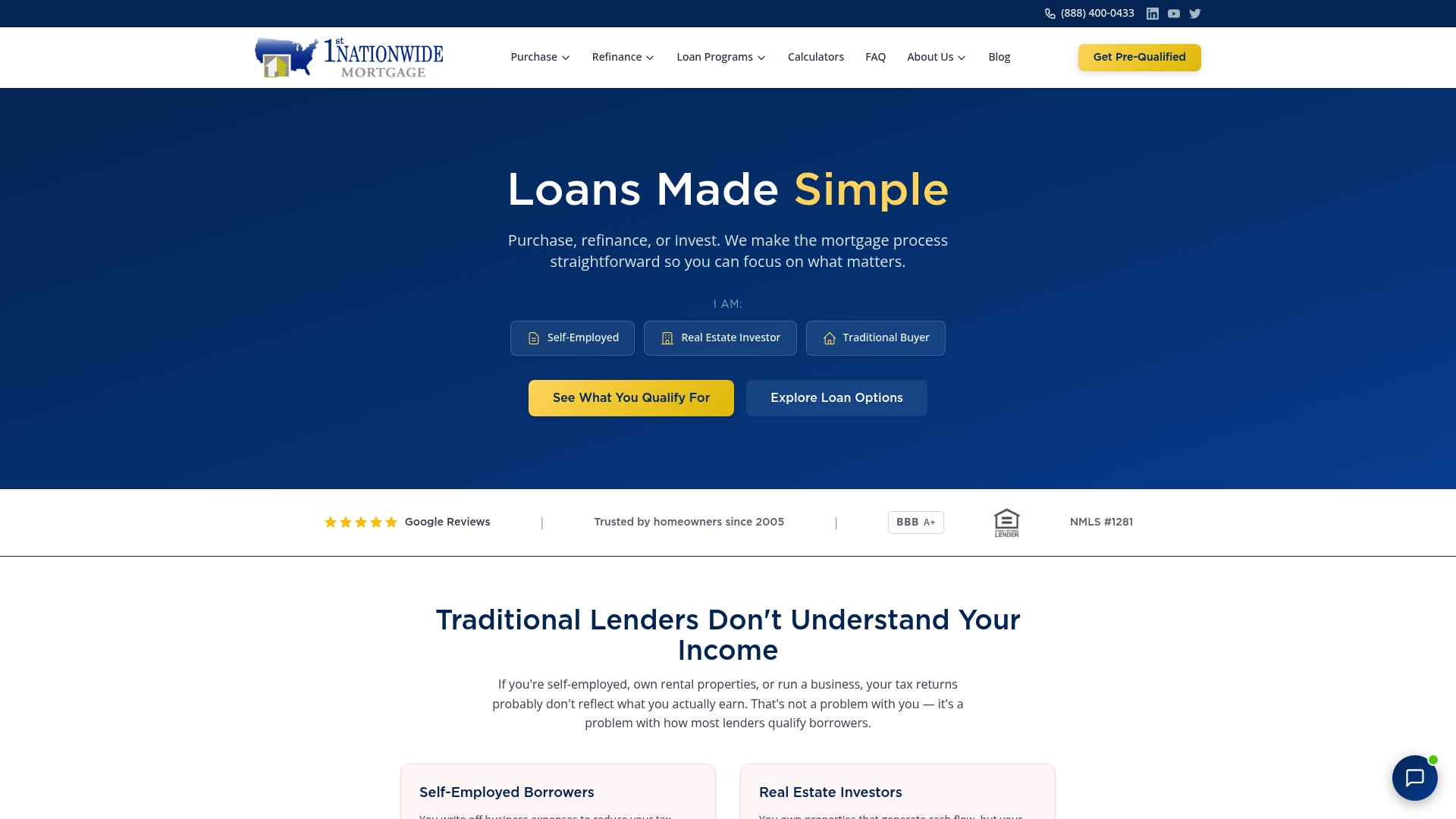
The lender qualifies self-employed borrowers using 12–24 months of bank deposits instead of tax returns. That method lets people with large tax write-offs show qualifying cash flow. 1st Nationwide Mortgage operates as a direct mortgage banker and focuses on non-QM and investor programs.
Core Features
1st Nationwide Mortgage supports Bank Statement Loans, DSCR Loans, and NONI investment programs alongside FHA, VA, USDA, conventional, and jumbo options. The company details a standard expense factor of 50% on business accounts and notes the factor can drop to 35–40% with a CPA-certified profit and loss. The firm is founded and operated by Christopher Arco, NMLS #1281, and it reports licensing for investor products in 41+ states while holding retail licenses in 18 states and a BBB A+ rating.
Key Differentiator
The clearest distinction is the focus on alternative qualifying methods for self-employed borrowers and investors after more than 20 years in mortgage lending. That depth shows up in underwriting that accepts deposit-based income, rental cash flow calculations, and foreign national pathways for borrowers with no documentable income. The underwriting approach reduces reliance on W-2 or tax return income when alternative documentation better reflects a borrower’s ability to repay.
Pros
The team brings long experience handling complex files for self-employed borrowers and investors, which shortens the back-and-forth on documentation. Their bank statement product accepts 12–24 months of deposits and offers an expense-factor path tied to CPA documentation, which can materially increase qualifying income for some applicants. They support investors with DSCR underwriting that uses property rental income and works with LLC structures, reducing the need to show personal income for qualification.
Cons
- Higher interest rates than conventional loans because programs sit outside standard QM guidelines.
Who It’s For
You should consider this if you are self-employed and your tax returns understate your cash flow. Real estate investors who need DSCR underwriting or want to finance multiple properties will find the product suite relevant. Foreign nationals and borrowers without traditional paperwork also fit the target profile.
Unique Value Proposition
The underwriting rule that uses a 50% standard expense factor on business accounts, which can fall to 35–40% with a CPA-certified P&L, makes income calculation predictable for complex files. That rule changes the payment-to-income math and often raises effective qualifying income for borrowers with many write-offs. For brokers and loan officers, that predictability means fewer last-minute surprises during underwriting.
Real World Use Case
A self-employed consultant with high business deductions provides 24 months of bank statements and a CPA-certified P&L. Under the bank statement method, the expense factor drops to 35%, raising qualifying income enough to approve a mortgage. The borrower closes without needing to increase down payment or alter business accounting substantially.
Pricing
Pricing is not published online because this offering is informational only and rates vary by product, credit, and loan-to-value. Loan pricing depends on program choice, credit score, down payment, and property type. Contact a loan officer for a tailored loan estimate and program quote.
Website: https://1stnwm.com
Origin Mortgage
At a Glance
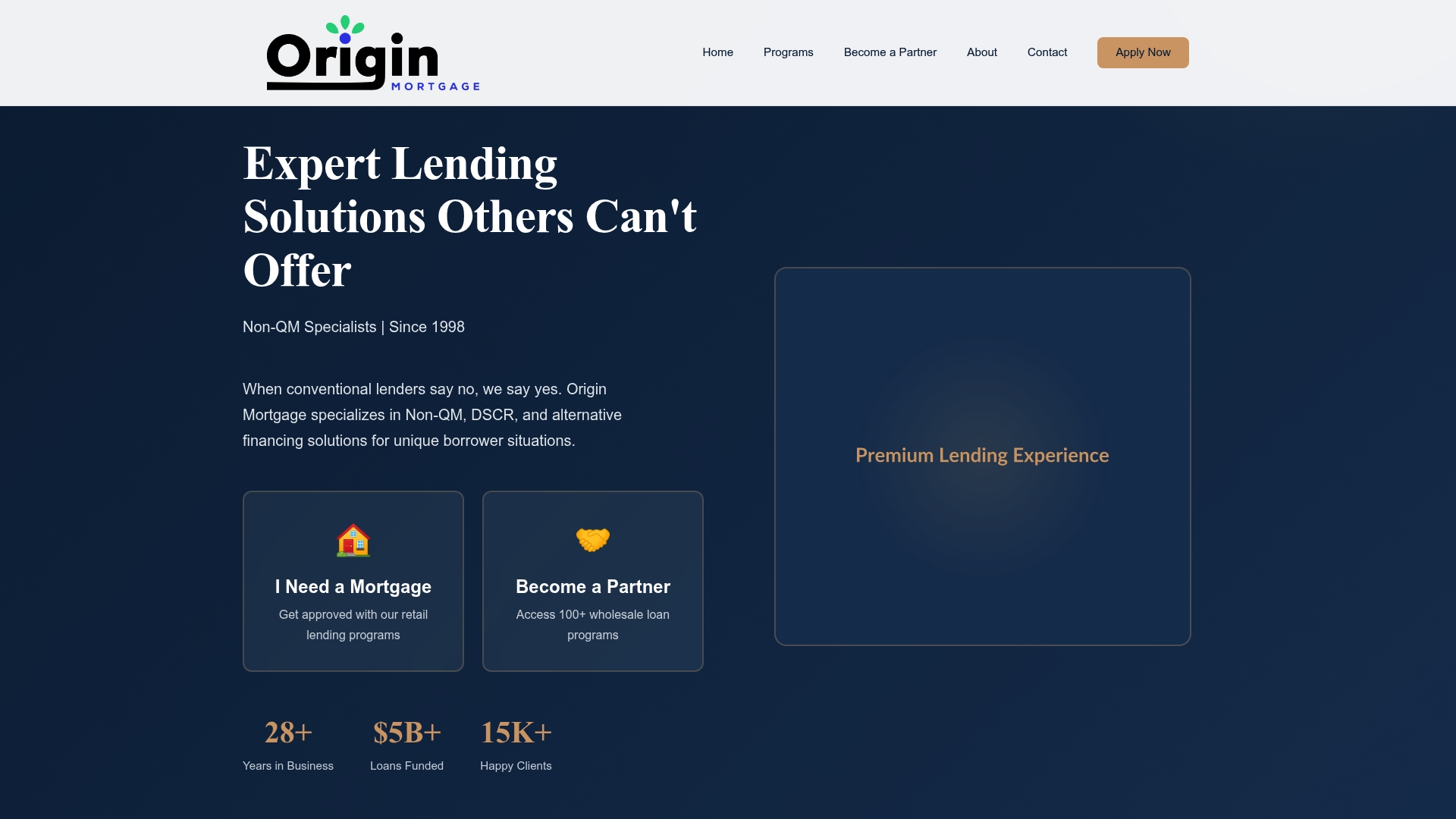
In house underwriting and deep non QM expertise drive faster decisions on complex loan files. Origin Mortgage reports operating since 1998 and serving retail and wholesale partners across all 50 states. The lender emphasizes quick turn times and hands-on structuring for self employed borrowers and investors. That focus makes it a frequent choice when standard underwriting fails.
Core Features
Origin Mortgage underwrites a wide set of non QM programs, including bank statement and P&L options, asset depletion, 1099, and foreign national loans. The product lineup also includes DSCR loans for investor financing, plus traditional FHA, VA, and conventional pathways and reverse mortgages for seniors. Wholesale partner programs provide in house underwriting and rapid turn times for brokers.
Key Differentiator
The single distinguishing feature is the lender’s in house underwriting team paired with non QM depth. That pairing lets origin structure deals other lenders reject and move documentation through underwriting faster. The model favors brokers who need discretionary decisions and bespoke income calculations. It trades off scale for underwriting flexibility.
Pros
Origin Mortgage offers clear strengths for brokers and complex borrowers. Its non QM expertise supports cases where tax returns understate viable income, and that expertise often converts declined applicants into funded loans. Fast turnaround is a common advantage, backed by dedicated teams and senior staff access. Nationwide licensing gives brokers reach across all states when the borrower location matters.
Cons
-
Third party reviews report overlay strictness that can produce last minute conditions.
-
The range of in house product options can feel complex for brokers new to non QM lending.
-
Speed and flexibility depend on documentation quality and case complexity, so results vary.
When It May Not Fit
Origin Mortgage may not fit borrowers who need plain conforming loans with standard documentation. It also may be a poor match in regions with strict local regulatory constraints or layered investor overlays. Brokers who prefer automated pricing and a single product workflow will likely find the variety cumbersome.
Who It’s For
Mortgage brokers and non QM lenders seeking a partner for fast, flexible alternative mortgage programs will gain the most. Real estate investors needing rental income based financing and self employed borrowers with complex cash flow also align well. Wholesale partners who require in house underwriting and case by case structuring benefit most.
Real World Use Case
A self employed borrower with substantial deposits but low taxable income uses the bank statement program to qualify. Origin’s underwriting accepts deposit based qualifying and issues a loan approval after targeted documentation. The result lets the borrower close when conventional lenders had declined.
Pricing
Pricing is not publicly listed. Origin Mortgage issues loan pricing through broker channels and wholesale rate sheets and quotes. Contact a broker or the company directly for case specific fees and rates.
Website: https://origin-mortgage.com
AD Mortgage
At a Glance
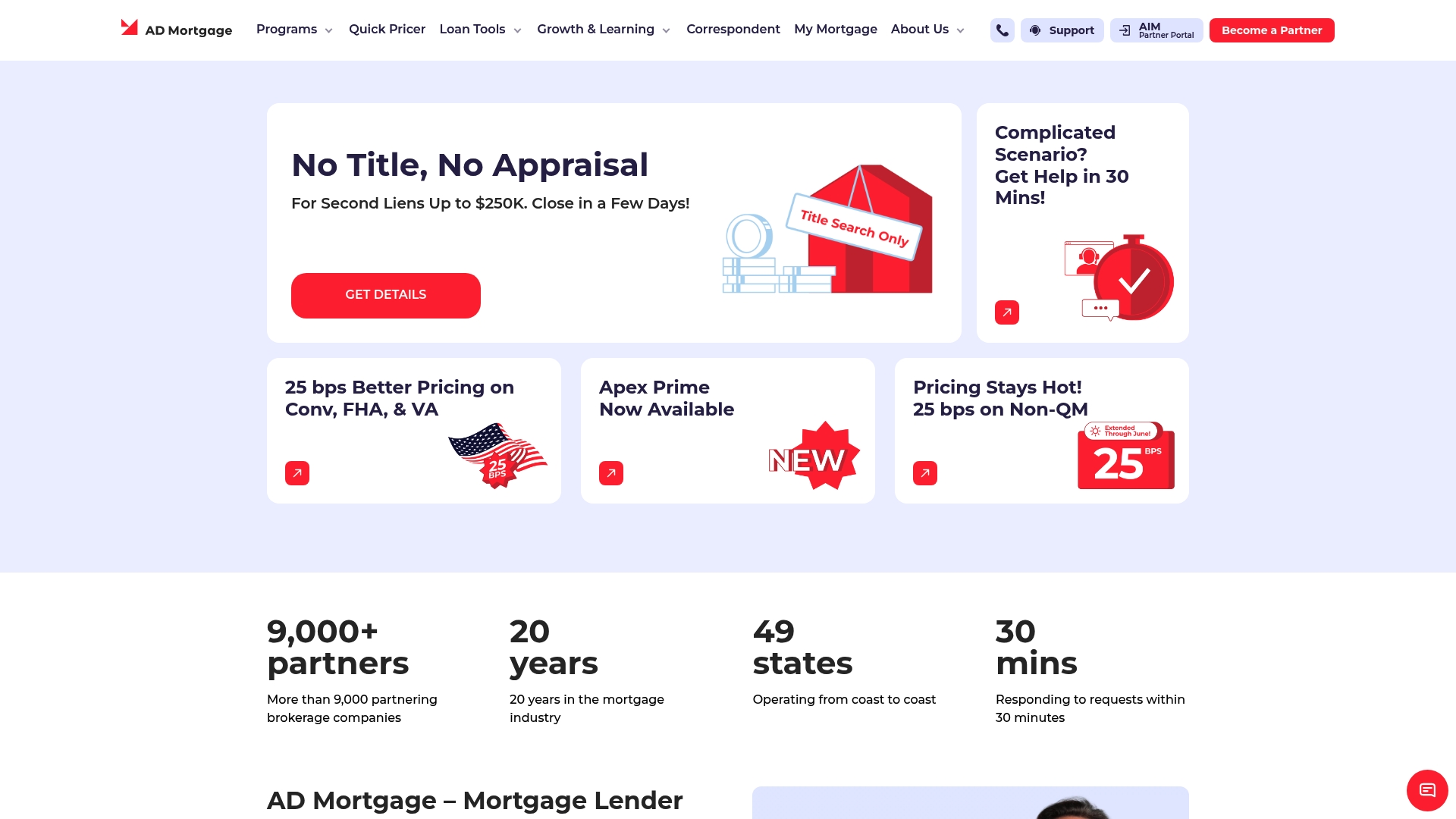
AD Mortgage reports a network of over 9,000 brokerage partners across 49 states and 20 years of industry experience. The firm positions itself as a wholesale lender concentrating on Non-QM and other programs. That scale supports broad distribution and rapid market reach for brokers.
Core Features
AD Mortgage offers a wide set of loan programs, including Non-QM, conventional, FHA, VA, and jumbo products, and portfolio options for real estate investors. The platform includes technology tools such as Quick Pricer, AD Studio, and AIM Portal, plus an automated guideline search to speed decisioning. The vendor advertises underwriting turnarounds as quick as 24 to 48 hours and provides account support, training, and industry guides.
Key Differentiator
Speed of execution and tailored support set AD Mortgage apart for brokers facing complex borrower profiles. The combination of rapid underwriting and loan options aimed at unconventional income sources reduces time to close. Dedicated training and a partner-focused portal aim to keep brokers informed and operationally efficient.
Pros
The team is described as highly responsive and professional, which helps smooth difficult deals and preserve borrower confidence. AD Mortgage reports over 1,300 positive reviews and a 4.8 star rating, which suggests consistent partner satisfaction. Robust tech tools shorten underwriting cycles and the lender supports a wide set of flexible loan structures for nontraditional income and investor needs.
Cons
- Specific limits exist on business purpose loans, which may exclude some niche commercial funding needs.
- Borrowers with highly complex credit or extreme file quirks can require extra underwriting steps and manual approvals.
- Several users report the interface is improving but still needs refinement to match automation elsewhere.
When It May Not Fit
If you require full retail-style consumer disclosures for every loan scenario, AD Mortgage’s wholesale model may not match your workflow. Brokers needing fully automated decisioning for every edge case will find manual approvals more frequent. Teams focused exclusively on small-scale consumer retail lending may prefer a different channel.
Notable Integrations
- ADwise guideline search
- Partner Portal AIM
- Loan Calculator Quick Pricer
- AD Appraisal Center
- Partner Support
Who It’s For
Mortgage brokers, lenders, and loan officers who handle unconventional income and investor deals will find AD Mortgage useful. Professionals who value fast turnarounds and a partner support model gain the most. Brokers closing complex or portfolio loans will see the platform fit their needs.
Real World Use Case
A broker used AD Mortgage to place a Non-QM loan for a self-employed borrower with irregular deposits and multiple income streams. Rapid underwriting and targeted product choice allowed closing in about 30 days. The broker relied on portal tools and account support to document qualifications.
Pricing
Pricing is not publicly specified and typically follows broker-specific models that vary by scenario. Expect pricing and overlays to depend on loan program, borrower profile, and wholesale relationship terms. Discuss pricing directly with an account representative for firm quotes.
Website: https://admortgage.com
Enrich Loans
At a Glance
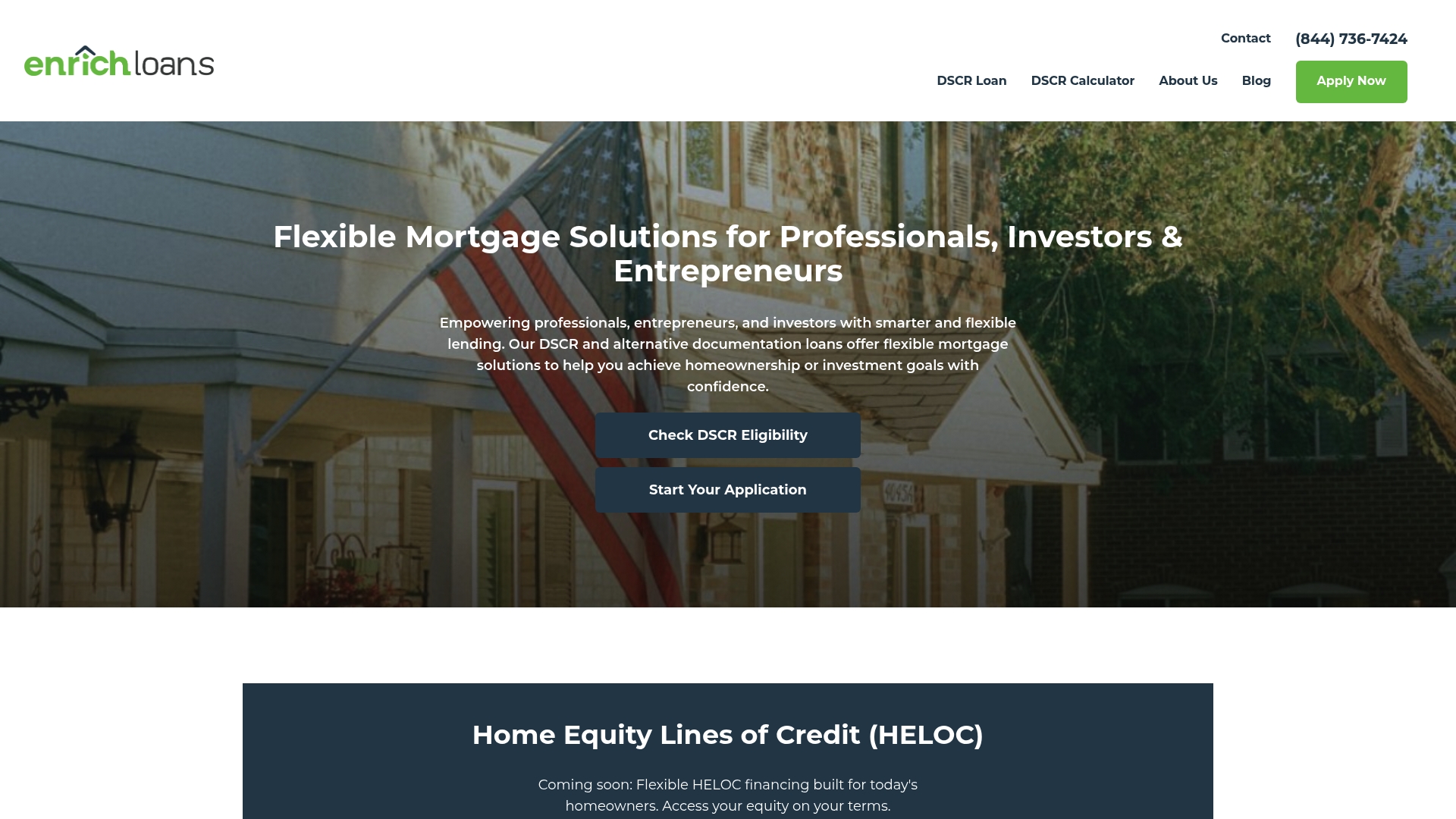
Approvals can close in as little as 30 days, according to Enrich Loans’ marketing materials. They target nonqualified mortgage borrowing for investors, entrepreneurs, and LLC owners. The company operates in nearly 30 states and plans to add HELOC and international solutions.
Core Features
Enrich Loans centers on non-QM and alternative documentation programs that let property cash flow serve as the qualifying income. The product set includes DSCR loans that accept rental income instead of personal payroll, plus programs that support LLC ownership and multiple property types. The underwriting emphasizes a faster approval process and flexible qualification criteria tied to the asset rather than borrower W2s or tax returns.
Key Differentiator
The firm qualifies loans primarily on property cash flow rather than the borrower’s personal income. That focus lets investors scale without producing conventional income documentation. This approach narrows the audience to investor-grade financing rather than primary residence lending.
Pros
No personal income verification is a clear strength for borrowers whose tax returns underreport cash flow. The lender advertises a quick turnaround, and that timeline helps investors close time-sensitive deals. Programs support LLC ownership and multiple property types, which simplifies portfolio growth. Underwriting that weights property cash flow over personal income reduces reliance on traditional debt to income calculations.
Cons
- Higher down payment requirements of 20–25% make early leverage more expensive for some buyers.
- Interest rates may run higher than conventional products, increasing holding costs for marginal deals.
- Product set is limited to investment and non-owner occupied properties, not primary residences.
- Not suitable for borrowers who need conventional owner-occupied financing or second home loans.
When It May Not Fit
Borrowers seeking purchase or refinance on a primary residence should look elsewhere. Borrowers with thin or negative property cash flow will have difficulty getting approval. The offering is also restricted by state licensing, so geography matters for availability.
Who It’s For
Serious real estate investors, entrepreneurs, and LLC owners who rely on rental income to qualify make the best fit. You should have established properties or clear rental projections and the capital for larger down payments. This product suits people who prioritize speed and flexible documentation over the cheapest long term rate.
Real World Use Case
An investor uses rental income to qualify for financing on multiple single family homes, avoiding time spent compiling years of personal tax documentation. They lock deals quickly using the advertised approval speed so they can close before competing bids move prices. The property cash flow underwriting lets the investor finance assets held in LLCs without personal income layering.
Pricing
No public pricing table appears; pricing is not listed and is informational only. Expect loan-level pricing that varies by state, property cash flow, and borrower profile. Contact the lender for a personalized rate quote and program terms.
Website: https://enrichloans.com
Rocket Mortgage
At a Glance
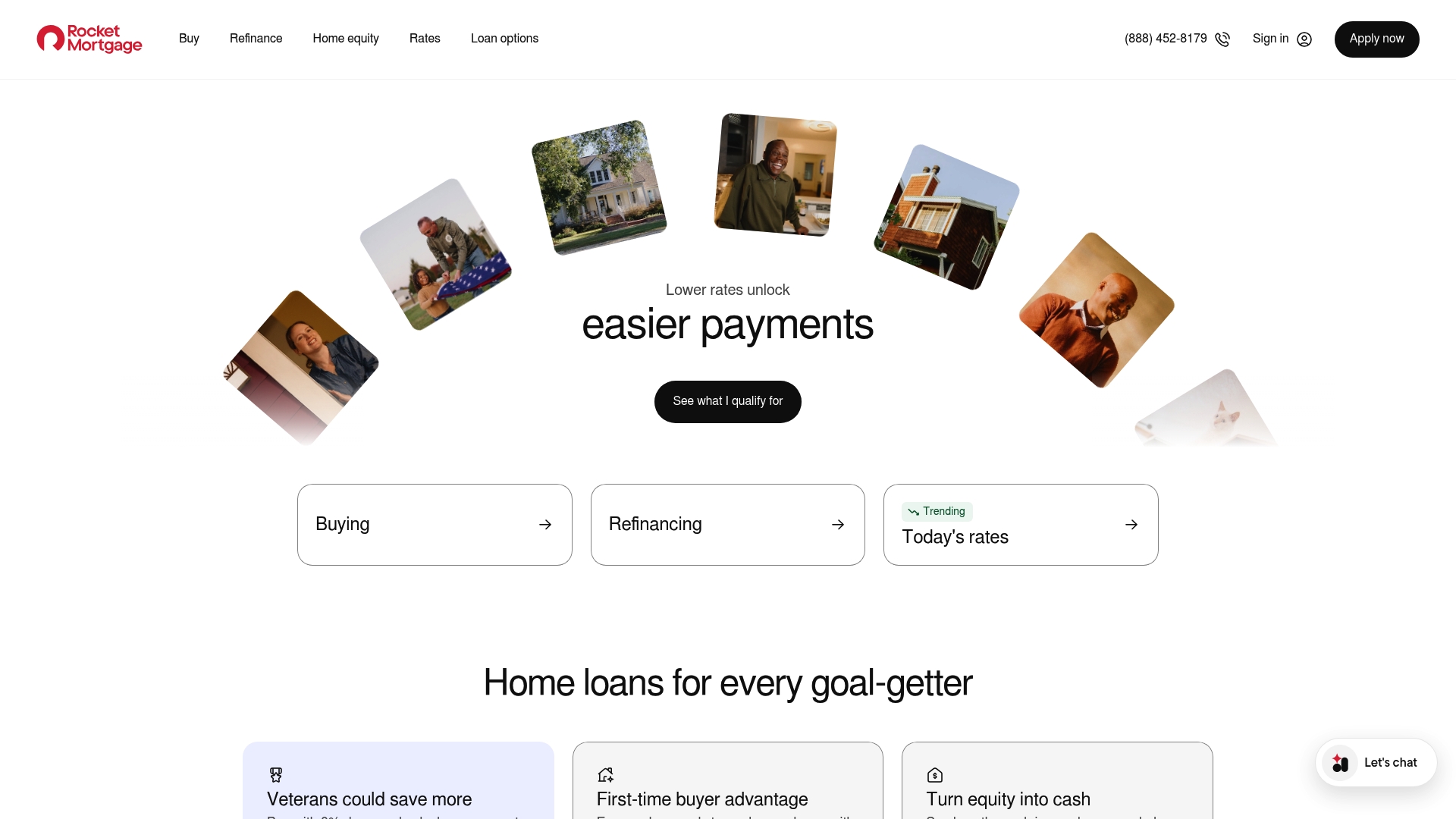
Rocket Mortgage reports closing over 9 million mortgages. The platform emphasizes a largely online application and fast rate visibility for U.S. residential borrowers. Its marketing highlights special offers with partners such as Redfin and lender credits aimed at lowering closing costs.
Core Features
The site offers an online mortgage application and pre-qualification flow that moves applicants from estimate to submission without in-person paperwork. It provides rate alerts and real-time rate updates alongside mortgage calculators for payment estimation. The product covers purchase loans, refinancing, VA loans, and options for debt consolidation using home equity.
Key Differentiator
Rocket Mortgage centers on a highly digital borrower experience that keeps rate data live and visible during the application process. That live rate focus, combined with partner offers, shortens the time you spend hunting for comparable lender credits and promotions. This emphasis on continuous rate visibility is the clearest difference versus more traditional lender workflows.
Pros
The online process reduces several common friction points in mortgage applications and keeps documents and messages in one interface. Multiple program types, including VA loans and first time buyer options, broaden who can qualify through the platform. Special offers and lender credit features can lower closing costs when paired correctly with a property transaction.
Cons
- Page content shows broken or missing detailed feature and pricing pages, limiting how deeply a borrower can research specific product terms.
- The scraped data provides limited specifics on adjustable features, exact loan terms, or underwriting nuances for complex income profiles.
- Third party reviews were not included in the dataset, so independent customer experience depth is not available here.
When It May Not Fit
If you lack reliable internet access or prefer in person meetings, the platform could be harder to use because the experience depends on digital access. Borrowers needing unusually customized loan structures or hyperlocal underwriting exceptions may find the public feature set thin. People outside supported geographic areas could face product or licensing limits based on location and borrower profile.
Who It’s For
This platform suits U.S. homebuyers and homeowners who want a largely online mortgage experience and clear rate visibility. It fits first time buyers, veterans seeking VA loans, and owners looking to refinance or consolidate debt through home equity. If you prefer phone and branch interaction over web driven steps, this may not match your preferred workflow.
Real World Use Case
A veteran compares VA loan options, watches live rate alerts, and completes the online application with a digital upload of service documents. A homeowner with equity runs payment estimates, sees lender credit offers with a partner, and submits a refinance application to lower monthly outlay. In both examples, the continuous rate updates speed decision making.
Pricing
The site lists pricing as not applicable for informational content and does not publish uniform lender fees on public pages. Loan pricing depends on individual loan terms, credit profile, and market rates at application. Expect final costs to come from a formal loan estimate after application and underwriting.
Website: https://rocketmortgage.com
loanDepot
At a Glance
loanDepot reports a consistent 90%+ customer survey rating. That figure signals strong reported satisfaction with loan officers and the digital experience. The company combines a digital mortgage workflow with a broad set of loan products for purchase and refinance.
Core Features
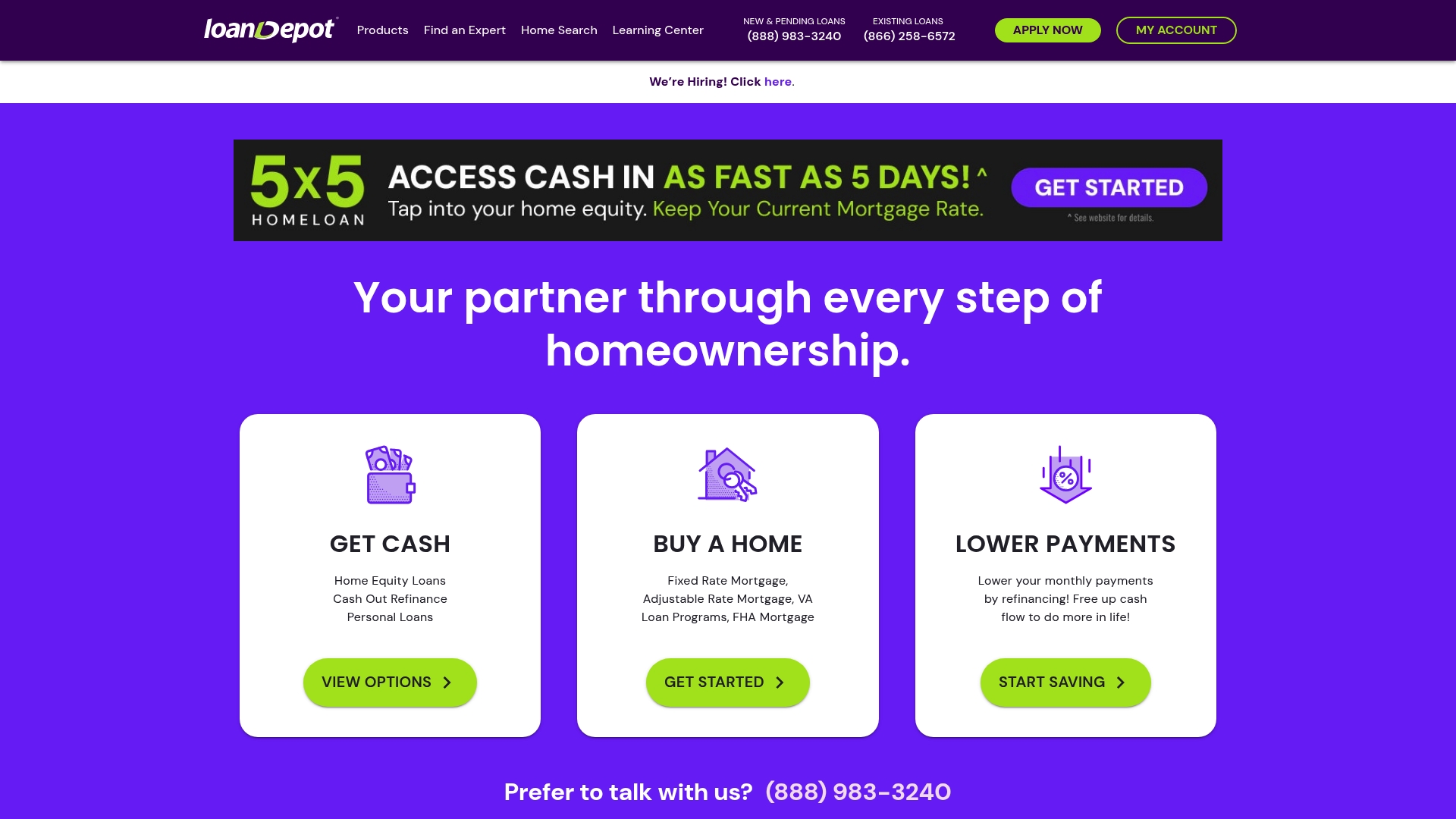
The platform centers on the digital platform “mello”, which handles online application, document upload, and real time status updates. Loan choices include fixed rate, adjustable rate, FHA, VA, jumbo, and rehab loans, plus programs for builders and real estate partners. Proprietary tooling aims to speed processing while keeping borrowers informed during underwriting and closing.
Key Differentiator
The single most distinguishing feature is “mello”. It provides a fully digital application and loan management experience across devices, with status transparency and document handling built in. That focus on an end to end digital workflow sets loanDepot apart from lenders that still rely on paper and manual status calls.
Pros
Reported customer satisfaction is high, and that rating suggests many borrowers have good experiences with service and communication. The digital workflow reduces back and forth. The product set covers common borrower needs, from FHA programs for low down payment buyers to jumbo loans for higher value purchases. Builder and realtor programs make loanDepot a practical choice when new construction finance must align with sales and closing schedules.
Cons
- Some detailed product and application information sits behind a paywall on the website, which makes initial comparison harder.
- A few reviews describe the process as complex for borrowers without mortgage experience, so guidance may be needed.
- Physical branch presence is limited, so borrowers who prefer face to face meetings may find the support model less convenient.
When It May Not Fit
If you prefer in person meetings for financial decisions, loanDepot may feel remote because it relies on digital processes and phone based support. Borrowers with unusually complex financing needs might need more hands on, localized underwriting. Small builders or agents who require local branch relationships could find the partnership model less helpful.
Who It’s For
You should consider loanDepot if you want a modern, digital mortgage workflow and a broad menu of loan products. It fits first time and experienced homebuyers who are comfortable managing much of the process online. It also fits builders and agents who need partnership programs and joint venture options.
Real World Use Case
A first time buyer compares rates, completes an application, and uploads bank statements through the platform. The borrower receives timely status updates and document requests via the portal. The digital handoff to underwriting and closing keeps the timeline predictable and reduces surprise requests.
Pricing
Not applicable. The site presents product and eligibility information rather than a per user or license pricing model, because loanDepot is a mortgage lender rather than software sold by subscription.
Website: https://loandepot.com
Comparison of alternatives
Among mortgage lenders, 1stnwm.com excels in tailoring solutions for self-employed borrowers through its specialized application processes and adjustable expense norms based on CPA documentation. Here, we compare the offerings of other notable lenders to highlight strengths and contexts where they shine.
Application process and underwriting speed
Origin Mortgage distinguishes itself by offering in-house underwriting and fast decision-making on complex files, giving brokers a consistent edge in rapid case handling. While other competitors provide platforms, Origin Mortgage’s hands-on approach allows for discretionary decisions that multiply approval possibilities for intricate borrower profiles.
Supporting tools and geographic flexibility
AD Mortgage leverages an extensive broker support network, technological tools like automated pricing systems, and accessible services across 49 states. This infrastructure aids brokers focusing on unconventional loans, though its geographic integration still falls short of full nationwide licensing. loanDepot emphasizes a highly digital workflow via its “mello” platform, facilitating a streamlined application journey for tech-savvy clients accustomed to web-based systems.
Best fit
- Self-employed borrowers prioritizing adjustable income qualification models will benefit most from 1stnwm.com’s specialized programs.
- Brokers requiring rapid underwriting decisions and customizable loan structuring should engage Origin Mortgage’s services.
- Real estate investors seeking financing based on property cash flow find Enrich Loans well-suited to their needs.
- Borrowers focused on an online-first workflow blended with transparent document handling gravitate towards loanDepot.
- Teams valuing responsive support paired with versatile programs can securely use AD Mortgage.
Our pick
1stnwm.com provides a unique capability by catering directly to self-employed borrowers needing income qualification through detailed bank statements and CPA-driven expense analysis. However, prospective clients prioritizing geographically exhaustive services or seeking purely automated underwriting processing might find other options more aligned with their preferences.
1st Nationwide Mortgage provides unique underwriting strategies tailored to individuals with unconventional income documentation, making it stand out among its alternatives.
| Product | Core Features | Target Audience | Pricing | Notable Limitation |
|---|---|---|---|---|
| 1st Nationwide Mortgage | Bank Statement Loans, DSCR Loans, NONI Investment Programs | Self-employed borrowers and real estate investors | Price not published | Higher interest rates than conventional loans |
| Origin Mortgage | In-house underwriting, flexible documentation options | Mortgage brokers and self-employed borrowers | Price not published | Potential overlay strictness causing additional conditions |
| AD Mortgage | Non-QM loans, advanced broker tools, rapid turnaround | Brokers focused on unconventional income and investor loans | Price not published | Interface improvements are ongoing |
| Enrich Loans | Non-QM programs qualifying on property cash flow | Real estate investors and entrepreneurs | Price not published | Higher down payment requirements |
| Rocket Mortgage | Digital application process, VA and refinance loans | Homebuyers preferring online workflows | Price not published | Limited details on adjustable loan features |
Challenges With Conventional Mortgage Qualification for Self-Employed Borrowers and Investors
Qualifying for a mortgage often depends heavily on tax returns and traditional income documents. For self-employed borrowers and real estate investors, this approach can obscure true cash flow due to deductible expenses and complex ownership structures. This mismatch leads to underreported income, stricter debt-to-income calculations, and limited loan options.
1st Nationwide Mortgage offers solutions addressing these challenges. Their bank statement loans use 12 to 24 months of bank deposits to measure real income instead of tax returns. With a CPA-certified profit and loss statement, the standard 50% expense factor on business accounts can adjust down to 35 to 40%, allowing more accurate income qualification. Investor borrowers benefit from DSCR Loans, where rental income—not personal income—determines eligibility, including for LLC-held properties.
Learn more about 1st Nationwide Mortgage’s loan programs.
Take the next step toward clearer income qualification by reviewing how bank statement documentation and DSCR underwriting can affect your loan estimate with 1st Nationwide Mortgage.
FAQ
How does 1st Nationwide Mortgage support self-employed borrowers?
1st Nationwide Mortgage primarily qualifies self-employed borrowers using 12–24 months of bank deposits instead of tax returns. This approach allows applicants with high tax write-offs to demonstrate qualifying cash flow effectively. If you are self-employed and your tax returns do not reflect your income, 1st Nationwide Mortgage could provide a viable alternative for securing a mortgage.
What is the difference between 1st Nationwide Mortgage and Origin Mortgage?
Origin Mortgage is recognized for its in-house underwriting and deep non-QM expertise, which drives faster decisions on complex loan files. 1st Nationwide Mortgage shines when borrowers need alternative qualifying methods, such as bank statement loans, where tax returns may not accurately show income. Consider what fits your specific needs as a borrower to choose between the two.
Can I use bank statement loans with 1st Nationwide Mortgage?
Yes, 1st Nationwide Mortgage offers bank statement loans that accept 12–24 months of deposits for qualifying income. This feature significantly benefits self-employed individuals whose tax returns understate their actual cash flow. If traditional documentation isn’t an option for you, exploring 1st Nationwide Mortgage’s bank statement loans could be a great starting point.
How quickly can I expect the underwriting process with 1st Nationwide Mortgage?
While specific timeframes weren’t detailed in the article, 1st Nationwide Mortgage’s focus on alternative income documentation typically allows for a streamlined qualification process. If you’re looking for faster approvals, 1st Nationwide Mortgage may serve as an effective choice compared to traditional lenders.
What are the interest rates like with 1st Nationwide Mortgage?
The article notes that 1st Nationwide Mortgage offers higher interest rates than conventional loans due to their non-QM program structure. Keep in mind that while their rates may be higher, their flexible qualifying criteria can meet unique borrower needs effectively. It’s worth evaluating your budget against these rates to determine if it meets your financing goals.