

Four financing paths let you bypass conventional property limits today: DSCR loans, portfolio loans, bank-statement loans, and NONI (No Income/No Asset) loans. Each one sidesteps the Fannie Mae and Freddie Mac rules that cap most investors at 10 financed properties, because none of them are sold to the GSEs. Your immediate next step: verify your property’s monthly rent covers its debt service, or pull 12–24 months of bank statements, then contact a direct lender who holds these programs in-house.
- DSCR loans qualify on rental income, not your tax returns or W-2. No GSE cap applies.
- Portfolio loans stay on the lender’s books, so the lender sets its own rules.
- Bank-statement loans use deposit history to derive qualifying income, bypassing tax-return limits.
- NONI loans require no income or asset documentation — built for foreign nationals and certain non-traditional borrowers.
Key Takeaways
Alternative financing paths remove the GSE 10-property cap by qualifying on property income, deposit history, or asset evidence rather than tax returns or borrower DTI.
| Point | Details |
|---|---|
| DSCR removes the property cap | No federal limit on DSCR loans; qualifies on rent vs. debt service, not personal income. |
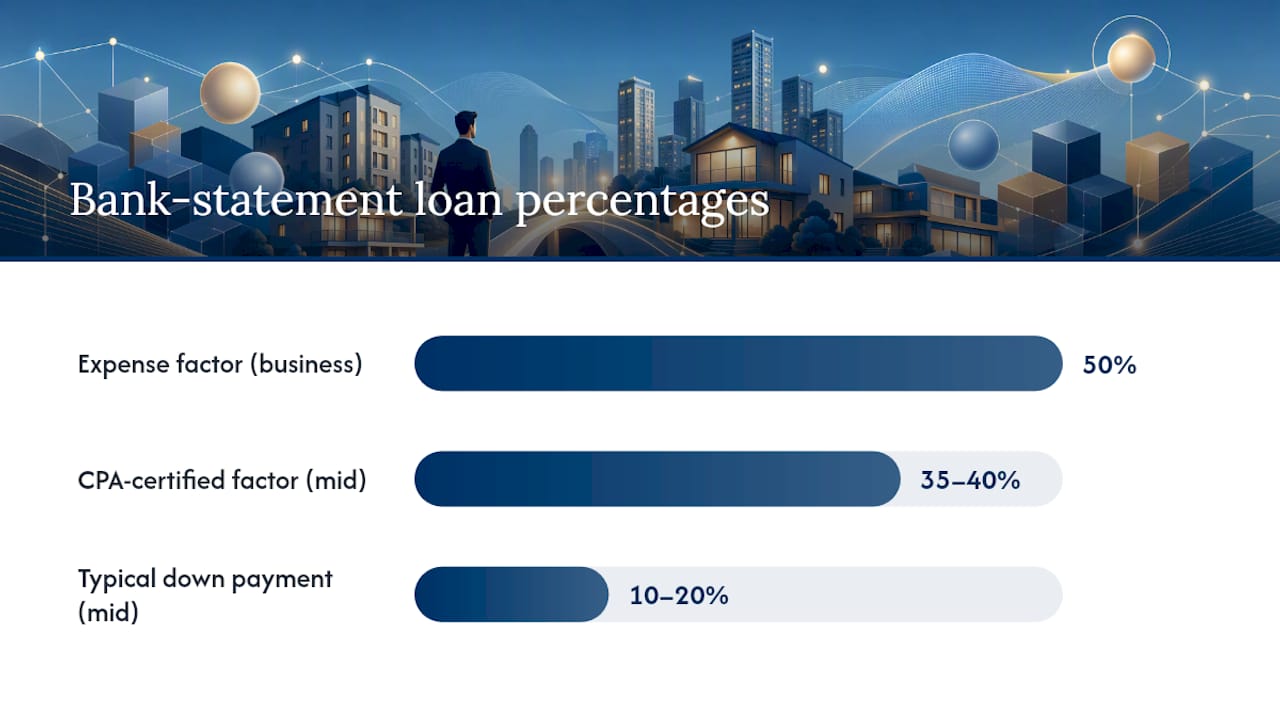
| Bank-statement unlocks self-employed buyers | 12–24 months of deposits replace tax returns; expense factor of 50% standard, 35–40% with CPA P&L. |
| NONI serves foreign nationals | No income or asset documentation required; down payment and source-of-funds evidence are key. |
| Reserves scale with portfolio size | Lenders commonly require 3–6 months of PITIA per property as holdings grow. |
| 1st Nationwide Mortgage | Direct lender offering DSCR, bank-statement, and NONI programs; BBB A+, founded by Christopher Arco, NMLS #1281. |
Table of Contents
- Why conventional underwriting creates hard property limits for investors
- Quick comparison: which alternative financing options remove property-count caps
- How DSCR loans work and why they remove per-borrower property caps
- How bank-statement loans qualify self-employed borrowers
- NONI loans: financing for foreign nationals and borrowers without documentable income
- Other practical routes: portfolio lenders, bridge loans, HELOCs, and cash-out strategies
- How to choose the right financing path
- Typical timeline, costs, and risks to expect
- How 1st Nationwide Mortgage supports borrowers who need to scale past conventional limits
- Ready to apply? Here is what to prepare
- Sources
Why conventional underwriting creates hard property limits for investors
Most conventional mortgages are sold to Fannie Mae or Freddie Mac after closing. That sale is what funds the next loan — but it also means every loan must conform to GSE guidelines. Those guidelines cap investors at 10 financed investment properties, and the practical ceiling is often lower once debt-to-income (DTI) constraints kick in.
Here is how each layer of conventional underwriting creates a wall:
- DTI limits: Fannie/Freddie require lenders to count all mortgage payments against your taxable income. Real estate investors who hold multiple properties quickly push DTI past the 45% threshold.
- Tax-return income rules: Self-employed borrowers and investors with aggressive depreciation schedules often show low net income on their returns, even when cash flow is strong. Conventional lenders use that reported figure, not actual deposits.
- Occupancy rules: Conventional investment-property programs carry stricter loan-to-value and reserve requirements than owner-occupied loans, compressing how much leverage you can deploy.
- GSE resale requirement: Because the loan must be sellable to Fannie or Freddie, the lender cannot make exceptions. Unique properties, LLC vesting, or complex income structures are often declined outright.
The core constraint: Conventional underwriting path → GSE resale requirement → agency property-count cap → investor ceiling.
Alternatives exist because some loans never touch the GSE system. Portfolio loans stay on the lender’s balance sheet, and DSCR loans qualify on property performance rather than borrower income — neither path is subject to agency caps.
Quick comparison: which alternative financing options remove property-count caps
DSCR and portfolio lending are the primary scale tools for investors who want to hold multiple properties without hitting a federal ceiling. The other options serve specific situations.
| Option | Best for | Documentation | Property limit | Typical speed |
|---|---|---|---|---|
| DSCR loan | Portfolio investors, LLCs | Lease/rent schedule, appraisal | No federal cap | 2–4 weeks |
| Portfolio loan | Unique properties, complex borrowers | Varies by lender | No GSE cap | 3–5 weeks |
| Bank-statement loan | Self-employed buyers | 12–24 months of statements | Lender-set | 3–5 weeks |
| NONI loan | Foreign nationals, non-documentable income | Passport/ID, down payment proof | Lender-set | 3–5 weeks |
| Bridge/hard money | Fix-and-flip, time-sensitive acquisitions | Asset-based, minimal | Lender-set | Days to 2 weeks |
| Cash-out refinance | Equity recycling from existing holdings | Varies by program | Program-dependent | 3–4 weeks |
How DSCR loans work and why they remove per-borrower property caps
DSCR loans qualify on the property’s income versus its debt service — your W-2, tax returns, and personal DTI are not part of the equation. That single underwriting shift is what removes the GSE 10-property ceiling.
The DSCR calculation:
Divide the property’s gross monthly rent by its total monthly debt service (principal, interest, taxes, insurance, and HOA if applicable). A result of 1.0 means rent exactly covers debt. Most lenders want to see 1.0–1.25 or higher, though some programs accept a DSCR below 1.0 with compensating factors like a larger down payment.
Illustrative example (not a commitment to lend):
- Monthly rent: $2,500
- Monthly PITIA: $2,000
- DSCR: 2,500 ÷ 2,000 = 1.25 — meets a typical minimum threshold
What lenders typically require:
- Executed lease or current rent schedule (or appraiser’s market rent estimate for vacant properties)
- Full appraisal with rent schedule
- Credit score — directionally, 620 or higher is a common floor
- Down payment — typically 20–25% for investment properties
- Proof of reserves (more on this below)
Key program notes:
- DSCR loans are for investment and non-owner-occupied properties only. They are never used for a primary residence.
- LLC vesting is permitted, which matters for investors who hold properties in entities.
- There is no federal cap on how many DSCR loans you can hold, because these loans are not sold to Fannie Mae or Freddie Mac.
Pro Tip: As your portfolio grows, lenders commonly require 3–6 months of PITIA in liquid reserves per property. Budget for this before you close on your next acquisition — reserve shortfalls are the most common reason DSCR approvals stall at scale.
Pros: no income documentation, LLC-friendly, no GSE property cap, faster underwriting. Cons: rates run directionally higher than conventional, down payments are larger, and individual lenders may impose their own concentration limits as your portfolio grows.
How bank-statement loans qualify self-employed borrowers
Bank-statement loans use 12–24 months of verified deposits to derive qualifying income rather than tax returns. For self-employed borrowers whose write-offs reduce reported income well below actual cash flow, this program is often the only path to owner-occupied or business-purpose financing.
How lenders convert deposits to qualifying income:
Lenders apply an expense factor to your gross deposits. The standard factor on business accounts is 50%, meaning $20,000 in monthly deposits yields $10,000 in qualifying income. With a CPA-certified profit and loss statement, that factor can drop to 35–40%, increasing your qualifying income without changing your actual deposits.
What you need to prepare:
- 12–24 months of business or personal bank statements (business accounts are most common)
- Business verification (business license, CPA letter, or similar)
- Minimum 620 credit score (directional)
- Down payment of 10–20% depending on program and occupancy type
- Reserves per lender requirements
State availability note: Owner-occupied bank-statement programs are available in California, Colorado, Oregon, Washington, Texas, and Idaho. For all other states, bank-statement financing is available as a business-purpose, non-owner-occupied program.
Pro Tip: Personal bank statements can be used when business and personal finances are not separated, but lenders scrutinize large irregular deposits. Keep accounts clean for at least 12 months before applying.
Compared to DSCR, bank-statement loans work better when you want owner-occupied or mixed-use financing and your income is deposit-verifiable but not tax-return-verifiable. Rates run directionally higher than conventional, and down payments are larger — but the trade-off is qualification based on real cash flow.
NONI loans: financing for foreign nationals and borrowers without documentable income
NONI (No Income, No Asset) loans enable financing for borrowers who cannot document traditional income at all. The most common use cases are foreign nationals purchasing U.S. investment property and certain self-employed borrowers in non-documentable situations.
Typical documentation lenders request:
- Valid passport or government-issued ID
- Source-of-funds documentation (wire records, bank statements showing down payment origin)
- Larger down payment — directionally higher than standard investment-property programs
- Property-level cash flow evidence or asset evidence where available
How NONI fits the broader strategy:
- NONI loans are typically held in portfolio or funded through private capital — not GSE-eligible.
- Loan amounts can reach meaningful levels; 1st Nationwide Mortgage’s NONI program goes up to $3.5 million.
- For higher-risk scenarios, NONI often pairs with portfolio lending or private capital to close gaps.
Pro Tip: Foreign nationals should prepare a clear source-of-funds paper trail before approaching any lender. U.S. lenders are required to verify the origin of down payment funds, and incomplete documentation is the most common delay in NONI closings.
Pros: access to U.S. financing without U.S. income documentation, works for LLCs and foreign entities. Cons: higher cost of capital, limited program availability compared to DSCR or bank-statement, and lender options are narrower.
Other practical routes: portfolio lenders, bridge loans, HELOCs, and cash-out strategies
When DSCR, bank-statement, or NONI is not the right fit, these four alternatives cover most remaining scenarios.
- Portfolio loans: Lenders retain these on their balance sheets, which means they can underwrite unique property types, mixed-use assets, and complex borrower situations that agencies would reject. No GSE property cap. Rates and terms vary widely by lender.
- Bridge and hard-money loans: Asset-based, fast, and expensive. Best for fix-and-flip acquisitions or time-sensitive purchases where a permanent loan follows. Closing can happen in days. Cost is the trade-off — origination fees and rates run significantly higher than term financing.
- HELOC on existing equity: Useful as temporary liquidity to fund a down payment on a new acquisition. Available as an owner-occupied product in California, Colorado, Oregon, Washington, Texas, and Idaho.
- Cash-out refinance: Recycles equity from a stabilized property into a new down payment. Works with DSCR or conventional programs depending on the property type and state.
Combining strategies: A bridge-to-DSCR refinance is one of the most common investor sequences — close fast with bridge financing, stabilize the property and establish rent, then refinance into a permanent DSCR loan. The key risk is refinancing uncertainty: if rates move or the property underperforms, the exit may cost more than projected.
Pro Tip: Never use bridge or hard-money financing without a clearly defined exit. The cost of carrying a bridge loan for an extra 6 months can erase months of rental income.
How to choose the right financing path
The right program depends on five factors, in this order:
- Purpose: Investment or non-owner-occupied? DSCR is your primary tool. Owner-occupied? Bank-statement or conventional (in eligible states).
- Documentation ability: Can you show tax returns? Conventional or jumbo. Deposits only? Bank-statement. Nothing documentable? NONI.
- Speed requirement: Closing in under two weeks? Bridge or hard money. Standard timeline? DSCR or portfolio.
- Portfolio size and reserves: Fewer than 10 properties with clean income? Conventional may still work. Beyond that, DSCR or portfolio.
- Exit strategy: Long-term hold favors DSCR. Short-term flip favors bridge. Equity recycling favors cash-out refinance.
Questions to ask any lender before committing:
- What documentation do you require for this specific program?
- Do you impose internal portfolio concentration limits?
- How many months of reserves do you require per property at my portfolio size?
- What is the expected time to close?
- What are the prepayment penalty terms? (Availability and structure vary by state, and penalties are prohibited or restricted in several. Terms are confirmed at application.)
- What is the typical down payment range for this program?
Red flags: A lender who cannot clearly answer the reserve question, gives vague prepayment language, or cannot confirm whether they are a direct lender or a broker is worth pausing on.
Pro Tip: Splitting volume across two or three DSCR or portfolio lenders reduces concentration risk and keeps you from hitting any single lender’s internal cap as your portfolio scales.
Typical timeline, costs, and risks to expect
Timeline by program type:
- Bridge/hard money: days to 2 weeks
- DSCR: 2–4 weeks is achievable with complete documentation
- Bank-statement and portfolio: 3–5 weeks typically
- Conventional: 30–45 days is standard
Cost categories to plan for:
- Origination points and lender fees (directionally higher on non-QM programs)
- Appraisal with rent schedule (required for DSCR)
- Legal and closing costs
- Reserves: lenders commonly require 3–6 months of PITIA per property as your portfolio grows
- Prepayment penalties: availability and structure vary by state, and penalties are prohibited or restricted in several. Terms are confirmed at application.
Material risks:
- Higher cost of capital on non-QM programs compared to conventional
- Refinancing risk if a bridge loan exit does not close on schedule
- Lender-level concentration limits that may surprise you at property 5 or 6
- Tax implications of LLC vesting and depreciation recapture on sale — consult a CPA before structuring
Pro Tip: Use the DSCR loan calculator to model rent versus debt service before you make an offer. A property that barely clears 1.0 DSCR leaves no margin for vacancy or rate movement.
How 1st Nationwide Mortgage supports borrowers who need to scale past conventional limits
1st Nationwide Mortgage Corporation is a direct lender offering DSCR, bank-statement, and NONI programs specifically designed for investors and self-employed borrowers who have hit conventional financing ceilings. As a mortgage banker — not a broker — 1st Nationwide Mortgage underwrites and funds loans in-house, which means faster decisions and no middleman.
Program summary:
- DSCR loans: For portfolio investors. Qualifies on rental income, LLC-friendly, no GSE property cap. Investment and non-owner-occupied only.
- Bank-statement loans: For self-employed borrowers. Uses 12–24 months of deposits. Owner-occupied programs available in California, Colorado, Oregon, Washington, Texas, and Idaho; business-purpose programs available across a multi-state footprint.
- NONI loans: For foreign nationals and borrowers with no documentable income. Programs available in eligible states.
Trust signals:
- BBB A+ rated
- Direct lender and mortgage banker (owner-operated)
- Founded by Christopher Arco, NMLS #1281
To get started, gather:
- Lease agreements or current rent schedule (DSCR)
- 12–24 months of bank statements (bank-statement program)
- Passport or government-issued ID (NONI/foreign national)
- Proof of down payment funds
- Most recent two months of asset statements for reserves
Visit the investment property mortgage page to review available programs or start a pre-qualification conversation.
A note on scaling with the right financing
The investors who scale most reliably are not the ones chasing the lowest rate. They are the ones who match the financing structure to the property’s cash flow, plan reserves before they need them, and build relationships with lenders who understand portfolio growth. DSCR and portfolio lending give you the structural freedom to grow — but that freedom only holds if each property genuinely covers its debt service. Plan the exit before you close, and treat reserves as a non-negotiable line item, not an afterthought.
Ready to apply? Here is what to prepare
1st Nationwide Mortgage offers DSCR, bank-statement, and NONI programs for investors and self-employed borrowers ready to move past conventional limits. A pre-qualification conversation takes minutes and requires no commitment.
What to gather before you call:
- Leases or rent schedule for each investment property
- 12–24 months of bank statements (business or personal)
- Government-issued ID or passport
- Proof of down payment and reserves
- Entity documents if vesting in an LLC
What to expect: After an initial conversation, you will receive a loan estimate outlining program terms, documentation requirements, and a projected timeline. Most DSCR files move to conditional approval within one to two weeks of a complete submission.
Connect with 1st Nationwide Mortgage through the DSCR loan page or use the mortgage calculators to run an illustrative cash-flow check before you apply.
For illustration only. Not a commitment to lend. Rates and terms subject to change and qualification. 1st Nationwide Mortgage Corporation, NMLS #1281. Equal Housing Lender.
Sources
- Portfolio Loans: Bypassing Conventional Lending Caps | CapRateCity
- Portfolio Lenders: Why They Matter | Deal Run
- How Many DSCR Loans Can You Have? | RefiGuide
Program-specific rules change. Confirm current requirements directly with your lender before making financing decisions.
This article is general information, not a substitute for advice from a qualified financial advisor. Consult a qualified financial professional about your own circumstances before acting on anything here.