

Yes, you can get mortgage approval based primarily on a rental property’s cash flow. DSCR loans (Debt Service Coverage Ratio loans) qualify you on what the property earns, not what you report on a W-2 or tax return. Most lenders require a minimum DSCR of 1.00–1.25, a credit score floor, and documented reserves. You can often satisfy income requirements with leases, market-rent appraisals, or bank statements alone.
Here is what you need to move forward:
- Run a quick DSCR check: Divide annual gross rent by annual debt service (principal + interest + taxes + insurance). A result at or above 1.00 means the property covers its own payment.
- Gather your documents: Current leases or a market-rent appraisal, 2–3 months of bank statements, entity paperwork if you hold the property in an LLC.
- Use a DSCR loan calculator to model how rent, rate, and loan size interact before you contact a lender.
A fast screen: multiply monthly rent by 50%, then subtract the estimated mortgage payment. If the result is positive, the deal is worth underwriting in full.
Table of Contents
- What is a DSCR loan and how does it differ from a traditional mortgage?
- How lenders underwrite property cash flow mortgage approval
- Who qualifies for a cash-flow or DSCR loan?
- Which property types and loan terms qualify for cash-flow-based underwriting?
- How to calculate property cash flow and DSCR
- How to improve your odds of DSCR loan approval
- What does the timeline and cost look like from application to close?
- The hidden expenses investors miss in cash-flow math
- Key Takeaways
- What most investors get wrong about DSCR underwriting
- How 1st Nationwide Mortgage structures DSCR and investor loans
- Useful sources and tools
What is a DSCR loan and how does it differ from a traditional mortgage?
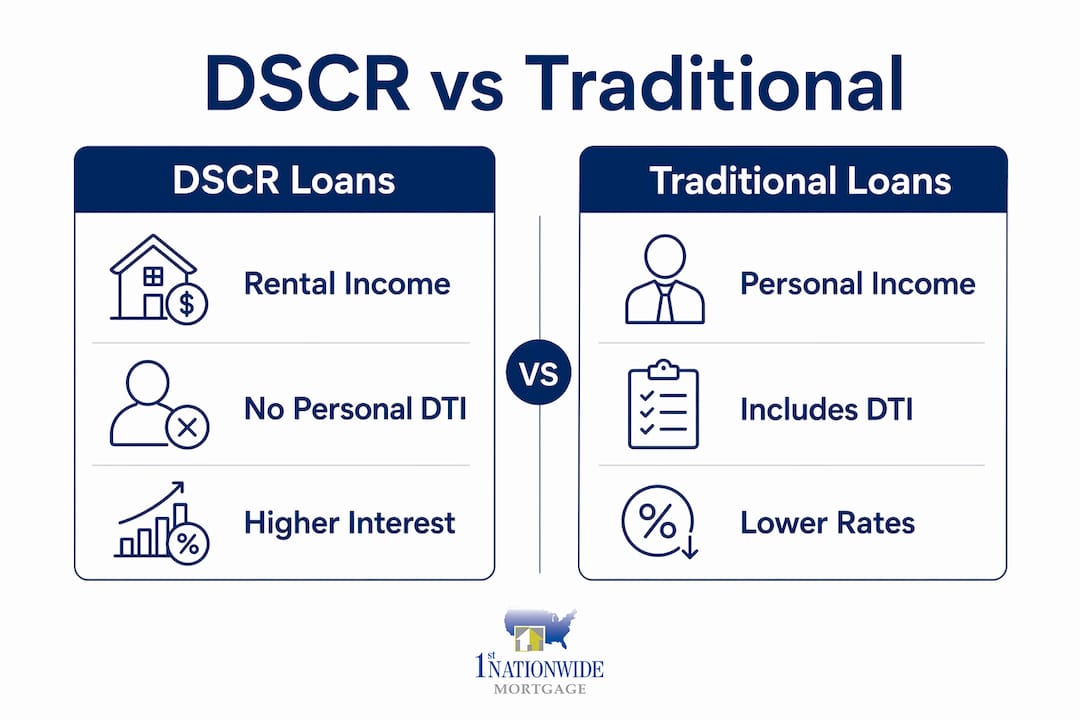
A DSCR loan is a non-QM (non-qualified mortgage) product designed specifically for real estate investors. The lender’s primary qualification metric is the property’s net operating income (NOI) divided by its annual debt service. Your personal income, employment history, and debt-to-income ratio are not part of the approval equation.
The core idea: if the property generates enough rent to cover its own mortgage, taxes, and insurance, the loan can close — regardless of how many properties you already own or how your personal tax returns look.
Traditional mortgage underwriting works the opposite way. Lenders calculate your DTI by stacking all your monthly debt obligations against your documented gross income from W-2s or tax returns. For investors with multiple properties and aggressive depreciation write-offs, that DTI calculation often disqualifies them even when their portfolio is profitable. DSCR underwriting sidesteps that entirely.
The trade-offs are real. DSCR loans typically carry interest rates 1–2 percentage points higher than conventional investor pricing, plus origination costs and reserve requirements that exceed what most primary-residence buyers expect. Prepayment penalties, often structured on a 5-4-3-2-1 declining schedule, are common. For investors who need to scale without hitting personal income ceilings, those costs are usually worth it.
How lenders underwrite property cash flow mortgage approval
The DSCR formula is straightforward:
DSCR = NOI ÷ Annual Debt Service
- NOI (Net Operating Income): Gross rent minus operating expenses (taxes, insurance, management, maintenance, vacancy allowance). Does not include the mortgage payment itself.
- Annual Debt Service: Total principal, interest, taxes, and insurance (PITI) paid over 12 months.
A DSCR of 1.00 means the property breaks even. A DSCR of 1.25 means it generates 25% more income than its debt obligation. Most lenders want to see at least 1.00, and many prefer 1.20–1.25 for better pricing.
What counts as income varies by program:
- Active leases: A signed lease is the cleanest income document. The lender uses the lower of the lease rent or the appraised market rent.
- Market-rent appraisal: When there is no lease or the property is between tenants, an appraiser determines market rent. Lenders often use this appraised figure to set the income number, which can reduce the loan size if the appraised rent comes in below what you expected.
- Short-term rental (STR) history: Some lenders accept Airbnb or Vrbo platform data, though they typically require 12–24 months of booking history and apply a conservative occupancy discount.
- Bank-statement deposits: Certain cash-flow programs allow 12–24 months of deposits to support income, particularly for self-employed investors.
Documents lenders typically request:
- Current signed lease(s) or rent roll
- Full appraisal with market-rent addendum (Form 1007 or 1025)
- 2–3 months of bank statements (personal and/or entity)
- LLC operating agreement and articles of organization (if applicable)
- Proof of reserves (bank or investment account statements)
- Property insurance declarations page
Pro Tip: Order a local rent comp or appraisal before you apply. If the appraised market rent comes in lower than your lease, the lender will resize the loan to match the lower figure, and you will need to bring more cash to closing.
Who qualifies for a cash-flow or DSCR loan?
DSCR loans were built for three investor profiles that traditional banks struggle to serve.
Active investors with LLCs are the most common applicants. Because DSCR underwriting ignores personal DTI, there is no limit on the number of financed properties. An LLC can hold the asset, which provides liability separation and cleaner entity documentation for the lender.
Self-employed owners whose tax returns show low net income due to depreciation and write-offs often qualify through bank-statement programs. Twelve to 24 months of deposits replace tax returns as the income source.
Foreign nationals with no U.S. income documentation can use NONI (No Income, No Asset) programs, which underwrite entirely on the property’s cash flow and asset position.
Baseline thresholds to expect: Most DSCR lenders require a minimum credit score in the 620–680 range, a down payment of 20%–25% (LTV of 75%–80%), and 6–12 months of PITI reserves. The 3-3-3 rule’s suggestion of three months of mortgage reserves is well below what DSCR lenders actually require — plan for at least six.
The same deal can underwrite very differently from one lender to another. Lender overlays on minimum DSCR, eligible property types, and reserve calculations vary enough that a file declined at one shop may close cleanly at another. That is why working with a direct lender who knows non-QM guidelines matters more than shopping on rate alone.
Which property types and loan terms qualify for cash-flow-based underwriting?
| Property Type | Typically Eligible | Common LTV Cap | Notes |
|---|---|---|---|
| Single-family rental (1 unit) | Yes | 75%–80% | Most widely accepted |
| Small multifamily (2–4 units) | Yes | 65%–70% | Rent roll required for all units |
| Condos | Often, with restrictions | 65%–70% | Warrantability and HOA review required |
| Short-term rentals | Lender-dependent | 65%–75% | Platform history and STR appraisal required |
| 5+ unit / commercial | Select lenders only | 65%–70% | Commercial DSCR rules apply |
Loan terms typically run 30 years fixed, though 5/1 and 7/1 ARMs are available and can improve DSCR at origination by lowering the initial payment. Fixed-rate products carry higher rates but eliminate rate-reset risk, which matters when you are modeling long-term cash flow. Down payment requirements generally increase as property complexity rises: a single-family rental at 20% down is standard, while a short-term rental or mixed-use property may require 25%–30%.
Short-term rental policies deserve special attention. Many lenders require a specialized STR appraisal rather than a standard Form 1007, and some cap STR loans at 65% LTV regardless of DSCR. If your portfolio is primarily Airbnb properties, confirm the lender’s STR overlay before you invest time in an application.
How to calculate property cash flow and DSCR
Real estate cash flow has four layers. Skipping any one of them produces a number that looks better than reality.
- Gross Rent: Total scheduled rent at 100% occupancy.
- Effective Gross Income (EGI): Gross rent minus vacancy allowance (typically 5%–10%).
- NOI: EGI minus operating expenses (management, taxes, insurance, maintenance, CapEx reserve).
- Cash Flow: NOI minus annual debt service (PITI).
The 50% Rule as a fast screen: Operating expenses typically consume 35%–50% of gross rent, not including the mortgage. Using 50% is the conservative quick-check that avoids optimistic bias.
Worked example:
- Monthly rent: $2,000 ($24,000/year)
- Vacancy (5%): $1,200/year
- EGI: $22,800/year
- Operating expenses (50% of gross rent): $12,000/year
- NOI: $10,800/year
- Annual PITI (on a $200,000 loan at 8%): approximately $18,000/year
- DSCR: $10,800 ÷ $18,000 = 0.60 — this deal does not qualify at standard thresholds.
Now adjust: if the property costs $160,000 with the same rent, annual PITI drops to roughly $14,400, and DSCR rises to 0.75. Still below 1.00. To hit a 1.00 DSCR, you need NOI to equal or exceed the full debt service. That is why professional investors now target a 1.1%–1.2% rent-to-price ratio rather than the old 1% rule, which no longer reliably produces positive cash flow at current rates.
How to improve your odds of DSCR loan approval
Most DSCR declines are preventable. The issues that kill deals fall into a short list: low DSCR, thin reserves, credit score just below the floor, or entity paperwork that is not lender-ready.
Before you apply:
- Increase the down payment if DSCR is borderline. A larger down payment reduces debt service, which directly improves the ratio.
- Lock in leases before application. A signed lease at market rent is stronger than a verbal agreement or a vacant unit.
- Order rent comps early. If the appraiser’s market-rent figure comes in below your lease, the lender will use the lower number. Knowing this in advance lets you price the deal correctly.
- Clean up credit. Pay down revolving balances to below 30% utilization. Even a 20-point credit score improvement can move you into a better rate tier.
- Show reserves. Six months of PITI in a verifiable account is a baseline; 12 months puts the file in a stronger position.
- Prepare entity documents. If you are buying in an LLC, have the operating agreement, articles of organization, and EIN letter ready before the application.
Pro Tip: Model your deal with a 10% vacancy rate and 50% operating expenses before you submit. If the DSCR still clears 1.20 under those conservative inputs, the file is unlikely to surprise you at underwriting.
A common mistake newer investors make is submitting a deal with a DSCR of exactly 1.00 and expecting smooth approval. Lenders price risk into the rate at that threshold, and any appraisal variance can push the ratio below the minimum. Target 1.20 or above before you apply. For a deeper look at lender overlays and document checklists, the DSCR loan qualification guide at 1st Nationwide Mortgage covers current requirements in detail.

What does the timeline and cost look like from application to close?
Typical timeline:
- Pre-qualification: 1–3 business days. Lender reviews rent, estimated value, credit, and reserves to give a preliminary approval range.
- Underwriting and appraisal: 10–30 days. The appraisal is usually the longest step, particularly in markets where STR appraisers are limited.
- Clear-to-close to funding: 7–14 days after conditions are satisfied.
Total time from application to funded loan: 21–45 days in most markets, though complex files or appraisal delays can extend that.
Fees and costs to budget:
- Origination: typically 1–2 points on DSCR loans
- Appraisal: $500–$800 for single-family; more for multifamily or STR-specific appraisals
- Underwriting and processing fees: vary by lender
- Prepayment penalty: often a 5-4-3-2-1 step-down structure (5% of loan balance in year one, declining by 1% per year)
Reserve requirements: DSCR lenders commonly require 6–12 months of PITI reserves, held in liquid accounts after closing. On a $200,000 loan with $1,500/month PITI, that means $9,000–$18,000 sitting in reserve after your down payment and closing costs. Budget for this separately from your acquisition capital.
The hidden expenses investors miss in cash-flow math
DSCR alone does not tell the full story. A property can show a DSCR of 1.10 and still produce negative actual cash flow once you account for all operating costs.
Industry analysts recommend budgeting 35%–50% of gross rent for operating expenses as a conservative quick-check for cash flow. That range covers the line items most investors undercount:
| Expense Category | Typical % of Gross Rent |
|---|---|
| Property management | 8%–12% |
| Maintenance and repairs | 5%–10% |
| CapEx reserve | 5%–10% |
| Vacancy allowance | 5%–10% |
| Property taxes and insurance | 10% |
| Total operating expenses | 35%–50% |
The DSCR calculation a lender runs often uses a simplified NOI that may not capture full CapEx reserves or management fees at market rates. That is why a deal that clears the lender’s DSCR threshold can still underperform in your actual portfolio.
A good cash-on-cash return benchmark for 2026 is 8%–12%. Returns below 6% rarely justify the operational demands of owning rental property. Run your own full-expense model before you rely on the lender’s DSCR calculation as a proxy for profitability. Avoiding common value investing mistakes applies directly here: optimistic assumptions at acquisition are the single most common reason rental portfolios underperform.
Key Takeaways
DSCR loans qualify investors on rental income alone, making property cash flow mortgage approval accessible without W-2s, tax returns, or personal DTI calculations.
| Point | Details |
|---|---|
| DSCR threshold to target | Aim for 1.20 or above; 1.00 is the floor, but better pricing starts at 1.20–1.25. |
| Operating expense reality | Budget 35%–50% of gross rent for operating costs before calculating true cash flow. |
| Reserve requirement | Plan for 6–12 months of PITI in liquid reserves after closing, not the 3-month rule. |
| Key documents | Signed leases, market-rent appraisal, bank statements, entity docs, and reserve proof. |
| 1st Nationwide Mortgage | Direct DSCR lender offering investor loans with no personal income docs required. |
What most investors get wrong about DSCR underwriting
The most common misconception I see is treating DSCR as a pass/fail checkbox rather than a pricing lever. Investors submit files at 1.00 DSCR and expect the same terms as a file at 1.30. They are not the same deal. Rate, reserve requirement, and lender appetite all shift meaningfully between those two numbers.
The second issue is appraisal surprise. Investors negotiate a lease at above-market rent, build their DSCR model on that number, and then discover at appraisal that the market supports something lower. The lender uses the appraised figure, not the lease, when the two diverge downward. Order a rent comp before you finalize your offer price, not after you are in underwriting.
Finally, the reserve requirement catches people off guard. Six to twelve months of PITI is a real number. On a $300,000 loan, that is $12,000–$24,000 sitting in an account after closing. Investors who plan their capital around the down payment and closing costs alone often find themselves short. Model the full cash requirement before you commit to a purchase price.
1st Nationwide Mortgage is licensed in 18 states and operates as a direct lender, NMLS #1281, with a BBB A+ rating. If you want to run the numbers on a specific deal, the DSCR loan calculator gives you an instant read on how rent, rate, and loan size interact.
How 1st Nationwide Mortgage structures DSCR and investor loans
Qualifying on rental income rather than personal tax returns is exactly what 1st Nationwide Mortgage was built for. As a direct lender, not a broker, the firm underwrites DSCR loans in-house, which means faster decisions and no middleman adding conditions to your file.
The core programs for investors: DSCR loans that qualify on property income with no personal income docs required, bank-statement loans for self-employed investors who need to document income through deposits rather than tax returns, and NONI loans for foreign nationals or borrowers with no documentable U.S. income. LLCs are accepted, and there is no cap on the number of financed properties.
The simplest next step is to run your deal through the DSCR loan calculator, then submit a short pre-qualification request. The team can model conservative cash-flow scenarios, including full operating expense loads, so you know exactly where your file stands before you go under contract. 1st Nationwide Mortgage is licensed in 18 states; check the states served page to confirm coverage for your market, or go directly to the investment property mortgage page to get started.
This article is general educational information, not financial or legal advice. Confirm current program guidelines and eligibility with a licensed mortgage professional for your specific situation.
Useful sources and tools
- DSCR Loan Calculator — 1st Nationwide Mortgage: Run instant DSCR checks and model how rent, rate, and loan size affect qualification.
- DSCR Loans for Investors — 1st Nationwide Mortgage: Program details, eligibility highlights, and a direct contact path for investor borrowers.
- DSCR Loan Qualification Requirements: 2026 Guide: Detailed breakdown of lender overlays, reserve calculations, and document checklists.
- How to Calculate Rental Property Cash Flow — ARVCalc: Step-by-step cash-flow formula with the 50% Rule explained.
- 5 Numbers That Tell You If a Rental Is Worth Buying — Canopy Press: Operating expense benchmarks, rent-to-price thresholds, and cash-on-cash return targets.
- What Is the Downside of a DSCR Loan? — Nicholas Davis Realtor: Honest breakdown of DSCR trade-offs including rate premiums and appraisal risk.