

Condotel financing is available in 2026, but rarely through a conventional mortgage. Realistic paths are DSCR loans, bank-statement/non-QM programs, NONI loans for foreign nationals, portfolio or condotel-specialty products, and bridge or hard-money loans when a deal moves fast or falls outside every other box. Expect higher down payments than a typical condo purchase, tighter appraisal scrutiny, and lenders who care as much about the property’s rental program as your credit file.
Here’s the quick shape of it:
- Down payment and LTV: most condotel loans require a substantial down payment, with maximum loan-to-value often capped at moderate levels depending on the program.
- Documentation: DSCR loans skip personal income entirely and qualify on the property’s rental numbers; bank-statement loans use 12 to 24 months of deposits instead of tax returns; NONI loans require neither.
- State rules matter: owner-occupied products are limited by compliance to a handful of states, while investment-purpose loans have far broader reach.
The next move is straightforward: pull together your HOA and management agreement paperwork, know whether you’re buying to occupy or to rent, and get a lender who actually underwrites condotels on the phone before you write an offer.
Key Takeaways
Condotel financing works reliably through DSCR, bank-statement, NONI, portfolio, and bridge loan programs, not through conventional agency mortgages, and the property’s HOA and management documentation determine underwriting speed more than the borrower’s credit profile.
| Point | Details |
|---|---|
| DSCR fits rental-income investors | Qualification runs on the property’s projected rental income, with no cap on financed properties. |
| Bank-statement loans fit self-employed buyers | 12-24 months of deposits replace tax returns, with a 35%-50% expense factor applied. |
| NONI fits foreign nationals | No income or asset documentation required, though down payments typically run 30%-40%. |
| Gather HOA documents first | Financials, reserve studies, and the management agreement drive underwriting speed more than anything else. |
| State rules limit consumer products | Owner-occupied programs apply only in CA, CO, OR, WA, TX, and ID; other states use business-purpose lending. |
| 1st Nationwide underwrites these programs directly | As a direct mortgage banker, it reviews DSCR, bank-statement, and NONI files in-house rather than through a wholesale investor. |
Table of Contents
- What Is Condotel Financing and How Does It Work?
- Why Condotel Financing Differs From Standard Condo Loans
- Condotel Loan Programs and When Each One Fits
- Documents Lenders Request for Condotel Loans
- The Real Risks and Tax Considerations of Condotel Ownership
- How to Prepare and Close a Condotel Loan, Step by Step
- Choosing a Condotel Lender: Questions to Ask and Red Flags to Avoid
- Matching Your Borrower Profile to the Right Program
- Condotel Financing for Investors: Which Loan Type Fits Your Situation
- Get a Condotel Loan Review Started
- Sources
What Is Condotel Financing and How Does It Work?
A condotel is a condominium unit inside a building operated like a hotel. When you’re not staying in it, the unit typically sits in the building’s rental inventory, managed and marketed by an on-site operator rather than by you individually. That single fact, more than any credit score or income document, is what makes condotel financing its own category.
A few operational features define the property type in the eyes of a lender:
- Short-term rental operation. Units rent nightly or weekly, like hotel rooms, not on 12-month leases.
- In-house or mandatory management. A management company or the HOA itself often runs the rental program, and owners may be required to participate in it.
- Revenue-sharing structure. Owners typically receive a percentage of rental income after the management company takes its cut, according to a legal definition from USLegal.
- Owner-use limits. Many condotel HOAs cap how many nights per year an owner can occupy their own unit, sometimes 30 nights, sometimes fewer, to preserve rental inventory for the hotel operation.
A typical owner-use clause might read something like: you may stay in your unit up to a set number of nights annually, and beyond that, the unit reverts to the rental pool automatically unless you request an exception in writing. That structure is exactly what tells an underwriter this isn’t a standard second home.
Why Condotel Financing Differs From Standard Condo Loans
Conventional financing is often unavailable for condotels, or so restricted it isn’t worth pursuing. The reason isn’t the buyer. It’s the building.
Fannie Mae and Freddie Mac guidelines exclude most hotel-operated condo projects from standard eligibility, which pushes these deals into what the industry calls “non-warrantable” territory. A handful of specific concerns drive that classification:
- Non-warrantable condo status. Buildings with hotel-style amenities, front desks, and daily rentals typically fail the agency checklist outright.
- High investor concentration. When most units in a building are owned by investors rather than occupants, lenders see less stability in the HOA’s finances and voting structure.
- Management and operating agreement risk. If the property’s rental income depends on a single operator, a management contract dispute or operator failure can hit every owner’s cash flow at once, according to Investopedia’s overview of condotel ownership.
- Revenue volatility. Hotel-style income swings with tourism seasons and demand cycles in a way that a long-term rental never does.
A quick glossary helps here, since lenders use this vocabulary constantly:
Non-warrantable means a condo project doesn’t meet conventional agency guidelines, usually due to commercial use, litigation, or investor concentration. Portfolio lender refers to a lender that keeps loans on its own books instead of selling them to Fannie Mae or Freddie Mac, giving it more flexibility to underwrite properties like condotels. Non-QM (non-qualified mortgage) and alternative documentation describe loan programs that qualify borrowers using something other than the standard W-2/tax-return model, such as bank deposits or property cash flow.
Condotel Loan Programs and When Each One Fits
The short answer: your borrower profile determines your program. Passive investors lean toward DSCR loans. Self-employed buyers lean toward bank-statement loans. Foreign nationals and borrowers without documentable income look at NONI. Owner-occupant buyers in a limited set of states may qualify for a portfolio or condotel-specialty product built for consumer use. And anyone facing a fast closing or an unusually messy deal often ends up in a bridge or hard-money loan as a stopgap.
Portfolio and commercial-style loans have become the primary route for condotel purchases because conventional agencies typically exclude these property types, and those loans generally require larger down payments, shorter amortization terms, and may have higher rate spreads than standard residential mortgages, according to LegalClarity’s breakdown of condotel ownership rules.
| Loan Type | Typical Down Payment / Max LTV | Documentation Required | Best-Fit Borrower | State/Occupancy Notes |
|---|---|---|---|---|
| DSCR | 25%-30% down, up to 70%-75% LTV | Property rental income/lease data; no personal income verification | Real estate investors, LLCs, repeat buyers | Investment/non-owner-occupied only, available broadly for business-purpose lending |
| Bank-statement / non-QM | 20%-30% down, up to 75%-80% LTV | 12-24 months of bank deposits, sometimes a CPA-prepared profit-and-loss statement | Self-employed owners, business operators | Owner-occupied version limited to CA, CO, OR, WA, TX, ID; non-owner version available more broadly |
| NONI (no income, no asset) | 30%-40% down, up to 60%-70% LTV | Minimal to no income or asset documentation | Foreign nationals, borrowers without U.S. tax filings | Business-purpose, broad state reach |
| Portfolio / condotel specialty | 25%-35% down, up to 65%-75% LTV | Full underwriting file including HOA and management documents | Owner-occupants and second-home buyers in approved states | Owner-occupied consumer product limited to CA, CO, OR, WA, TX, ID |
| Bridge / hard money | 30%-40% down, up to 60%-65% LTV | Minimal documentation, asset-based approval | Cash-tight buyers needing speed, unusual property situations | Business-purpose, short term, higher cost |
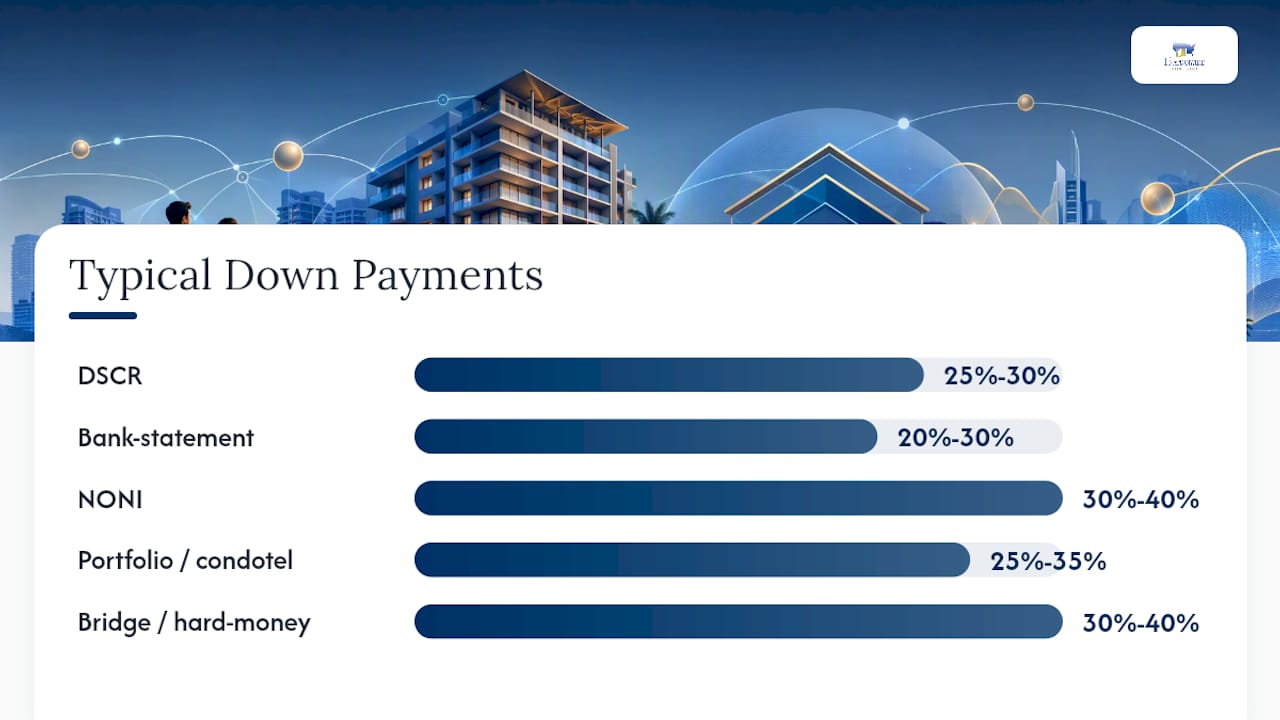
Speed versus cost is the real tradeoff. DSCR loans close faster than a full-doc portfolio loan because there’s no personal income to verify, but they don’t work for owner-occupants. NONI loans move quickly for foreign buyers but come with the steepest down payment requirements on this list. Bridge loans solve a timing problem, not a permanent financing problem, and they’re priced accordingly.
Documents Lenders Request for Condotel Loans
The single biggest underwriting filter for a condotel loan isn’t your credit score. It’s whether the property itself, its HOA financials, its management agreement, and (for income-based programs) its rental history hold up to scrutiny. Get those documents organized before you apply, and the file moves fast. Skip that step, and expect delays.
- HOA/condo certification and financial statements. Lenders want to see reserve funding, delinquency rates, and the percentage of owner-occupied versus investor units.
- Management or rental-pool agreement. This spells out the revenue split, owner-use restrictions, and who operates the rental program.
- Rental history or projected income. For DSCR loans, this often comes from a market rent schedule or the unit’s actual trailing rental performance.
- Borrower income documentation. Tax returns and W-2s for conventional-adjacent programs, or 12-24 months of bank statements for non-QM. Borrowers documenting wage income should be ready to produce IRS Form W-2 when requested.
- Asset and reserve statements. Portfolio lenders commonly expect two to six months of property and personal reserves on top of the down payment, according to LegalClarity.
- Identification and entity documents. A government-issued ID, and for LLC purchases, operating agreements and EIN documentation.
Pro Tip: Request the HOA’s most recent budget, reserve study, and delinquency report the same week you go under contract. These three documents alone are what most underwriting delays trace back to, and getting them early can shave a week or more off your closing timeline.
The Real Risks and Tax Considerations of Condotel Ownership
Four risks show up in nearly every condotel deal: financing is scarcer and costlier than for a standard property, occupancy income swings with tourism demand, your own use of the unit is capped, and resale can take longer than you’d expect. None of these are dealbreakers, but they change the math.
- Financing scarcity and cost. Many banks decline condotel loans outright because the property functions as a hotel, which pushes buyers toward portfolio and non-QM lenders that price in the added risk, per Investopedia.
- Occupancy volatility. Short-term rental income rises and falls with tourism cycles, meaning a slow season can hit your cash flow harder than a long-term lease ever would.
- Owner-use restrictions. If the HOA caps your personal nights, you can’t treat the unit as a full-time vacation home even if you own it outright.
- Management stability. Your rental income depends on the operator staying solvent and competent. A management shakeup can disrupt bookings for months.
- Insurance and liability. Hotel-style operations often require different, sometimes costlier, insurance coverage than a standard condo policy.
- Resale and liquidity constraints. The same financing limits that make it hard for you to buy will make it hard for the next buyer too, which tends to depress resale values compared to conventional condos in the same market.
The financing constraints that affect a condotel’s initial buyer don’t disappear at resale. They limit the pool of future buyers in exactly the same way, and that scarcity of financeable buyers is often reflected in lower resale values relative to a standard residential condo in the same building or market.
Tax treatment for condotels can get complicated fast, especially around rental income reporting, depreciation, and how personal-use days factor into deductions. Rules differ based on how many nights you personally use the unit versus how many it’s rented out, and getting this wrong can cost you at filing time. This isn’t the place for guesswork. Talk to a CPA who has handled short-term rental or hotel-condo returns before, and use the IRS as your starting point for form and documentation basics.
How to Prepare and Close a Condotel Loan, Step by Step
Your very next move should be gathering the property’s HOA, management, and rental documents while you schedule a loan review with a lender who actually handles condotels regularly. Everything downstream depends on how quickly that packet comes together.
- Screen the deal. Confirm the building’s investor-to-owner-occupant ratio, whether participation in the rental program is mandatory, and what the HOA’s reserve position looks like. This takes a day or two if the listing agent is cooperative.
- Collect your documents. Pull together tax returns or bank statements (depending on program), asset statements, ID, and entity paperwork if you’re buying through an LLC. Budget three to five days if you’re organized, longer if you’re chasing down old statements.
- Choose a lender and get pre-qualified. A lender experienced with condotels can tell you within a day or two, often after one conversation, which program fits and what down payment to expect.
- Move through underwriting. This is typically the longest stretch, often two to four weeks for non-QM and DSCR products, longer for full-documentation portfolio loans if HOA paperwork is slow to arrive.
- Order the appraisal. Condotel appraisals often require a specialist familiar with hotel-condo comparables, which can add a week versus a standard residential appraisal.
- Clear conditions and close. Final underwriting conditions, title work, and closing disclosure review typically take another one to two weeks once the appraisal and HOA documents are in hand.
Document checklist by stage: bring HOA financials and the management agreement to step one, income/asset documentation to step two, and be ready to supply any updated bank statements or reserve verification during step four, since underwriters commonly request refreshed statements if the file drags past 30 days.
Choosing a Condotel Lender: Questions to Ask and Red Flags to Avoid
Prioritize lenders who actively underwrite DSCR, NONI, and bank-statement files, or who hold portfolio-based condotel programs in-house rather than trying to force the deal through an agency that will reject it outright. That single filter eliminates most of the wasted time in this process.
Before you commit to a lender, ask:
- Do you currently offer financing for condotel or non-warrantable condo properties, and how many have you closed recently?
- Is this loan held in your own portfolio, or sold to another investor after closing?
- What down payment and LTV should I expect given this specific property and my borrower profile?
- How many months of reserves will I need to show?
- What’s your typical timeline from application to closing for this loan type?
- How does your appraisal process handle hotel-condo comparables?
- Have you worked with this specific building or management company before?
Watch for these red flags, because they usually mean wasted weeks: vague or evasive answers about HOA and management document requirements, an inability to clearly explain whether a program is business-purpose or owner-occupied, and any promise of a guaranteed approval or a specific rate before your file has even been reviewed. You can also verify a lender’s basic licensing and disclosure details through NMLS Consumer Access before you share sensitive financial documents.
Matching Your Borrower Profile to the Right Program
Real estate investors buying with rental cash flow in mind, self-employed business owners, foreign nationals, and buyers moving fast on a cash-flow deal all need different underwriting paths, and 1st Nationwide Mortgage builds its condotel-relevant programs around exactly those four profiles. Founder Christopher Arco, NMLS #1281, operates 1st Nationwide Mortgage as a direct mortgage banker, not a broker, and the company carries a BBB A+ rating.
Here’s how borrower scenarios typically map to program:
- An investor buying a condotel unit for rental income is a natural fit for a DSCR loan, since qualification runs off the property’s projected rental income rather than personal tax returns, and there’s no cap on how many financed properties an investor can hold.
- A self-employed buyer whose tax returns understate real cash flow typically fits a bank-statement loan, which uses 12 to 24 months of business or personal deposits to establish qualifying income instead.
- A foreign national without U.S. tax filings is the classic candidate for a NONI loan, which requires no traditional income or asset documentation.
- A buyer facing a tight closing window or an unusually complex property situation often turns to a bridge-style solution built for speed over long-term pricing, an approach that overlaps with the commercial lending structures used for non-standard collateral.
The common thread across these programs is that each one solves a specific documentation or income-verification problem that a standard conventional mortgage simply isn’t built to handle, whether that’s qualifying on rental cash flow, working around inconsistent self-employment income, or serving a borrower with no U.S. credit or tax history at all.
Condotel Financing for Investors: Which Loan Type Fits Your Situation
Most advice on condotel financing treats it like a niche footnote to regular condo buying. It isn’t. It’s closer to commercial real estate underwriting wearing a residential-sounding name, and the sooner a buyer accepts that framing, the faster they stop wasting time chasing conventional rates that were never going to materialize.
The conventional-wisdom failure here is assuming the property is the obstacle. It isn’t, exactly. The obstacle is a mismatch between what agency underwriting was built to evaluate and what a hotel-operated condo actually is. Fannie Mae and Freddie Mac guidelines were written for owner-occupied stability, not nightly rental turnover and revenue-sharing management contracts. Once you understand that the building’s operating structure, not your personal finances, drives most of the friction, the whole search for financing gets simpler. You stop asking “why won’t my bank approve this” and start asking “which lender actually underwrites this property type.”
What gets overrated in most guides is the down payment conversation. A DSCR borrower with clean rental comps can move through underwriting faster than a full-documentation buyer whose tax returns need explaining. Speed and predictability are worth as much as a slightly better down payment number, particularly in a market where hotel-condo inventory moves fast.
What I’d prioritize first, if I were advising a buyer today, is getting the HOA and management paperwork request out the door before anything else. That single step reveals more about whether a deal will close smoothly than any conversation about credit scores or reserves. A building with a stable, well-documented management agreement and healthy reserves will sail through underwriting on almost any program. A building without those things will fight you no matter which lender you choose.
Get a Condotel Loan Review Started
If you already know which program fits, either DSCR for rental income, bank-statement for self-employed cash flow, or NONI for a foreign national or non-traditional borrower, the fastest path forward is a direct conversation with an underwriter who can review your specific deal, not a call center reading from a script. As a direct mortgage banker, 1st Nationwide Mortgage reviews condotel files in-house rather than routing them through a wholesale investor’s rulebook, which is often the difference between a fast yes and a slow no on a non-warrantable property.
Start by gathering your HOA financials, management agreement, and either 12-24 months of bank statements or a rental income schedule, depending on which program applies to you. From there, a DSCR loan review can tell you within days whether your projected rental income supports the loan amount you need, and a bank-statement loan calculator gives self-employed buyers a fast directional estimate before you formally apply.
A few compliance notes worth keeping in mind: owner-occupied consumer products are only available in California, Colorado, Oregon, Washington, Texas, and Idaho; every other state is served through business-purpose investment lending such as DSCR, non-owner bank-statement, and NONI programs. No rate or APR is quoted here or in any initial conversation, since actual pricing depends on your file and current market conditions. Prepayment penalty availability and structure vary by state, are restricted or prohibited in several, and terms are always confirmed at application.
For illustration only. Not a commitment to lend. Rates and terms subject to change and qualification. 1st Nationwide Mortgage Corporation, NMLS #1281. Equal Housing Lender.
Sources
These sources cover the definitions, tax basics, and lender-verification tools that matter most once you start comparing condotel loan options.
- Condotel: Definition, Ownership, Pros and Cons — Investopedia
- What Is a Condotel? Ownership, Taxes, and Legal Rules – LegalClarity
- Condotel Law and Legal Definition — USLegal
- About Form W-2 — IRS
This article is general information, not a substitute for advice from a qualified financial advisor. Consult a qualified financial professional about your own circumstances before acting on anything here.