
Blog

  • Top 3 fhahandbook.com Alternatives for Income Verification 2026

    Top 3 fhahandbook.com Alternatives for Income Verification 2026

    Verifying income without standard tax documentation often leads to denied mortgage options for self-employed professionals and real estate investors. Many non QM lenders require additional paperwork, lack digital workflows, or do not offer accurate upfront rate or fee information. This comparison shows which bank statement or DSCR loan provider matches your documentation and process needs for a non-qualified mortgage.

    Table of Contents

    1st Nationwide Mortgage

    https://1stnwm.com

    At a Glance

    Qualifies borrowers using 12–24 months of bank deposits instead of tax returns. 1st Nationwide Mortgage reports this method as its standard for bank statement loans. That approach helps self employed borrowers whose tax returns understate cash flow.

    Core Features

    1st Nationwide Mortgage is a direct mortgage banker, not a broker, founded and operated by Christopher Arco, NMLS #1281. The company reports it is licensed in 18 states and holds a BBB A+ rating. Loan programs include bank statement loans, DSCR investor loans, NONI, FHA, VA, USDA, conventional, and jumbo options.

    Key Differentiator

    The firm focuses exclusively on non QM and investor loans and underwrites income from deposits and property cash flow. That specialty lets underwriters accept bank deposits and rental cash flow instead of standard tax based income. The vendor reports over 20 years of industry experience supporting this underwriting approach.

    Pros

    Flexible qualification methods work for self employed borrowers who lack conventional tax documentation. Investor borrowers can use DSCR loans where rental income qualifies the loan without personal income verification. The vendor advertises lending in 41+ states for investor and DSCR loans, and it offers many government and jumbo programs.

    Cons

    • Higher interest rates for non QM and investor programs compared with conventional mortgages.

    Who It’s For

    You are a self employed professional with large business write offs who cannot show adequate taxable income. You are a real estate investor who needs DSCR financing or wants loans for LLC owned properties. You are a foreign national or someone without traditional income documentation seeking mortgage options.

    Unique Value Proposition

    According to the company, standard bank statement underwriting applies a 50% expense factor on business accounts. It can drop to 35–40% with a CPA certified profit and loss statement. That math raises qualifying income for borrowers whose tax returns show low net profit. For investors, DSCR underwriting relies on property cash flow instead of the borrower’s personal income, which simplifies qualification for rental portfolios.

    Real World Use Case

    A photographer with large business deductions provided 12 months of deposits to prove steady monthly cash flow. That evidence replaced tax based income and produced a mortgage approval where conventional underwriting declined. Loan terms required a down payment and underwriting review specific to bank statement files.

    Pricing

    Pricing varies by program. Non QM and investor loans generally have higher rates and fees than conventional products. Exact rates and lender fees require a direct quote and underwriting review.

    Website: https://1stnwm.com

    NewPoint Mortgage

    https://newpointmortgage.com

    At a Glance

    The site combines a broad menu of non QM product links with a broker resource library and unexpected travel and lifestyle posts. That mix makes it a repository for loan officers who need quick product references and printable broker materials. Individual borrowers will find less direct guidance.

    Core Features

    NewPoint Mortgage lists multiple non QM programs including P&L Only, Bank Statement, DSCR, foreign national, ITIN, stand alone second lien, and multi family options. The site also hosts broker tools such as how TOS, flyers, matrices, forms, and a company directory, plus dedicated contact channels for scenario questions, locks, appraisals, and funding. It includes travel and lifestyle blog content that does not relate to mortgage products.

    Key Differentiator

    NewPoint Mortgage centers on broker enablement. The site groups many alternative qualifying programs in one place and pairs those product links with downloadable broker resources and direct contact points for underwriting or funding questions. That focus makes it faster for brokers to match unusual borrower profiles to potential non QM paths.

    Pros

    The product set covers the common non QM categories brokers request, so you can find P&L only and bank statement options in one place. The resource library supplies matrices, forms, and printable flyers that save time when preparing client packages. Multiple contact channels for scenarios, locks, and appraisals reduce back and forth by directing questions to the correct team.

    Cons

    • Limited product detail: many program pages link to general descriptions without full eligibility rules or sample loan scenarios.
    • Broker focus: the site is organized for loan officers and brokers rather than direct consumer shopping or application flows.
    • Distracting content: travel and lifestyle posts appear alongside broker tools and can make navigation feel unfocused.

    When It May Not Fit

    If you are an individual borrower who wants step by step application instructions and consumer facing disclosures, this site will not serve that need well. If you prefer an online portal that accepts consumer applications and returns automated preapprovals, this site lacks that workflow. If you need fully documented product matrices with pricing and fee schedules, those specifics are not consistently available on the site.

    Who It’s For

    Mortgage brokers and loan officers searching for alternative qualifying options will find this resource useful. Sales teams assembling pitch materials and brokers building case files for self employed or foreign national borrowers will benefit from the matrices and contact points. Individual borrowers should work through a broker to access these programs.

    Real World Use Case

    A broker has a self employed client who cannot use tax returns to show income. The broker reviews the bank statement and P&L links on NewPoint Mortgage, downloads the matrix, and calls the designated scenario channel to confirm a documentation checklist. That process shortens the path to an underwriter conversation.

    Pricing

    Pricing and compensation details are not published on the website and appear to be set per scenario. Brokers should contact NewPoint Mortgage directly to request product pricing, fee schedules, and lock desk procedures before submitting a file.

    Website: https://newpointmortgage.com

    Griffin Funding

    https://griffinfunding.com

    At a Glance

    Griffin Funding reports over $3.6 billion funded. The company focuses on digital mortgage workflows for self-employed borrowers, real estate investors, and veterans. It emphasizes fast closings and tailored underwriting for complex income profiles.

    Core Features

    Griffin Funding combines a range of mortgage products including bank statement loans, DSCR loans, home equity loans, and VA mortgages into a single digital application. The lender uses in-house underwriting supported by AI-driven tools to process applications and pull documentation faster. Nationwide servicing across multiple states keeps the product accessible to remote investors and self-employed borrowers.

    Key Differentiator

    The vendor advertises an AI-driven in-house underwriting platform that targets non-traditional borrower profiles and complex loan cases. That tech is paired with flexible manual overlays from dedicated underwriters so files that fail automated rules can still move forward. The combined approach prioritizes speed without discarding human review for edge cases.

    Pros

    Underwriting rules are designed for borrowers with nonstandard documentation, which helps self-employed applicants whose tax returns understate cash flow. A fully digital application and dedicated loan officers reduce back-and-forth and often shorten the time to pre-approval and closing. Specialized programs for investors and veterans mean the product set matches several common financing needs for rental purchases, cash-out equity, and VA refinancing.

    Cons

    • Limited public detail on interest rates and fees makes cost comparisons difficult when shopping multiple lenders.
    • Brand recognition is lower than large national banks, which may affect borrower comfort with long-term servicing or secondary market perceptions.
    • Marketing material does not include explicit side-by-side rate comparisons with competitors, so price transparency depends on requesting a quote.

    When It May Not Fit

    Borrowers who prefer a traditional bank relationship and local branch access will likely find Griffin Funding less familiar. If you want immediate published rate sheets or fee schedules, this lender may not meet that need. Applicants who require heavy counseling on loan features might prefer a lender with larger retail footprint.

    Who It’s For

    Self-employed professionals who lack standard W2 documentation and need bank statement or alternative income underwriting. Real estate investors who qualify on property cash flow rather than personal income. Veterans and active military personnel seeking VA mortgage options through a digitally managed process.

    Real World Use Case

    A self-employed consultant uses Griffin Funding to apply with 12 months of business bank statements instead of tax returns. The file moves through the digital portal, then through AI-assisted underwriting, and receives a tailored loan recommendation. The borrower closes with financing appropriate for a rental property purchase without traditional income verification.

    Pricing

    Pricing is not specified in the available materials and likely varies by loan program, credit profile, and property type. Expect to request a personalized loan estimate to get exact rates, fees, and closing cost details.

    Website: https://griffinfunding.com

    Comparing Non-Qualified Mortgage Lenders

    Explore your options in non-qualified mortgage lending by evaluating their loan programs, expertise, and suitability for specific needs.

    Product Name Offered Programs Key Differentiator Best For Pricing Notable Limitation
    1st Nationwide Mortgage Bank Statement, DSCR, Government, Jumbo Deposit and Property Cash Flow Underwriting Self-employed professionals and real estate investors Price not published Higher rates compared to conventional mortgages
    NewPoint Mortgage P&L Only, Bank Statement, DSCR, Multi-Family Broker-oriented tools and resources Mortgage brokers seeking alternative qualification options Price not published Geared towards brokers, limited direct consumer application support
    Griffin Funding Bank Statement, DSCR, VA, Equity Loans AI-driven in-house underwriting Self-employed and veteran borrowers Price not published Limited rate transparency, requiring direct quotes for comparison

    When Traditional Income Verification Limits Your Mortgage Options

    Many self-employed professionals and real estate investors find conventional tax return requirements do not reflect their true cash flow. This issue often results in lower qualifying income that keeps you from securing the mortgage you need. Underwriting that assesses 12 to 24 months of bank deposits instead of tax returns offers a more accurate picture of your income, especially when business write-offs reduce reported profits.

    1st Nationwide Mortgage specializes in bank statement and DSCR loans that validate income using your actual bank deposits and rental property cash flow. This approach helps self-employed borrowers and investors who struggle with traditional documentation requirements. Whether you are a self-employed professional, a real estate investor, or a foreign national without conventional income proof, their loan programs offer tailored solutions across 18 states. Learn more about their offerings at 1st Nationwide Mortgage.

    Take the next step by reviewing how income based on bank deposits could increase your qualifying income and open doors to more mortgage options with 1st Nationwide Mortgage. Get clear guidance on programs designed for your unique financial profile and advance your home financing with confidence.

    https://1stnwm.com

    FAQ

    What features make 1st Nationwide Mortgage ideal for self-employed borrowers?

    1st Nationwide Mortgage uses a bank statement loan approach, allowing self-employed borrowers to qualify using 12–24 months of bank deposits instead of tax returns. This method is designed specifically for borrowers whose tax returns may understate their actual cash flow. If you’re self-employed and struggling to provide traditional documentation, this approach can simplify your mortgage application process.

    How does 1st Nationwide Mortgage compare to Griffin Funding for income verification?

    Griffin Funding focuses on digital mortgage workflows and offers tailored underwriting for complex income profiles. In contrast, 1st Nationwide Mortgage specifically targets self-employed borrowers by allowing them to qualify based on bank statements, which can be more beneficial if you cannot meet standard income documentation requirements. Each choice presents unique advantages depending on your specific financial situation.

    Can 1st Nationwide Mortgage help if I have low net profit on my tax returns?

    Yes, 1st Nationwide Mortgage can accommodate borrowers with low net profit by applying a 50% expense factor on business accounts. This may drop to 35–40% with a CPA certified profit and loss statement. This flexibility allows you to demonstrate more qualifying income than what your tax returns alone may show.

    What are the costs associated with 1st Nationwide Mortgage products?

    Pricing for 1st Nationwide Mortgage varies widely by program, particularly for non QM and investor loans, which generally have higher rates compared to conventional mortgages. To get an exact quote that suits your needs, direct communication with the lender will be necessary.

    How accessible are 1st Nationwide Mortgage’s services across different states?

    1st Nationwide Mortgage offers lending services in 41+ states, making it accessible to a broad range of borrowers, including both self-employed individuals and real estate investors. This extensive coverage means you can find options tailored to your needs regardless of your location.

  • Top 6 nmbnow.com Alternatives for Mortgage Providers 2026

    Top 6 nmbnow.com Alternatives for Mortgage Providers 2026

    Finding a direct mortgage lender that reliably qualifies self-employed borrowers and investors without relying on tax returns or rigid W-2 income is still difficult. Many well-known lenders use only standard documentation, lock unconventional borrowers out, or hide program and pricing specifics until late in the process. This list highlights six direct alternatives to nmbnow.com, so mortgage brokers and non-QM lenders can match the right lender to each borrower’s complexity.

    Table of Contents

    1st Nationwide Mortgage

    https://1stnwm.com

    At a Glance

    The lender qualifies self-employed borrowers using 12–24 months of bank deposits instead of tax returns. That method lets people with large tax write-offs show qualifying cash flow. 1st Nationwide Mortgage operates as a direct mortgage banker and focuses on non-QM and investor programs.

    Core Features

    1st Nationwide Mortgage supports Bank Statement Loans, DSCR Loans, and NONI investment programs alongside FHA, VA, USDA, conventional, and jumbo options. The company details a standard expense factor of 50% on business accounts and notes the factor can drop to 35–40% with a CPA-certified profit and loss. The firm is founded and operated by Christopher Arco, NMLS #1281, and it reports licensing for investor products in 41+ states while holding retail licenses in 18 states and a BBB A+ rating.

    Key Differentiator

    The clearest distinction is the focus on alternative qualifying methods for self-employed borrowers and investors after more than 20 years in mortgage lending. That depth shows up in underwriting that accepts deposit-based income, rental cash flow calculations, and foreign national pathways for borrowers with no documentable income. The underwriting approach reduces reliance on W-2 or tax return income when alternative documentation better reflects a borrower’s ability to repay.

    Pros

    The team brings long experience handling complex files for self-employed borrowers and investors, which shortens the back-and-forth on documentation. Their bank statement product accepts 12–24 months of deposits and offers an expense-factor path tied to CPA documentation, which can materially increase qualifying income for some applicants. They support investors with DSCR underwriting that uses property rental income and works with LLC structures, reducing the need to show personal income for qualification.

    Cons

    • Higher interest rates than conventional loans because programs sit outside standard QM guidelines.

    Who It’s For

    You should consider this if you are self-employed and your tax returns understate your cash flow. Real estate investors who need DSCR underwriting or want to finance multiple properties will find the product suite relevant. Foreign nationals and borrowers without traditional paperwork also fit the target profile.

    Unique Value Proposition

    The underwriting rule that uses a 50% standard expense factor on business accounts, which can fall to 35–40% with a CPA-certified P&L, makes income calculation predictable for complex files. That rule changes the payment-to-income math and often raises effective qualifying income for borrowers with many write-offs. For brokers and loan officers, that predictability means fewer last-minute surprises during underwriting.

    Real World Use Case

    A self-employed consultant with high business deductions provides 24 months of bank statements and a CPA-certified P&L. Under the bank statement method, the expense factor drops to 35%, raising qualifying income enough to approve a mortgage. The borrower closes without needing to increase down payment or alter business accounting substantially.

    Pricing

    Pricing is not published online because this offering is informational only and rates vary by product, credit, and loan-to-value. Loan pricing depends on program choice, credit score, down payment, and property type. Contact a loan officer for a tailored loan estimate and program quote.

    Website: https://1stnwm.com

    Origin Mortgage

    https://origin-mortgage.com

    At a Glance

    In house underwriting and deep non QM expertise drive faster decisions on complex loan files. Origin Mortgage reports operating since 1998 and serving retail and wholesale partners across all 50 states. The lender emphasizes quick turn times and hands-on structuring for self employed borrowers and investors. That focus makes it a frequent choice when standard underwriting fails.

    Core Features

    Origin Mortgage underwrites a wide set of non QM programs, including bank statement and P&L options, asset depletion, 1099, and foreign national loans. The product lineup also includes DSCR loans for investor financing, plus traditional FHA, VA, and conventional pathways and reverse mortgages for seniors. Wholesale partner programs provide in house underwriting and rapid turn times for brokers.

    Key Differentiator

    The single distinguishing feature is the lender’s in house underwriting team paired with non QM depth. That pairing lets origin structure deals other lenders reject and move documentation through underwriting faster. The model favors brokers who need discretionary decisions and bespoke income calculations. It trades off scale for underwriting flexibility.

    Pros

    Origin Mortgage offers clear strengths for brokers and complex borrowers. Its non QM expertise supports cases where tax returns understate viable income, and that expertise often converts declined applicants into funded loans. Fast turnaround is a common advantage, backed by dedicated teams and senior staff access. Nationwide licensing gives brokers reach across all states when the borrower location matters.

    Cons

    • Third party reviews report overlay strictness that can produce last minute conditions.

    • The range of in house product options can feel complex for brokers new to non QM lending.

    • Speed and flexibility depend on documentation quality and case complexity, so results vary.

    When It May Not Fit

    Origin Mortgage may not fit borrowers who need plain conforming loans with standard documentation. It also may be a poor match in regions with strict local regulatory constraints or layered investor overlays. Brokers who prefer automated pricing and a single product workflow will likely find the variety cumbersome.

    Who It’s For

    Mortgage brokers and non QM lenders seeking a partner for fast, flexible alternative mortgage programs will gain the most. Real estate investors needing rental income based financing and self employed borrowers with complex cash flow also align well. Wholesale partners who require in house underwriting and case by case structuring benefit most.

    Real World Use Case

    A self employed borrower with substantial deposits but low taxable income uses the bank statement program to qualify. Origin’s underwriting accepts deposit based qualifying and issues a loan approval after targeted documentation. The result lets the borrower close when conventional lenders had declined.

    Pricing

    Pricing is not publicly listed. Origin Mortgage issues loan pricing through broker channels and wholesale rate sheets and quotes. Contact a broker or the company directly for case specific fees and rates.

    Website: https://origin-mortgage.com

    AD Mortgage

    https://admortgage.com

    At a Glance

    AD Mortgage reports a network of over 9,000 brokerage partners across 49 states and 20 years of industry experience. The firm positions itself as a wholesale lender concentrating on Non-QM and other programs. That scale supports broad distribution and rapid market reach for brokers.

    Core Features

    AD Mortgage offers a wide set of loan programs, including Non-QM, conventional, FHA, VA, and jumbo products, and portfolio options for real estate investors. The platform includes technology tools such as Quick Pricer, AD Studio, and AIM Portal, plus an automated guideline search to speed decisioning. The vendor advertises underwriting turnarounds as quick as 24 to 48 hours and provides account support, training, and industry guides.

    Key Differentiator

    Speed of execution and tailored support set AD Mortgage apart for brokers facing complex borrower profiles. The combination of rapid underwriting and loan options aimed at unconventional income sources reduces time to close. Dedicated training and a partner-focused portal aim to keep brokers informed and operationally efficient.

    Pros

    The team is described as highly responsive and professional, which helps smooth difficult deals and preserve borrower confidence. AD Mortgage reports over 1,300 positive reviews and a 4.8 star rating, which suggests consistent partner satisfaction. Robust tech tools shorten underwriting cycles and the lender supports a wide set of flexible loan structures for nontraditional income and investor needs.

    Cons

    • Specific limits exist on business purpose loans, which may exclude some niche commercial funding needs.
    • Borrowers with highly complex credit or extreme file quirks can require extra underwriting steps and manual approvals.
    • Several users report the interface is improving but still needs refinement to match automation elsewhere.

    When It May Not Fit

    If you require full retail-style consumer disclosures for every loan scenario, AD Mortgage’s wholesale model may not match your workflow. Brokers needing fully automated decisioning for every edge case will find manual approvals more frequent. Teams focused exclusively on small-scale consumer retail lending may prefer a different channel.

    Notable Integrations

    • ADwise guideline search
    • Partner Portal AIM
    • Loan Calculator Quick Pricer
    • AD Appraisal Center
    • Partner Support

    Who It’s For

    Mortgage brokers, lenders, and loan officers who handle unconventional income and investor deals will find AD Mortgage useful. Professionals who value fast turnarounds and a partner support model gain the most. Brokers closing complex or portfolio loans will see the platform fit their needs.

    Real World Use Case

    A broker used AD Mortgage to place a Non-QM loan for a self-employed borrower with irregular deposits and multiple income streams. Rapid underwriting and targeted product choice allowed closing in about 30 days. The broker relied on portal tools and account support to document qualifications.

    Pricing

    Pricing is not publicly specified and typically follows broker-specific models that vary by scenario. Expect pricing and overlays to depend on loan program, borrower profile, and wholesale relationship terms. Discuss pricing directly with an account representative for firm quotes.

    Website: https://admortgage.com

    Enrich Loans

    https://enrichloans.com

    At a Glance

    Approvals can close in as little as 30 days, according to Enrich Loans’ marketing materials. They target nonqualified mortgage borrowing for investors, entrepreneurs, and LLC owners. The company operates in nearly 30 states and plans to add HELOC and international solutions.

    Core Features

    Enrich Loans centers on non-QM and alternative documentation programs that let property cash flow serve as the qualifying income. The product set includes DSCR loans that accept rental income instead of personal payroll, plus programs that support LLC ownership and multiple property types. The underwriting emphasizes a faster approval process and flexible qualification criteria tied to the asset rather than borrower W2s or tax returns.

    Key Differentiator

    The firm qualifies loans primarily on property cash flow rather than the borrower’s personal income. That focus lets investors scale without producing conventional income documentation. This approach narrows the audience to investor-grade financing rather than primary residence lending.

    Pros

    No personal income verification is a clear strength for borrowers whose tax returns underreport cash flow. The lender advertises a quick turnaround, and that timeline helps investors close time-sensitive deals. Programs support LLC ownership and multiple property types, which simplifies portfolio growth. Underwriting that weights property cash flow over personal income reduces reliance on traditional debt to income calculations.

    Cons

    • Higher down payment requirements of 20–25% make early leverage more expensive for some buyers.
    • Interest rates may run higher than conventional products, increasing holding costs for marginal deals.
    • Product set is limited to investment and non-owner occupied properties, not primary residences.
    • Not suitable for borrowers who need conventional owner-occupied financing or second home loans.

    When It May Not Fit

    Borrowers seeking purchase or refinance on a primary residence should look elsewhere. Borrowers with thin or negative property cash flow will have difficulty getting approval. The offering is also restricted by state licensing, so geography matters for availability.

    Who It’s For

    Serious real estate investors, entrepreneurs, and LLC owners who rely on rental income to qualify make the best fit. You should have established properties or clear rental projections and the capital for larger down payments. This product suits people who prioritize speed and flexible documentation over the cheapest long term rate.

    Real World Use Case

    An investor uses rental income to qualify for financing on multiple single family homes, avoiding time spent compiling years of personal tax documentation. They lock deals quickly using the advertised approval speed so they can close before competing bids move prices. The property cash flow underwriting lets the investor finance assets held in LLCs without personal income layering.

    Pricing

    No public pricing table appears; pricing is not listed and is informational only. Expect loan-level pricing that varies by state, property cash flow, and borrower profile. Contact the lender for a personalized rate quote and program terms.

    Website: https://enrichloans.com

    Rocket Mortgage

    https://rocketmortgage.com

    At a Glance

    Rocket Mortgage reports closing over 9 million mortgages. The platform emphasizes a largely online application and fast rate visibility for U.S. residential borrowers. Its marketing highlights special offers with partners such as Redfin and lender credits aimed at lowering closing costs.

    Core Features

    The site offers an online mortgage application and pre-qualification flow that moves applicants from estimate to submission without in-person paperwork. It provides rate alerts and real-time rate updates alongside mortgage calculators for payment estimation. The product covers purchase loans, refinancing, VA loans, and options for debt consolidation using home equity.

    Key Differentiator

    Rocket Mortgage centers on a highly digital borrower experience that keeps rate data live and visible during the application process. That live rate focus, combined with partner offers, shortens the time you spend hunting for comparable lender credits and promotions. This emphasis on continuous rate visibility is the clearest difference versus more traditional lender workflows.

    Pros

    The online process reduces several common friction points in mortgage applications and keeps documents and messages in one interface. Multiple program types, including VA loans and first time buyer options, broaden who can qualify through the platform. Special offers and lender credit features can lower closing costs when paired correctly with a property transaction.

    Cons

    • Page content shows broken or missing detailed feature and pricing pages, limiting how deeply a borrower can research specific product terms.
    • The scraped data provides limited specifics on adjustable features, exact loan terms, or underwriting nuances for complex income profiles.
    • Third party reviews were not included in the dataset, so independent customer experience depth is not available here.

    When It May Not Fit

    If you lack reliable internet access or prefer in person meetings, the platform could be harder to use because the experience depends on digital access. Borrowers needing unusually customized loan structures or hyperlocal underwriting exceptions may find the public feature set thin. People outside supported geographic areas could face product or licensing limits based on location and borrower profile.

    Who It’s For

    This platform suits U.S. homebuyers and homeowners who want a largely online mortgage experience and clear rate visibility. It fits first time buyers, veterans seeking VA loans, and owners looking to refinance or consolidate debt through home equity. If you prefer phone and branch interaction over web driven steps, this may not match your preferred workflow.

    Real World Use Case

    A veteran compares VA loan options, watches live rate alerts, and completes the online application with a digital upload of service documents. A homeowner with equity runs payment estimates, sees lender credit offers with a partner, and submits a refinance application to lower monthly outlay. In both examples, the continuous rate updates speed decision making.

    Pricing

    The site lists pricing as not applicable for informational content and does not publish uniform lender fees on public pages. Loan pricing depends on individual loan terms, credit profile, and market rates at application. Expect final costs to come from a formal loan estimate after application and underwriting.

    Website: https://rocketmortgage.com

    loanDepot

    https://loandepot.com

    At a Glance

    loanDepot reports a consistent 90%+ customer survey rating. That figure signals strong reported satisfaction with loan officers and the digital experience. The company combines a digital mortgage workflow with a broad set of loan products for purchase and refinance.

    Core Features

    The platform centers on the digital platform “mello”, which handles online application, document upload, and real time status updates. Loan choices include fixed rate, adjustable rate, FHA, VA, jumbo, and rehab loans, plus programs for builders and real estate partners. Proprietary tooling aims to speed processing while keeping borrowers informed during underwriting and closing.

    Key Differentiator

    The single most distinguishing feature is “mello”. It provides a fully digital application and loan management experience across devices, with status transparency and document handling built in. That focus on an end to end digital workflow sets loanDepot apart from lenders that still rely on paper and manual status calls.

    Pros

    Reported customer satisfaction is high, and that rating suggests many borrowers have good experiences with service and communication. The digital workflow reduces back and forth. The product set covers common borrower needs, from FHA programs for low down payment buyers to jumbo loans for higher value purchases. Builder and realtor programs make loanDepot a practical choice when new construction finance must align with sales and closing schedules.

    Cons

    • Some detailed product and application information sits behind a paywall on the website, which makes initial comparison harder.
    • A few reviews describe the process as complex for borrowers without mortgage experience, so guidance may be needed.
    • Physical branch presence is limited, so borrowers who prefer face to face meetings may find the support model less convenient.

    When It May Not Fit

    If you prefer in person meetings for financial decisions, loanDepot may feel remote because it relies on digital processes and phone based support. Borrowers with unusually complex financing needs might need more hands on, localized underwriting. Small builders or agents who require local branch relationships could find the partnership model less helpful.

    Who It’s For

    You should consider loanDepot if you want a modern, digital mortgage workflow and a broad menu of loan products. It fits first time and experienced homebuyers who are comfortable managing much of the process online. It also fits builders and agents who need partnership programs and joint venture options.

    Real World Use Case

    A first time buyer compares rates, completes an application, and uploads bank statements through the platform. The borrower receives timely status updates and document requests via the portal. The digital handoff to underwriting and closing keeps the timeline predictable and reduces surprise requests.

    Pricing

    Not applicable. The site presents product and eligibility information rather than a per user or license pricing model, because loanDepot is a mortgage lender rather than software sold by subscription.

    Website: https://loandepot.com

    Comparison of alternatives

    Among mortgage lenders, 1stnwm.com excels in tailoring solutions for self-employed borrowers through its specialized application processes and adjustable expense norms based on CPA documentation. Here, we compare the offerings of other notable lenders to highlight strengths and contexts where they shine.

    Application process and underwriting speed

    Origin Mortgage distinguishes itself by offering in-house underwriting and fast decision-making on complex files, giving brokers a consistent edge in rapid case handling. While other competitors provide platforms, Origin Mortgage’s hands-on approach allows for discretionary decisions that multiply approval possibilities for intricate borrower profiles.

    Supporting tools and geographic flexibility

    AD Mortgage leverages an extensive broker support network, technological tools like automated pricing systems, and accessible services across 49 states. This infrastructure aids brokers focusing on unconventional loans, though its geographic integration still falls short of full nationwide licensing. loanDepot emphasizes a highly digital workflow via its “mello” platform, facilitating a streamlined application journey for tech-savvy clients accustomed to web-based systems.

    Best fit

    • Self-employed borrowers prioritizing adjustable income qualification models will benefit most from 1stnwm.com’s specialized programs.
    • Brokers requiring rapid underwriting decisions and customizable loan structuring should engage Origin Mortgage’s services.
    • Real estate investors seeking financing based on property cash flow find Enrich Loans well-suited to their needs.
    • Borrowers focused on an online-first workflow blended with transparent document handling gravitate towards loanDepot.
    • Teams valuing responsive support paired with versatile programs can securely use AD Mortgage.

    Our pick

    1stnwm.com provides a unique capability by catering directly to self-employed borrowers needing income qualification through detailed bank statements and CPA-driven expense analysis. However, prospective clients prioritizing geographically exhaustive services or seeking purely automated underwriting processing might find other options more aligned with their preferences.

    1st Nationwide Mortgage provides unique underwriting strategies tailored to individuals with unconventional income documentation, making it stand out among its alternatives.

    Product Core Features Target Audience Pricing Notable Limitation
    1st Nationwide Mortgage Bank Statement Loans, DSCR Loans, NONI Investment Programs Self-employed borrowers and real estate investors Price not published Higher interest rates than conventional loans
    Origin Mortgage In-house underwriting, flexible documentation options Mortgage brokers and self-employed borrowers Price not published Potential overlay strictness causing additional conditions
    AD Mortgage Non-QM loans, advanced broker tools, rapid turnaround Brokers focused on unconventional income and investor loans Price not published Interface improvements are ongoing
    Enrich Loans Non-QM programs qualifying on property cash flow Real estate investors and entrepreneurs Price not published Higher down payment requirements
    Rocket Mortgage Digital application process, VA and refinance loans Homebuyers preferring online workflows Price not published Limited details on adjustable loan features

    Challenges With Conventional Mortgage Qualification for Self-Employed Borrowers and Investors

    Qualifying for a mortgage often depends heavily on tax returns and traditional income documents. For self-employed borrowers and real estate investors, this approach can obscure true cash flow due to deductible expenses and complex ownership structures. This mismatch leads to underreported income, stricter debt-to-income calculations, and limited loan options.

    1st Nationwide Mortgage offers solutions addressing these challenges. Their bank statement loans use 12 to 24 months of bank deposits to measure real income instead of tax returns. With a CPA-certified profit and loss statement, the standard 50% expense factor on business accounts can adjust down to 35 to 40%, allowing more accurate income qualification. Investor borrowers benefit from DSCR Loans, where rental income—not personal income—determines eligibility, including for LLC-held properties.

    Learn more about 1st Nationwide Mortgage’s loan programs.

    Take the next step toward clearer income qualification by reviewing how bank statement documentation and DSCR underwriting can affect your loan estimate with 1st Nationwide Mortgage.

    FAQ

    How does 1st Nationwide Mortgage support self-employed borrowers?

    1st Nationwide Mortgage primarily qualifies self-employed borrowers using 12–24 months of bank deposits instead of tax returns. This approach allows applicants with high tax write-offs to demonstrate qualifying cash flow effectively. If you are self-employed and your tax returns do not reflect your income, 1st Nationwide Mortgage could provide a viable alternative for securing a mortgage.

    What is the difference between 1st Nationwide Mortgage and Origin Mortgage?

    Origin Mortgage is recognized for its in-house underwriting and deep non-QM expertise, which drives faster decisions on complex loan files. 1st Nationwide Mortgage shines when borrowers need alternative qualifying methods, such as bank statement loans, where tax returns may not accurately show income. Consider what fits your specific needs as a borrower to choose between the two.

    Can I use bank statement loans with 1st Nationwide Mortgage?

    Yes, 1st Nationwide Mortgage offers bank statement loans that accept 12–24 months of deposits for qualifying income. This feature significantly benefits self-employed individuals whose tax returns understate their actual cash flow. If traditional documentation isn’t an option for you, exploring 1st Nationwide Mortgage’s bank statement loans could be a great starting point.

    How quickly can I expect the underwriting process with 1st Nationwide Mortgage?

    While specific timeframes weren’t detailed in the article, 1st Nationwide Mortgage’s focus on alternative income documentation typically allows for a streamlined qualification process. If you’re looking for faster approvals, 1st Nationwide Mortgage may serve as an effective choice compared to traditional lenders.

    What are the interest rates like with 1st Nationwide Mortgage?

    The article notes that 1st Nationwide Mortgage offers higher interest rates than conventional loans due to their non-QM program structure. Keep in mind that while their rates may be higher, their flexible qualifying criteria can meet unique borrower needs effectively. It’s worth evaluating your budget against these rates to determine if it meets your financing goals.

  • Two-Year Self-Employment Mortgage Requirement Explained

    Two-Year Self-Employment Mortgage Requirement Explained

    The two-year self-employment mortgage requirement is the standard lenders use to verify that your income is stable enough to support a home loan. Most conventional and government-backed programs, including those governed by Fannie Mae and Freddie Mac guidelines, require at least two full years of self-employment history before they will count your income toward qualification. If you own 25% or more of a business, work as a sole proprietor, or earn income as an independent contractor, this rule applies to you. Understanding exactly what lenders want, and how to prepare for it, is the fastest path to approval.

    What documents prove the two-year self-employment mortgage requirement?

    Lenders do not offer a separate “self-employed mortgage.” They use standard mortgage programs with specialized income verification layered on top. The goal is proving that your income is real, consistent, and likely to continue.

    For a conventional or government-backed loan, you will typically need:

    • Two years of personal tax returns (IRS Form 1040) with all schedules attached
    • Two years of business tax returns (Form 1120S for S-corps, Form 1065 for partnerships, or Schedule C for sole proprietors)
    • A year-to-date profit and loss (P&L) statement, prepared or reviewed by a CPA
    • 12–24 months of business bank statements to confirm deposit activity
    • Evidence of business ownership, such as a business license, articles of incorporation, or a CPA letter

    Lenders require this documentation to verify both the existence of your business and the sustainability of your income. A single profitable year is not enough. Underwriters want to see a pattern.

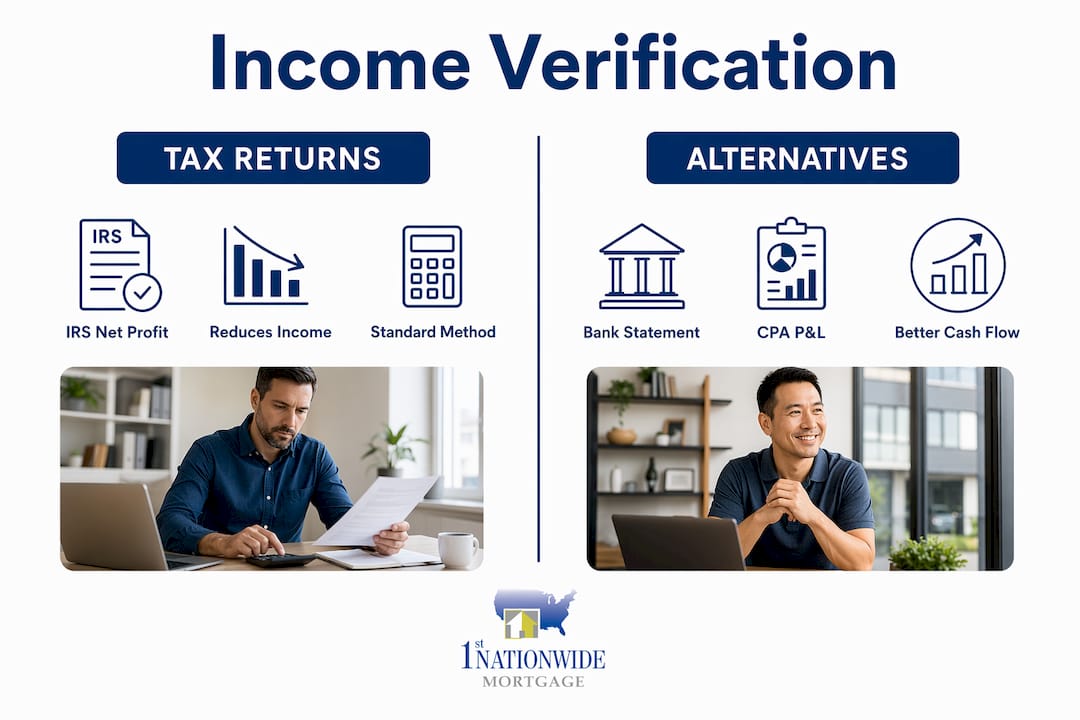
    Bank statement loans work differently. Instead of tax returns, bank statement loans use 12–24 months of deposit history to calculate qualifying income. This approach is built for self-employed borrowers whose tax write-offs reduce their reported net income below what conventional underwriting accepts. The lender applies an expense factor, typically 50% on business accounts, to arrive at a usable income figure. A CPA-certified P&L can lower that expense factor to 35–40%, which increases your qualifying income.

    Hands pointing at self-employment income documents

    Pro Tip: Keep your personal and business bank accounts completely separate. Commingled accounts create confusion during underwriting and can delay or derail your approval.

    Lenders also look at whether your income documentation is professionally prepared. Accounts finalized by a qualified accountant carry more weight than self-prepared spreadsheets. That credibility matters when an underwriter is deciding whether to approve your file.

    Are there exceptions to the two-year requirement for new self-employed borrowers?

    The two-year benchmark is a guideline, not an absolute wall. Fannie Mae guidelines allow lenders to qualify a borrower with just one year of self-employment income under specific conditions. Income stability takes priority over the exact date your business started.

    To qualify with one year of self-employment, you generally need to meet all of the following:

    • Prior W-2 employment in the same field as your current self-employment
    • A documented transition from employee to self-employed, showing the work is the same type
    • Strong supporting financials, including a healthy credit score and reserves
    • A lender willing to accept the exception, since not all lenders apply this flexibility

    The key word is “same field.” A graphic designer who spent five years at an agency and then went freelance has a credible case. Someone who left a corporate finance role to open a restaurant does not. Underwriters look for continuity of skill and income source, not just continuity of employment.

    Income from self-employment under one year cannot be used for qualification on government-backed loans without that accompanying employment history. If you are under the one-year mark entirely, alternative loan products are your only path. Options like mortgage without tax returns programs or asset-based lending may apply depending on your financial profile.

    How do lenders calculate qualifying income from self-employment?

    Lenders calculate your qualifying income by averaging your net profit across the two-year period, then dividing by 24 to get a monthly figure. Fannie Mae’s income calculation method also allows adjustments for nonrecurring expenses and losses that appear on your returns but do not reflect your ongoing earning capacity.

    Infographic showing steps to calculate qualifying self-employment income

    The table below shows how income averaging works in practice:

    Scenario Year 1 Net Profit Year 2 Net Profit Monthly Qualifying Income
    Stable growth $80,000 $100,000 $7,500
    Declining income $100,000 $80,000 $7,500
    Sharp decline $120,000 $60,000 $7,500
    Single year only N/A $90,000 $7,500

    The math looks identical in the first three rows, but the underwriting outcome is not. A declining income trend raises a red flag even when the average looks acceptable. Underwriters are trained to ask whether the lower year represents a new normal. If year two is significantly lower than year one, many lenders will cap qualifying income at the lower year’s figure rather than use the average.

    Lenders average income over two years to assess sustainability, not just current earning power. That distinction matters when you are planning your application timeline. If your income dipped in one year due to a one-time expense or a slow quarter, having your CPA document that clearly in a letter can prevent the underwriter from treating it as a trend.

    Variable income borrowers should also review variable income qualification tips before applying. Seasonal businesses, project-based work, and commission-heavy income all require extra documentation to show the pattern is predictable.

    What are common mistakes to avoid when applying under the two-year rule?

    Most self-employed mortgage denials come down to preparation, not eligibility. The income is there. The documentation is not. Avoiding these mistakes puts you in a much stronger position before you ever submit an application.

    • Submitting incomplete tax returns. Missing schedules, unsigned returns, or returns that do not match your IRS transcripts will stop your file cold. Lenders order IRS transcripts directly and compare them to what you submit.
    • Mixing personal and business finances. Lenders classify self-employed borrowers as those owning 20–25% or more in a business and expect clean financial separation. Commingled accounts make income harder to verify and raise questions about business viability.
    • Applying right after a big income spike. Sudden income increases just before applying raise lender concerns about sustainability. A year with unusually high revenue looks great on paper but can actually hurt you if the underwriter cannot confirm it will continue.
    • Waiting too long to consult a mortgage professional. Many self-employed borrowers apply and get denied, then learn they could have qualified if they had structured their finances differently 12 months earlier.

    Pro Tip: Talk to a mortgage professional at least one year before you plan to buy. They can review your tax returns, flag documentation gaps, and tell you exactly what your qualifying income looks like before you fall in love with a property.

    Self-employed borrowers who work with a 1099 contractor mortgage specialist also tend to move through underwriting faster. A lender who regularly works with self-employed files knows what documentation to request upfront and how to present your income clearly to an underwriter.

    Key Takeaways

    Meeting the two-year self-employment mortgage requirement depends on consistent income documentation, clean financial records, and choosing the right loan program for your situation.

    Point Details
    Two-year standard Most conventional and government-backed loans require two full years of self-employment income history.
    Documentation matters Tax returns, P&L statements, and 12–24 months of bank statements are the core verification tools.
    One-year exception exists One year of self-employment may qualify if prior W-2 work in the same field is documented.
    Income averaging is key Lenders average net profit over two years; a declining trend can cap your qualifying income at the lower figure.
    Bank statement loans offer an alternative Self-employed borrowers with high write-offs can use deposit history instead of tax returns to qualify.

    What I have learned helping self-employed borrowers qualify

    After working with hundreds of self-employed borrowers, the pattern is clear. The ones who struggle are not struggling because their income is too low. They struggle because their documentation does not tell a clean story.

    Tax write-offs are a legitimate and smart financial tool. But they create a gap between what you actually earn and what a conventional underwriter sees on paper. That gap is the core challenge of self-employed mortgage qualification, and it is entirely solvable with the right preparation.

    The biggest misunderstanding I see is that borrowers assume their accountant has already optimized their returns for mortgage qualification. Accountants optimize for tax savings. Mortgage qualification requires a different lens. Those two goals often pull in opposite directions. A CPA who understands mortgage underwriting is worth every dollar.

    Lender variability is also real. Not every lender applies the one-year exception. Not every lender offers bank statement programs. Working with a direct lender who actively underwrites self-employed files, rather than routing your application through a broker who sends it wherever it fits, gives you a clearer picture of what is actually possible for your specific situation.

    Preparation and transparency are not just good habits. They are the difference between a smooth approval and a 60-day delay.

    — Chris Arco, NMLS #1281

    Self-employed borrowers and 1st Nationwide Mortgage

    Self-employed borrowers who have been turned away by conventional lenders often find that the right loan program was available all along. 1st Nationwide Mortgage is a direct mortgage banker, not a broker, which means your file is underwritten in-house by a team that works with self-employed income every day.

    https://1stnwm.com

    For borrowers who cannot qualify using tax returns, bank statement mortgage programs use 12–24 months of deposits to calculate income directly. For those who meet the two-year standard, conventional loan options are available in 18 licensed states. Use the mortgage calculators to estimate your qualifying income before you apply, or speak directly with Chris Arco, NMLS #1281, to review your documentation and identify the right path forward.

    FAQ

    What is the two-year self-employment mortgage requirement?

    The two-year self-employment mortgage requirement is the standard used by most conventional and government-backed lenders, including those following Fannie Mae guidelines, to verify that a self-employed borrower’s income is stable and sustainable before approving a loan.

    Can I qualify with less than two years of self-employment?

    Yes, in limited cases. Fannie Mae allows one year of self-employment income to qualify if the borrower has prior W-2 employment in the same industry. Less than one year of self-employment cannot be used for qualification on standard loan programs.

    What documents do I need for a self-employed home loan?

    You typically need two years of personal and business tax returns, a year-to-date P&L statement, 12–24 months of bank statements, and evidence of business ownership such as a business license or CPA letter.

    How does a bank statement loan differ from a conventional mortgage?

    A bank statement loan uses 12–24 months of deposit history instead of tax returns to calculate qualifying income. This option works well for self-employed borrowers whose write-offs reduce their reported net income below conventional underwriting thresholds.

    Does a declining income trend hurt my mortgage application?

    Yes. Lenders average net profit over two years, but a significant decline from year one to year two often leads underwriters to cap qualifying income at the lower figure rather than use the average.

  • Why Freelancers Are Considered High-Risk Borrowers

    Why Freelancers Are Considered High-Risk Borrowers

    Freelancers are classified as high-risk borrowers because their income is irregular, variable, and difficult for traditional lenders to verify reliably. In the mortgage and lending world, the standard term for this classification is “non-traditional income borrower,” though lenders still apply high-risk underwriting criteria to this group. 38% of the U.S. workforce freelanced in 2023, yet 30% of self-employed borrowers report that legacy credit model requirements like 2–3 years of audited returns create major financing barriers. That gap between workforce size and credit access defines the core problem. Understanding why freelancers are considered high-risk borrowers is the first step toward doing something about it.

    Why are freelancers considered high-risk borrowers by lenders?

    The root cause is how lenders measure income reliability. Traditional underwriting was built around W-2 employees, where income is verified in real time through employer records and pay stubs. Lending algorithms favor W-2 income because it is predictable and instantly verifiable. Freelancers, by contrast, submit 1099 forms and Schedule C tax returns, which show net income after deductions rather than gross earnings. That distinction alone can cut a freelancer’s qualifying income in half.

    Mortgage officer reviewing freelancer income documents

    Lenders use a two-year average of Schedule C net income to calculate debt-to-income (DTI) ratios. If your net income was $80,000 in year one and $60,000 in year two, your qualifying income is $70,000, not $80,000. This backward-looking average penalizes freelancers who are growing their business. It also ignores the fact that 68% of gig workers carry prime or better credit, which is a strong indicator of financial responsibility.

    The documentation burden compounds the problem. Lenders typically require two years of personal and business tax returns, a year-to-date profit and loss statement, and sometimes a CPA letter confirming self-employment. A salaried employee provides two pay stubs and a W-2. That asymmetry is not just inconvenient. It signals to the lender that your income is harder to trust, even when your actual cash flow is strong.

    • W-2 income: Verified in real time, stable, and predictable
    • 1099 income: Verified through tax returns, averaged over two years, and reduced by deductions
    • Schedule C net income: The figure lenders actually use for DTI calculations
    • Bank statement analysis: An emerging alternative that uses 12–24 months of deposits to derive qualifying income

    Pro Tip: Start organizing your income documentation 12 months before you plan to apply for a loan. Lenders want to see consistency, not just totals. Monthly deposits that are steady carry more weight than a few large irregular payments.

    Common challenges freelancers face in loan applications

    Freelancer borrowing risks go beyond paperwork. The structural mismatch between how freelancers earn and how lenders evaluate income creates several specific hurdles.

    1. Income volatility signals risk. Lenders interpret month-to-month swings in deposits as instability, even when annual totals are strong. A freelancer earning $120,000 per year with uneven monthly deposits looks riskier than a salaried employee earning $90,000 per year with identical monthly paychecks.

    2. Gross revenue does not equal borrowing power. Lenders focus on net taxable income, not gross receipts. A freelancer billing $200,000 per year but deducting $80,000 in business expenses qualifies on $120,000, not $200,000. Many freelancers are surprised by this when they first apply.

    3. Tax deductions reduce loan eligibility. Aggressive tax planning is smart for minimizing your IRS bill. It is counterproductive when you need a mortgage. Every dollar you deduct lowers your net income, which directly lowers your qualifying loan amount. This is one of the most overlooked conflicts in freelance financial planning.

    4. Client concentration raises red flags. If 70% of your revenue comes from one client, lenders see a single point of failure. Losing that client would eliminate most of your income. Lenders model this as elevated default risk, even if your credit score is excellent.

    5. Fixed loan payments clash with variable income. Loan payments are fixed, but client payments vary with 30–60 day billing cycles. That timing gap creates cash flow stress and can push freelancers into high-interest revolving debt to cover a single missed payment.

    Pro Tip: Talk to a CPA before tax season if you plan to apply for a loan within the next two years. Balancing deductions against qualifying income is a real tradeoff. Taking every possible deduction this year could cost you more in loan terms than you saved on taxes.

    How interest rates and loan terms reflect the freelancer risk profile

    Infographic comparing salaried and freelancer borrowers

    The financial cost of being classified as a high-risk borrower is concrete. Gig workers pay 3–7% more in effective interest rates than salaried employees. That premium exists because lenders price income unpredictability into the rate. It is not a penalty for bad credit. It is a charge for uncertainty.

    That rate difference has a real dollar impact. On a $400,000 mortgage, a 3% rate premium adds roughly $700 per month in payments and over $250,000 in total interest over a 30-year term. Conservative underwriting also compresses the loan amount itself. Lenders apply stricter DTI limits and may require larger down payments, typically 10–20%, compared to the 3–5% available to W-2 borrowers through conventional programs.

    Factor Salaried W-2 borrower Freelancer or 1099 borrower
    Income verification Pay stubs and W-2 Two years of tax returns, Schedule C
    Qualifying income basis Gross salary Net income after deductions
    DTI calculation Straightforward Two-year average, often compressed
    Typical down payment 3–5% (conventional) 10–20% (non-QM programs)
    Rate premium Standard market rate 3–7% higher for non-QM products
    Documentation burden Low High

    Loan-to-value requirements also tighten for freelancers. A lower LTV means more cash out of pocket at closing. For a freelancer who has been reinvesting in their business rather than accumulating liquid savings, that requirement alone can delay homeownership by years.

    Strategies to improve your loan approval odds as a freelancer

    Freelancers and self-employed borrowers have real options. The key is preparing before you apply, not after a lender declines you.

    • Build a consistent income floor. A steady monthly deposit pattern over 12–24 months is one of the strongest signals you can send to a lender. Aim for predictable monthly deposits rather than irregular large payments. If you invoice clients monthly instead of quarterly, your bank statements will reflect that consistency.

    • Maintain a cash reserve separate from business capital. A dedicated reserve account that covers 3–6 months of loan payments protects you from the timing gap between client payments and loan due dates. It also demonstrates financial discipline to underwriters reviewing your application.

    • Use bank statements actively. Open banking and real-time bank statement analysis are now accepted by a growing number of lenders. Programs like bank statement loans use 12–24 months of deposits to calculate qualifying income, bypassing the Schedule C problem entirely. At 1st Nationwide Mortgage, the bank statement loan program applies a standard 50% expense factor to business account deposits, which can drop to 35–40% with a CPA-certified profit and loss statement.

    • Consult a tax professional before applying. The balance between tax efficiency and qualifying income is a nuanced decision. A CPA who understands mortgage qualification can help you structure deductions to preserve enough net income for the loan amount you need.

    • Explore 1099 mortgage programs designed for your income type. These programs evaluate your gross 1099 income rather than Schedule C net income, which can significantly increase your qualifying amount. They exist specifically because the conventional model fails non-traditional income borrowers.

    Pro Tip: Keep personal and business bank accounts separate. Lenders reviewing mixed accounts have a harder time calculating your true income, and that ambiguity works against you. Clean account separation also makes the documentation process faster.

    Key Takeaways

    Freelancers face higher borrowing costs and stricter loan terms because conventional underwriting penalizes income variability and tax deductions, but bank statement loans and consistent income documentation can materially improve approval odds.

    Point Details
    Net income drives qualification Lenders use Schedule C net income, not gross revenue, so deductions directly reduce your borrowing power.
    Rate premium is real Gig workers pay 3–7% more in effective interest rates due to income unpredictability in lender risk models.
    Consistency beats volume Steady monthly deposits over 12–24 months improve lender confidence more than large irregular payments.
    Bank statement loans bypass the problem These programs use deposit history instead of tax returns, helping freelancers qualify on actual cash flow.
    Tax strategy affects loan eligibility Aggressive deductions lower net income and loan qualification amounts, requiring careful planning before applying.

    The reliability gap is real, but it is not permanent

    I have worked with hundreds of self-employed borrowers over the years, and the single most common frustration I hear is this: “My business is doing well. Why won’t a lender believe me?” The honest answer is that conventional underwriting was designed in a different era. It assumes that a W-2 paycheck is the only reliable measure of income. That assumption is increasingly wrong.

    What I have seen work, time and again, is preparation that starts well before the loan application. Freelancers who treat their bank statements like a financial resume, who keep their accounts clean, and who work with a CPA to balance deductions against qualifying income, get approved. The ones who walk in with two years of heavily deducted tax returns and no reserves often do not, even when their actual cash flow is strong.

    The lending industry is moving toward cash-flow-based evaluation. Real-time bank data and open banking integrations are changing what lenders can see and verify. That shift benefits freelancers directly. But the transition is slow, and most conventional lenders have not caught up. The practical advice I give every self-employed borrower is this: do not wait for the system to change. Use the programs that already exist for your income type, document your income consistently, and apply with a lender who understands how self-employment actually works.

    — Chris Arco, NMLS #1281

    Loan programs built for self-employed borrowers at 1st Nationwide Mortgage

    Freelancers and self-employed borrowers do not have to fit into a conventional lending box. 1st Nationwide Mortgage offers bank statement mortgage programs that use 12–24 months of deposit history to calculate qualifying income, bypassing the Schedule C problem that trips up so many self-employed applicants.

    https://1stnwm.com

    The full range of loan programs for self-employed borrowers at 1st Nationwide Mortgage includes options for variable income, 1099 contractors, and real estate investors. Minimum credit score requirements start at 620, and down payments range from 10–20% depending on the program. 1st Nationwide Mortgage is a direct mortgage banker, not a broker, licensed in 18 states with a BBB A+ rating. You work directly with an underwriter who understands non-traditional income from the first conversation.

    FAQ

    Why are freelancers classified as high-risk borrowers?

    Lenders classify freelancers as high-risk because their income is variable, harder to verify, and reported on Schedule C tax returns after deductions, which reduces the net income figure used for debt-to-income calculations.

    Does good credit help freelancers get better loan terms?

    Good credit helps, but it does not offset income verification challenges. 68% of gig workers carry prime or better credit, yet they still face higher rates and stricter documentation requirements because lenders price income unpredictability separately from credit risk.

    What is a bank statement loan and how does it help freelancers?

    A bank statement loan uses 12–24 months of deposit history to calculate qualifying income instead of tax returns, allowing freelancers to qualify based on actual cash flow rather than net taxable income after deductions.

    How much more do freelancers pay in interest compared to salaried borrowers?

    Gig workers pay 3–7% more in effective interest rates than salaried employees, a premium that reflects lender risk models built around income unpredictability rather than creditworthiness alone.

    Can freelancers qualify for a mortgage with variable income in 2026?

    Yes. Programs like bank statement loans and 1099 mortgage options are specifically designed for variable income borrowers. Consistent deposit history over 12–24 months and a minimum 620 credit score are the primary qualifying factors for these programs.

  • High Write-Off Mortgage Qualification Guide for Investors

    High Write-Off Mortgage Qualification Guide for Investors

    High write-off mortgage qualification is the process of meeting IRS deduction rules and lender income standards to maximize deductible mortgage interest while still securing loan approval. Self-employed borrowers and real estate investors face a specific challenge: the same tax write-offs that reduce their IRS bill also shrink the income figure lenders use to approve loans. This guide covers the IRS debt limits that govern deductions, the alternative documentation methods that solve the income gap, and the loan programs built for borrowers with complex tax situations. Understanding all three gives you a real path forward.

    What are the IRS rules on mortgage interest deductions?

    The IRS mortgage interest deduction is the foundation of any high write-off mortgage qualification guide. Knowing the exact limits prevents costly mistakes at tax time and during underwriting.

    Debt limits that control your deduction

    For mortgage debt originated after december 15, 2017, the IRS caps deductible interest at the first $750,000 of combined mortgage debt. Debt originated before that date carries a higher limit of $1,000,000. If your total mortgage balance exceeds the applicable limit, only the proportional share of interest qualifies for the deduction.

    These limits apply across your primary residence and one secondary home combined. A $900,000 mortgage originated in 2023 means you can only deduct interest on $750,000 of that balance. The remaining $150,000 generates interest that produces no tax benefit.

    What counts as a qualified home

    The deduction applies only to loans secured by a qualified home used as your primary or secondary residence. Qualified homes include houses, condominiums, cooperatives, mobile homes with sleeping and bathroom facilities, and houseboats. A loan secured by a property you use purely for investment does not qualify for the personal mortgage interest deduction.

    Loan proceeds must also be used to buy, build, or substantially improve the home. The IRS disqualifies interest on home equity loans used for unrelated purposes such as paying off credit cards or funding a business. This distinction matters for real estate investors who pull equity from one property to fund another.

    Itemizing versus taking the standard deduction

    Over 90% of U.S. tax filers claim the standard deduction since 2018, when the Tax Cuts and Jobs Act nearly doubled standard deduction amounts. That shift means most homeowners no longer benefit from the mortgage interest deduction at all. Self-employed borrowers and investors with large loan balances, significant business deductions, and multiple properties are the group most likely to clear the itemization threshold.

    Infographic showing mortgage qualification steps

    Filing Status 2025 Standard Deduction Mortgage Interest Needed to Benefit from Itemizing
    Single $15,000 More than $15,000 in total itemized deductions
    Married Filing Jointly $30,000 More than $30,000 in total itemized deductions
    Head of Household $22,500 More than $22,500 in total itemized deductions

    Rental and business use of a property changes the tax form you use. Itemizing personal deductions requires Schedule A on Form 1040. Rental income and expenses go on Schedule E. Business use of a home goes on Schedule C. Getting the form right determines whether the deduction survives an audit.

    How can self-employed borrowers document income for mortgage qualification?

    Self-employed borrowers and real estate investors face a documentation problem that conventional underwriting was not designed to solve. Tax returns show taxable income after write-offs, which is often far below actual cash flow. The solution is alternative income documentation.

    Bank statements as proof of income

    Bank statement loans use 12–24 months of business or personal bank deposits to calculate qualifying income instead of tax returns. The lender applies an expense factor to the gross deposits to estimate net income. At 1st Nationwide Mortgage, the standard expense factor on business accounts is 50%. That means $20,000 per month in deposits produces $10,000 in qualifying income. With a CPA-certified profit and loss statement, that expense factor can drop to 35–40%, which meaningfully increases the qualifying income figure.

    Hands holding bank statement over table

    This approach works because it reflects actual cash flow rather than the taxable income number your accountant minimized. A freelance consultant depositing $180,000 per year might show $40,000 in taxable income after write-offs. A bank statement loan sees the $180,000 and works from there.

    Pro Tip: Ask your CPA to prepare a certified profit and loss statement before you apply. That single document can reduce your expense factor by 10–15 percentage points and increase your qualifying income significantly.

    1099 forms and profit and loss statements

    1099 mortgage loans use contractor income forms instead of W-2s or tax returns. Lenders average two years of 1099 income and apply their own expense ratio to arrive at qualifying income. This works well for independent contractors, consultants, and gig workers who receive consistent 1099 income but write off substantial business expenses.

    Key documentation lenders typically require for alternative income qualification:

    • 12–24 months of business or personal bank statements
    • A CPA-certified profit and loss statement (current year and prior year)
    • 1099 forms for the past two years if applicable
    • Business license or proof of self-employment for at least two years
    • A minimum 620 credit score for most alternative loan programs
    • 10–20% down payment depending on the loan program and property type

    Business write-offs do not automatically disqualify a self-employed borrower. Careful documentation is what separates a declined application from an approved one. The goal is to show a lender your real cash flow, not the number your tax return was designed to minimize.

    What mortgage types best support high write-off qualifications?

    Not every loan program handles complex income the same way. The right loan type depends on your income source, property type, and how you hold title.

    Bank statement loans

    Bank statement loans are the primary tool for self-employed borrowers who maximize write-offs. They replace tax return income with deposit-based income. At 1st Nationwide Mortgage, these loans require a minimum 620 credit score and 10–20% down. They are available for primary residences, second homes, and investment properties. A bank statement mortgage is the most direct solution for a borrower whose Schedule C shows minimal taxable income.

    DSCR loans for real estate investors

    Debt Service Coverage Ratio loans qualify the property, not the borrower. The lender compares the property’s rental income to its monthly mortgage payment. If the rent covers the debt service, the loan qualifies. The borrower’s personal income, tax returns, and write-offs are not part of the equation. DSCR loans at 1st Nationwide Mortgage work for LLCs and carry no limit on the number of financed properties. This makes them the best write-off mortgage strategy for investors building a portfolio.

    Mortgage without tax returns

    A mortgage without tax returns covers several program types beyond bank statement and DSCR loans. These include asset depletion loans, which calculate income from liquid assets, and NONI programs for borrowers with no documentable income. Foreign nationals and borrowers with offshore income structures often use these programs.

    Loan Type Qualifying Income Source Best For
    Bank Statement Loan 12–24 months of deposits Self-employed with high write-offs
    DSCR Loan Property rental income Real estate investors, LLCs
    1099 Loan Contractor income forms Freelancers, consultants
    Mortgage Without Tax Returns Assets or alternative docs Complex income, foreign nationals
    Conventional Loan Tax return income (2-year average) W-2 earners with stable income

    Rental property mortgage interest is deductible as a rental expense on Schedule E, separate from the personal mortgage interest deduction. A second home rented out must meet personal use tests to qualify for the personal deduction. If you rent it out more than 14 days per year and do not use it personally for the required number of days, it becomes a rental property for tax purposes.

    Step-by-step process to qualify for a high write-off mortgage

    A successful application requires preparation before you contact any lender. Rushing the process without the right documents is the most common reason self-employed borrowers get declined.

    1. Assess your income documentation. Determine whether your tax returns show enough income to qualify conventionally. If your adjusted gross income after write-offs is too low, identify whether bank statements, 1099 forms, or a CPA-certified P&L will better represent your cash flow.

    2. Pull and review your credit report. Most alternative loan programs require a minimum 620 credit score. Review your report at least 60 days before applying so you have time to correct errors or pay down balances that affect your score.

    3. Gather 12–24 months of bank statements. Separate business and personal accounts. Lenders will flag large irregular deposits, so prepare explanations for any non-recurring income. Consistent monthly deposits strengthen your file.

    4. Get a CPA-certified profit and loss statement. This document is not optional if you want the lower expense factor. It must be prepared and signed by a licensed CPA, not self-generated. A lower expense factor means higher qualifying income.

    5. Shop multiple lenders and compare APRs. Comparing APRs from multiple lenders is the most effective way to secure a mortgage that balances rate, tax strategy, and monthly payment. No single lender consistently offers the lowest rate for alternative income borrowers.

    6. Decide whether to itemize on your tax return. If your mortgage interest, state and local taxes, and charitable contributions exceed your standard deduction, file Schedule A. Work with your CPA to confirm this before filing, since the decision affects your after-tax cost of the mortgage.

    7. Time your write-offs carefully. If you are planning to apply for a mortgage in the next 12–24 months, discuss with your CPA whether maximizing write-offs in the current tax year will hurt your qualifying income. Bank statement loans reduce this tension, but conventional and jumbo loans still use tax return income.

    Pro Tip: If you are close to the $750,000 debt limit, consider structuring a purchase with a larger down payment to keep the deductible balance below the cap. That keeps 100% of your interest deductible.

    Key takeaways

    Self-employed borrowers and real estate investors qualify for mortgages by using alternative income documentation, choosing the right loan program, and understanding IRS deduction limits before they apply.

    Point Details
    IRS debt limit is $750,000 Mortgage interest is only deductible on the first $750,000 of debt for loans originated after december 15, 2017.
    Bank statement loans solve the write-off gap Lenders use 12–24 months of deposits instead of tax returns, making write-offs irrelevant to qualification.
    DSCR loans ignore personal income Real estate investors qualify based on rental income alone, with no limit on financed properties.
    Itemizing is required to claim the deduction You must file Schedule A to deduct mortgage interest; over 90% of filers now take the standard deduction instead.
    Shop at least 3–5 lenders No single lender consistently offers the best rate for alternative income borrowers; comparing APRs is non-negotiable.

    What I’ve learned after years of working with high write-off borrowers

    The biggest mistake I see is borrowers treating their tax strategy and their mortgage strategy as two separate conversations. They are not. Your CPA is optimizing for the lowest possible tax bill. That is exactly the right goal for April 15. But that same optimization can make your income look too low for a conventional lender in October when you want to buy a property.

    The fix is not to stop taking write-offs. The fix is to choose a loan program that does not penalize you for them. Bank statement loans and DSCR loans exist precisely because the tax code rewards business owners for reducing taxable income. The mortgage market caught up.

    What I also see is borrowers who assume the mortgage interest deduction is automatic. It is not. You have to itemize, your loan has to be secured by a qualified home, and the proceeds have to have been used to buy or improve that home. A home equity line used to fund a business does not qualify. These details matter, and most borrowers do not find out until they are sitting with their CPA after closing.

    My advice: have the mortgage conversation before you finalize your tax return for the year you plan to buy. One conversation between your CPA and your loan officer can save you from a declined application or a missed deduction worth thousands of dollars.

    — Chris Arco, NMLS #1281

    Specialized loan programs for self-employed borrowers and investors

    Self-employed borrowers and real estate investors have more financing options than most conventional lenders suggest. 1st Nationwide Mortgage is a direct mortgage banker, not a broker, licensed in 18 states with a BBB A+ rating. The programs available include bank statement loans, DSCR loans for investment properties, and mortgage options without tax returns for borrowers with complex income structures.

    https://1stnwm.com

    If you are building a rental portfolio or running a business with significant write-offs, the right loan program changes the entire qualification picture. Explore the full range of loan programs at 1st Nationwide Mortgage or use the mortgage calculators to estimate payments across different loan structures before you apply.

    FAQ

    What is a high write-off mortgage qualification?

    High write-off mortgage qualification is the process of securing a home loan when significant business or tax deductions reduce your reported income below conventional lender thresholds. Alternative programs like bank statement loans and DSCR loans solve this by using actual cash flow or rental income instead of tax return figures.

    Can I still get a mortgage if my tax returns show low income?

    Yes. Bank statement loans use 12–24 months of deposits to calculate qualifying income, bypassing tax returns entirely. DSCR loans for investment properties qualify based on rental income, with no reference to your personal tax return.

    What is the IRS limit on mortgage interest deductions?

    The IRS limits deductible mortgage interest to the first $750,000 of debt for loans originated after december 15, 2017, and $1,000,000 for older debt. Interest on balances above these limits is not deductible.

    Do I need to itemize to claim the mortgage interest deduction?

    Yes. You must file Schedule A on Form 1040 to claim the personal mortgage interest deduction. With the standard deduction now at $30,000 for married filers, you need total itemized deductions above that threshold to benefit.

    Are DSCR loans a good option for real estate investors with write-offs?

    DSCR loans are the strongest option for investors because personal income and tax returns are not part of the qualification. The property’s rental income covers the debt service, and the loan can be held in an LLC with no cap on the number of properties financed.

  • Alternative Income Documentation Mortgage: 2026 Guide

    Alternative Income Documentation Mortgage: 2026 Guide

    An alternative income documentation mortgage is a home loan that uses non-traditional financial records, such as bank statements, profit and loss statements, or 1099 forms, to verify a borrower’s income instead of W-2s and pay stubs. This approach exists because the standard tax return model fails freelancers, self-employed business owners, and real estate investors who write off significant expenses. Fannie Mae guidelines, IRS transcript requirements, and the federal Ability-to-Repay rule all shape how lenders handle these loans. If you earn income outside a traditional paycheck, understanding how alternative income verification works is the first step toward qualifying.

    What counts as alternative income documentation for a mortgage?

    The documents lenders accept as non-traditional income proof fall into several clear categories. Each one tells a different part of your financial story, and lenders typically want more than one type.

    Bank statements are the most common alternative. Lenders review 12 or 24 months of personal or business deposits to calculate average monthly income. The deposit total replaces the adjusted gross income figure on a tax return, which often understates what a self-employed borrower actually earns.

    Hands organizing bank statements for mortgage

    Profit and loss statements prepared by a licensed CPA carry significant weight. They show revenue, expenses, and net income for a defined period. Lenders use them alongside bank statements to confirm that the numbers align.

    IRS tax return transcripts serve as a third-party verification layer. Lenders commonly request current-year profit and loss statements plus recent business bank statements alongside signed personal federal tax returns. The transcript confirms what was actually filed with the IRS, not just what a borrower submits.

    1099 forms document income paid to contractors and consultants. A full two-year history of 1099s, combined with bank records, gives lenders a clear picture of income consistency. Borrowers who qualify for a 1099 mortgage loan skip the tax return requirement entirely under certain non-QM programs.

    Rental income documentation includes executed lease agreements, Schedule E from prior tax returns, and sometimes a current rent roll. Investment property borrowers often pair this with a DSCR analysis.

    • Bank statements (12 or 24 months, personal or business)
    • CPA-prepared profit and loss statements
    • IRS tax return transcripts via Form 4506-C
    • 1099 forms for contractors and freelancers
    • Executed lease agreements and rent rolls for rental income
    • Business licenses and contracts proving active self-employment

    One factor that cuts across all document types is ownership structure. Borrowers who own 25% or more of a business are treated as self-employed under Fannie Mae rules, triggering the full alternative documentation review regardless of how they receive their pay.

    Pro Tip: Ask your CPA to prepare a year-to-date profit and loss statement within 60 days of your application date. Lenders treat statements older than 60 days as stale, which can stall your file.

    Infographic showing mortgage documentation steps

    How do lenders verify self-employed income under current guidelines?

    Lender verification of non-traditional income follows a structured process, not a judgment call. Two frameworks drive most of it: Fannie Mae underwriting guidelines and the federal Ability-to-Repay rule.

    Fannie Mae requires a 2-year history of self-employment income supported by signed personal federal tax returns and business returns when applicable. That two-year window exists to filter out borrowers whose income is new and unproven.

    Income must also pass a continuance test. Qualifying self-employed income must be stable and likely to continue for at least three years after closing. Lenders analyze earnings trends and exclude one-off or declining income sources. A freelance designer who earned $120,000 two years ago but $80,000 last year will face questions about that downward trend.

    The IRS verification step adds another layer. The IRS Income Verification Express Service, accessed through Form 4506-C, lets lenders request tax transcripts directly from the IRS with your signed consent. The IRS only releases transcripts after the borrower approves the request. This step cross-checks the returns you submit against what the IRS has on file.

    Automation has real limits here. Fannie Mae’s Desktop Underwriter can validate self-employed income automatically only for sole proprietors filing Schedule C. Borrowers with S corporations, partnerships, or multi-member LLCs require manual underwriting. That means a human underwriter reviews every page of your tax package.

    “Borrowers with income outside DU automated validation scope often face manual underwriting, making documentation quality the deciding factor.” — Fannie Mae DU Validation guidelines

    The federal Ability-to-Repay rule applies to all loan types, including non-QM products. Lenders must verify income using reliable third-party records. Self-certification alone is not sufficient. Even bank statement loans must satisfy this standard, which is why lenders cross-reference deposits against business records.

    1. Collect two years of signed personal and business tax returns.
    2. Request IRS transcripts using Form 4506-C to confirm filed returns.
    3. Run the file through Desktop Underwriter for automated validation.
    4. Shift to manual underwriting for S corps, partnerships, and LLCs.
    5. Apply the three-year continuance test to all income sources.
    6. Confirm compliance with the Ability-to-Repay rule before approval.

    Pro Tip: If your business structure is anything other than a sole proprietorship, tell your loan officer upfront. It saves two weeks of back-and-forth when the underwriter flags it during review.

    How to prepare and submit your alternative income documentation

    Preparation separates borrowers who close on time from those who spend weeks chasing documents. The process is straightforward when you know what each income type requires.

    Step 1: Identify your income type and match your documents.
    Sole proprietors need two years of personal tax returns with Schedule C. S corporation owners need personal returns plus Form 1120-S. Partners in a partnership need personal returns plus Form 1065. Each structure has its own document set, and mixing them up wastes everyone’s time.

    Step 2: Authorize IRS transcript requests early.
    Sign Form 4506-C as soon as your lender requests it. Form 4506-C errors and mismatches cause delays in transcript delivery and can disrupt your entire mortgage timeline. Verify that your name, Social Security number, address, and tax year entries match your IRS records exactly before signing.

    Step 3: Organize bank statements by account and month.
    Lenders want clean, sequential statements with no missing pages. If you use multiple accounts, label each one clearly. Unexplained large deposits trigger questions, so prepare a brief written explanation for any deposit that looks unusual.

    Step 4: Get your CPA to prepare a current profit and loss statement.
    The statement should cover the current year to date and be signed by your CPA. Lenders treat unsigned or self-prepared P&L statements with skepticism, especially during manual underwriting.

    Step 5: Gather supporting business documents.
    These include your business license, any active client contracts, and a letter from your CPA or attorney confirming your business has been operating for at least two years.

    Common mistakes that delay approval:

    • Submitting unsigned tax returns
    • Missing pages in bank statements
    • Form 4506-C data that does not match IRS records exactly
    • P&L statements older than 60 days
    • Failing to disclose all business entities you own

    When your income pattern looks unusual, write a short letter to the underwriter explaining it. A seasonal contractor whose income spikes in summer and drops in winter should explain that pattern in writing. Underwriters appreciate context. It reduces the number of conditions they issue.

    Working with a mortgage specialist who focuses on self-employed mortgage documentation makes a measurable difference. These specialists know which documents satisfy which guidelines and can flag problems before the file reaches underwriting.

    Which alternative income documentation mortgage fits your situation?

    Different loan products serve different borrower profiles. The table below compares the three most common options.

    Loan type Income documentation Best for Key consideration
    Bank statement loan 12 or 24 months of deposits Self-employed with strong cash flow Higher rates than conventional; no tax returns needed
    1099 loan Two years of 1099 forms Contractors and consultants Income averaged over 24 months
    Conventional loan W-2s, pay stubs, tax returns Salaried employees Lowest rates; strict documentation rules
    DSCR loan Rental income and property cash flow Real estate investors No personal income verification required
    No-income verification loan Asset statements or none High-asset borrowers Highest rates; limited availability

    Non-QM loans use alternative documentation such as bank statements and profit and loss statements instead of traditional tax returns. The Ability-to-Repay rule still applies, but lenders have more flexibility in how they satisfy it.

    Bank statement loans work best for self-employed borrowers who show lower taxable income on returns due to business deductions. A bank statement mortgage uses actual deposits to calculate qualifying income, which often results in a higher loan amount than a conventional loan would allow.

    DSCR loans serve real estate investors who want to qualify based on property cash flow rather than personal income. The lender calculates whether the rental income covers the mortgage payment, and personal income documents are not required.

    1099 loans target contractors and consultants who receive most of their income on 1099 forms. These borrowers often have strong gross income but complex tax situations that make conventional qualification difficult.

    Key takeaways

    Alternative income documentation mortgages qualify borrowers by using bank statements, 1099 forms, profit and loss statements, or rental income records instead of W-2s and pay stubs.

    Point Details
    Two-year income history required Fannie Mae requires two years of self-employment income with signed tax returns or approved alternatives.
    Form 4506-C accuracy is critical Errors on this IRS transcript request form cause delays that can derail your mortgage timeline.
    DU automation has limits Desktop Underwriter validates only Schedule C filers; all other business structures require manual underwriting.
    Income must show continuance Lenders require income to be stable and likely to continue for at least three years after closing.
    Loan type should match income type Bank statement loans, 1099 loans, and DSCR loans each serve a distinct borrower profile.

    What I’ve learned from working with alternative income borrowers

    By Chris Arco, NMLS #1281

    The biggest mistake I see is borrowers treating alternative income documentation as a workaround. It is not. It is a legitimate underwriting path with its own set of rules, and those rules are just as strict as conventional guidelines. Borrowers who approach it casually end up with incomplete files and extended timelines.

    The second mistake is waiting too long to involve a loan officer. I have worked with self-employed borrowers who spent months organizing documents on their own, only to find out they had the wrong tax years or a Form 4506-C that did not match their IRS records. Starting the conversation early gives you time to fix problems before they become deal-breakers.

    One thing that surprises many borrowers: a declining income trend is often more damaging than a lower income level. A borrower earning $90,000 consistently over two years qualifies more easily than one who earned $130,000 and then $85,000. Lenders look at direction, not just totals.

    My practical advice is to work with a lender who specializes in non-traditional income mortgages. Generalist lenders often apply conventional logic to non-QM files, which creates unnecessary friction. Specialists know which documents satisfy which guidelines and can structure your file correctly from the start.

    — Chris Arco, NMLS #1281

    Mortgage programs built for non-traditional income borrowers

    Self-employed borrowers and investors often qualify for more than they expect when they use the right loan program. 1st Nationwide Mortgage specializes in exactly this type of financing.

    https://1stnwm.com

    1st Nationwide Mortgage offers bank statement loans that use 12 or 24 months of deposits to calculate qualifying income, bypassing the tax return requirement entirely. For contractors and consultants, 1099 mortgage options provide a direct path to approval using the income forms you already receive. Real estate investors can qualify through DSCR loan programs based on property cash flow, with no personal income documentation required. Use the bank statement income calculator to estimate your qualifying income before you apply, or contact a loan specialist at 1st Nationwide Mortgage to review your specific situation.

    FAQ

    What is an alternative income documentation mortgage?

    An alternative income documentation mortgage is a home loan that verifies income using non-traditional records such as bank statements, 1099 forms, or profit and loss statements instead of W-2s and tax returns. It is designed for self-employed borrowers, contractors, and investors with non-traditional income sources.

    What documents do self-employed borrowers need for a mortgage?

    Self-employed borrowers typically need two years of signed personal and business tax returns, recent bank statements, a current CPA-prepared profit and loss statement, and a signed Form 4506-C authorizing IRS transcript verification.

    Can I get a mortgage using only bank statements?

    Yes. Bank statement loans use 12 or 24 months of deposit history to calculate qualifying income without requiring tax returns. These are non-QM loans, so rates are typically higher than conventional mortgages, but they are widely available for self-employed borrowers.

    How does the Ability-to-Repay rule affect alternative income loans?

    The Ability-to-Repay rule requires lenders to verify income using reliable third-party records regardless of loan type. Even non-QM bank statement loans must satisfy this standard, meaning self-certification alone is never sufficient for approval.

    Does Fannie Mae accept bank statements as income proof?

    Fannie Mae primarily requires tax returns for self-employed borrowers, but it does allow IRS transcripts and current profit and loss statements as supporting documentation. Bank statement loans that bypass tax returns entirely are typically non-QM products outside Fannie Mae’s standard guidelines.

  • 1099 Contractor Mortgage Qualification: 2026 Guide

    1099 Contractor Mortgage Qualification: 2026 Guide

    1099 contractor mortgage qualification is the process by which self-employed borrowers and independent contractors demonstrate sufficient, stable income to a lender using 1099 forms, tax returns, bank statements, or other non-traditional documentation. The industry term for loans designed around this process is “non-QM” (non-qualified mortgage), though many lenders also market them as “1099 mortgage loans.” If you earn income as a freelancer, consultant, or independent contractor, you can qualify for a mortgage. The path looks different from a W-2 employee’s application, but programs like conventional loans, FHA loans, and non-QM products from lenders such as 1st Nationwide Mortgage are all accessible with the right preparation.

    What are the key 1099 contractor mortgage qualification requirements?

    Lenders evaluate 1099 contractors on four core factors: self-employment history, income documentation, credit profile, and down payment. Meeting each one clearly is what separates an approval from a denial.

    Self-employment history

    Most lenders require at least 2 years of self-employment history for traditional and non-QM mortgage approval. Borrowers with less than 1 year of history face significant approval difficulty and are generally advised to wait until after filing a second year of tax returns. Some lenders allow 1 year of self-employment if you can show prior experience in the same field, such as a licensed electrician who recently went independent.

    Hands exchanging CPA letter verifying self-employment

    Documentation checklist

    You will need to gather the following before applying:

    • 1099 forms from all clients for the past 2 years
    • Personal tax returns (IRS Form 1040) including Schedule C for sole proprietors or K-1s for partnerships
    • Business tax returns if you operate as an LLC or S-corp
    • Profit and loss statement prepared or reviewed by a CPA
    • CPA letter confirming active business operations and income consistency
    • Business license or professional certifications showing the business is ongoing
    • 12 to 24 months of bank statements for both personal and business accounts
    • Proof of contracts or client agreements to support income continuity

    Proof of active business operation, such as CPA letters or business licenses, is especially important when your self-employment history is close to the 2-year threshold. Lenders want evidence that income will continue, not just that it existed last year.

    Pro Tip: Keep your business and personal bank accounts completely separate. Comingling funds complicates income verification and triggers additional documentation requests from underwriters.

    Credit scores and down payments follow similar benchmarks to conventional borrowers. Most lenders expect a minimum credit score of 620 for conventional loans and 580 for FHA. Non-QM lenders may accept lower scores but typically require larger down payments to offset the risk.

    Infographic comparing conventional and non-QM 1099 loan types

    How do lenders calculate income from 1099 earnings?

    Income calculation is where 1099 contractor home loan options diverge most sharply from W-2 mortgage applications. The method a lender uses directly determines how much house you can afford.

    Net income vs. gross 1099 income

    Conventional loans calculate qualifying income using net self-employment earnings averaged over 24 months. This means your tax deductions work against you. A contractor earning $150,000 gross but deducting $60,000 in business expenses qualifies on $90,000, not $150,000.

    Non-QM 1099-specific loans take a different approach. They use your gross 1099 income, which produces a higher qualifying number and makes approval more realistic for contractors who run tax-efficient businesses. Lenders apply an expense factor to that gross figure to estimate overhead costs, so 100% of your gross income does not always count. Ask each lender exactly what percentage they credit before you run the numbers.

    Debt-to-income (DTI) ratio is calculated by dividing your total monthly debt payments by your gross qualifying income. Lenders prefer a DTI below 43–45%. If your qualifying income drops due to deductions, your DTI rises, which can push you out of range for certain programs.

    Loan type comparison

    Loan Type Income Method Documentation Pros Cons
    Conventional Net income, 24-month average 2 years tax returns, Schedule C Lower rates, standard terms Deductions reduce qualifying income
    FHA Net income, 24-month average 2 years tax returns, CPA letter Lower credit score threshold Mortgage insurance required
    Non-QM 1099 Loan Gross 1099 income minus expense factor 1099 forms, CPA letter Higher qualifying amount Higher interest rates
    Bank Statement Loan Average monthly deposits 12–24 months bank statements No tax returns required Higher rates, larger down payment
    DSCR Loan Property cash flow, not personal income Lease agreements, appraisal No personal income docs needed Investment properties only

    Pro Tip: Non-QM loans are the primary solution for contractors with high gross earnings but large tax deductions. They bridge the gap when net income is too low for conventional financing.

    What strategies improve your chances of self-employed mortgage approval?

    A strong application is built before you ever contact a lender. The contractors who get approved quickly are the ones who treated their finances like a business long before they needed a mortgage.

    Here are the practices that make the biggest difference:

    • Separate your finances. Strict separation of business and personal accounts simplifies underwriting and removes doubt about income sources.
    • File complete, accurate tax returns. Lenders cross-reference your 1099 forms against your tax returns. Discrepancies create delays and can trigger denials.
    • Maintain a consistent income trend. Lenders prefer income that is stable or growing over 2 years. A sharp drop in year two raises questions about sustainability.
    • Reduce outstanding debts before applying. Paying down credit cards and installment loans lowers your DTI, which directly increases your qualifying loan amount.
    • Get a CPA letter early. A letter from your accountant confirming active business operations and income stability carries real weight with underwriters.
    • Shop multiple lenders. 1099 mortgage programs are lender-defined with no government standard. Each lender sets its own expense factors, reserve requirements, and documentation rules. One lender’s denial is another’s approval.

    The most common application mistake is assuming your gross 1099 income is your qualifying income. It is not. Run your numbers using net income first, then explore non-QM options if the result is too low for your target loan amount.

    Pro Tip: Get a pre-qualification letter from a lender who specializes in self-employed mortgage approval before you start house hunting. It sets realistic expectations and strengthens your offer.

    What alternative options exist for contractors with limited history or lower income?

    Not every contractor has 2 years of clean tax returns. If your self-employment history is shorter or your qualifying income falls short, several programs are built specifically for your situation.

    Bank statement loans

    Bank statement loans replace tax returns with 12 to 24 months of deposit history. Lenders average your monthly deposits to calculate income, which is a significant advantage if your gross cash flow is strong but your net taxable income is low. The bank statement mortgage guide from 1st Nationwide Mortgage covers current qualification standards in detail. These loans typically require a larger down payment and carry slightly higher interest rates than conventional products.

    DSCR loans

    Debt service coverage ratio (DSCR) loans qualify you based on the rental income of the property, not your personal income at all. If you are purchasing an investment property, a DSCR loan removes the personal income documentation requirement entirely. The property’s cash flow must cover the mortgage payment, usually at a ratio of 1.0 or higher.

    Alternative loan comparison

    Option Self-Employment History Needed Income Docs Required Best For
    Non-QM 1099 Loan 1–2 years 1099 forms, CPA letter Contractors with high gross income
    Bank Statement Loan 1–2 years 12–24 months bank statements Contractors with strong cash flow
    DSCR Loan None Property lease or market rent Investment property purchases
    Conventional with 1 year 1 year (prior field experience required) Full tax returns, CPA letter Contractors transitioning from W-2

    Key trade-offs to understand before choosing an alternative program:

    • Higher interest rates are standard for non-QM products. The rate premium reflects the additional documentation flexibility.
    • Larger down payments, often 20–25%, are common for bank statement and DSCR loans.
    • Strong cash reserves, typically 6 to 12 months of mortgage payments, can offset a shorter self-employment history in many lender underwriting models.
    • Self-employed borrowers can access conventional, FHA, VA, non-QM, and bank statement programs if they meet the documentation and credit criteria for each.

    The right program depends on your income structure, property type, and how long you have been self-employed. A lender who works exclusively with 1099 borrowers can match you to the right product faster than a general mortgage broker.

    Key takeaways

    1099 contractors qualify for mortgages by choosing the right loan type for their income structure and preparing documentation that clearly proves income stability and business continuity.

    Point Details
    Two-year history is the standard Most lenders require 2 years of self-employment; 1 year is possible with prior field experience.
    Net vs. gross income changes everything Conventional loans use net income; non-QM 1099 loans use gross, which often qualifies you for more.
    Separate your accounts Mixing business and personal funds complicates underwriting and slows approvals.
    Shop lenders aggressively No government standard exists for 1099 loans; criteria vary widely between lenders.
    Alternatives exist for short history Bank statement loans and DSCR loans serve contractors who cannot qualify through tax returns.

    What I have learned working with 1099 borrowers

    The biggest misconception I see is that contractors assume their tax return tells the whole story. It does not. Tax returns are built to minimize taxable income. That is smart accounting. But it creates a real problem when a lender looks at your Schedule C and sees $40,000 net on $130,000 gross. The conventional system penalizes you for being financially responsible.

    What I tell every contractor I work with: know your numbers before you apply. Understand what your net income looks like on paper, then ask a lender what their expense factor is for non-QM 1099 income. That single question tells you whether you are in the right program. Most borrowers never ask it.

    The lender landscape in 2026 has more options for 1099 borrowers than it did five years ago. Non-QM volume has grown, and lenders have refined their 1099 programs. That is good news. But it also means more variation in terms, rates, and documentation rules. A lender who says they do 1099 loans and one who specializes in them are not the same thing. Ask how many 1099 files they close per month. The answer tells you everything.

    My strongest advice: get your financial house in order 12 months before you plan to buy. Separate your accounts, reduce your debts, and work with a CPA who understands mortgage qualification, not just tax minimization. Those two goals sometimes conflict, and you need someone who can balance both.

    — Chris Arco, NMLS #1281

    1099 mortgage programs built for self-employed borrowers

    1st Nationwide Mortgage specializes in loan programs designed around the way contractors actually earn money. If tax returns understate your income, the bank statement loan program at 1st Nationwide Mortgage qualifies you on actual deposits instead. If you are purchasing an investment property, the DSCR program removes personal income documentation entirely.

    https://1stnwm.com

    For contractors who want to see where they stand before applying, the bank statement income calculator gives you a fast estimate based on your deposit history. 1st Nationwide Mortgage also offers dedicated 1099 mortgage loans for independent contractors and consultants, with flexible documentation options and lenders who understand non-traditional income. Contact 1st Nationwide Mortgage to review your options with a loan officer who works with 1099 borrowers every day.

    FAQ

    What credit score do I need for a 1099 mortgage?

    Most conventional and FHA lenders require a minimum score of 620 and 580 respectively. Non-QM 1099 lenders may accept lower scores but typically require a larger down payment.

    Can I get a mortgage with only 1 year of 1099 income?

    Yes, some lenders allow 1 year of self-employment history if you have prior experience in the same field and can provide strong supporting documentation such as a CPA letter and business license.

    Do 1099 mortgage lenders require tax returns?

    Conventional and FHA lenders require 2 years of tax returns. Bank statement loans and non-QM 1099 programs replace tax returns with deposit history or gross 1099 income documentation.

    How does a lender calculate my qualifying income from 1099 earnings?

    Conventional lenders average your net self-employment income over 24 months. Non-QM lenders use gross 1099 income and apply an expense factor, which typically results in a higher qualifying amount.

    What is the difference between a 1099 loan and a bank statement loan?

    A 1099 loan qualifies you based on gross 1099 income minus an expense factor. A bank statement loan qualifies you based on average monthly deposits over 12 to 24 months. Both are non-QM products and serve contractors who cannot qualify through standard tax return documentation.

  • Bank Deposit Loan Qualification Factors Explained

    Bank Deposit Loan Qualification Factors Explained

    Bank deposit loan qualification factors are the measurable criteria lenders use to assess your eligibility, including credit score, income verified through bank deposits, debt-to-income ratio, and down payment amount. These factors apply directly to bank statement loans, the industry term for mortgage products that use 12–24 months of deposit history instead of tax returns to establish qualifying income. If you are self-employed, a freelancer, or earn income that does not show up cleanly on a W-2, understanding each of these factors gives you a real advantage before you apply.

    1. What role does your credit score play in bank deposit loan qualification?

    Credit score is the first filter lenders apply before reviewing anything else. Lenders typically require a minimum score of 620 for bank statement loan approval, with scores above 700 unlocking better interest rates and higher loan-to-value ratios. A higher score signals lower default risk, which directly translates to more favorable loan terms.

    Your score is not the only credit factor in play. Payment history and credit utilization also influence approval decisions, even when your score sits in an acceptable range. A borrower with a 650 score and a clean payment history often qualifies more easily than one with a 670 score and several recent late payments.

    • Minimum threshold: 620 for most bank statement loan programs
    • Best pricing tier: 700 and above
    • Key history factors: On-time payments, credit utilization below 30%, no recent collections
    • What to avoid before applying: Opening new credit accounts, missing payments, or carrying high balances

    Pro Tip: Pull your credit report at least 90 days before applying. That gives you enough time to dispute errors and pay down revolving balances, both of which can move your score meaningfully.

    2. How do banks analyze your bank deposits to verify income?

    Lenders calculate qualifying income by averaging your total eligible deposits across 12–24 months of bank statements, then applying an expense ratio to account for business costs. This process replaces the tax return review used in conventional lending. The 12-month bank statement method is the most common starting point, though 24 months of data produces a more stable income picture.

    Not every deposit counts. Lenders include business revenue, client payments, accounts receivable collections, contract income, royalties, and licensing payments. They exclude transfers between accounts you own, loan proceeds, tax refunds, gifts, and one-time settlements. Mixing personal and business accounts without clear separation is one of the fastest ways to reduce your qualifying income.

    1. Collect 12–24 months of business bank statements from a single consistent account.
    2. Total all eligible deposits and exclude transfers, refunds, and non-income items.
    3. Divide by the number of months to get your average monthly gross deposit.
    4. Apply the expense ratio (typically 50% for business accounts) to arrive at qualifying income.
    5. Submit a CPA-certified profit and loss statement to potentially reduce the expense ratio to 35–40%.

    The expense ratio is the single variable that most borrowers underestimate. A $20,000 average monthly deposit at a 50% expense ratio produces $10,000 in qualifying income. The same deposit with a CPA-certified P&L at 40% produces $12,000. That $2,000 difference can change your maximum loan amount significantly.

    3. Why debt-to-income ratio matters in loan qualification

    Debt-to-income ratio, or DTI, measures your total monthly debt payments divided by your qualifying monthly income. Most lenders cap DTI between 36% and 43% for bank statement loan programs. Exceeding that ceiling typically results in a denial or a requirement to pay down existing debt before reapplying.

    DTI breaks into two components. The front-end ratio covers only your proposed housing payment, including principal, interest, taxes, and insurance. The back-end ratio adds all other monthly obligations, such as car loans, student loans, and credit card minimums. Lenders prefer a back-end DTI below 36%, though some programs allow up to 43% with compensating factors like strong reserves or a larger down payment.

    • Front-end ratio: Housing costs divided by gross qualifying income
    • Back-end ratio: All monthly debts divided by gross qualifying income
    • Preferred maximum: 36% back-end DTI
    • Program maximum: 43% back-end DTI for most bank statement loans
    • Fastest way to lower DTI: Pay off installment loans or reduce credit card balances before applying

    A high DTI does not always mean rejection. Lenders weigh DTI alongside credit score, down payment, and reserves. A borrower with a 42% DTI and 20% down plus six months of reserves presents a very different risk profile than one with the same DTI and no savings.

    4. How down payment size and asset verification influence qualification

    Down payment requirements for bank statement loans range from 10% to 25% depending on the loan amount, credit score, and lender guidelines. A larger down payment reduces the lender’s exposure and often results in a lower interest rate and fewer documentation requirements. Putting 20% down, for example, typically eliminates private mortgage insurance and signals financial stability.

    Down Payment Typical LTV Risk Level for Lender Common Outcome
    10% 90% Higher Requires strong credit and reserves
    15% 85% Moderate Broader program access
    20% 80% Lower Best pricing, no PMI
    25%+ 75% Lowest Maximum flexibility on other factors

    Asset verification goes beyond the down payment itself. Verified savings and cash reserves give lenders confidence that you can cover payments if income dips temporarily. Most programs require two to six months of reserves after closing, held in a verifiable account.

    Pro Tip: Keep your down payment funds in one account for at least 60 days before applying. Large deposits that appear suddenly require a paper trail, and unexplained transfers can delay or derail your approval.

    5. What unique factors apply to self-employed borrowers for bank statement loans?

    Self-employed borrowers face a specific set of loan eligibility criteria that conventional programs were not built to handle. Bank statement loans require 12–24 months of consistent deposits, a minimum of two years of self-employment history, and no W-2s or tax returns as income proof. The deposit record itself becomes the income document.

    The expense ratio is the most critical variable in this process. Industry experts confirm that a CPA-certified profit and loss statement can reduce the standard 50% expense ratio down to 35–40%, which directly increases qualifying income without changing a single deposit. That adjustment alone can make the difference between qualifying and not qualifying for a target loan amount.

    • Qualifying deposit types: Business revenue, contract payments, royalties, licensing fees, accounts receivable
    • Excluded deposit types: Owner transfers, personal gifts, loan proceeds, tax refunds
    • Documentation that helps: CPA-certified P&L, business license, two years of self-employment history
    • Account separation: Business and personal accounts should be kept separate to simplify income calculation

    If you write off significant business expenses on your taxes, your reported net income will likely be too low for a conventional loan. Bank statement loans solve this by looking at what actually flows into your accounts, not what survives after deductions.

    Self-employed borrowers who cannot document income through traditional channels also have access to no-income-verification programs. These are worth exploring if your deposit history is inconsistent or if you operate through multiple entities.

    6. How loan-to-value ratio affects your bank loan assessment

    Loan-to-value ratio, or LTV, compares the loan amount to the appraised property value. A lower LTV means you are borrowing less relative to what the property is worth, which reduces lender risk. Bank statement loan programs generally allow LTVs up to 90% for well-qualified borrowers, but the best terms come at 80% LTV or below.

    LTV connects directly to your down payment. A 20% down payment produces an 80% LTV. A 10% down payment produces a 90% LTV. Lenders use LTV alongside credit score and DTI to build a complete risk picture. A borrower with a moderate credit score can sometimes offset that weakness with a lower LTV, giving the lender more collateral protection.

    Property type also affects acceptable LTV. Primary residences typically qualify for higher LTVs than investment properties or second homes. If you are financing an investment property, expect lower maximum LTVs and stricter bank deposit requirements across the board.

    7. Why employment history and income consistency matter

    Two years of consistent self-employment history is a standard bank loan prerequisite. Lenders want to see that your income is not a one-time event. A borrower who started a business six months ago and shows large deposits may not qualify, even if the deposit totals look strong.

    Income consistency across the statement period matters as much as the total. Lenders look for steady or growing deposits month over month. A pattern of large deposits followed by months of near-zero activity raises questions about income reliability. If your business is seasonal, be prepared to explain the pattern and provide context through a CPA letter or business documentation.

    The two-year self-employment standard also applies to the business structure itself. Switching from a sole proprietorship to an LLC mid-statement period can complicate the income analysis. Keeping your business structure stable during the qualification window simplifies the review process.

    Key Takeaways

    Bank deposit loan qualification depends on five core factors: credit score, verified deposit income, DTI ratio, down payment size, and employment consistency. Each factor carries weight independently, but lenders assess them together to build a full risk profile.

    Point Details
    Credit score floor A minimum 620 score is required; scores above 700 unlock better rates and higher LTV options.
    Deposit income calculation Lenders average 12–24 months of eligible deposits and apply an expense ratio to derive qualifying income.
    DTI ratio ceiling Most bank statement loan programs cap back-end DTI at 43%, with 36% preferred for best terms.
    Down payment range Expect 10–25% down; 20% or more reduces lender risk and improves pricing.
    CPA letter impact A certified P&L can reduce the expense ratio from 50% to 35–40%, directly increasing qualifying income.

    What I have learned after years of working with self-employed borrowers

    Working with self-employed borrowers every day has taught me one consistent lesson: the biggest obstacle is not income. It is documentation. Borrowers often have strong cash flow but have never organized their deposits in a way that a lender can read clearly. They mix personal and business accounts, accept payments through multiple channels, and then wonder why their qualifying income looks low.

    The expense ratio conversation is where most borrowers are surprised. A standard 50% expense ratio cuts your qualifying income in half before the lender looks at anything else. Getting a CPA to certify your actual expense ratio is one of the highest-return steps you can take before applying. It costs a few hundred dollars and can add tens of thousands to your qualifying loan amount.

    Credit is the other area where preparation pays off. I have seen borrowers lose a full rate tier because they opened a new credit card two months before applying. Small decisions made without context can cost real money. Work with a mortgage professional before you start the process, not after you have already made moves that affect your file.

    The borrowers who qualify most smoothly are the ones who treat their bank accounts like a lender will read them. Clean deposits, consistent history, and a well-documented expense ratio make every other factor easier to manage.

    — Chris Arco, NMLS #1281

    Bank statement loan programs at 1st Nationwide Mortgage

    Self-employed borrowers who qualify through deposit history have real options. 1st Nationwide Mortgage is a direct mortgage banker, not a broker, licensed in 18 states and rated A+ by the BBB.

    The bank statement loan programs at 1st Nationwide Mortgage are built specifically for borrowers who cannot use tax returns to prove income. You can use the bank statement income calculator to estimate your qualifying income before you speak with anyone. If your situation involves no documentable income at all, the no-income-verification mortgage program may be the right fit. Contact 1st Nationwide Mortgage directly to review your deposit history and find out which program matches your profile.

    FAQ

    What is the minimum credit score for a bank statement loan?

    Most bank statement loan programs require a minimum credit score of 620. Scores above 700 typically qualify for better interest rates and higher loan-to-value ratios.

    How many months of bank statements do lenders require?

    Lenders generally require 12–24 months of bank statements. A longer statement history produces a more stable income average and can strengthen your application.

    What deposits do lenders exclude from income calculations?

    Lenders exclude transfers between accounts you own, loan proceeds, tax refunds, gifts, and one-time settlements. Only consistent business revenue and client payments count toward qualifying income.

    How does the expense ratio affect my qualifying income?

    The expense ratio deducts estimated business costs from your gross deposits. A standard 50% ratio cuts qualifying income in half, but a CPA-certified profit and loss statement can reduce it to 35–40%, increasing your qualifying income without changing your deposits.

    What is the maximum DTI for a bank statement loan?

    Most bank statement loan programs allow a maximum back-end debt-to-income ratio of 43%. Lenders prefer 36% or below, and borrowers near the ceiling may need stronger reserves or a larger down payment to compensate.

  • Variable Income Mortgage Qualification Tips for 2026

    Variable Income Mortgage Qualification Tips for 2026

    Variable income mortgage qualification is defined as the process of demonstrating consistent, verifiable earnings to a lender when your pay fluctuates month to month. Fannie Mae and Freddie Mac both require a minimum 12-month income history for variable income sources, and two years is the stronger standard. Freelancers, 1099 contractors, self-employed professionals, and real estate investors all face this same documentation challenge. The good news: lenders care more about income patterns than income perfection. Follow the right steps, and a fluctuating income does not disqualify you.

    What documentation do lenders require for variable income borrowers?

    Lenders build their case for your qualification on documents, not promises. Fannie Mae and Freddie Mac set the baseline: 12+ months of income history is the minimum, but 24 months gives underwriters a cleaner picture of your earning pattern. The more consistent your records, the less explaining you have to do.

    The core documents lenders request include:

    • Tax returns (1040s): Two years of federal returns show gross income, deductions, and business activity. Self-employed borrowers must include all schedules.
    • Bank statements: Typically 12–24 months of personal and business statements. These verify actual deposits, not just reported income.
    • Verification of employment (VOE): A written confirmation from your employer or CPA that your income is likely to continue.
    • Pay stubs or 1099 forms: Recent stubs confirm current pay rates. 1099s document contractor income across clients.
    • Profit and loss (P&L) statements: Required for self-employed borrowers to show current business performance.

    Employment gaps matter. Gaps over one month in the past 12 months signal instability to underwriters. If you changed jobs or had a slow season, document the reason and show that income resumed at a predictable level.

    Pro Tip: Every document you submit tells a story. Make sure your tax returns, bank statements, and VOE all tell the same story. Contradictions between documents are the single fastest way to trigger an underwriting delay.

    How do lenders calculate variable income for mortgage qualification?

    Lenders do not simply add up your last 12 months of deposits and divide by 12. Fannie Mae requires that income averaging methods depend on the income trend and the length of documented history. The direction your income is moving matters as much as the total.

    Income trend How lenders calculate it What you need
    Stable or increasing Average of year-to-date plus prior year 12–24 months of documentation
    Decreasing Must be proven stabilized Documentation of why it dropped and evidence it leveled off
    Seasonal or contract-based Averaged over full cycle Full 12-month history showing predictable pattern

    For stable or increasing income, lenders add your year-to-date earnings to your prior year total, then divide by the number of months covered. That average becomes your qualifying monthly income. A graphic designer earning $72,000 in year one and $84,000 year-to-date through June of year two would have their income averaged across those months, not just the most recent quarter.

    Decreasing income follows a stricter rule. Declining income must be proven stabilized before it counts. If your income dropped from $10,000 per month to $7,000 per month due to a contract change, you must document the reason and show that $7,000 is now the consistent new baseline. Lenders will qualify you at the lower level, not the average of both.

    Payment frequency also affects the calculation. Fannie Mae’s policy requires lenders to consider payment frequency and income trends when averaging variable income. A borrower paid weekly needs a different divisor than one paid quarterly. Two borrowers with identical annual totals can produce different qualifying incomes if their payment patterns differ.

    Pro Tip: If your income has been declining, treat the stabilization process as a documentation project. Write a clear letter explaining the cause, attach supporting contracts or client agreements, and show three to six months of consistent deposits at the new level before you apply.

    What are the best practices for variable income borrowers?

    The strongest variable income mortgage applications share four qualities: clean documentation, consistent narratives, strong credit, and adequate reserves. These are the levers you control before you ever speak to an underwriter.

    • Keep two years of organized records. Store tax returns, bank statements, and 1099s in one place. Gaps in your paper trail force lenders to make assumptions, and they rarely assume in your favor.
    • Prioritize your credit score. Self-employed mortgage underwriting is fundamentally risk management. A credit score above 720 signals to lenders that you manage financial obligations reliably, which offsets the uncertainty of variable income.
    • Manage your debt-to-income (DTI) ratio. Pay down revolving debt before applying. A lower DTI gives lenders more confidence that your variable income can cover your obligations even in a slow month.
    • Build liquid reserves. Lenders want to see that you can cover several months of mortgage payments from savings. Reserves act as a buffer that makes variable income feel less risky to an underwriter.
    • Consider alternative loan programs. If your tax returns understate your actual income due to deductions, a bank statement mortgage may qualify you based on actual deposits rather than adjusted gross income.

    Frequent job changes do not automatically disqualify you. Predictable earning patterns matter more than employer continuity. A consultant who has worked with five clients over two years but maintained steady monthly deposits has a stronger case than a salaried employee with a six-month gap.

    How do self-employed borrowers and real estate investors qualify?

    Variable income borrowers are not a single group. Self-employed professionals, 1099 contractors, and real estate investors each face distinct documentation challenges and have access to different loan programs.

    Self-employed borrowers

    Self-employed borrowers qualify by showing consistent income with tax returns and bank statements, typically over two years. The challenge is that Schedule C deductions reduce taxable income, which can make your qualifying income look smaller than your actual cash flow. A business owner earning $150,000 in gross revenue but claiming $60,000 in deductions qualifies on $90,000, not $150,000.

    Bank statement loans solve this problem directly. Lenders using 12-month bank statement programs calculate income from actual deposits, bypassing the tax return entirely. This approach works best for borrowers with high gross revenue and legitimate but aggressive deductions.

    1099 contractors and freelancers

    1099 contractors qualify using their 1099 forms, tax returns, and bank statements. 1099 mortgage loans are specifically designed for this group, using gross 1099 income rather than net income after deductions. Freelancers with multiple clients benefit from showing consistent total deposits across clients rather than relying on any single income source.

    Real estate investors

    Real estate investors face a different problem. Rental income is variable by nature, and conventional lenders often cap the number of financed properties. DSCR loans bypass personal income documentation entirely.

    Loan type Income method Best for
    Conventional Tax returns, W-2s, 24-month history Salaried borrowers with simple income
    Bank statement loan 12–24 months of deposits Self-employed with high deductions
    DSCR loan Property cash flow vs. debt payment Real estate investors
    1099 mortgage Gross 1099 income Contractors and freelancers

    DSCR loans qualify investors based on whether the property’s rental income covers its debt service, not on the borrower’s personal income. A rental property generating $2,500 per month against a $2,000 mortgage payment has a DSCR of 1.25, which meets most lender thresholds. Investors can use this structure to expand their portfolios without conventional limits on financed properties.

    Key takeaways

    Variable income borrowers qualify for mortgages by documenting consistent income patterns, managing credit and DTI, and choosing the right loan program for their income type.

    Point Details
    Minimum income history Fannie Mae requires at least 12 months; 24 months produces a stronger application.
    Income trend determines method Stable or increasing income is averaged; declining income must be proven stabilized first.
    Documentation consistency Tax returns, bank statements, and VOE must all tell the same income story.
    Credit and reserves matter Strong credit and liquid savings offset the risk lenders associate with variable income.
    Alternative programs exist Bank statement loans and DSCR loans qualify borrowers who cannot use standard tax return documentation.

    What I’ve learned from watching variable income applications fail

    The most common reason variable income borrowers get denied is not that their income is too low. It is that their documents contradict each other. I have seen applications where the tax return showed $80,000 in net income, the bank statements showed $140,000 in deposits, and the borrower had no explanation ready. Underwriters do not fill in the blanks for you. They deny the file and move on.

    The second mistake is treating declining income as a problem to hide. Borrowers who experienced a slow year often try to bury it in the averages or submit only the stronger year. Lenders see through this. The better move is to document the decline clearly, explain the cause, and show stabilization at the new level. A well-documented lower income beats an unexplained higher one every time.

    The third mistake is applying too early. Borrowers who just started freelancing or recently went self-employed often push to buy before they have 12 months of clean records. Waiting six more months to build a cleaner income history can mean the difference between approval and denial, or between qualifying for the home you want and settling for less.

    The insight that most borrowers miss: recent income patterns matter more than total income history. A borrower with 18 months of clean, consistent deposits is often in a better position than one with four years of erratic records. Focus your documentation on the last 12–24 months, make it spotless, and let the trend speak for itself.

    — Christopher

    How 1stnwm helps variable income borrowers get qualified

    Variable income borrowers often have strong cash flow that conventional lenders simply cannot see through a tax return. 1stnwm specializes in exactly this gap.

    1stnwm’s bank statement loan programs qualify self-employed borrowers and freelancers using 12–24 months of actual deposits, with no tax returns required. For real estate investors, DSCR loans use property cash flow to determine eligibility, removing personal income from the equation entirely. Use the bank statement income calculator to see what you may qualify for before you apply. If your income is real and your deposits are consistent, 1stnwm has a program built for your profile.

    FAQ

    What is the minimum income history for variable income mortgage qualification?

    Fannie Mae allows qualification with as little as 12 months of income history when positive offsetting factors are present. Two years of documented history remains the standard that produces the strongest application.

    Can I qualify for a mortgage if my income has been declining?

    Yes, but declining income must be proven stabilized before it counts toward qualification. You need documentation showing the cause of the decline and consistent deposits at the new, lower level.

    How do self-employed borrowers qualify without W-2s?

    Self-employed borrowers qualify using two years of tax returns, bank statements, and a CPA-prepared P&L statement. Bank statement loans offer an alternative path for borrowers whose tax returns understate actual cash flow.

    What is a DSCR loan and who is it for?

    A DSCR loan qualifies real estate investors based on a property’s rental income relative to its debt payment, not the borrower’s personal income. It is the primary tool for investors who want to expand a portfolio without conventional income documentation requirements.

    Do employment gaps disqualify variable income borrowers?

    Gaps over one month in the past 12 months require explanation and evidence that income has resumed. Gaps do not automatically disqualify you, but they must be addressed directly in your application with supporting documentation.

  • How Lenders Handle Business Debt in Underwriting

    How Lenders Handle Business Debt in Underwriting

    Business debt underwriting is the process lenders use to measure whether your total debt obligations fit inside your income and cash flow before approving a loan. Two metrics drive every decision: the debt-to-income ratio (DTI) and the debt service coverage ratio (DSCR). Understanding how lenders handle business debt in underwriting gives you a direct advantage when preparing your financials, choosing the right loan type, and avoiding the mistakes that trigger denials. Whether you are applying through a conventional mortgage lender, the SBA, or a specialized program, the same core logic applies: lenders treat debt as a stream of required payments, and they stress-test whether your cash flow can absorb them.

    How do lenders calculate DTI for business owners?

    DTI is total monthly debt payments divided by gross monthly income. Lenders split it into two versions: front-end DTI covers only housing costs, and back-end DTI covers every recurring obligation. For business owners, back-end DTI is the number that matters most, because it pulls in business loan payments, equipment leases, lines of credit, and any personal installment debts.

    Fannie Mae guidelines include installment debts and mortgage debts extending beyond 10 months in the DTI calculation. Manually underwritten loans carry a maximum DTI of 36%, extendable to 45% with strong credit reserves, and Desktop Underwriter loans allow up to 50%. That 50% ceiling is not just a policy number.

    Analysis of over 30 million mortgage applications reveals a practical denial cliff at approximately 50% DTI, where crossing this threshold raises denial rates by about 15–17 percentage points. That jump means a borrower at 49% DTI and a borrower at 51% DTI are in entirely different risk categories in the eyes of a lender.

    Business owners face a specific challenge here. Tax deductions that reduce taxable income also reduce the gross income figure lenders use to calculate DTI. A business generating strong cash flow can look underpowered on paper, which is why programs like Bank Statement Loans exist to capture actual deposits rather than tax-return income.

    Key DTI thresholds to know:

    • 36%: Standard ceiling for manually underwritten conventional loans
    • 45%: Extended limit with compensating factors like strong reserves
    • 50%: Hard ceiling for Fannie Mae Desktop Underwriter loans and the real-world denial cliff
    • 43%: The qualified mortgage (QM) benchmark under federal ability-to-repay rules

    Pro Tip: Keep your back-end DTI at least 5 percentage points below the lender’s stated maximum. That buffer protects you if a new debt surfaces or income is recalculated during closing.

    How does DSCR factor into the business debt underwriting process?

    DSCR measures whether a business generates enough operating income to cover its debt payments. The formula is operating cash flow (EBITDA) divided by total debt service, where total debt service includes every required principal and interest payment across all business debts. A DSCR of 1.0 means income exactly covers payments. Anything below 1.0 means the business runs a deficit on debt service.

    The SBA 7(a) loan program sets a minimum DSCR of 1.1 for small loans under $350,000. That 1.1 threshold means operating income must exceed total debt service by at least 10%. The SBA’s approach explicitly integrates all business debts, including the new loan being applied for, so adding a new obligation directly lowers DSCR.

    Lenders use DSCR to determine not just approval or denial, but also loan size and terms. A borrower with a DSCR of 1.4 will typically qualify for a larger loan at a better rate than a borrower at 1.15, even if both clear the minimum threshold. DSCR is a stress test, not a checkbox.

    For real estate investors, DSCR takes on a different form. Instead of business EBITDA, lenders use the property’s net rental income divided by the mortgage payment. A DSCR loan calculator lets you run this math before you apply, so you know exactly where you stand.

    What lenders include in total debt service for DSCR:

    • All existing business term loans (principal and interest)
    • Lines of credit with outstanding balances
    • Equipment financing and capital leases
    • The proposed new loan payment
    • Any personal guarantees on business debt that cross into personal liability

    Pro Tip: If your DSCR sits between 1.1 and 1.25, ask your lender whether extending the loan term reduces the monthly payment enough to push your ratio above 1.3. A longer term costs more in total interest, but it can be the difference between approval and denial.

    What factors influence lenders’ assessment of business debt beyond ratios?

    DTI and DSCR are the headline numbers, but business term loan underwriters weigh several additional factors when building a complete risk profile. Cash flow coverage takes priority over credit score alone, which surprises many business owners who assume a strong personal credit score compensates for tight debt ratios.

    The composition of your debt matters as much as the total amount. Secured debt backed by real assets carries less risk than unsecured debt. Short-term debt with balloon payments due within 12 months signals near-term cash pressure. A business with $500,000 in long-term, fixed-rate debt is a fundamentally different risk than a business with $500,000 in revolving credit lines that can be called or repriced.

    Lenders also examine maturity schedules closely. A balloon payment due in 18 months creates refinancing risk. If market conditions tighten before that date, the business may not be able to refinance on acceptable terms, and the lender absorbs that risk. Seasonal cash flow patterns add another layer. A business that earns 70% of its revenue in Q4 needs to demonstrate it can service debt during the lean months of Q1 and Q2.

    Payment history on existing debt is the most direct signal of future behavior. Late payments on business credit lines, even if subsequently resolved, raise questions about cash management discipline. Collateral quality rounds out the picture: lenders want to know that if cash flow fails, the underlying assets can cover the outstanding balance.

    How can business owners optimize their debt profile before underwriting?

    Preparation is the single most controllable variable in the business debt underwriting process. The most common mistake business owners make is treating underwriting as a review of past performance rather than a forward-looking stress test. Lenders are asking one question: can this borrower sustain payments if conditions get harder?

    Steps to strengthen your debt profile before applying:

    1. Disclose all debts upfront. Undisclosed debts discovered during underwriting can trigger re-underwriting or outright denial. Fannie Mae requires recalculation if DTI increases beyond allowable tolerances before closing. Surprises hurt you more than the debt itself.
    2. Calculate your DSCR before the lender does. Use actual EBITDA from the last 12–24 months and include every debt payment. If the number is below 1.25, address it before applying.
    3. Freeze new credit activity. New financing close to closing can cause re-underwriting and risk losing loan approval if DTI thresholds are exceeded. A new equipment lease signed two weeks before closing has ended approvals.
    4. Organize your financial documents consistently. SBA lenders must document credit scoring models and provide credit analysis including debt service coverage, recent bank activity, and projected earnings. Inconsistencies between your tax returns, bank statements, and debt schedules create underwriting delays.
    5. Restructure debt only if it reduces recognized debt service. Refinancing a loan into a longer term lowers the monthly payment and improves DSCR. Consolidating two loans into one at the same payment does not. SBA loan restructuring must translate into recognized reductions in future debt service payments to improve underwriting outcomes.

    Pro Tip: If you are self-employed and your tax returns understate income, a bank statement mortgage uses 12 to 24 months of deposits to calculate qualifying income. This directly raises the denominator in your DTI calculation, which can move you well below the denial threshold.

    Key Takeaways

    Lenders evaluate business debt by measuring total payment obligations against income and cash flow using DTI and DSCR, and crossing the 50% DTI threshold or falling below a 1.1 DSCR materially increases denial risk.

    Point Details
    DTI denial cliff at 50% Crossing 50% DTI raises mortgage denial rates by 15–17 percentage points in real-world data.
    DSCR minimum of 1.1 SBA 7(a) loans require operating income to exceed total debt service by at least 10%.
    Debt composition matters Secured, long-term debt carries less underwriting risk than short-term or balloon-payment obligations.
    Disclose all debts early Undisclosed debts found during underwriting trigger re-underwriting and can cause last-minute denials.
    Freeze new credit before closing New financing taken out close to closing can push DTI above thresholds and void an approval.

    What I’ve learned about business debt and underwriting the hard way

    Most business owners walk into underwriting focused on the wrong thing. They worry about their credit score when the lender is actually running stress tests on their payment capacity. I have seen borrowers with 780 FICO scores get denied because their back-end DTI sat at 52%. The score was irrelevant once the ratio broke the threshold.

    The buffer zone concept is underused. Lenders do not just check whether you clear the minimum. They implicitly test whether a small change in income or a single new payment would push you over the denial line. A borrower at 48% DTI is one car payment away from a problem. A borrower at 40% DTI has room to absorb surprises. That 8-point difference is worth months of debt paydown before you apply.

    Transparent communication with your lender is not just good manners. It is a practical risk management tool. If you know a balloon payment is coming due in 14 months, tell your lender before they find it in the schedule. Lenders who understand the full picture can structure terms around it. Lenders who discover it mid-process treat it as a red flag.

    The other thing most articles miss: debt management affects your rate, not just your approval. A DSCR of 1.4 versus 1.15 can mean a 50 to 75 basis point difference in your interest rate. Over a 10-year term on a $1,000,000 loan, that spread costs or saves tens of thousands of dollars. Underwriting is not a pass-fail test. It is a pricing mechanism, and your debt profile is the input.

    — Christopher

    Mortgage solutions built around your business debt profile

    Business owners with complex debt structures rarely fit the conventional mortgage mold. 1stnwm specializes in loan programs designed for exactly this situation.

    1stnwm offers Bank Statement Loans that qualify income from actual deposits rather than tax returns, directly addressing the DTI problem that self-employed borrowers face. For real estate investors, DSCR Loans underwrite based on property cash flow rather than personal income, removing the business debt complexity from the equation entirely. Both programs are built for borrowers who generate real income but do not fit the W-2 template. Contact 1stnwm to get a pre-qualification review that accounts for your actual debt structure, not a generic formula.

    FAQ

    What is DTI and why does it affect loan approval?

    DTI is total monthly debt payments divided by gross monthly income. Lenders use it to measure whether your income can support additional debt, and crossing the 50% threshold raises denial rates sharply.

    What DSCR do lenders require for SBA loans?

    The SBA requires a minimum DSCR of 1.1 for 7(a) small loans under $350,000, meaning operating income must cover total debt service by at least 10%.

    Can business debt disqualify you from a mortgage?

    Yes. Business debts that push your back-end DTI above 50% or reduce your DSCR below lender minimums can result in denial, even with strong personal credit.

    What happens if new debt appears during underwriting?

    Undisclosed or new debts discovered before closing trigger re-underwriting. If the updated DTI exceeds allowable limits, the lender can deny the loan even after initial approval.

    How do bank statement loans handle business debt differently?

    Bank statement loans calculate qualifying income from actual deposits rather than tax returns, which raises the income figure used in DTI calculations and can bring business owners well below the denial threshold.