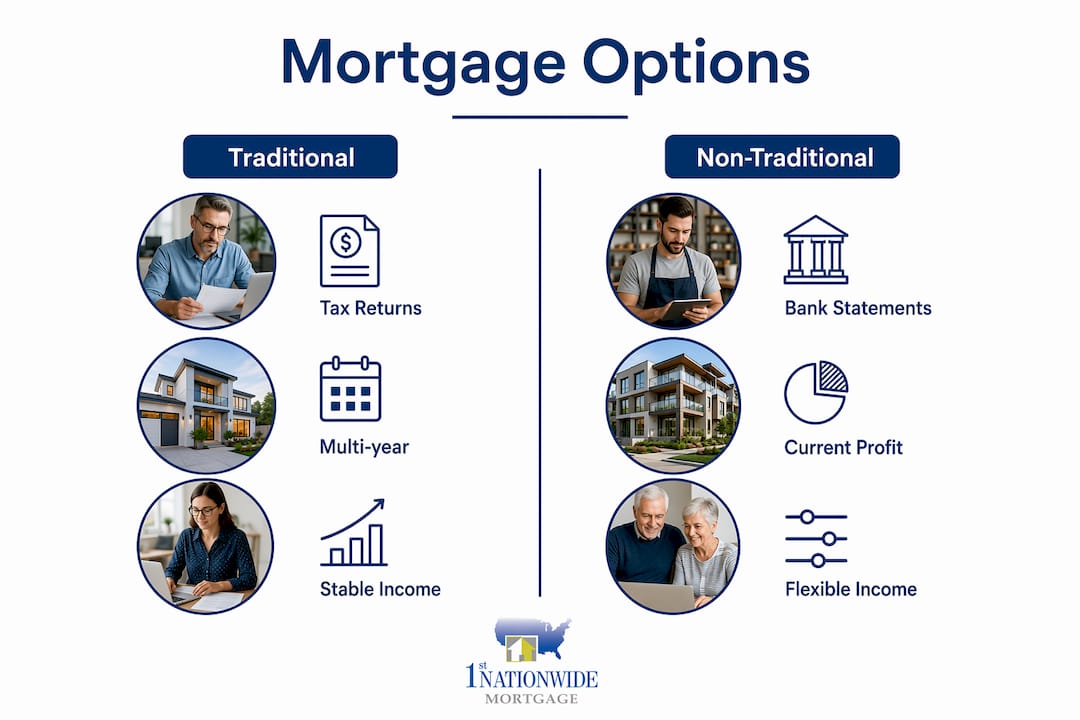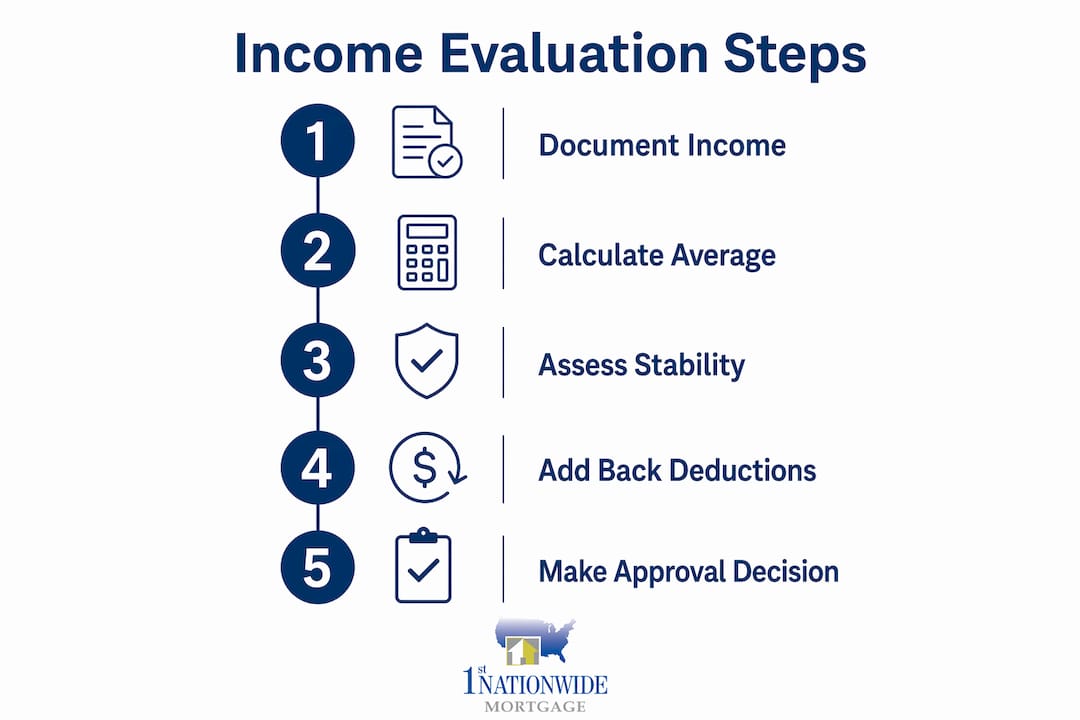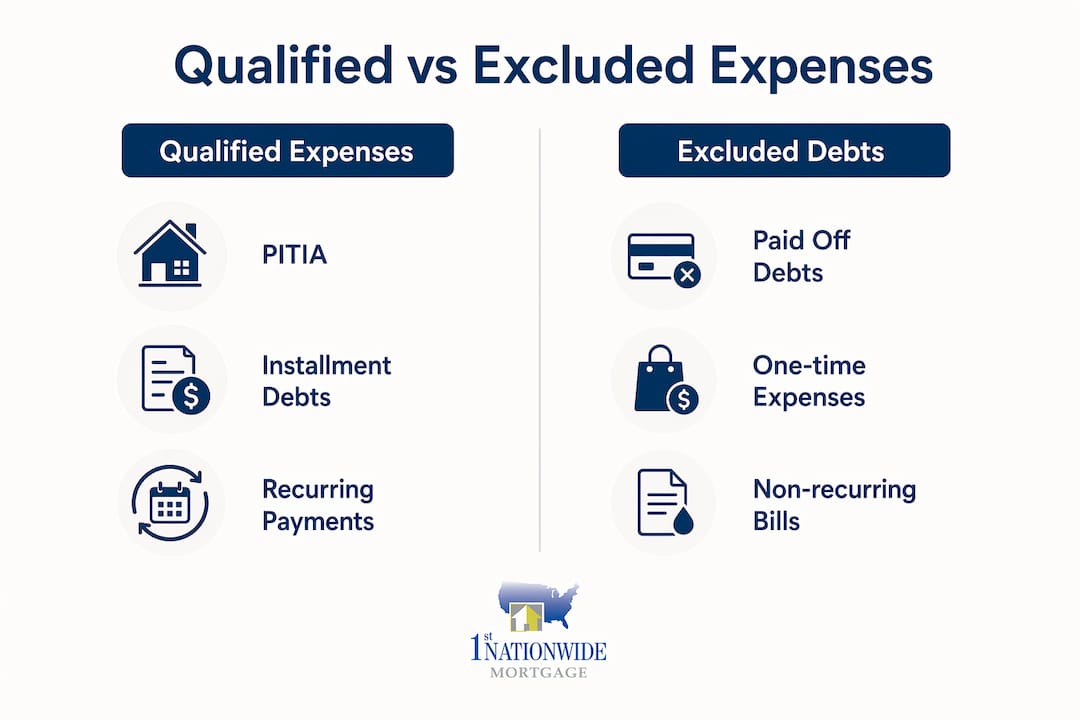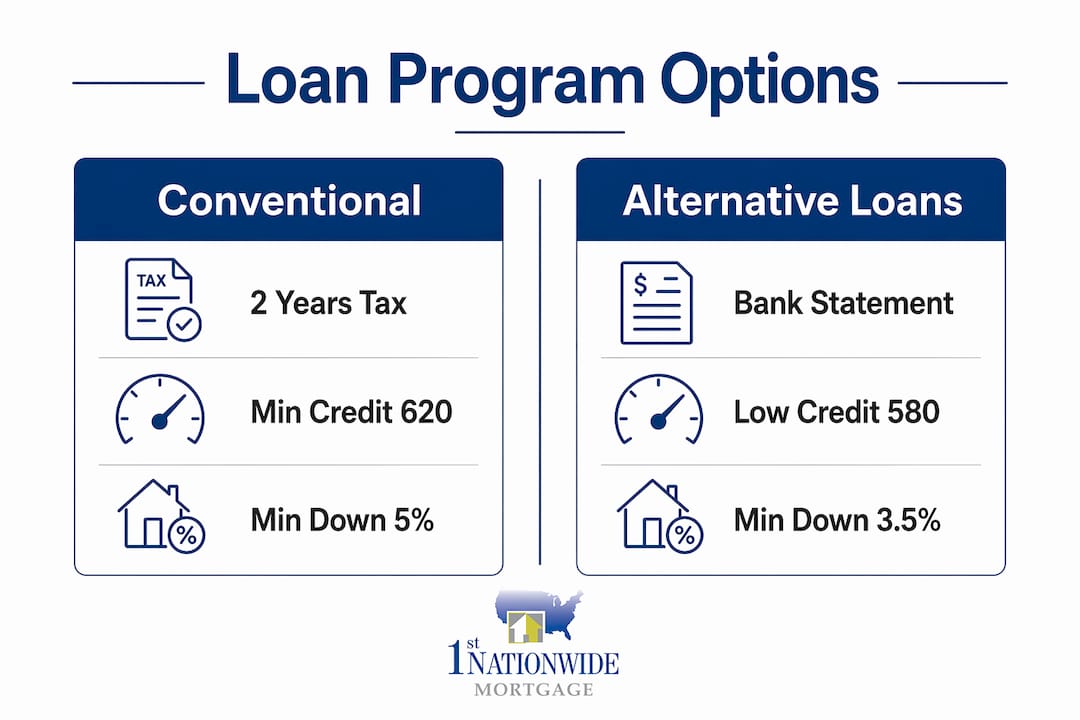

Blog

  • Mortgage Pre-Qualification Explained for Homebuyers

    Mortgage Pre-Qualification Explained for Homebuyers

    Mortgage pre-qualification is defined as a lender’s early estimate of how much you may be able to borrow, based on financial information you provide without formal document verification. This estimate gives you a working budget before you start house hunting, and it does not trigger a Loan Estimate under federal TRID regulations because no property address or verified documentation is involved. Pre-qualification differs from pre-approval, which requires a hard credit pull, income documentation, and underwriting analysis. Knowing the difference between these two steps protects you from overestimating your buying power and helps you move through the homebuying process with realistic expectations.

    How does mortgage pre-qualification work?

    Pre-qualification is built almost entirely on information you supply. You tell a lender your estimated income, monthly debts, and available assets. The lender uses those figures, along with general debt-to-income ratio guidelines, to produce a rough loan amount estimate. No appraisal, no underwriting review, and no hard credit pull occur at this stage.

    Mortgage banker reviewing client financial documents

    Because the process relies on self-reported data, the estimate is only as accurate as the numbers you provide. If you underestimate your monthly debt obligations or overstate your income, the resulting figure will be off. Lenders treat pre-qualification as a directional opinion, not a financial commitment. The informal nature of pre-qualification means no regulatory disclosures are required, unlike the formal Loan Estimate triggered later in the process.

    What lenders typically ask for during pre-qualification:

    • Gross monthly income: Your salary, self-employment income, or rental income before taxes
    • Monthly debt payments: Car loans, student loans, credit card minimums, and other recurring obligations
    • Estimated assets: Savings, checking, and retirement account balances
    • Desired loan amount or purchase price range: Helps the lender frame the estimate
    • Credit score range: Sometimes requested, though usually not verified at this stage

    Pro Tip: Ask your lender directly whether they ran a soft credit check or used only self-reported figures. Some lenders pull a soft inquiry during pre-qualification, which gives a more accurate picture without affecting your credit score.

    What is the difference between pre-qualification and pre-approval?

    Pre-qualification is informal and unverified. Pre-approval is documented, verified, and far closer to a conditional loan commitment. The distinction matters because sellers typically prefer pre-approval letters over pre-qualification letters when evaluating offers. A pre-qualification letter signals interest. A pre-approval letter signals financial credibility.

    Pre-approval requires you to submit pay stubs, W-2s, tax returns, bank statements, and authorization for a hard credit pull. The lender’s underwriting team reviews those documents and issues a letter specifying a loan amount, loan type, and conditions. Even then, pre-approval remains conditional, subject to a satisfactory appraisal, title search, and final underwriting sign-off before closing.

    The table below summarizes the core differences:

    Feature Pre-qualification Pre-approval
    Data source Self-reported by borrower Verified documents submitted
    Credit check Usually none or soft inquiry Hard credit pull required
    Income verification None Pay stubs, W-2s, tax returns
    Lender commitment None Conditional commitment
    Seller perception Weak signal Strong signal of readiness
    TRID Loan Estimate Not triggered May be triggered
    Typical use Budget planning Making serious purchase offers

    Infographic comparing pre-qualification and pre-approval

    One practical point worth understanding: mortgage industry experts note that lenders sometimes use “pre-qualification” and “pre-approval” interchangeably, which creates real confusion for buyers. Always ask your lender exactly what data they reviewed and whether any verification occurred. That single question tells you which category your letter actually falls into.

    For self-employed borrowers, the gap between pre-qualification and pre-approval is especially significant. Standard income documentation may not reflect actual earnings. Understanding self-employed mortgage qualification early helps you prepare the right documents before moving to pre-approval.

    What are the benefits and limitations of mortgage pre-qualification?

    Pre-qualification delivers real value when used correctly. Its primary benefit is early budget clarity. Knowing your approximate price range before you tour homes prevents you from falling in love with a property you cannot finance. It also opens a productive conversation with a loan officer about your financial profile and what steps to take before applying formally.

    Additional benefits include:

    • No credit score impact: Pre-qualification does not affect your credit score since it typically skips the hard credit inquiry.
    • Fast turnaround: You can often get a pre-qualification estimate the same day, sometimes within minutes online.
    • Financial gap identification: A lender may flag a debt-to-income ratio that is too high or a credit score range that needs improvement before you apply.
    • Lender comparison: You can speak with multiple lenders during pre-qualification without the credit impact that comes from multiple hard pulls.

    The limitations are equally real. A pre-qualification letter carries no evidentiary weight with most sellers in a competitive market. It does not guarantee you will qualify for the loan amount stated. If your self-reported income was higher than what your tax returns show, the estimate will not survive the pre-approval process.

    The most common misconception is treating a pre-qualification letter as a firm loan offer. It is not. Misinterpreting pre-qualification as a guarantee leads buyers to pursue homes outside their real financial reach, which wastes time and risks failed offers.

    Pro Tip: Before you start touring homes, ask your lender what it would take to move from pre-qualification to pre-approval. That conversation reveals exactly what documents you need and how long the process will take.

    How do you get pre-qualified for a mortgage?

    Getting pre-qualified is straightforward. You can do it by phone, through an online form, or in person with a loan officer. The entire process typically takes less than an hour. Here is what to expect, step by step:

    1. Gather your financial information. Pull together your estimated gross monthly income, a list of monthly debt payments, and approximate balances in your savings and checking accounts. You do not need official documents yet, but having accurate numbers matters.

    2. Choose how to connect with a lender. Online pre-qualification forms are fast and available around the clock. Phone conversations with a loan officer give you the chance to ask questions in real time. In-person meetings work well if you have a complex financial picture.

    3. Provide your information. The lender will ask about income, debts, assets, and sometimes your estimated credit score range. Answer as accurately as possible. Inflated numbers produce an inflated estimate that will not hold up later.

    4. Receive your estimate. The lender returns a loan amount range or maximum purchase price based on your inputs. This figure reflects standard debt-to-income ratio thresholds and general credit guidelines, not a verified review of your finances.

    5. Ask clarifying questions. Find out whether a soft credit check was run, what loan programs you may qualify for, and what the next steps toward pre-approval look like. Understanding what lenders verify during pre-approval helps you prepare now.

    6. Use the estimate to set your budget. Shop for homes within a price range that gives you a comfortable cushion below the maximum estimate. This protects you if your verified income or credit comes in slightly lower during pre-approval.

    The 100% of final loan underwriting only happens after you identify a property and go under contract. Pre-qualification is the starting line, not the finish line.

    Key Takeaways

    Mortgage pre-qualification is an unverified, self-reported estimate that sets your budget but carries no lender commitment and holds little weight with sellers compared to pre-approval.

    Point Details
    Pre-qualification is unverified Estimates rely on self-reported data with no document review or hard credit pull.
    Pre-approval carries more weight Sellers and agents treat pre-approval as proof of financing readiness.
    No credit score impact Pre-qualification skips the hard inquiry, so your score stays intact.
    Accuracy depends on you Inflated income or understated debts produce an estimate that will not survive pre-approval.
    Use it as a starting point Pre-qualification sets your budget; pre-approval is required before making serious offers.

    What I’ve learned after years of watching buyers misread pre-qualification

    Most buyers I work with come in thinking their pre-qualification letter is nearly as good as a loan approval. It is not, and that misunderstanding costs people real opportunities in competitive markets.

    Pre-qualification is a conversation, not a commitment. I have seen buyers tour homes at the top of their pre-qualification range, fall in love with a property, and then discover during pre-approval that their actual qualifying income was lower because of tax write-offs or undisclosed debts. That gap between expectation and reality is painful and avoidable.

    My honest advice: treat pre-qualification as a diagnostic tool. Use it to identify what needs to improve before you apply formally. If your debt-to-income ratio is too high, you now know to pay down a loan. If your credit score range is borderline, you have time to address it. The borrowers who move smoothly from pre-qualification to pre-approval are the ones who used the pre-qualification conversation to ask hard questions, not just collect a number.

    The right time to move from pre-qualification to pre-approval is before you make your first serious offer. Not after you find the house you want. By then, you are racing the clock.

    — Chris Arco, NMLS #1281

    Ready to move from estimate to approval with 1st Nationwide Mortgage?

    Pre-qualification gives you a starting number. 1st Nationwide Mortgage helps you turn that number into a real loan.

    https://1stnwm.com

    Use the mortgage calculators at 1st Nationwide Mortgage to run your own affordability estimates before you speak with a loan officer. When you are ready to take the next step, the team at 1st Nationwide Mortgage reviews your full financial picture and matches you with the right program. Whether you need a conventional loan, a bank statement mortgage for self-employment income, or a DSCR loan for an investment property, 1st Nationwide Mortgage works directly as a lender, not a broker, across 18 licensed states. Explore the full range of loan programs and connect with a loan officer who can walk you from pre-qualification to closing.

    FAQ

    What is mortgage pre-qualification?

    Mortgage pre-qualification is a lender’s informal estimate of how much you may be able to borrow, based on self-reported income, debts, and assets without document verification or a hard credit pull.

    Does pre-qualification hurt your credit score?

    Pre-qualification typically does not affect your credit score because it does not involve a hard credit inquiry. Credit inquiries for mortgage lending grouped within a 45-day window minimize score impact if you later apply with multiple lenders.

    How long does mortgage pre-qualification take?

    Pre-qualification usually takes less than an hour and can be completed online, by phone, or in person. You receive a loan amount estimate the same day in most cases.

    Can I make an offer on a home with only a pre-qualification letter?

    You can submit an offer, but sellers generally prefer pre-approval letters because pre-approval involves verified income and credit. In competitive markets, a pre-qualification letter alone may not be enough to have your offer taken seriously.

    What documents do I need for mortgage pre-qualification?

    Pre-qualification typically requires no official documents. You provide estimated figures for income, monthly debts, and assets. Preparing accurate numbers in advance produces a more reliable estimate and speeds up the move to pre-approval.

  • How Lenders Assess Seasonal Freelance Income

    How Lenders Assess Seasonal Freelance Income

    Lenders assess seasonal freelance income by requiring a minimum two-year documented history, then averaging net profit after specific expense adjustments to determine a stable qualifying figure. This process, formally called self-employed income analysis, goes far beyond simply adding up your deposits. Underwriters apply Fannie Mae guidelines, cash flow worksheets, and expense factors to arrive at a number that reflects what you can reliably repay, not what your best month looked like. If you earn as a photographer, landscaper, tax preparer, or any other seasonal freelancer, knowing this process before you apply changes everything.

    How lenders assess seasonal freelance income: the two-year rule

    The two-year minimum is the single most important threshold in seasonal income underwriting. Without at least 24 months of documented earnings, lenders exclude that income from qualification entirely. This applies across conventional, FHA, VA, and most non-agency loan programs.

    The logic behind this rule is straightforward. A single year of freelance income could be a fluke, a windfall project, or a business that has not yet proven it can survive an off-season. Two years of tax returns show a pattern. They reveal whether your income is growing, shrinking, or holding steady across multiple seasonal cycles.

    What happens if you have less than two years of history? Your options narrow, but they do not disappear:

    • Less than one year: Income is almost always excluded from conventional qualification.
    • One to two years: Some lenders may consider it with strong compensating factors, such as a high credit score, large reserves, or a low debt-to-income ratio.
    • Alternative programs: Bank statement loans analyze 12–24 months of deposits instead of tax returns, making them a practical path for newer freelancers.

    Pro Tip: Start building your paper trail the moment you go freelance. Open a dedicated business bank account, file Schedule C every year, and keep your tax returns organized. Every month of documented history you accumulate now is a month closer to conventional qualification.

    How do lenders calculate qualifying income from seasonal earnings?

    Gross revenue is not qualifying income. Lenders focus on net profit after deductions, then make specific adjustments to reflect your actual cash flow. The calculation follows a defined sequence.

    1. Pull two years of Schedule C (or business tax returns). The underwriter starts with your net profit from IRS Form 1040 Schedule C for each of the past two years.
    2. Add back non-cash deductions. Depreciation and amortization are added back because they reduce taxable income without actually reducing your cash. The same applies to one-time business losses that will not recur.
    3. Subtract non-recurring income. A single large contract that inflated one year’s earnings gets removed. Lenders want income you can replicate.
    4. Average the two years. The adjusted figures from both years are added together and divided by 24 to produce a monthly qualifying income figure.
    5. Apply Fannie Mae Form 1084. This cash flow analysis worksheet standardizes the calculation across conventional loans, reducing underwriter discretion and making the process predictable.

    The result can be significantly lower than your gross deposits, which surprises many freelancers. A photographer who deposited $120,000 last year but wrote off $60,000 in equipment, travel, and software may qualify on only $50,000 or less after the full adjustment process.

    Income type How lenders treat it
    Net profit (Schedule C) Primary qualifying figure after adjustments
    Depreciation Added back to net profit
    Non-recurring income Subtracted from qualifying total
    Gross deposits (bank statement loan) Reduced by 50% expense factor, or 35–40% with CPA-certified P&L

    Infographic showing steps to qualify seasonal freelance income

    Pro Tip: Work with a CPA who understands mortgage qualification before you file your taxes. A CPA-prepared profit and loss statement can lower the expense factor on a bank statement loan from 50% to as low as 35%, which meaningfully increases your qualifying income.

    What income stability signals do lenders look for?

    Stability is the word underwriters use most when evaluating seasonal freelancers. Predictable recurring annual cycles signal a viable business. Sporadic or irregular patterns signal risk.

    Hands pointing at income graphs in client meeting

    The distinction matters in practice. A landscaper who earns $80,000 every spring and summer, then earns little in winter, demonstrates a predictable cycle. An underwriter can see that pattern repeat across two years and treat it as stable. A freelancer who earned $90,000 one year from a single large client, then $30,000 the next, presents a very different picture.

    The most critical stability threshold is the year-over-year income decline rule:

    • An income decline greater than 20% year-over-year may disqualify the borrower entirely, or force the lender to use only the lower year’s income for qualification.
    • A modest decline under 10% is generally acceptable with a written explanation.
    • Increasing income across both years is the strongest possible signal and often allows the lender to use the two-year average without additional scrutiny.

    Underwriters are not just checking whether you made money. They are checking whether your business has a reason to keep making money. A seasonal freelancer who can show consistent clients, recurring contracts, and year-over-year stability gives the underwriter a story they can approve.

    Documentation that supports business viability year-round strengthens your file even during off-season months. Business licenses, client contracts, professional memberships, and a letter from your CPA confirming ongoing operations all help. The loan process for seasonal freelancers requires more thorough cash flow analysis than a standard W-2 review, and the supporting documents you provide shape that analysis directly.

    What documents do lenders require, and what alternatives exist?

    Standard documentation for seasonal freelance income qualification includes:

    • Two years of federal tax returns (personal and business, including all schedules)
    • Year-to-date profit and loss statement, ideally prepared by a CPA
    • Two to three months of business and personal bank statements
    • Business license or proof of self-employment
    • Evidence of seasonal work patterns, such as contracts, invoices, or client letters

    A detailed, accountant-prepared P&L demonstrates off-season cash flow management and reserves, which directly supports income reliability in the underwriter’s eyes. Freelancers who own 25% or more of their business are classified as self-employed under Fannie Mae guidelines and face the full self-employed documentation requirements, not the lighter seasonal employee standards.

    When tax returns show low net income because of aggressive write-offs, bank statement loans offer a practical alternative. These programs analyze 12–24 months of deposits and apply an expense factor to calculate qualifying income, bypassing the tax return entirely.

    Documentation type Conventional loan Bank statement loan
    Tax returns (2 years) Required Not required
    Bank statements (12–24 months) Supplemental Primary income document
    CPA-prepared P&L Helpful Can reduce expense factor to 35–40%
    Business license Required Required
    Year-to-date P&L Required Required

    Bank statement loan programs use a standard 50% expense factor on business account deposits. With a CPA-certified P&L, that factor can drop to 35–40%, which increases qualifying income without changing your actual earnings. For a freelancer with $150,000 in annual deposits, the difference between a 50% and a 35% expense factor is $22,500 in additional qualifying income per year. That gap can determine whether you qualify or not. For a deeper look at how these programs work in 2026, the variable income qualification guide covers current thresholds and documentation requirements in detail.

    My honest read on seasonal income and mortgage qualification

    By Chris Arco, NMLS #1281

    The freelancers who struggle most with mortgage qualification are not the ones with low income. They are the ones with good income that their tax returns do not show. Aggressive write-offs are a smart tax strategy right up until the moment you apply for a mortgage. Then they become a liability.

    The most common mistake I see is freelancers filing taxes to minimize their tax bill for years, then expecting a lender to approve them based on what they actually deposited. Underwriting does not work that way. The qualifying income number comes from your tax returns, not your bank account, unless you specifically choose a bank statement loan program.

    The second mistake is waiting too long to plan. Seasonal freelancers who want to buy a home in the next 12–18 months should be thinking about their tax strategy now, not after they file. A CPA who understands mortgage qualification can help you find the right balance between tax efficiency and qualifying income. That conversation is worth more than any rate negotiation.

    The third thing I would tell any seasonal freelancer: your income pattern matters as much as your income level. Two years of consistent, predictable earnings in your field is a stronger file than three years of erratic numbers. Build the pattern deliberately. Keep your business accounts clean. Document your off-season activity. When you sit down with an underwriter, you want your file to tell a clear, repeatable story.

    — Chris Arco, NMLS #1281

    Seasonal freelancers and 1st Nationwide Mortgage loan programs

    Qualifying for a mortgage with seasonal income is achievable when you work with a lender who understands how self-employed income actually works. 1st Nationwide Mortgage is a direct mortgage banker, not a broker, licensed in 18 states and rated A+ by the BBB.

    https://1stnwm.com

    The bank statement mortgage program at 1st Nationwide Mortgage is built specifically for self-employed borrowers whose tax returns understate their real income. Deposits from 12 or 24 months replace tax returns as the qualifying document, with a minimum 620 credit score and 10–20% down. Use the bank statement income calculator to estimate your qualifying income before you apply. It takes your deposit totals and applies the appropriate expense factor so you know exactly where you stand. Reach out to 1st Nationwide Mortgage directly to discuss which program fits your income structure and timeline.

    Key takeaways

    Lenders qualify seasonal freelancers by averaging two years of adjusted net income, and bank statement loans offer a direct alternative when tax returns understate actual earnings.

    Point Details
    Two-year history is mandatory Without 24 months of documented income, lenders exclude seasonal earnings from qualification.
    Net profit drives the number Gross deposits do not qualify; lenders average adjusted net profit after adding back depreciation and removing one-time income.
    Stability matters as much as income A year-over-year decline greater than 20% can disqualify a borrower or force use of the lower income year.
    CPA-prepared P&L reduces expense factor A certified profit and loss statement can lower the bank statement loan expense factor from 50% to 35–40%, increasing qualifying income.
    Bank statement loans bypass tax returns Freelancers with high write-offs can qualify using 12–24 months of deposits instead of Schedule C net profit.

    FAQ

    How much income history do lenders require for seasonal freelancers?

    Lenders require a minimum of two years of documented income history for seasonal freelance earnings to count toward mortgage qualification. Without it, the income is excluded from the qualifying calculation entirely.

    What is the expense factor on a bank statement loan?

    The standard expense factor is 50% on business account deposits, meaning lenders count half of your total deposits as qualifying income. A CPA-certified profit and loss statement can reduce that factor to 35–40%, increasing your qualifying income.

    Can a year-over-year income decline disqualify a seasonal freelancer?

    A decline greater than 20% year-over-year may disqualify the borrower or require the lender to use only the lower year’s income for qualification. Smaller declines are generally acceptable with a written explanation.

    What documents do seasonal freelancers need to apply for a mortgage?

    The standard package includes two years of federal tax returns, a year-to-date profit and loss statement, two to three months of bank statements, a business license, and evidence of ongoing seasonal work such as contracts or client letters.

    What makes seasonal income different from irregular freelance income?

    Seasonal income follows a predictable annual cycle tied to a specific time of year, such as summer landscaping or holiday retail work. Irregular freelance income lacks that pattern, and underwriters treat unpredictable income as a higher qualification risk.

  • Foreign National Mortgage Qualification Factors Explained

    Foreign National Mortgage Qualification Factors Explained

    Foreign national mortgage qualification factors are the specific criteria lenders use to determine whether a non-citizen can secure financing for a U.S. investment property. These factors cover legal residency status, income verification, credit history, and documentation requirements. Unlike standard U.S. mortgages, foreign national loans fall outside Fannie Mae and Freddie Mac guidelines, which means lenders apply stricter standards and require alternative documentation. Understanding what lenders evaluate before you apply puts you in a much stronger position to close successfully.

    Legal residency status is the first factor every lender evaluates. Your visa type and immigration category determine which loan programs you can access and what documentation you must provide.

    Permanent and non-permanent residents follow different qualification pathways. Permanent residents with a green card generally follow standard U.S. lending guidelines. Non-permanent residents face stricter income and legal verification requirements because lenders must confirm that your right to remain in the country extends far enough to support the loan term.

    Accepted visa types include:

    • H-1B (specialty occupation workers)
    • L-1 (intracompany transferees)
    • E-2 (treaty investors)
    • F-1 (students, who must also provide an I-20 and employment authorization document)
    • O-1 (individuals with extraordinary ability)

    Lenders scrutinize visa expiration dates carefully. If your visa expires within 12 months of the loan closing date, most lenders will require evidence of renewal or a history of prior renewals. USCIS documentation must be current and match the name on all financial records exactly.

    Pro Tip: Get certified copies of all USCIS forms before you start the application. Discrepancies between your visa name and your bank account name are one of the most common causes of processing delays.

    2. What income verification methods do lenders accept for foreign nationals?

    Income verification for foreign nationals requires more documentation than a standard U.S. mortgage. Lenders need to confirm that your income is real, stable, and likely to continue for at least three years after closing.

    Man highlighting foreign income documents in bank

    Stable income for three years post-closing is a common lender requirement for non-permanent residents. That standard exists because lenders are underwriting a long-term obligation and need confidence that your income source will not disappear.

    Accepted income documentation typically includes:

    • Foreign pay stubs (last 30 days, with certified English translations)
    • Two years of foreign tax returns or business tax returns
    • Foreign bank statements showing 12–24 months of deposits
    • Retirement or pension income statements
    • Business income documentation for self-employed borrowers

    All foreign-language documents must be accompanied by certified English translations. Notarized translations carry more weight with underwriters than informal translations. If your income comes from a foreign business, lenders may also request a letter from a licensed accountant confirming the business’s operating status and your ownership percentage.

    Pro Tip: Open a U.S. bank account at least six months before applying. Transferring funds into a domestic account creates a paper trail that simplifies reserve verification and reduces underwriter questions.

    3. How do credit history and international credit reports impact approval chances?

    Most foreign nationals have no U.S. credit score. That is not automatically disqualifying, but it does require you to substitute alternative credit references that lenders can evaluate in place of a FICO score.

    Lenders accept international credit references including bank reference letters, global credit bureau reports, and character references from licensed professionals. The threshold varies by country of origin. Canadian borrowers typically need a credit score of 700 or above, while U.K. borrowers generally need 720 or above with no County Court Judgments on record.

    Here is how lenders typically rank alternative credit evidence:

    1. Official credit bureau report from your home country (strongest option)
    2. Bank reference letter from a major financial institution confirming account standing and payment history
    3. Mortgage payment history from a foreign lender showing on-time payments
    4. Utility and rental payment records spanning 12–24 months
    5. Character reference from a licensed attorney, CPA, or financial professional

    Because foreign national loans do not meet standard guidelines set by Fannie Mae or Freddie Mac, they are classified as non-qualified mortgages. That classification means lenders price in additional risk, which shows up in higher interest rates and stricter underwriting criteria compared to conforming loans.

    Foreign national mortgage applications require a specific set of documents that go beyond what a U.S. citizen would submit. Missing even one item can stall your closing by weeks.

    Standard documentation for a foreign national mortgage application includes a valid government-issued passport, proof of foreign residency such as a utility bill, and certified English translations for all financial records. Processing times for these specialized loans typically run 45–60 days. That timeline is longer than a conventional loan, so planning ahead is critical.

    One legal step that surprises many foreign buyers is LLC formation. Forming a U.S. LLC is often a legal prerequisite for closing on an investment property because it satisfies FIRPTA withholding and tax compliance requirements. LLC formation costs range from $500 to $2,500 depending on the state and legal counsel involved. The LLC must be established during the Letter of Intent phase, not at closing, or you risk delaying the entire transaction.

    Document Purpose
    Valid passport Primary identity verification
    Visa or green card Confirms legal entry and residency status
    Proof of foreign residency Utility bill or bank statement from home country
    Certified income translations Validates foreign pay stubs, tax returns, and bank records
    U.S. LLC formation documents Required for FIRPTA compliance on investment properties

    Pro Tip: Hire a U.S.-licensed real estate attorney before you make an offer. They can set up your LLC, review FIRPTA implications, and coordinate with your lender so nothing falls through the cracks at closing.

    5. Which specialized mortgage programs serve foreign nationals best?

    Most retail banks and credit unions do not offer foreign national loans. These loans are only accessible through specialized wholesale lenders and mortgage bankers who understand the non-QM market and have built programs specifically for international borrowers.

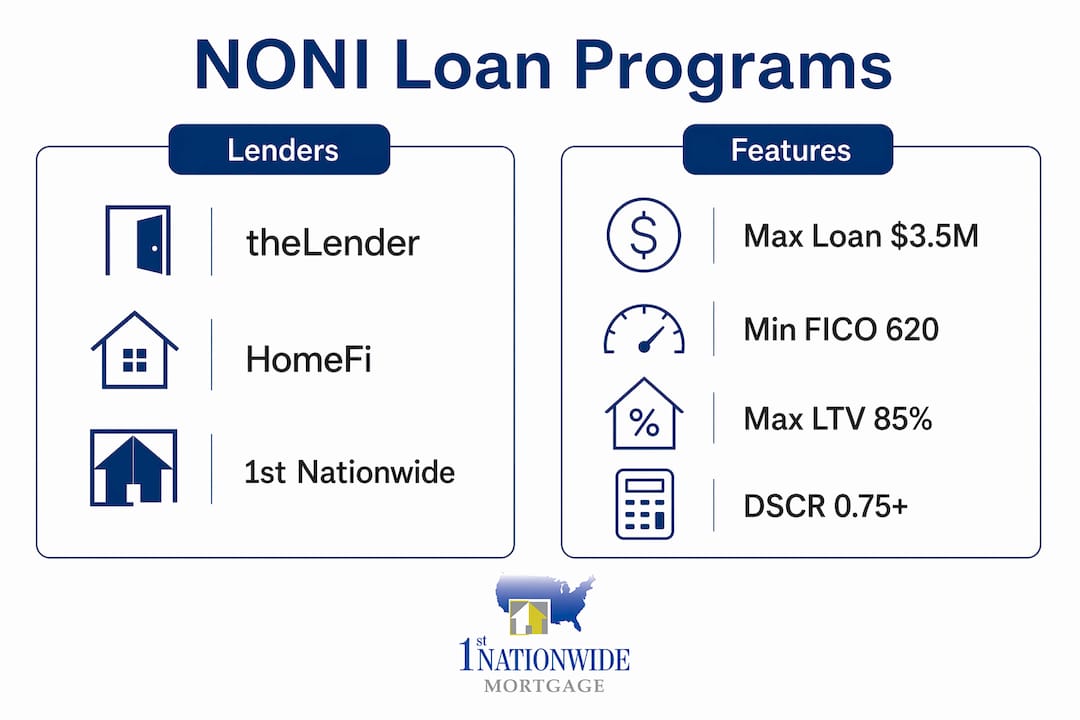
    The two most common program types for foreign nationals are DSCR loans and NONI loans. A DSCR (Debt Service Coverage Ratio) loan qualifies the property based on its rental income rather than your personal income. If the property generates enough rent to cover the mortgage payment, you qualify. This structure works well for investment properties and eliminates the need to document personal income from a foreign employer. DSCR loans also work for LLCs, which aligns with the entity structure most foreign nationals use for FIRPTA compliance.

    A NONI (No Income, No Asset) loan goes one step further. It requires no income documentation and no asset verification. 1st Nationwide Mortgage offers a NONI loan program specifically designed for foreign nationals who cannot document income through traditional channels.

    Key program features to compare when evaluating your options:

    • Down payment: Most foreign national programs require at least 20% down, with some lenders requiring 25–30% for non-permanent residents
    • Interest rates: Expect rates above conforming loan levels, reflecting the non-QM classification and additional compliance requirements
    • Loan limits: Jumbo amounts are available through select wholesale lenders
    • Entity eligibility: DSCR programs typically allow LLC borrowers, which is the preferred structure for foreign nationals

    Working with a mortgage banker who has direct access to wholesale lender channels gives you the widest range of program options. A lender who specializes in investment property financing for foreign nationals can match your residency status and credit profile to the right program from the start.

    Key takeaways

    Foreign national mortgage qualification depends on meeting specific legal, income, credit, and documentation standards that differ significantly from conventional U.S. lending requirements.

    Point Details
    Residency status drives eligibility Permanent residents follow standard guidelines; non-permanent residents face stricter income and visa documentation requirements.
    Income must show three-year stability Lenders require evidence that foreign income will continue for at least three years post-closing.
    Alternative credit references are accepted Bank letters, foreign bureau reports, and payment histories substitute for a U.S. credit score.
    LLC formation is a legal prerequisite Form your U.S. LLC during the Letter of Intent phase to satisfy FIRPTA rules and avoid closing delays.
    Specialized lenders are required Retail banks rarely offer these loans; non-QM wholesale lenders and direct mortgage bankers are the right channel.

    What I have learned from working with foreign national borrowers

    Working with foreign national borrowers has taught me one consistent lesson: the biggest obstacle is almost never the borrower’s financial strength. It is preparation.

    The foreign nationals who close smoothly are the ones who treat the mortgage process like a business project. They gather certified translations before the lender asks. They form their LLC at the Letter of Intent stage, not two weeks before closing. They open a U.S. bank account months in advance so their reserves are easy to verify. The ones who struggle are often just as financially qualified, but they underestimate how much documentation the process requires and how little room there is for last-minute scrambling.

    I also think the non-QM label scares people unnecessarily. Yes, foreign national loans carry higher rates than conforming loans. That is a real cost. But for an investor buying a cash-flowing rental property, the rate is one variable in a larger return calculation. The question is not whether the rate is higher than a 30-year fixed. The question is whether the property generates enough income to make the investment worthwhile. For most of the foreign national borrowers I work with, the answer is yes.

    My strongest advice is to start the legal and documentation work at least 90 days before you plan to make an offer. That window gives you time to form your LLC, gather certified translations, establish U.S. banking history, and connect with a lender who actually understands your situation. Foreign national mortgage qualification is achievable. It just rewards people who plan ahead.

    — Chris Arco, NMLS #1281

    How 1st Nationwide Mortgage helps foreign nationals finance U.S. properties

    1st Nationwide Mortgage is a direct mortgage banker, not a broker, with specialized experience working with foreign national borrowers. The firm offers DSCR loans, NONI loans, and other non-QM programs designed for international investors who cannot qualify through conventional channels.

    https://1stnwm.com

    If you are a foreign national looking to finance a U.S. investment property, the investment property mortgage page outlines the programs and qualification criteria in detail. 1st Nationwide Mortgage works directly with wholesale lender channels to match your residency status, income profile, and property type to the right loan program. Contact 1st Nationwide Mortgage to schedule a consultation and get a clear picture of what you qualify for before you make an offer.

    FAQ

    What is a foreign national mortgage?

    A foreign national mortgage is a loan made to a non-U.S. citizen who lacks a Social Security number or U.S. credit history. These loans are classified as non-qualified mortgages and are only available through specialized lenders.

    How much do foreign nationals need to put down on a U.S. property?

    Most foreign national loan programs require a minimum down payment of 20%, with some lenders requiring 25–30% depending on residency status and credit profile.

    Can a foreign national qualify without a U.S. credit score?

    Yes. Lenders accept alternative credit references including foreign credit bureau reports, bank reference letters, and documented payment histories from foreign lenders or landlords.

    What is a DSCR loan and why does it suit foreign nationals?

    A DSCR loan qualifies the borrower based on the property’s rental income rather than personal income. This structure removes the need to document foreign employment income, making it one of the most practical options for international real estate investors.

    How long does a foreign national mortgage take to close?

    Processing times for foreign national mortgage loans typically run 45–60 days, longer than a conventional loan, due to the additional documentation and compliance requirements involved.

  • Alternative Mortgage Qualification Criteria for Freelancers

    Alternative Mortgage Qualification Criteria for Freelancers

    Alternative mortgage qualification criteria for freelancers are defined as income verification methods that replace traditional W-2 documentation with bank statements, profit-and-loss statements, or other flexible evidence of cash flow. Fannie Mae and Freddie Mac set the two-year self-employment benchmark as the industry standard for self-employed borrowers. Most freelancers fail conventional qualification not because their income is insufficient, but because their tax returns understate it after deductions. The good news: lenders have built entire loan categories around this exact problem. Understanding which path fits your financial profile is the first step toward approval.

    1. What are alternative mortgage qualification criteria for freelancers?

    Alternative mortgage qualification criteria are underwriting standards that accept non-traditional income proof in place of W-2s and tax returns. They exist because conventional loans, which follow Fannie Mae and Freddie Mac guidelines, calculate qualifying income from net profit after deductions. Freelancers who write off legitimate business expenses often show taxable income far below their actual earnings.

    The most common alternative paths include bank statement loans, profit-and-loss statement loans, and 1099-based programs. Each path has its own documentation rules, credit thresholds, and cost structure. Knowing which one fits your situation before you apply saves time and protects your credit score from unnecessary inquiries.

    Hands sorting mortgage financial documents overhead

    2. Bank statement loans: how they work and who qualifies

    Bank statement loans are non-QM mortgage products that calculate your income from 12 to 24 months of bank deposits rather than tax returns. The lender applies an expense factor to your gross deposits to estimate net income. At 1st Nationwide Mortgage, the standard expense factor on business accounts is 50%, which can drop to 35–40% with a CPA-certified profit-and-loss statement.

    Key qualification criteria for bank statement loans include:

    • Bank statements: 12 or 24 months of personal or business account statements
    • Credit score: Minimum 620, though higher scores improve rate pricing
    • Down payment: Typically 10–20% of the purchase price
    • Income calculation: Gross deposits multiplied by the applicable expense factor
    • Consistency: Deposits must show a stable or growing pattern across the statement period

    Non-QM bank statement loans carry higher interest rates and closing costs than conventional loans. That tradeoff is worth it when your tax returns show too little income to qualify conventionally.

    Pro Tip: Avoid large, irregular deposits in the 12–24 months before applying. Underwriters flag unexplained spikes as non-recurring income and exclude them from the calculation.

    3. Using profit-and-loss statements for mortgage qualification

    A profit-and-loss statement, or P&L, is a financial summary showing your revenue, expenses, and net income over a set period. Lenders use it to verify that your cash flow is real and consistent, especially when bank deposits alone do not tell a complete picture. A CPA-prepared P&L carries significantly more weight than a self-prepared one.

    The documents that lenders cross-reference when reviewing a P&L include:

    • Tax returns: Schedule C or business returns for the past one to two years
    • Bank statements: To confirm that deposits match reported revenue
    • Invoices or contracts: To support income claims for ongoing client work
    • Business license or CPA letter: To confirm active self-employment status

    Applicants whose documents tell a consistent story avoid underwriting red flags and additional scrutiny. A P&L that shows $120,000 in revenue while bank statements show $80,000 in deposits will trigger questions. Alignment across all three document types is what moves an application forward.

    Pro Tip: Prepare your P&L before you start shopping for a home. A CPA-certified statement dated within 60 days of application is the most lender-friendly format.

    4. Credit and financial requirements for alternative mortgage paths

    Credit score minimums for non-QM loans sit around 620, though some lenders accept scores as low as 500 with compensating factors such as a larger down payment or significant cash reserves. Lower scores come with higher rates. A score above 700 meaningfully improves your pricing on alternative products.

    Debt-to-income ratios must typically stay below 43% for most alternative mortgage programs. Lenders calculate DTI using the income derived from your bank statements or P&L, not your gross revenue. Irregular income patterns require lenders to average your earnings, which can compress your qualifying DTI.

    Loan type Min. credit score Down payment DTI limit
    Conventional (tax return) 620+ 3–20% 43–45%
    Bank statement loan 620+ 10–20% 43–50%
    P&L-based loan 620+ 10–20% 43–50%
    1099 income loan 620+ 10–20% 43–50%

    Cash reserves matter more for freelancers than for salaried borrowers. Lenders want to see that you can cover several months of mortgage payments if client work slows. Twelve months of reserves strengthens any alternative mortgage application.

    5. How lenders assess self-employment history and income stability

    The two-year self-employment requirement from Fannie Mae and Freddie Mac is the baseline for conventional loans. It signals to lenders that your freelance income is established, not experimental. Alternative loan programs often follow the same standard, though some allow exceptions.

    Lenders look for these signals of income stability:

    • Two-year history: Consistent self-employment for at least 24 months, documented by tax returns and business records
    • Income trend: Flat or growing income year over year. Declining income raises questions even if totals are high
    • Client diversification: Income from multiple clients reduces the risk that losing one contract collapses your cash flow
    • Related field exception: Some lenders allow one year of self-employment if paired with two years of W-2 work in the same field or a relevant degree

    The two-year self-employment mortgage rule is not arbitrary. It gives underwriters two full tax cycles to evaluate income patterns. If you are approaching the two-year mark, waiting a few months before applying can significantly expand your loan options.

    Lenders also weigh client concentration. A freelancer earning $150,000 from one client looks riskier than one earning $150,000 from eight clients. Documenting your client base with contracts or 1099 forms strengthens your application.

    6. Choosing the right alternative mortgage option for your freelance profile

    The best freelance income mortgage documentation strategy starts with tax returns. If your net income after deductions qualifies you conventionally, that is always the lower-cost path. You move to bank statement or P&L-based loans only when tax returns understate your actual earnings.

    Here is how to match your situation to the right loan type:

    • Heavy write-offs, strong deposits: Bank statement loan. Your gross deposits reflect real income that tax returns hide.
    • Clean books, CPA-prepared financials: P&L loan. A certified statement can substitute for or supplement tax returns.
    • 1099 income, limited deductions: 1099 mortgage programs treat your gross 1099 income more favorably than Schedule C.
    • Lower credit score: Look for lenders with compensating factor flexibility. A larger down payment or strong reserves can offset a score below 680.
    • Short self-employment history: Explore lenders who accept one year of self-employment with a related employment background.

    Mortgage products are matched to borrower documentation, not the other way around. Talk to a lender before you decide which documents to gather. An experienced underwriter can identify your qualifying lane in a single conversation and prevent wasted effort.

    The Consumer Financial Protection Bureau notes that non-QM loans do not meet the Ability-to-Repay standards that qualified mortgages must satisfy. That means you carry more responsibility for evaluating affordability when choosing these products. Run the numbers carefully before committing to a higher-rate alternative loan.

    Pro Tip: Reducing business deductions in the 12–24 months before applying raises your qualifying income on conventional and tax-return-based loans. Coordinate with your CPA before making that decision, since it affects your tax liability.

    Key takeaways

    Freelancers qualify for mortgages most effectively by matching their documentation type to the right loan program, whether that is bank statements, a CPA-certified P&L, or 1099-based income verification.

    Point Details
    Two-year history is the baseline Fannie Mae and Freddie Mac require two years of self-employment for conventional qualification.
    Bank statement loans fill the gap 12–24 months of deposits replace tax returns when write-offs reduce reported income.
    Document consistency is critical Tax returns, bank statements, and P&L statements must tell the same income story.
    Credit and reserves both matter A 620+ score and 12 months of cash reserves strengthen any alternative application.
    Match the loan to your documents Tax-return loans cost less; move to non-QM options only when conventional income falls short.

    What I’ve learned about freelancer mortgage applications after years in the field

    Most freelancers come to me frustrated. They have been told “no” by a lender who ran their tax returns and stopped there. What they do not realize is that the “no” was not about their income. It was about which document the lender looked at.

    The single biggest mistake I see is document inconsistency. A freelancer shows me bank statements with $180,000 in annual deposits, a tax return showing $60,000 in net income, and a P&L prepared the week before the application that shows $140,000. Those three numbers do not reconcile. Underwriters do not give the benefit of the doubt. They flag the file and ask for explanations that slow everything down or kill the deal.

    The freelancers who close successfully treat their financial documents like a single, coherent report. They work with their CPA throughout the year, not just at tax time. They know their average monthly deposits. They understand how their expense ratio affects their qualifying income under a bank statement loan. They come to the first conversation with a lender already knowing their numbers.

    My advice: contact a lender at least six months before you plan to buy. That window gives you time to adjust your documentation strategy, reduce unnecessary deductions if needed, and build reserves. The alternative income documentation path is not harder than conventional. It just requires more preparation.

    — Chris Arco, NMLS #1281

    Loan programs at 1st Nationwide Mortgage built for freelancers

    Freelancers with non-traditional income have real options at 1st Nationwide Mortgage. As a direct mortgage banker licensed in 18 states, 1st Nationwide Mortgage underwrites bank statement loans in-house, which means faster decisions and no broker markup. The bank statement program accepts 12 or 24 months of deposits, applies a CPA-adjustable expense factor, and requires a minimum 620 credit score with 10–20% down.

    https://1stnwm.com

    If you are unsure which loan program fits your income documentation, the loan programs overview at 1st Nationwide Mortgage covers every available path, from bank statement and 1099 loans to conventional and FHA options. You can also use the mortgage calculators to estimate your qualifying income and monthly payment before speaking with a loan officer. Reach out directly to get a clear answer on which underwriting lane fits your freelance profile.

    FAQ

    What documents do freelancers need for a mortgage?

    Freelancers typically need 12–24 months of bank statements or tax returns, a CPA-prepared profit-and-loss statement, a business license, and 1099 forms from clients. The exact set depends on which loan program you use.

    What credit score do freelancers need for a mortgage?

    Most alternative mortgage programs require a minimum 620 credit score. Some lenders accept scores as low as 500 with compensating factors such as a larger down payment or strong cash reserves.

    How does a bank statement loan calculate income?

    The lender totals your gross deposits over 12 or 24 months and applies an expense factor, typically 50% on business accounts, to estimate net qualifying income. A CPA-certified P&L can lower that expense factor to 35–40%.

    Can a freelancer qualify with less than two years of self-employment?

    Some lenders allow one year of self-employment if the borrower has two years of W-2 work in the same field or a related degree. The borrower must also show income equal to or greater than their prior employment.

    Are bank statement loans more expensive than conventional loans?

    Bank statement loans carry higher interest rates and closing costs than conventional loans because they are non-QM products not backed by Fannie Mae or Freddie Mac. The cost premium is the tradeoff for qualifying without tax-return income.

  • Bank Statement Loan Lender Examples for Self-Employed Buyers

    Bank Statement Loan Lender Examples for Self-Employed Buyers

    A bank statement loan is defined as a mortgage that uses 12–24 months of bank deposits to calculate qualifying income instead of tax returns or W-2s. This approach exists specifically for self-employed borrowers, freelancers, and business owners whose write-offs reduce their reported income below what conventional lenders will accept. The best bank statement loan lender examples share one trait: they specialize in reading deposit history as a proxy for real earning power. Understanding how these lenders think, what they measure, and where they differ gives you a real advantage when you apply. 1st Nationwide Mortgage is a direct mortgage banker that operates this way across 18 licensed states.

    What makes bank statement loan lender examples different from traditional lenders

    Traditional mortgage lenders rely on tax returns, W-2s, and pay stubs to verify income. Bank statement mortgage lenders take a different path entirely. They average your monthly deposits over 12 or 24 months, then apply an expense factor to deposits to estimate your net qualifying income. That expense factor typically runs between 10% and 50%, depending on your industry and documentation.

    Hands sorting bank statements and tax documents

    The underwriting process is manual, not automated. A human underwriter reviews your statements line by line, looking for patterns, not just totals. Bank statement loans are classified as non-QM loans, meaning Fannie Mae and Freddie Mac do not purchase them. Private lenders set their own rules, which creates real variation in how each lender qualifies you.

    Key features that define this lender category:

    • Income source: Deposits replace tax returns as the income document
    • Expense factor: Applied to gross deposits to estimate net income (commonly 50% on business accounts)
    • Statement period: 12 or 24 months, depending on the lender’s program
    • Account type: Business statements, personal statements, or a blended mix
    • Underwriting: Manual review with a 30–45 day typical timeline
    • Loan type: Non-QM portfolio product, not sold to government-sponsored enterprises

    Pro Tip: Ask any lender upfront whether they accept a CPA-prepared Profit and Loss statement. A certified P&L can drop your expense factor from 50% down to 35–40%, which directly increases your qualifying income without changing your actual deposits.

    1. Self-employed borrowers with consistent business deposits

    The most common borrower profile for this loan type is a self-employed business owner with two or more years of operating history. Lenders in this category look for steady monthly deposits that tell a believable income story. Underwriters prioritize consistency over raw volume. A borrower depositing $15,000 every month is a stronger file than one depositing $5,000 one month and $40,000 the next, even if the annual totals are similar.

    1st Nationwide Mortgage structures its bank statement program around this profile. The minimum credit score is 620, and down payment requirements run from 10% to 20% depending on loan size and credit. Business account deposits carry a standard 50% expense factor, which drops to 35–40% with a CPA-certified P&L.

    2. Freelancers and contractors using personal bank statements

    Freelancers often lack a formal business account. Many bank statement lenders accept personal statements as the primary income document, provided the deposits are clearly tied to client payments rather than transfers or gifts. The lender will ask you to explain any deposit that looks like a transfer from another account you own.

    Personal account programs typically apply a higher expense factor than business account programs, since the lender cannot verify business overhead separately. If you operate as a sole proprietor and run all income through a personal checking account, confirm with the lender whether they accept that structure before you apply.

    3. Real estate investors with rental income complexity

    Real estate investors often have layered income: rental deposits, property management reimbursements, and occasional large inflows from property sales. Bank statement lenders that serve investors know how to separate operating income from one-time events. Lenders accept personal or business statements, sometimes blended, depending on how the investor’s corporate structure is organized.

    For investors who own properties in an LLC, 1st Nationwide Mortgage also offers DSCR loans for investors, where the property’s rental income qualifies the loan rather than the borrower’s personal deposits. That option removes personal income from the equation entirely.

    4. Seasonal business owners with fluctuating deposits

    Restaurant owners, landscapers, tax professionals, and tourism operators all experience income that peaks and drops by season. Borrowers with fluctuating incomes can qualify by providing consistent deposits with written explanations for seasonal or irregular cash flow. The key is that the pattern must match the business type.

    A landscaping company showing low deposits in january and february is expected. An accountant showing low deposits in april is not. Underwriters want the income story to make sense for the industry. Prepare a brief written explanation of your business cycle before you submit your application.

    5. High-expense businesses like restaurants and construction

    Some industries carry overhead so high that even a generous expense factor leaves little qualifying income. Default expense factors can reach 70% for industries like restaurants, where food costs, labor, and rent consume most of gross revenue. Construction companies face similar math.

    The solution is a CPA-prepared P&L that documents actual overhead. Expense factor negotiation can significantly improve qualifying income when a certified accountant shows that real expenses are lower than the lender’s default assumption. This is one of the most underused tools in the bank statement loan application guide.

    6. Borrowers with large or unusual deposits

    Large deposits create underwriting friction. Deposits exceeding 50% of monthly qualifying income are flagged for explanation. The underwriter needs to confirm the deposit is income, not a gift, loan, or transfer. If you recently sold a property or received a large client payment, document it with a contract, closing statement, or invoice before your lender asks.

    Deposit seasoning matters too. Funds that have been in your account for 60 or more days draw far less scrutiny than a large deposit that arrived last week. Plan your application timing around your deposit history, not just your credit score.

    7. Borrowers in California with high property values

    Bank statement loans in California often involve jumbo loan amounts because of the state’s property values. Lenders serving California borrowers need to be comfortable with larger loan balances and higher reserve requirements. 1st Nationwide Mortgage is licensed in California and structures its programs to accommodate the state’s price environment.

    California borrowers should also expect that lenders will scrutinize business account statements more carefully when loan amounts are high. The income calculation must support a debt-to-income ratio that works at the loan size requested.

    8. Texas borrowers with self-employed income

    Texas has no state income tax, which means many self-employed borrowers there run lean on paper income. Bank statement loans in Texas are a natural fit for this population. Lenders licensed in Texas understand the state’s homestead laws and property tax structure, both of which affect the total payment calculation.

    1st Nationwide Mortgage is licensed in Texas and works with self-employed borrowers across the state. The same 620 minimum credit score and 10–20% down payment structure applies.

    9. Portfolio lenders vs. wholesale lenders for bank statement products

    Portfolio lenders hold the loan on their own balance sheet after closing. Wholesale lenders sell the loan to a secondary market investor. For bank statement loans, portfolio lenders offer more flexibility because they set their own underwriting rules. Wholesale lenders must follow investor guidelines, which can be more rigid.

    The trade-off is rate. Portfolio lenders sometimes price slightly higher because they carry the credit risk themselves. Non-QM bank statement loans carry higher rates than conventional loans regardless of lender type. The rate premium is the cost of qualifying without tax returns. For most self-employed borrowers, that trade-off is worth it.

    10. How underwriters verify business expense patterns

    Underwriters check business expense patterns against deposits by looking at payroll, rent, and utility payments. If your deposits suggest a $20,000-per-month business but your statements show no payroll, no rent, and no supply purchases, the underwriter will ask questions. The business activity visible in your statements must match the scale of income you are claiming.

    This is why clean, well-organized bank statements matter. Avoid running personal expenses through your business account during the 12–24 months you plan to use for qualification. Mixing personal and business transactions makes the underwriter’s job harder and your approval slower.

    Key takeaways

    Bank statement loan lenders qualify self-employed borrowers by averaging deposits over 12–24 months and applying an expense factor, making deposit consistency more important than total volume.

    Point Details
    Expense factor drives income A 50% factor on business deposits cuts qualifying income in half; a CPA P&L can reduce it to 35–40%.
    Consistency beats volume Underwriters favor steady monthly deposits over large, irregular inflows that require explanation.
    Large deposits need documentation Any deposit over 50% of monthly qualifying income will be flagged and must be sourced clearly.
    Portfolio lenders offer more flexibility They set their own rules and can accommodate unusual income profiles better than wholesale lenders.
    State licensing matters Confirm your lender is licensed in California, Texas, or your target state before you apply.

    What I’ve learned after years of bank statement underwriting

    Working directly with self-employed borrowers for years, I’ve seen one pattern repeat more than any other: borrowers who prepare their documentation before they apply close faster and with fewer conditions. The borrowers who struggle are the ones who assume the lender will figure out their income story for them.

    The most common mistake I see is mixing personal and business transactions in the same account. When an underwriter sees a business account with grocery store charges, Amazon purchases, and school tuition payments, they question whether the deposits are really business income. That doubt creates conditions, and conditions create delays.

    The second mistake is waiting until the last minute to get a CPA-prepared P&L. That document can meaningfully change your qualifying income, but it takes time to prepare correctly. If your accountant needs two weeks, factor that into your timeline.

    I also want to address the rate question directly. Yes, bank statement loans carry higher rates than conventional mortgages. That is the cost of the program, and it is a fair trade for borrowers who cannot qualify any other way. The goal is to get into the property, build equity, and refinance into a conventional loan when your tax returns reflect your actual income. That path works. I’ve seen it work many times.

    The lenders who serve this market well are the ones who communicate clearly, explain the expense factor calculation upfront, and tell you exactly what documentation they need before you submit. If a lender is vague about how they calculate income, that is a signal to ask more questions.

    — Chris Arco, NMLS #1281

    1st Nationwide Mortgage’s bank statement loan programs

    Self-employed borrowers and real estate investors have real options at 1st Nationwide Mortgage. As a direct mortgage banker licensed in 18 states, 1st Nationwide Mortgage underwrites bank statement loans in-house, which means faster decisions and direct communication with the team reviewing your file.

    https://1stnwm.com

    You can review the full bank statement loan program details, including documentation requirements and qualifying criteria. The bank statement income calculator lets you estimate your qualifying income before you apply, using your actual deposit history and expense factor. For a broader view of available programs, the loan programs overview covers every product 1st Nationwide Mortgage offers, from bank statement loans to DSCR and NONI options for investors and foreign nationals.

    FAQ

    What is a bank statement loan?

    A bank statement loan is a non-QM mortgage that uses 12–24 months of bank deposits to calculate qualifying income instead of tax returns or W-2s. It is designed for self-employed borrowers whose write-offs reduce their reported income below conventional lending thresholds.

    How do lenders calculate income from bank statements?

    Lenders average monthly deposits over the statement period and apply an expense factor, typically 50% on business accounts, to estimate net income. A CPA-prepared P&L can reduce that factor to 35–40%, increasing the qualifying income figure.

    What credit score do I need for a bank statement loan?

    Most bank statement loan lenders require a minimum credit score of 620. Down payment requirements typically range from 10% to 20% depending on loan size and credit profile.

    Can seasonal business owners qualify for bank statement loans?

    Yes. Lenders accept fluctuating deposits when the pattern matches the business type. A written explanation of your business cycle, paired with consistent year-over-year deposit history, satisfies most underwriters.

    Are bank statement loans available in California and Texas?

    Yes. Bank statement loans are available in both states through lenders licensed there, including 1st Nationwide Mortgage. California borrowers often need jumbo loan amounts, while Texas borrowers benefit from the program’s flexibility around self-employed income with no state tax returns to complicate the picture.

  • How Mortgage Lenders Verify Self-Employed Income

    How Mortgage Lenders Verify Self-Employed Income

    Mortgage lenders verify self-employed income through signed federal tax returns, business financial records, and bank statements reviewed together to confirm that your earnings are real, stable, and sufficient to repay a loan. The process is formally called self-employed income verification, and it follows stricter documentation standards than W-2 borrower reviews. Understanding how mortgage lenders verify self-employed income before you apply puts you in control of the outcome. The lender’s goal is not to penalize you for running a business. The goal is to confirm that your income will continue after closing.

    What documentation do lenders require to verify self-employed income?

    Conventional mortgage lenders require two years of signed personal federal tax returns and business tax returns if you own 25% or more of a business. That two-year window gives underwriters a pattern, not just a snapshot. One strong year means little without a second year to confirm the trend.

    The full document list typically includes:

    • Two years of signed personal tax returns with all schedules (Schedule C, Schedule E, Schedule K-1 depending on your business structure)
    • Two years of business tax returns for S-corps, partnerships, or corporations you own at 25% or more
    • Year-to-date profit and loss statement prepared or reviewed by a licensed CPA to reflect current income
    • Business and personal bank statements covering 12–24 months of deposits
    • Business license or registration to confirm the business has been operating for the required period
    • CPA letter or accountant letter confirming you are self-employed and your business is active

    Lenders review P&L statements alongside tax returns because tax returns reflect the prior year while a current P&L shows what your business is earning right now. The two documents together give underwriters a complete picture of past and present income.

    IRS transcripts may serve as an alternative to signed tax returns if they are complete and legible. Some lenders pull transcripts directly from the IRS to confirm that what you submitted matches what was filed. This step protects against income inflation and is standard practice at many institutions.

    Loan officer examining financial paperwork

    Pro Tip: Have your CPA prepare a year-to-date P&L before you apply, not after the lender requests it. A well-organized P&L signals professionalism and speeds up underwriting.

    How do lenders calculate qualifying income from self-employment?

    Income calculation for self-employed borrowers follows a specific method that differs significantly from how W-2 income is counted. Lenders do not use your gross revenue. They use your net business income after expenses, averaged across the documentation period.

    Here is how the calculation typically works:

    1. Start with net income from tax returns. The underwriter pulls your net profit from Schedule C (sole proprietors), Schedule K-1 (partnerships and S-corps), or Form 1120S (S-corp returns).
    2. Add back allowable deductions. Lenders add back deductions like depreciation, depletion, and non-recurring business expenses that reduced your taxable income but did not represent actual cash leaving the business.
    3. Subtract business use of home and meals. These deductions are not added back because they represent real costs of running the business.
    4. Average the two years. The underwriter adds year one and year two adjusted income, then divides by 24 months to get a monthly qualifying figure.
    5. Apply the income trend rule. If income rose from year one to year two, some lenders use only the most recent year’s figure, which benefits you. If income fell, the lender uses the lower figure or may require a written explanation.
    Income Scenario Lender Approach Impact on Qualification
    Stable income (both years similar) 2-year average Neutral
    Rising income May use most recent year only Positive
    Declining income Uses lower year or requires explanation Negative
    Sharp decline May reduce qualifying income or deny Significant risk

    When income shows a downward trend, lenders expect a written explanation and supporting proof that the decline was temporary. Client contracts, signed agreements, or a letter from your accountant can support that explanation.

    Infographic showing steps for income verification

    Pro Tip: If your income rose significantly in the most recent year, ask your loan officer whether the lender’s guidelines allow a one-year average. Not all lenders offer this, but those who do can qualify you at a higher income figure.

    How do lenders verify the legitimacy and stability of your business?

    Lenders treat income verification as an underwrite of business survivability, not just a tax document review. A business that generated strong income last year but shows signs of closing today is a risk no lender will accept.

    Business legitimacy checks typically include:

    • Secretary of state records to confirm the business is registered and in good standing
    • Online presence review including a website, Google Business listing, or professional directory listing that confirms the business is active
    • Accountant or CPA contact where the lender may call or send a written inquiry to confirm your business is operating
    • Business bank account activity reviewed to confirm regular deposits consistent with the income claimed on tax returns
    • Explanation letters for gaps if there are periods of reduced or no business activity, the lender requires a written explanation with supporting documentation

    Business verification checks must confirm the business is active close to the loan closing date. A business found dormant near closing can stall or cancel the loan entirely. This is not a formality. Underwriters take it seriously.

    Consistency of income is the primary metric lenders use when evaluating self-employed borrowers. Fluctuations require credible explanations backed by documentation, not just verbal assurances.

    What challenges do self-employed borrowers face and how can you prepare?

    Self-employed borrowers face documentation hurdles that W-2 employees never encounter. Knowing the common obstacles in advance lets you address them before the underwriter raises them.

    The most frequent challenges include:

    • Tax write-offs that reduce qualifying income. Aggressive deductions lower your taxable income, which is great for taxes but reduces the net income lenders count. A freelancer earning $120,000 gross but claiming $60,000 in deductions qualifies on $60,000, not $120,000.
    • Business debts that affect your personal DTI. Business loans personally guaranteed by you appear in your personal debt-to-income ratio even if the business makes the payments. A business line of credit you signed for personally counts against you.
    • Fluctuating income that triggers scrutiny. A year with significantly lower income requires a documented explanation. Without one, the lender uses the lower figure or declines the file.
    • Incomplete or unreviewed P&L statements. A P&L prepared without CPA review carries less weight with underwriters than one signed by a licensed accountant.

    Preparation steps that improve your approval odds:

    • Work with a CPA familiar with mortgage underwriting who can prepare documentation that meets lender standards, not just IRS standards
    • Gather client contracts, signed agreements, and letters of ongoing work to support income stability claims
    • Review the two-year self-employment requirement before applying so you understand exactly what the documentation window covers
    • Consider alternative income documentation programs if your tax returns understate your actual cash flow

    Pro Tip: If your write-offs are so large that your tax returns cannot support the loan amount you need, a bank statement loan may qualify you on actual deposits instead of net taxable income. 1st Nationwide Mortgage offers bank statement programs using 12–24 months of deposits with a standard expense factor of 50%, which can drop to 35–40% with a CPA-certified P&L.

    Key Takeaways

    Self-employed income verification requires two years of tax returns, add-back calculations, business legitimacy checks, and documented explanations for any income decline before a lender approves your loan.

    Point Details
    Two-year tax return standard Lenders require signed personal and business returns for the past two years to establish an income pattern.
    Net income with add-backs Qualifying income starts with net profit, then adds back depreciation and non-recurring expenses.
    Business legitimacy checks Lenders verify active business status through state records, online presence, and accountant confirmation.
    Business debts count personally Loans you personally guaranteed appear in your debt-to-income ratio even if the business pays them.
    Alternatives exist for write-off-heavy filers Bank statement loans qualify borrowers on actual deposits when tax returns understate real income.

    What I’ve learned from years of self-employed mortgage files

    Working with self-employed borrowers for years, the single biggest mistake I see is waiting until the last minute to organize documentation. A freelance consultant who earns $200,000 a year can lose a loan approval because their CPA prepared a P&L in three days that does not reconcile with the bank statements. Underwriters notice every discrepancy.

    The second mistake is assuming that a high gross revenue number will carry the file. Lenders do not care what you billed. They care what you kept after expenses, and they will calculate that number themselves from your returns. If your write-offs are aggressive, your qualifying income may be a fraction of what you expected.

    What actually works is transparency paired with preparation. Borrowers who come in with organized two-year returns, a clean CPA-reviewed P&L, and a clear explanation for any income variation close faster and with fewer conditions. The lender is not your adversary. The underwriter is trying to build a case that your income is real and sustainable. Your job is to make that case easy to build.

    If your tax returns genuinely cannot support the loan you need, that is not a dead end. Bank statement programs exist specifically for this situation. At 1st Nationwide Mortgage, we work with self-employed borrowers every day who qualify on deposits rather than net taxable income. The path to approval exists. You just need to know which road to take.

    — Chris Arco, NMLS #1281

    Self-employed mortgage options at 1st Nationwide Mortgage

    1st Nationwide Mortgage is a direct mortgage banker, not a broker, licensed in 18 states and rated BBB A+. The team works specifically with self-employed borrowers, freelancers, and contractors who face documentation challenges with conventional loan programs.

    https://1stnwm.com

    For borrowers whose tax returns understate real income, the bank statement loan program uses 12–24 months of deposits to calculate qualifying income. No tax returns required. For real estate investors, DSCR loans qualify on property rental income with no personal income documentation at all. You can review the full range of self-employed loan programs or use the mortgage calculators to estimate what you may qualify for based on your actual income picture.

    FAQ

    What tax returns do lenders require from self-employed borrowers?

    Lenders require two years of signed personal federal tax returns and business tax returns if you own 25% or more of the business. IRS transcripts may be accepted as an alternative when complete and legible.

    How do lenders calculate self-employed qualifying income?

    Lenders average net business income over two years and add back deductions like depreciation and non-recurring expenses. If income is rising, some lenders use only the most recent year’s figure.

    Can a self-employed borrower qualify without tax returns?

    Yes. Bank statement loan programs use 12–24 months of deposit history to derive qualifying income instead of tax returns. These programs are designed for borrowers whose write-offs reduce net taxable income below what conventional underwriting accepts.

    Do business debts affect a self-employed borrower’s mortgage qualification?

    Business debts you personally guaranteed count in your personal debt-to-income ratio, even if the business makes the monthly payments. This can reduce the loan amount you qualify for.

    What happens if my self-employed income declined last year?

    A declining income trend requires a written explanation and supporting documentation such as client contracts or a CPA letter confirming the setback was temporary. Without adequate documentation, the lender uses the lower income figure or may reduce the qualifying amount.

  • Depreciation’s Role in Mortgage Qualification Explained

    Depreciation’s Role in Mortgage Qualification Explained

    Depreciation is defined as a non-cash accounting expense that lenders add back to your reported income when calculating how much mortgage you qualify for. This add-back is the core of the role of depreciation in mortgage qualification: it increases your effective qualifying income without requiring you to earn more money. Self-employed borrowers and rental property investors benefit most from this treatment, because aggressive tax write-offs often push their reported net income far below their actual cash flow. Understanding how lenders apply these adjustments, and how to position your finances accordingly, can meaningfully increase your borrowing capacity.

    How does depreciation affect mortgage qualification for self-employed borrowers?

    Lenders do not take your tax return net income at face value. For self-employed borrowers, underwriters analyze Schedule C and add back non-cash expenses like depreciation, amortization, and depletion to arrive at a more accurate picture of your cash flow. These add-backs can increase monthly qualifying income by $500 to $2,000 depending on your assets and business scale. That range is significant because even a $500 monthly increase can raise your qualifying loan amount by tens of thousands of dollars.

    The standard underwriting process for self-employment income involves two key steps. First, lenders average two years of net profit after adding back non-cash expenses. Second, they exclude non-recurring income that will not continue. This two-year average smooths out volatile income years and gives underwriters a defensible number to work with.

    Here is what lenders typically add back from Schedule C:

    • Depreciation: The most common add-back for business owners with equipment, vehicles, or property.
    • Amortization: Write-offs for intangible assets like patents or goodwill.
    • Depletion: Relevant for borrowers in natural resource industries.
    • Casualty losses: One-time losses from events like fires or floods.
    • Business use of home: Non-cash home expenses added back because they do not represent real cash leaving your account.

    Each of these items reduces your taxable income on paper. None of them reduces the actual cash you have available to make a mortgage payment.

    Pro Tip: If you are self-employed and planning to apply for a mortgage within the next 12 months, ask your CPA to run a projection showing your qualifying income with all add-backs applied. That number, not your net profit, is what the lender will use.

    How rental property income is calculated with depreciation add-backs

    Rental property owners face a similar dynamic, but the mechanics work through Schedule E instead of Schedule C. Lenders calculate net rental income by starting with gross rents and then adding back depreciation, mortgage interest, taxes, and insurance. The result is a cash flow figure that reflects what the property actually generates, not what the tax return shows after depreciation.

    Hands reviewing rental income tax documents

    One important adjustment: lenders typically count only 75% of gross rent. The 25% reduction accounts for vacancies and maintenance costs. Even with that haircut, the depreciation add-back often more than compensates, because rental property depreciation can be substantial on a $300,000 or $400,000 asset.

    Infographic comparing mortgage income with and without depreciation

    The table below shows how depreciation add-backs change the qualifying income calculation on a single rental property:

    Income Component Without Add-Back With Depreciation Add-Back
    Gross monthly rent $2,400 $2,400
    75% vacancy adjustment $1,800 $1,800
    Net income after expenses $400 $400
    Depreciation add-back $0 $700
    Qualifying monthly income $400 $1,100

    The difference between $400 and $1,100 per month in qualifying income is not a rounding error. On a 30-year mortgage at a typical rate, that gap can represent $100,000 or more in additional borrowing capacity. Investors with multiple rental properties see this effect multiply across their entire portfolio.

    Pro Tip: When you own multiple rentals, the combined depreciation add-backs across all Schedule E properties can dramatically shift your debt-to-income ratio. Run the numbers on your full portfolio before assuming you do not qualify.

    Why lenders treat depreciation differently than repairs

    Depreciation and repairs both reduce your taxable income, but lenders treat them in opposite ways. Depreciation is a non-cash expense. Repairs are recurring cash expenditures that you actually pay out of pocket. Because depreciation does not reduce your real cash flow, lenders add it back. Because repairs do reduce your cash flow, lenders leave them as deductions.

    This distinction matters enormously for how you categorize property improvements. Tax consultant Neil Langlois points out that treating expenditures as capital improvements rather than repairs converts them into depreciable assets. That shift generates future add-backs instead of immediate expense deductions, which preserves your qualifying income on paper.

    The practical implications for borrowers:

    • Repairs expensed immediately reduce your net income dollar for dollar and stay as deductions. Lenders count them against you.
    • Capital improvements depreciated over time reduce your taxable income slowly. Lenders add the annual depreciation back, so the net effect on qualifying income is minimal or positive.
    • Bonus depreciation and Section 179 elections can create large one-year deductions that look alarming on a tax return but are fully added back by underwriters who recognize them as non-cash.
    • Expense categorization strategy should be coordinated between your CPA and your mortgage professional before you file, not after.

    The key takeaway is that the same dollar spent on a property can either hurt or help your mortgage qualification depending entirely on how it is categorized. This is not a gray area. It is a documented underwriting principle that rewards borrowers who plan ahead.

    Alternative qualification strategies when depreciation is not enough

    Sometimes depreciation add-backs improve your qualifying income but still leave you short of what you need to qualify for your target loan amount. Three alternative strategies address this gap directly.

    1. Bank Statement Loans. These programs use 12 to 24 months of bank deposits to derive qualifying income instead of tax returns. For self-employed borrowers whose write-offs reduce reported income below what conventional lenders accept, bank statement mortgages bypass the tax return entirely. The standard expense factor is 50% on business accounts, which can drop to 35–40% with a CPA-certified profit and loss statement. This approach captures actual cash flow rather than accounting income.

    2. DSCR Loans. Debt Service Coverage Ratio loans qualify the property, not the borrower. For real estate investors, the rental income from the subject property is the qualifying income. Your personal income, tax returns, and depreciation schedule are irrelevant. This makes DSCR loans particularly useful for investors who have maximized depreciation write-offs across a large portfolio. You can review DSCR loan options to see how rental cash flow alone can support a new acquisition.

    3. Asset depletion loans. These specialized mortgage products convert liquid assets into imputed income. The calculation applies a haircut to your liquid portfolio and divides the result by the loan term in months. Typical haircuts are 60–70% on retirement accounts and 70% on taxable brokerage accounts, with minimum eligible assets starting at $500,000. A borrower with $1,000,000 in a taxable brokerage account could generate roughly $1,944 per month in imputed income on a 360-month loan term after the 70% haircut. That imputed income can be combined with documented income and depreciation add-backs to clear the qualifying threshold.

    The most effective approach combines all available income streams: tax return income with add-backs, bank statement income if applicable, and asset depletion if you hold substantial liquid assets. Each layer adds to your qualifying total.

    Key Takeaways

    Depreciation increases your qualifying income because lenders add it back as a non-cash expense, giving self-employed borrowers and investors access to larger loan amounts than their tax returns alone would suggest.

    Point Details
    Depreciation is added back Lenders add depreciation to net profit, increasing your qualifying income by up to $2,000 per month.
    Rental income benefits too Schedule E add-backs for depreciation can nearly triple qualifying rental income on a single property.
    Repairs are not added back Only non-cash expenses like depreciation are added back; cash expenses like repairs reduce qualifying income.
    Capital improvements beat repairs Categorizing property work as capital improvements creates depreciable assets that preserve qualifying income.
    Alternative loans fill the gap Bank statement loans, DSCR loans, and asset depletion mortgages qualify borrowers when tax return income falls short.

    What I have learned about depreciation and mortgage planning

    Most borrowers I work with at 1st Nationwide Mortgage discover the depreciation add-back benefit too late. They file their taxes, see a low net income number, and assume they cannot qualify for the mortgage they want. By the time they call me, the tax year is closed and the opportunity to optimize is gone.

    The uncomfortable truth is that tax strategy and mortgage strategy are the same conversation, but most people treat them as separate. Your CPA is focused on minimizing your tax bill. That is their job. But minimizing taxable income and maximizing qualifying income are often in direct conflict. A borrower who takes every available deduction may pay less to the IRS and simultaneously disqualify themselves from the mortgage they need.

    My advice is to have a three-way conversation between yourself, your CPA, and your mortgage professional before you file each year. A good mortgage professional can show your CPA exactly which add-backs will be recognized by underwriters and which deductions will hurt your qualification. That conversation, held in october or november rather than april, changes outcomes.

    The other misunderstanding I see constantly is around bonus depreciation. Borrowers take large Section 179 or bonus depreciation elections, see their net income drop to near zero, and panic. Underwriters who know what they are doing add those back completely. The problem is not the depreciation. The problem is working with a lender who does not understand self-employment income. If you want to see how your actual numbers work, the mortgage qualification calculators at 1st Nationwide Mortgage are a good starting point before you sit down with a loan officer.

    — Chris Arco, NMLS #1281

    How 1st Nationwide Mortgage works with depreciation add-backs

    Self-employed borrowers and real estate investors often qualify for more than they expect once depreciation add-backs are properly applied.

    https://1stnwm.com

    1st Nationwide Mortgage is a direct mortgage banker licensed in 18 states, with an A+ rating from the Better Business Bureau. The team specializes in income structures that conventional lenders misread, including Schedule C and Schedule E borrowers with significant depreciation. Use the qualifying income calculators to estimate your adjusted income before you apply. For investors who want to qualify on rental cash flow without personal income documentation, DSCR loan programs are available with no limit on financed properties. For self-employed borrowers, bank statement loan options use 12 to 24 months of deposits instead of tax returns.

    FAQ

    What is the role of depreciation in mortgage qualification?

    Depreciation is a non-cash expense that lenders add back to your net income when calculating qualifying income. This add-back increases the income figure used to determine how large a mortgage you can receive.

    Does depreciation help or hurt your mortgage application?

    Depreciation helps your mortgage application. Because lenders add it back to net profit, it increases your qualifying income rather than reducing it, unlike cash expenses such as repairs.

    How do lenders calculate rental income with depreciation?

    Lenders use Schedule E, add back depreciation, mortgage interest, taxes, and insurance to net rental income, then apply a 75% factor to gross rents to account for vacancies and maintenance.

    Can I qualify for a mortgage if my tax return shows very low income due to depreciation?

    Yes. Lenders add back depreciation and other non-cash expenses to your reported income. If your qualifying income is still insufficient after add-backs, bank statement loans, DSCR loans, or asset depletion mortgages offer alternative qualification paths.

    What is the difference between depreciation and repairs for mortgage purposes?

    Depreciation is a non-cash expense added back by lenders, so it does not reduce your qualifying income. Repairs are cash expenses that lenders count as real costs, which reduces the income available to support your mortgage payment.

  • Self-Employed Mortgage Qualification Explained for Borrowers

    Self-Employed Mortgage Qualification Explained for Borrowers

    Self-employed mortgage qualification is the process lenders use to verify income and financial stability for borrowers without traditional W-2 employment, relying instead on tax returns, bank statements, and business documents. Unlike salaried workers who submit pay stubs, self-employed borrowers must prove their income through a more detailed paper trail. The core challenge is that tax write-offs reduce reported income, which can limit how much you qualify to borrow even when your business generates strong revenue. Understanding how lenders read your financials is the first step toward getting approved on your terms.

    What documentation do lenders require from self-employed borrowers?

    Lenders verify income for self-employed borrowers through a specific set of documents that prove both income level and business continuity. Standard qualification requires at least two years of self-employment history, typically documented through signed tax returns. That two-year threshold exists because lenders want to see that your income is stable, not a one-time spike.

    The documents most lenders request include:

    • Two years of personal tax returns (Form 1040 with all schedules, including Schedule C for sole proprietors, Schedule E for rental or partnership income, and K-1 forms for S-corp or partnership distributions)
    • Business tax returns for the same two years, using Form 1120S for S-corporations or Form 1065 for partnerships
    • Year-to-date profit and loss statement, ideally prepared or reviewed by a CPA
    • 12–24 months of personal and business bank statements to verify actual cash deposits
    • CPA letter or accountant verification confirming your business is active and ongoing
    • Proof of business ownership, such as a business license, articles of incorporation, or DBA registration

    Each document serves a specific purpose. Tax returns with schedules show your income history, while bank statements confirm that money is actually flowing into your accounts. The CPA letter adds a third-party confirmation that your business is real and operating. Together, these documents give the lender a complete picture of your financial life.

    Pro Tip: If your business is structured as an S-corp or partnership, your personal return alone will not tell the full story. Make sure your CPA prepares clean business returns every year, even if your accountant says you do not legally need them.

    Mortgage officer reviewing income verification with clients

    How do lenders calculate qualifying income for self-employed borrowers?

    Qualifying income for self-employed borrowers is not the same as taxable income. Lenders focus on your actual cash flow, and aggressive tax deductions can significantly reduce the income figure lenders use to qualify you. A business generating $300,000 in revenue might show only $120,000 in net profit after deductions. That $120,000 is what the lender works with, not the $300,000.

    To recover some of that lost income, underwriters apply a process called “add-backs.” Lenders add back certain deductions like depreciation, depletion, and one-time non-recurring expenses to your Schedule C net profit. This increases your qualifying income without changing your tax liability. Common add-backs include:

    • Depreciation on business assets
    • Home office deductions
    • Business use of a vehicle (mileage or actual expenses)
    • One-time losses or extraordinary expenses that will not repeat

    After calculating your qualifying income, lenders apply the debt-to-income ratio, or DTI. DTI is often the most limiting factor for self-employed borrowers because qualifying income is frequently lower than actual cash flow. Most conventional loan programs cap DTI at 43–45%.

    When automated underwriting systems flag a file as too complex, manual underwriting allows a human underwriter to review the full picture. This process takes longer, but it gives borrowers with unusual income patterns, one-time losses, or new client contracts a real chance at approval. Manual underwriting is not a red flag. For self-employed borrowers, it is often the path to a fair decision.

    Infographic showing mortgage income qualification steps

    Pro Tip: Before you apply, ask your CPA to run a “mortgage income analysis.” This is a calculation of what your qualifying income looks like after add-backs, using the same method lenders use. Knowing your number in advance prevents surprises at underwriting.

    What alternative mortgage programs exist for self-employed borrowers?

    When tax returns produce a qualifying income that is too low, alternative mortgage programs fill the gap. The most widely used option is the bank statement loan, a type of non-QM (non-qualified mortgage) product designed specifically for borrowers whose tax returns do not reflect their true earning power.

    Bank statement loans use 12–24 months of deposits to estimate income instead of tax returns. The lender averages your monthly deposits and applies an expense factor to arrive at qualifying income. At 1st Nationwide Mortgage, the standard expense factor on business accounts is 50%, meaning half of your average monthly deposits count as income. That factor can drop to 35–40% if you provide a CPA-certified profit and loss statement, which directly increases your qualifying income. You can use the bank statement income calculator to estimate your number before you apply.

    Here is how bank statement loans compare to conventional loans on key qualification criteria:

    Criteria Conventional loan Bank statement loan
    Income verification Tax returns, W-2s 12–24 months of bank deposits
    Minimum credit score Typically 620+ Typically 620+
    Down payment 3–20% 10–20%
    Self-employment history 2 years required Flexible, often 1–2 years
    DTI calculation Based on tax return income Based on deposit-derived income

    Real estate investors have a separate option: DSCR loans. A DSCR loan qualifies the property based on its rental income, not the borrower’s personal income. If the rent covers the mortgage payment, the loan can be approved without any personal income documentation. This makes DSCR loans particularly useful for landlords and investors who hold properties in LLCs.

    Pro Tip: If you have been self-employed for less than two years but have prior W-2 income in the same field, some lenders will make an exception. A borrower who spent eight years as a salaried graphic designer and then went freelance 14 months ago has a strong case for a conventional loan with the right lender.

    What steps can self-employed borrowers take to improve approval chances?

    Preparation is the single biggest factor in mortgage approval for self-employed borrowers. Starting 12–24 months before you apply gives you time to fix the issues that most commonly derail applications.

    1. Consult a loan officer and CPA together. Talking to a loan officer at least 12 months before applying lets you balance tax savings with the income you need to qualify. Your CPA minimizes taxes. Your loan officer maximizes qualifying income. These goals sometimes conflict, and you need both perspectives before filing your next return.

    2. Balance your deductions. Aggressive write-offs lower your tax bill but also lower your qualifying income. Decide which matters more in the year before you apply. You can always take more deductions after you close.

    3. Pay down existing debts. Reducing your debt load before applying directly improves your DTI. Pay off credit cards, auto loans, or any installment debt you can eliminate without draining your reserves.

    4. Keep your business and personal accounts separate. Commingled accounts create confusion for underwriters. Clean, separate bank statements are much easier to document and verify.

    5. Maintain consistent business performance. A sharp drop in revenue between year one and year two raises underwriting concerns. Lenders average the two years, but a declining trend can trigger additional scrutiny or a denial.

    6. Build your credit score. Most loan programs require a minimum score of 620, but a score above 700 opens better pricing and more program options. Pay all accounts on time and keep credit card balances below 30% of your limit.

    7. Save for reserves. Many lenders require 3–6 months of mortgage payments in savings after closing. Self-employed borrowers with variable income often need to show more. Start building that cushion now.

    For freelancers and 1099 contractors, the 1099 contractor mortgage guide covers additional nuances specific to your income type.

    Key Takeaways

    Self-employed mortgage qualification depends on documenting stable cash flow through tax returns, bank statements, or alternative programs, not on business revenue alone.

    Point Details
    Two-year history is standard Most lenders require two years of self-employment documented through signed tax returns.
    Add-backs increase qualifying income Depreciation and one-time expenses can be added back to net profit to raise your qualifying figure.
    DTI is the most common barrier Paying down debts before applying directly improves your debt-to-income ratio and approval odds.
    Bank statement loans bypass tax returns These non-QM products use 12–24 months of deposits to calculate income, ideal for high-write-off borrowers.
    Early preparation changes outcomes Starting 12–24 months ahead lets you align your tax strategy with your mortgage qualification goals.

    What I have learned after years of working with self-employed borrowers

    The most common mistake I see is borrowers who come in after filing two years of very aggressive returns and then wonder why they cannot qualify for the loan they need. They did everything right from a tax perspective and everything wrong from a mortgage perspective. These two goals require coordination, and most people do not realize that until it is too late to fix it for that tax year.

    The second thing I see constantly is a misunderstanding of the add-back process. Borrowers assume their net profit is their qualifying income. It is not. A good loan officer walks through your Schedule C line by line and recovers income that the tax return buried. That conversation alone can change your qualifying amount by tens of thousands of dollars.

    Manual underwriting gets a bad reputation because it sounds like a problem. It is not. For self-employed borrowers with complex financials, a human underwriter who can read context is often better than an automated system that just sees a number. If your file goes to manual underwriting, that is not a sign you are being rejected. It is a sign someone is actually looking at your situation.

    My honest advice: treat your mortgage application like a two-year project, not a two-week process. The borrowers who qualify smoothly are the ones who planned ahead, kept clean records, and talked to a loan officer before they filed their taxes, not after.

    — Chris Arco, NMLS #1281

    How 1st Nationwide Mortgage helps self-employed borrowers qualify

    Self-employed borrowers have more options than most realize. 1st Nationwide Mortgage is a direct mortgage banker, not a broker, which means faster decisions and direct control over the underwriting process.

    https://1stnwm.com

    For borrowers whose tax returns show too little income, bank statement loans use 12–24 months of deposits to calculate qualifying income instead. For real estate investors, DSCR loans qualify the property on rental income alone, with no personal income documentation required. 1st Nationwide Mortgage is licensed in 18 states and holds a BBB A+ rating. Whether you are a freelancer, a business owner, or a landlord building a portfolio, the right loan program exists for your situation. Contact a loan officer to review your documents and identify the best path forward.

    FAQ

    How long do you need to be self-employed to get a mortgage?

    Most lenders require at least two years of self-employment history, documented through signed tax returns. Exceptions exist for borrowers with prior W-2 income in the same field.

    Can high tax write-offs prevent mortgage approval?

    Yes. Aggressive deductions reduce the net income lenders use to calculate your qualifying amount, which can lower your maximum loan size even when your business revenue is strong.

    What is a bank statement loan and who qualifies?

    A bank statement loan uses 12–24 months of bank deposits to estimate income instead of tax returns. Self-employed borrowers with a minimum 620 credit score and 10–20% down payment typically qualify.

    What is the add-back process in mortgage underwriting?

    Add-backs are deductions from your tax return, such as depreciation or one-time expenses, that lenders add back to your net profit to increase your qualifying income. This process can meaningfully raise the loan amount you qualify for.

    How does a DSCR loan work for self-employed real estate investors?

    A DSCR loan qualifies based on the rental income of the property being financed, not the borrower’s personal income. If the property’s rent covers the mortgage payment, approval is possible without any personal income documentation.

  • Non-QM Loans for Real Estate Investors: 2026 Guide

    Non-QM Loans for Real Estate Investors: 2026 Guide

    Non-QM loans are specialized mortgage products that fall outside the qualified mortgage rules set by the Consumer Financial Protection Bureau, and they are exactly why real estate investors need non-QM loans to grow portfolios that conventional financing cannot reach. Traditional lenders rely on W-2s and debt-to-income ratios that penalize investors with complex tax returns, multiple properties, or self-employment income. Non-QM loans replace those rigid requirements with flexible alternatives: bank statements, rental cash flow, and asset-based income. The result is a financing path built for how investors actually earn money, not how a salaried employee does.

    Why real estate investors need non-QM loans

    Non-QM loans are defined as mortgages that do not meet the Consumer Financial Protection Bureau’s qualified mortgage standards. Those standards require lenders to verify a borrower’s ability to repay using strict documentation, typically W-2s and tax returns. Investors who write off significant expenses often show taxable income far below their actual cash flow, which disqualifies them under conventional rules.

    The core advantage is flexibility in income verification. Non-QM programs accommodate borrowers with unconventional income by using bank statements, property cash flow analysis, and 1099 earnings instead of tax returns. That flexibility is not a workaround. It is a recognition that real estate investors operate differently from salaried borrowers.

    Investor and banker discussing non-QM loans

    Self-employed investors face a specific problem: aggressive tax deductions reduce reported income, which tanks their debt-to-income ratio. A self-employed borrower can qualify for more than $100,000 above what a traditional tax return assessment would allow through non-QM programs. That gap represents real deals that would otherwise fall apart at the underwriting stage.

    What are the key features and requirements of non-QM loans?

    Non-QM loans carry distinct underwriting criteria that differ from conventional mortgages in three main areas: income documentation, credit requirements, and down payment expectations.

    Income documentation methods

    Bank statement loans use 12–24 months of deposits to calculate qualifying income. DSCR loans skip personal income entirely and qualify the borrower based on the property’s rental income relative to its debt obligations. Asset-based income programs count liquid assets as a proxy for monthly earnings. Each method targets a different investor profile.

    Credit score and down payment requirements

    Credit score requirements for non-QM loans are more flexible than conventional mortgages but still matter. A minimum score of 620 is typical for programs like bank statement loans at 1st Nationwide Mortgage. Down payments generally run higher. Non-QM loans typically require down payments of 15%–30%, compared to the median 23% seen for repeat buyers in 2025. That higher upfront requirement reflects the lender’s increased risk exposure.

    Infographic comparing Non-QM and Conventional loans

    Interest rates and risk profile

    Non-QM loans are not backed by government agencies such as Fannie Mae or Freddie Mac. That absence of agency backing places underwriting risk directly on the lender, which drives rates higher. Investors should expect rates approximately 1%–2% above conventional mortgage rates. That premium is the cost of qualifying without traditional income documentation.

    Pro Tip: Use a mortgage calculator to model the impact of a 1%–2% rate premium on your projected rental yield before committing to a non-QM loan. The math often still works in your favor when the alternative is no financing at all.

    Feature Non-QM Loans Conventional Loans
    Income verification Bank statements, DSCR, assets W-2s and tax returns
    Down payment 15%–30% 3%–20%
    Interest rate 1%–2% above conventional Standard market rate
    Agency backing None Fannie Mae or Freddie Mac
    Credit minimum Typically 620+ Typically 620–640+

    How do non-QM loan types differ for investors?

    The major non-QM loan types include Bank Statement Loans, DSCR Loans, 1099 Loans, and NONI Loans. Each one solves a different income documentation problem.

    Bank Statement Loans use 12–24 months of business or personal bank deposits to calculate qualifying income. A standard expense factor of 50% applies to business accounts, which can drop to 35%–40% with a CPA-certified profit and loss statement. These loans work best for self-employed investors whose write-offs reduce their taxable income well below actual earnings.

    DSCR Loans are built specifically for real estate investors. The lender measures the property’s debt service coverage ratio, which compares rental income to the monthly mortgage payment. Qualifying based on property cash flow means your personal income never enters the equation. DSCR loans also work for LLCs and carry no limit on the number of financed properties, which makes them ideal for portfolio growth.

    1099 Loans serve independent contractors and freelancers who receive 1099 income rather than W-2s. The lender uses one to two years of 1099 forms to calculate qualifying income. This product directly addresses what a non-QM loan for contractors looks like in practice: income verification without requiring tax returns that show heavy deductions.

    NONI Loans (No Income, No Asset) serve foreign nationals and borrowers with no documentable income. NONI programs can reach up to $3.5 million, making them viable for high-value investment acquisitions where traditional documentation simply does not exist.

    • Bank Statement Loans: best for self-employed investors with high write-offs
    • DSCR Loans: best for qualifying on rental income with no personal income docs
    • 1099 Loans: best for contractors and freelancers with 1099 earnings
    • NONI Loans: best for foreign nationals or borrowers with no documentable income

    Why do real estate investors specifically benefit from non-QM loans?

    The benefits of non-QM loans for investors go beyond just qualifying. They change what deals are possible and how fast you can move on them.

    1. Qualify on property income, not personal income. DSCR loans let the rental property carry its own weight. If the property generates enough cash flow to cover the mortgage, you qualify. This removes the ceiling that personal debt-to-income ratios impose on active investors.

    2. Grow your portfolio without hitting a loan limit. Conventional financing caps the number of financed properties at ten. Non-QM loans carry no such restriction. Investors can finance multiple properties simultaneously, which directly supports portfolio expansion strategies.

    3. Close faster on time-sensitive deals. Non-QM lenders work with alternative documentation from the start, which reduces back-and-forth during underwriting. Faster processing means you can act on off-market deals or competitive listings before other buyers.

    4. Protect your personal financial profile. Qualifying through DSCR or bank statements keeps your personal tax returns and W-2 history out of the equation. That separation is valuable for investors who want to keep their business and personal finances distinct.

    5. Access higher loan amounts as a self-employed borrower. Because non-QM programs use actual deposits or rental income rather than taxable income, the qualifying loan amount more accurately reflects your real financial position.

    Pro Tip: If you invest in Texas, non-QM loan programs in Texas include both bank statement and DSCR options through 1st Nationwide Mortgage, which is licensed in the state and operates as a direct lender, not a broker.

    What are the costs and risks of non-QM loans for investors?

    Non-QM loans carry real trade-offs that every investor should weigh before committing.

    • Higher interest rates reduce monthly cash flow. A 1%–2% rate premium on a $500,000 loan adds $5,000–$10,000 per year in interest costs. That affects your net operating income and cap rate calculations.
    • Larger down payments increase upfront capital requirements. Higher down payments of 15%–30% tie up more equity per property, which can slow portfolio expansion if capital is limited.
    • No agency backing means lenders set their own underwriting standards. Those standards vary across lenders, and terms can shift based on market conditions or the lender’s risk appetite.
    • Mortgage insurance is generally not required for non-QM loans the way it is for conventional loans with less than 20% down. Lenders manage risk through higher rates and larger down payments instead. That distinction matters when you are calculating total loan costs.
    • Variable lender quality is a real risk. Because non-QM loans are not standardized by agency guidelines, the quality of underwriting and loan terms depends heavily on the lender you choose.

    The best way to manage these risks is to work with a direct lender, not a broker, and to run your numbers on projected rental income before applying. A deal that pencils out at a conventional rate may still work at a non-QM rate if the property cash flow is strong enough.

    Key Takeaways

    Non-QM loans are the most practical financing path for real estate investors who cannot qualify under conventional income documentation rules, and DSCR loans are the single most investor-specific tool in that category.

    Point Details
    Non-QM definition Mortgages outside CFPB qualified mortgage rules, using alternative income verification.
    DSCR loans qualify on cash flow Property rental income replaces personal income docs, with no cap on financed properties.
    Higher costs are the trade-off Expect rates 1%–2% above conventional and down payments of 15%–30%.
    Multiple loan types serve different needs Bank Statement, DSCR, 1099, and NONI loans each target a distinct investor profile.
    No agency backing shifts risk Lenders set their own standards, so lender quality and terms vary significantly.

    What I’ve learned after years of non-QM lending

    I have worked with real estate investors long enough to see a clear pattern. The investors who struggle with non-QM financing are almost always the ones who approach it like a conventional loan with looser rules. It is not that. It is a fundamentally different underwriting philosophy.

    The biggest mistake I see is investors applying for a DSCR loan on a property with weak rental income projections, assuming the flexible documentation will compensate. It will not. The property still has to carry the debt. If the rent does not cover the payment at a reasonable coverage ratio, the loan does not close. Flexibility in documentation does not mean flexibility in math.

    The second mistake is ignoring the rate premium until it is too late. A 1%–2% higher rate sounds manageable in the abstract, but on a $700,000 investment property, that is real money every month. Run the numbers before you apply, not after you are under contract.

    What I find genuinely encouraging about the non-QM market in 2026 is that lender competition has improved product quality. Investors today have access to cleaner loan structures, more transparent terms, and faster closings than they did five years ago. The market has matured. That is good news for anyone building a portfolio through alternative financing.

    My honest advice: use non-QM financing as a deliberate tool, not a fallback. If DSCR fits your deal, use it because it fits, not because you ran out of conventional options.

    — Chris Arco, NMLS #1281

    Non-QM financing options at 1st Nationwide Mortgage

    Real estate investors who need flexible financing have direct access to non-QM programs through 1st Nationwide Mortgage, a direct mortgage banker licensed in 18 states and rated BBB A+.

    https://1stnwm.com

    1st Nationwide Mortgage offers DSCR loans for investors that qualify on rental income with no personal income documentation required, and bank statement loan programs that use 12–24 months of deposits for self-employed borrowers. Both programs work for LLCs and carry no limit on financed properties. If you are ready to run the numbers on your next acquisition, the investment property mortgage page at 1st Nationwide Mortgage is the right starting point. Speak directly with a licensed loan officer who understands how investors qualify, not just how salaried borrowers do.

    FAQ

    What is a non-QM loan?

    A non-QM loan is a mortgage that does not meet the Consumer Financial Protection Bureau’s qualified mortgage standards. It uses alternative income verification methods such as bank statements, rental cash flow, or 1099 earnings instead of W-2s and tax returns.

    What is the role of credit score in non-QM loans?

    Credit score still matters in non-QM underwriting, with most programs requiring a minimum score of 620. A higher score can improve your rate, but non-QM lenders weigh income documentation and property cash flow alongside credit history.

    Do non-QM loans require mortgage insurance?

    Non-QM loans generally do not require mortgage insurance the way conventional loans do for borrowers with less than 20% down. Lenders manage their risk through higher interest rates and larger down payment requirements instead.

    What is a non-QM loan for contractors?

    A non-QM loan for contractors is typically a 1099 loan that uses one to two years of 1099 income forms to calculate qualifying income. It eliminates the need for tax returns that often show deductions reducing a contractor’s apparent income below what lenders would accept.

    Are non-QM loans available in Texas?

    Yes, non-QM loans including bank statement and DSCR programs are available in Texas through lenders like 1st Nationwide Mortgage, which is licensed in the state and operates as a direct lender.

  • Top 5 Enrichloans.com Alternatives Providers 2026

    Top 5 Enrichloans.com Alternatives Providers 2026

    Finding a non-QM mortgage lender that approves complex income profiles without vague eligibility requirements creates delays and wasted applications. Most alternatives require traditional tax return verification or only publish opaque pricing without clear qualification tools. This guide compares five non-QM mortgage lenders on product range, approval process, and eligibility so brokers and loan officers can match a provider to their client’s needs without guesswork.

    Table of Contents

    1st Nationwide Mortgage

    https://1stnwm.com

    At a Glance

    The vendor advertises serving 41+ states for DSCR loans and 49+ states for NONI loans. The vendor states it has operated since 2005 and focuses on personalized service for self-employed borrowers and investors. The vendor also advertises fast closing timelines, often 21–30 days.

    Core Features

    1st Nationwide Mortgage centers on non‑QM and investor mortgage programs and supports a wide mix of conventional and alternative products. Offerings include bank statement loans, DSCR loans, NONI loans, bridge and commercial loans, FHA, VA, USDA, jumbo, reverse mortgages, and HELOCs. The lender pairs these product options with dedicated loan officers and claims quicker-than-average closing timelines for qualified files.

    Key Differentiator

    The firm’s clearest distinction is its focus on non‑QM and investor underwriting while covering most U.S. states for investor and foreign national programs. It emphasizes bank statement and DSCR qualification flows that avoid traditional tax return income measures. That combination targets self‑employed borrowers and real estate investors who need alternative income verification.

    Pros

    The vendor states over 20 years of specialized mortgage lending experience, which supports its non‑QM expertise. The team understands bank statement underwriting and DSCR math, so borrowers with heavy write offs or complex rental cash flows get tailored qualification paths. Licensing across many states and dedicated loan officers make the process more hands on than a large retail bank.

    Cons

    • Rates typically run slightly above conventional mortgages because of the non‑QM product mix.

    Who It’s For

    Self‑employed borrowers who cannot show qualifying income on tax returns will find the bank statement paths relevant. Real estate investors who prefer DSCR underwriting and LLC financing will benefit from the investor focus. Foreign nationals without U.S. income documentation can also access NONI programs where licensing permits.

    Unique Value Proposition

    Bank statement loans that calculate qualifying income from 12–24 months of deposits let applicants show cash flow instead of reported taxable income. The program applies a standard expense factor of 50% on business accounts, and that factor can drop to 35–40% with a CPA‑certified profit and loss statement. Minimum credit requirements and down payment expectations are explicit, with borrowers often needing at least a 620 score and 10–20% down depending on program details.

    Real World Use Case

    A freelance consultant with large deductions and low reported taxable income can use 12–24 months of bank deposits to document qualifying income. That approach lets the consultant secure a purchase mortgage that a conventional processor would likely decline. A small investor can qualify a rental property using DSCR underwriting without including personal wages.

    Pricing

    Pricing is not publicly specified on the site. The firm positions rates as generally competitive, though they usually run slightly higher than traditional lenders because non‑QM and investor products carry additional risk pricing.

    Website: https://1stnwm.com

    Angel Oak Mortgage Solutions

    https://angeloakms.com

    At a Glance

    A full stack broker approval and closing platform sits alongside quick qualification tools and educational content. Angel Oak targets brokers who place borrowers with complex income, credit, or property profiles into non QM programs. The platform pairs toolsets for fast prequalification with training resources for brokers expanding their product mix.

    Core Features

    The platform combines non QM loan programs with a broker portal that handles approval and closing workflows. It includes quick qualification and eligibility calculators, webinars for continuing education, and rate and LTV mortgage calculators for underwriting scenarios. These elements work together to help brokers assess eligibility and move cases toward closing.

    Key Differentiator

    The main distinction is the broker-centric toolset that couples instant qualification aids with ongoing education. Angel Oak packages underwriting resources, calculators, and regular webinars inside a single broker-facing environment. That mix aims to reduce back and forth between originator and investor while keeping brokers updated on program changes.

    Pros

    Specialization in flexible non QM lending makes the platform useful when conventional documentation fails. The broker resources include approval workflows, calculators, and educational webinars that shorten the learning curve for less familiar loan products. Market experience with underserved borrower types and alternative property situations gives brokers program options they may not find at mainstream banks.

    Cons

    • No detailed public pricing for programs or broker fees.
    • Limited public detail on specific loan terms and published rates.
    • Some programs may require complex documentation or underwriting steps for certain borrower profiles.

    Who It’s For

    Mortgage brokers and lending professionals focused on self employed, non standard income, or credit challenged borrowers will find relevant options. Brokers who need a centralized approval and closing workflow for non QM files will get the most value. Real estate professionals handling investment properties will also benefit from the product mix.

    Real World Use Case

    A broker uses the portal to run a quick qualification for a self employed borrower using bank statement analysis and then routes the file through the platform for approval. The broker streams calculator outputs and webinar insights to the loan officer handling the file. The result is a single place to prequalify and progress a non QM mortgage case toward closing.

    Pricing

    Not applicable — informational only. Angel Oak does not publish detailed program pricing on the website. Brokers should contact their Angel Oak sales or broker support representative for fee schedules and program costs.

    Website: https://angeloakms.com

    LendSure

    https://lendsure.com

    At a Glance

    LendSure reports a pre-underwriting process that delivers approvals and pricing within 24 hours. This claim targets mortgage brokers who need faster non-QM responses than typical wholesale channels. The quick turn time supports faster lock decisions and earlier borrower communications.

    Core Features

    LendSure focuses on a broad suite of non-QM loan programs, including bank statement loans, asset depletion, foreign national, fix-and-flip, and jumbo options. The company pairs that product range with a formal pre-underwriting workflow, broker education resources, and calculators plus white papers for training. In-house underwriting and support aim to help brokers place complex files with fewer follow-ups.

    Key Differentiator

    The standout element is the pre-underwriting workflow that claims approvals and pricing in one business day. That rapid quote process reduces uncertainty for loan officers managing self-employed or investor borrowers. Brokers who need fast conditional pricing will find this workflow central to LendSure’s offering.

    Pros

    LendSure centers on the non-QM niche and builds an extensive product suite around those needs. The firm supports brokers with training programs, onboarding webinars, and management trainee options that shorten the learning curve. Fast pre-approval and funding times, combined with in-house underwriting, reduce back-and-forth on unusual income profiles.

    Cons

    • Not suitable for borrowers who require traditional conforming loans. LendSure focuses on non-QM pathways only.

    • Geographic coverage specifics are not listed publicly. Brokers must contact LendSure to confirm licensing in their state.

    • Pricing and interest rate details are not posted on the website. Rates and fees require direct outreach for a quote.

    When It May Not Fit

    If you place mostly conventional conforming loans, LendSure will not match that workflow. Brokers who rely on transparent online rate sheets may find the lack of public pricing cumbersome. Small teams that cannot invest time in training or onboarding programs could prefer a provider with more public documentation. For lenders needing nationwide licensing details on the website, the limited public information requires phone or email follow up.

    Who It’s For

    Mortgage brokers and loan officers focused on self-employed borrowers, real estate investors, and foreign nationals will get the most value. Professionals who place bank statement loans or fix-and-flip financing and who need flexible underwriting should evaluate LendSure. It suits brokers who prefer partner training and a hands-on underwriting relationship.

    Real World Use Case

    A mortgage broker places a bank statement loan for a self-employed borrower who has low reported taxable income. The broker submits deposits and supporting documents into LendSure’s pre-underwriting queue. The broker receives conditional pricing and approval quickly and communicates a firm plan to the borrower, allowing a faster close timeline.

    Pricing

    LendSure does not publish pricing on the public site. Loan officers must contact the team to get rate and fee quotes for specific products and states. Pricing is provided case by case during the pre-underwriting or quoting process.

    Website: https://lendsure.com

    NewPoint Mortgage LLC

    https://newpointmortgage.com

    At a Glance

    Loan amounts up to $3.5 million and LTVs up to 90% on select programs. NewPoint targets non-QM paths such as bank statement, DSCR, ITIN, and P&L only loans for complex borrower profiles. The vendor advertises some programs can close within 10 days. The platform is built to help brokers place cases that standard underwriting will not accept.

    Core Features

    NewPoint’s platform lists bank statement, DSCR, and ITIN workflows along with P&L only options in one product menu. It covers purchase and refinance for investment, owner occupied, and second home property types and accepts mixed use properties. The company pairs larger loan sizes with state licensing and resources for brokers and loan officers.

    Key Differentiator

    NewPoint concentrates on alternative qualification paths for underserved borrowers while keeping decision timelines focused and predictable. The program mix aligns with investors, foreign nationals, and self employed borrowers who cannot use conventional tax return income. That timeline for fast approvals helps brokers convert complex files into clear submission options.

    Pros

    A broad catalog of non standard workflows lets brokers match documentation to client income realities. Fast decisioning and the vendor cited quick closings let originators offer time sensitive commitments when clients need speed. Multi state licensing and broker resources reduce friction for teams placing specialty loans across jurisdictions.

    Cons

    • Limited to non QM loan solutions rather than standard conforming products.
    • Some programs require minimum credit scores, often in the 620 to 680 range.
    • Interest rates and fees can be higher than conventional loans for comparable credit profiles.
    • Availability varies by state licensing and borrower credit profile, which can block certain cases.

    When It May Not Fit

    If you need conventional conforming products this platform is not a match. Rate sensitive borrowers seeking the lowest possible interest will likely prefer traditional lenders. Teams that operate only in states where NewPoint is not licensed will face coverage gaps for placement.

    Who It’s For

    Mortgage brokers and loan officers serving self employed clients, foreign nationals, and real estate investors will find the platform useful. Originators who package non standard files for underwriting and need a roster of alternative programs will use it to expand placement options. The ideal user understands specialty documentation workflows.

    Real World Use Case

    A self employed borrower with minimal tax return income qualified under bank statement rules to purchase an investment property. The broker collected 12 to 24 months of deposits and matched the file to NewPoint’s documentation checklist. That timeline let the file move from submission to conditional approval quickly, allowing a timely closing.

    Pricing

    Not applicable for public pricing. The site lists program details but does not publish standard pricing or rate sheets, so brokers must request pricing on a case by case basis.

    Website: https://newpointmortgage.com

    SoFi

    https://sofi.com

    At a Glance

    Members can earn crypto match promotions and lottery style bonus rewards, a distinct perk tied to account activity. The platform combines banking, loans, investing, insurance, and crypto trading within a single platform. SoFi Plus members receive tiered interest yields and reward boosts that create clear cost and return differences between basic and paid membership.

    Core Features

    SoFi bundles deposit accounts, personal and student loans, mortgages, investing, insurance, and crypto trading behind a single account and dashboard. The platform pairs member perks with personalized financial advice and rewards programs that include cash back, crypto matches, and lottery style bonus promotions. Modular product access means you can open accounts, refinance debt, and invest without separate vendors.

    Key Differentiator

    SoFi’s defining angle is its membership tier model. SoFi Plus layers tiered savings yields, enhanced rewards, and event access on top of the basic product set. That membership structure ties return enhancement directly to recurring engagement across banking, lending, and investing products.

    Pros

    SoFi brings many financial services under one login, which reduces the number of vendors you manage and centralizes statements and tools. Its rewards programs increase value for active members who hold products across accounts and who enroll in SoFi Plus. Flexible loan terms and lack of prepayment penalties simplify payoff planning for borrowers. The platform also offers accessible financial planning and coaching resources that help members set goals and act on them.

    Cons

    • Complexity of many products can overwhelm new members during onboarding, especially when choosing between similar loan and account options.
    • Several top rewards and higher yields require SoFi Plus membership or other eligibility criteria.
    • Promotional offers and specific rates change frequently and can carry renewal conditions.
    • Physical branch presence is limited, so people who prefer face to face banking will rely on online support only.

    When It May Not Fit

    If you need in-person branch service for complex transactions, this primarily digital platform will not meet that need. If you want consistently high rates without a membership requirement, the tiered model will feel restrictive. Businesses or highly specialized investors who require institutional accounts or advanced trading tools will find SoFi’s retail focus limiting.

    Who It’s For

    Tech savvy consumers who prefer a single vendor for banking, lending, and investing and who value rewards and member perks. It fits borrowers who want flexible loan terms and savers who can justify a membership for higher yields. It also suits people who want integrated crypto access alongside traditional accounts.

    Real World Use Case

    A young professional consolidates student loans, opens a savings account, and sets up regular stock and crypto investments within the same dashboard. They enroll in SoFi Plus to boost savings yields and earn extra rewards on recurring deposits and credit card activity.

    Pricing

    Access to the platform is free. Individual products carry their own rates, fees, and eligibility rules, and SoFi Plus is offered as a paid tier that unlocks higher yields, rewards boosts, and select member perks.

    Website: https://sofi.com

    Comparison of alternatives

    In evaluating leading providers in the non-QM mortgage lending field, several dimensions of distinction emerge based on their services and targeted audiences. While each firm caters to specific niches within the alternative mortgage landscape, their individual strengths provide varied options for borrowers, brokers, and investors.

    Distinctions in state coverage and lender expertise

    1st Nationwide Mortgage stands out prominently for its extensive state licensing, particularly covering 49+ states for NONI loans. This coverage makes it a versatile option for borrowers residing across various jurisdictions. Furthermore, its specialized expertise in managing unconventional income verification, such as DSCR and bank statement qualifications, underscores its appeal to self-employed borrowers or investors with unique financial circumstances. By comparison, while other providers might cater to similar clients, their ability to serve across as many states varies, often requiring further inquiry into licensing specifics.

    Resources and speed aiding brokers

    Angel Oak Mortgage Solutions shines with its broker-centric platform that not only enables fast qualification calculators but also provides educational tools like webinars for continued professional growth. This makes them highly attractive to mortgage brokers managing non-QM files. LendSure claims a competitive edge concerning speed, offering pricing and approvals within one business day through its pre-underwriting process. Brokers needing rapid decision timelines will find this feature beneficial.

    Best fit

    • Borrowers seeking broad state coverage of NONI programs and tailored underwriting will find 1st Nationwide Mortgage’s extensive reach and expertise aligned with their needs.
    • Brokers requiring centralized tools and resources for managing non-QM files will benefit from Angel Oak Mortgage Solutions’ dedicated broker platform.
    • Brokers needing rapid conditional approvals paired with ongoing training should consider LendSure’s expedited pre-underwriting capabilities.

    Our pick

    For borrowers prioritizing state access and experienced non-QM underwriting, 1st Nationwide Mortgage emerges as the choice. Its ability to handle unconventional income verification with broad NONI loan availability makes it an resource for self-employed individuals or real estate investors. However, other alternatives like Angel Oak Mortgage Solutions and LendSure provide substantial benefits tailored to mortgage brokers and those prioritizing speed over geographical coverage.

    To assist in selecting the most appropriate non-QM mortgage lender, here is a comparison of leading providers based on their primary strengths and attributes:

    Provider Core Feature Key Differentiator Best For Notable Limitation
    1st Nationwide Mortgage Comprehensive non-QM loan offerings Network covering most U.S. states Self-employed borrowers needing alternative income verification Slightly higher rates than conventional lenders
    Angel Oak Mortgage Solutions Broker-centric approval tools Broker education and training resources Brokers handling complex borrower profiles No public pricing or detailed loan terms
    LendSure Quick pre-underwriting approvals 24-hour pricing and approval workflows Brokers needing fast non-QM responses Focuses exclusively on non-QM loans
    NewPoint Mortgage LLC Loan options with high LTV and large balances Fast approval and timeline predictability Real estate investors and self-employed clients Not ideal for borrowers needing conforming loans
    SoFi Integrated financial services platform Comprehensive membership reward system Tech-savvy individuals seeking diverse financial tools Limited physical branch presence

    Challenges with Income Verification for Self-Employed Borrowers and Investors

    Qualifying for a mortgage can be difficult when traditional tax returns do not reflect your actual income. This situation often affects self-employed borrowers and real estate investors who write off many expenses or rely on rental income reported under different entities. These challenges make conventional underwriting models difficult to satisfy, limiting loan options.

    1st Nationwide Mortgage offers tailored solutions that use bank statement loans with 12 to 24 months of deposits, DSCR loans that focus on property rental income, and NONI loans for foreign nationals without standard income documents. These programs consider your true cash flow rather than just reported taxable income, providing more flexible qualification paths.

    Learn more about these specialized loan options and the benefits of working with a direct lender at 1st Nationwide Mortgage. See how alternative documentation methods can help you qualify without relying solely on tax returns or traditional income verification.

    FAQ

    What is the benefit of using 1st Nationwide Mortgage for self-employed borrowers?

    1st Nationwide Mortgage offers bank statement loans that assess qualifying income from 12–24 months of deposits. This approach supports self-employed borrowers who struggle to meet traditional tax return requirements, allowing them to secure financing based on actual cash flow.

    How does 1st Nationwide Mortgage compare to LendSure for non-QM loans?

    LendSure provides a fast pre-underwriting process that delivers approvals and pricing within 24 hours, which can be ideal for brokers needing quick responses. In contrast, 1st Nationwide Mortgage focuses on personalized service for self-employed borrowers and real estate investors, providing customized qualification paths tailored to their unique income situations.

    What unique feature does 1st Nationwide Mortgage have for foreign nationals?

    1st Nationwide Mortgage’s NONI loan program allows foreign nationals without U.S. income documentation to qualify, as long as licensing permits. This makes it a viable option for non-residents seeking financing in the U.S.

    Can borrowers expect lower interest rates with 1st Nationwide Mortgage?

    Borrowers may find that rates with 1st Nationwide Mortgage typically run slightly above conventional mortgages. This is due to the non-QM product mix, which often carries added risk pricing.

    What is the minimum credit score required by 1st Nationwide Mortgage?

    1st Nationwide Mortgage generally requires a minimum credit score of 620 for most of its programs. This requirement can vary depending on specific loan details, so borrowers should verify their eligibility based on their situation.