
Blog

  • Why Traditional Mortgages Exclude Entrepreneurs in 2026

    Why Traditional Mortgages Exclude Entrepreneurs in 2026

    Why traditional mortgage underwriting often excludes entrepreneurs

    Traditional mortgages exclude entrepreneurs primarily because conventional lenders rely on tax return net income to measure repayment ability, and most self-employed borrowers deliberately reduce that number through legal deductions. The result is a structural mismatch: you run a profitable business, your bank account reflects it, but your tax return tells a completely different story.

    Conventional lenders require tax returns covering a multi-year period to establish income stability. The multi-year average is calculated mechanically, which means a strong recent year can be diluted by a slower prior year, making a growing business look weaker on paper than it actually is.

    The core problem is a conflict built into the system. The IRS rewards you for maximizing deductions. Mortgage underwriters penalize you for the same behavior. Tax deductions lower visible income on your return, which raises your debt-to-income ratio in the lender’s model, which triggers a denial, even when your actual cash flow comfortably covers the payment.

    Common reasons traditional lenders deny self-employed borrowers:

    • Net income on tax returns is too low after deductions for depreciation, home office, vehicle use, and business expenses
    • Income fluctuates year to year, making the two-year average unreliable as a predictor
    • Self-employment history is less than two years, disqualifying the income entirely under conventional guidelines
    • Business and personal finances are intertwined, making income harder to document cleanly
    • Automated underwriting systems are built around W-2 income and often cannot interpret Schedule C or K-1 income accurately

    The disconnect is real, and it affects a large share of the workforce. If you are self-employed and have ever been told your income “doesn’t qualify,” the problem usually isn’t your finances. It’s the tool being used to measure them.

    How underwriting systems misread entrepreneurial income

    The biggest underwriting hurdle for self-employed borrowers isn’t the paperwork. It’s that conventional underwriting systems were designed around predictable W-2 income, and entrepreneurial income doesn’t fit that model.

    Underwriter examining tax documents closely

    Tax returns are the preferred verification tool because they are government-recorded and difficult to falsify. Lenders use Form 4506-C to request transcripts directly through the IRS Income Verification Express Service, which confirms what you reported. The problem isn’t the verification process. It’s that the number being verified, your net taxable income, often understates what you actually earn and keep.

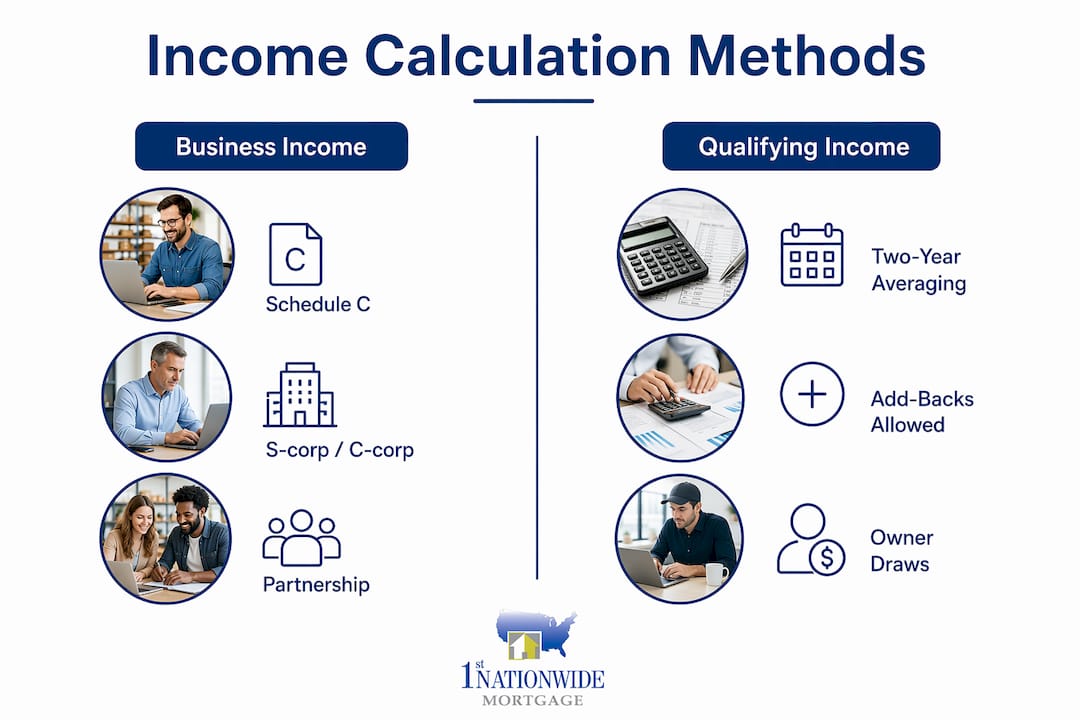
    Consider what happens when an underwriter looks at your Schedule C. Every legitimate deduction you claimed, depreciation on equipment, a home office, vehicle mileage, business meals, reduces your qualifying income dollar for dollar. A skilled underwriter can add back non-cash expenses like depreciation and amortization, since those represent accounting entries for past purchases rather than current cash going out the door. Business-use-of-home deductions can sometimes be added back as well. But many lenders don’t perform this level of analysis.

    Infographic comparing traditional and non-traditional mortgage options

    Liquidity is another factor that automated systems miss entirely. A business showing strong profits on paper but carrying high short-term debt and minimal cash reserves raises serious risk flags for an experienced underwriter. The reverse is also true: a business with modest reported income but strong retained earnings and consistent distributions tells a much more favorable story. The tax return alone captures neither picture accurately.

    Common underwriting challenges specific to self-employed borrowers:

    • Automated systems average two years of income without accounting for growth trajectory or one-time events
    • Seasonal businesses get misread when a single quarter of data is extrapolated incorrectly
    • S-corp and partnership K-1 income requires analysis of whether the business actually has the liquidity to support the distributions claimed
    • Year-over-year income declines trigger automatic denials under standard guidelines, even when the decline was a deliberate business decision
    • Profit and loss statements are not always required, so current-year performance often goes unreviewed

    Pro Tip: Before applying for any mortgage, ask your CPA to prepare a current-year profit and loss statement and a written explanation of any significant deductions. A well-documented P&L can sometimes allow an underwriter to add back expenses that would otherwise reduce your qualifying income, and it demonstrates that your finances are organized and transparent.

    The difference between a denial and an approval often comes down to who is reviewing your file. An underwriter who understands business financials can build a case for approval that a less experienced reviewer would abandon.

    Non-traditional mortgage options built for entrepreneurs

    Non-traditional mortgages, also called non-QM loans (non-qualified mortgages), exist specifically because tax returns don’t always reflect true earning power. These products bypass standard income documentation in favor of verification methods that better match how entrepreneurs actually earn and manage money.

    The main types available to self-employed borrowers:

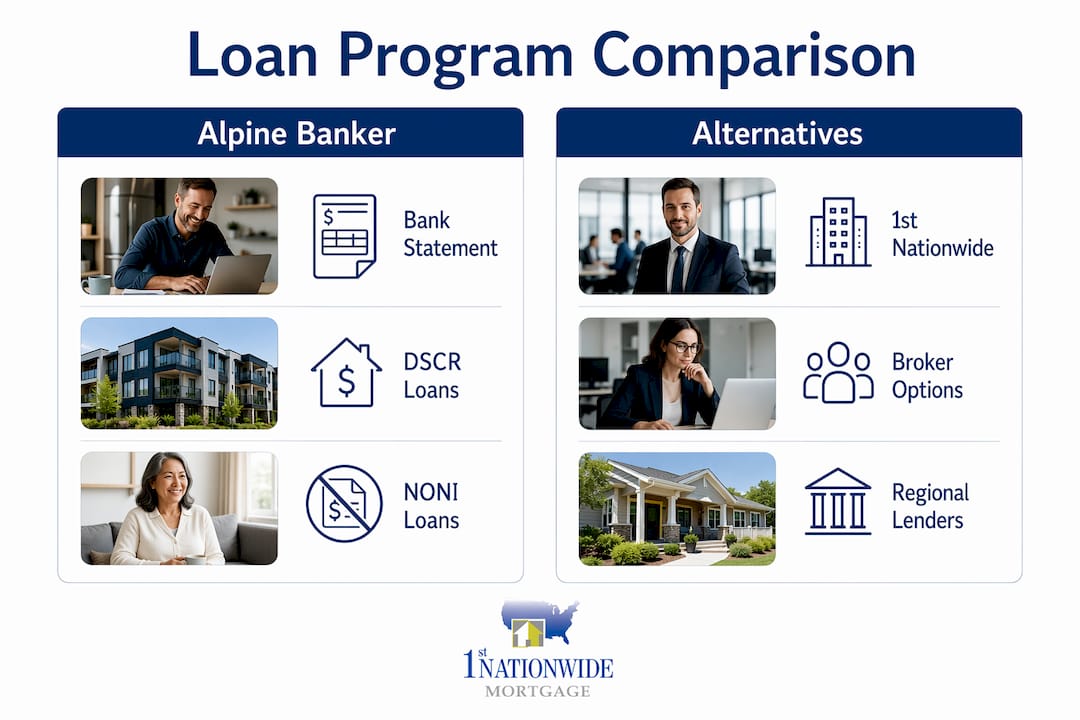
    • Bank statement loans: The lender reviews multiple months of personal or business bank deposits to derive qualifying income. This works well when write-offs have reduced your taxable income far below your actual cash flow. A standard expense factor applies to business accounts, though it can drop with a CPA-certified profit and loss statement. Minimum credit score and down payment requirements vary, typically requiring higher down payments than conventional loans.
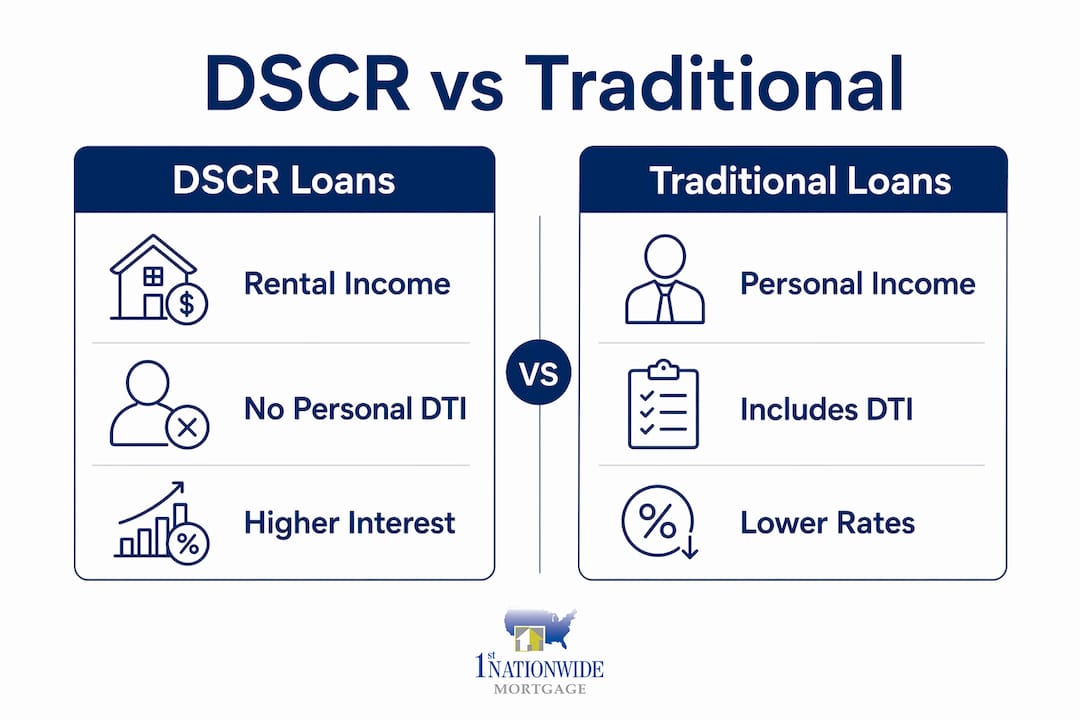
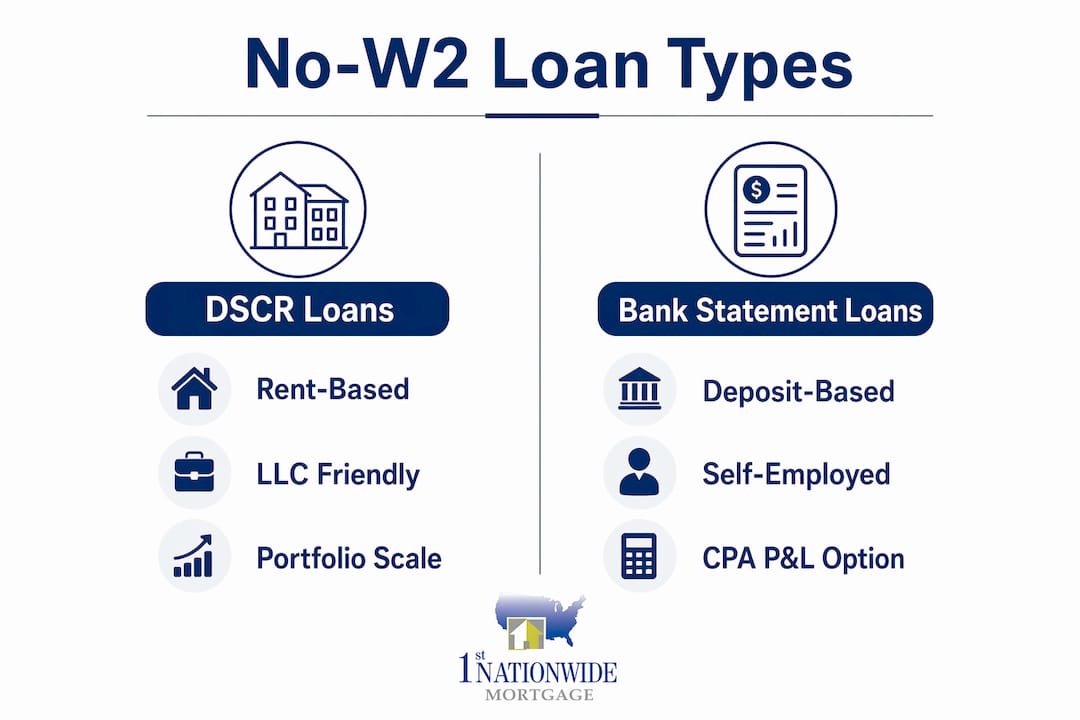
    • DSCR loans (Debt Service Coverage Ratio): Designed for investment properties. The lender evaluates whether the property’s rental income covers the mortgage payment. Your personal income and tax returns are not part of the qualification. These loans typically require 20–25% down and work for LLCs with no limit on the number of financed properties.
    • 1099 loans: Income is verified using 1099 forms rather than full tax returns, making them a fit for independent contractors and freelancers whose gross earnings are documented but whose deductions create a taxable income problem.
    • Asset-based loans: Qualification is based on documented liquid assets rather than income. The lender calculates a monthly income figure by dividing your total qualifying assets over a set period. This suits high-net-worth borrowers with substantial savings or investment accounts but limited reportable income.
    • Interest-only mortgages: The borrower pays only interest for an initial period, reducing monthly obligations during years when cash flow may be less predictable. These are often used by entrepreneurs who expect income to grow significantly in the near term.
    • NONI loans (No Income, No Asset): These require no income or asset documentation at all. They are primarily used by foreign nationals and borrowers whose income cannot be documented through any standard channel.

    For a clearer picture of how these products compare to conventional loans, the table below lays out the key differences across qualification method, borrower profile, and practical tradeoffs:

    Loan type Qualification method Income verification Typical borrower profile Key pros Key cons Best-use situation
    Conventional Automated underwriting Two years of tax returns, W-2s Salaried employee, stable income Lowest rates, widest availability Excludes most self-employed borrowers W-2 earners with clean income history
    Bank statement loan Manual underwriting 12–24 months of bank deposits Self-employed with heavy write-offs No tax returns needed, flexible income view Higher rates, larger down payment Business owners with strong cash flow but low taxable income
    DSCR loan Property cash flow analysis Rental income only Real estate investor, LLC owner No personal income docs, no property limit 20–25% down, investment properties only Rental property purchases and refinances
    1099 loan Gross earnings verification 1099 forms, 1–2 years Freelancers, independent contractors Reflects gross pay, not net taxable income Less widely available Contractors with consistent 1099 income
    Asset-based loan Asset depletion formula Liquid assets documented High-net-worth, low reportable income No income required Requires substantial liquid assets Retirees, investors with large portfolios
    Interest-only Income or asset based Varies by lender Growth-stage entrepreneurs Lower initial payments Rate and payment increase after initial period Borrowers expecting income growth
    NONI No documentation None required Foreign nationals, undocumentable income Maximum flexibility Highest rates, limited availability Foreign nationals, unique income situations

    Key terms to know:

    • Non-QM: A mortgage that does not meet federal qualified mortgage standards, allowing more flexible underwriting
    • Debt-to-income ratio (DTI): Your total monthly debt payments divided by gross monthly income, expressed as a percentage
    • Expense factor: The percentage of gross deposits a lender subtracts to estimate business expenses when calculating qualifying income from bank statements
    • DSCR: The ratio of a property’s rental income to its mortgage payment; a ratio above 1.0 means the property covers its own debt

    Pros and cons of non-traditional mortgages

    Non-traditional mortgages solve a real problem for entrepreneurs, but they come with genuine tradeoffs. Understanding both sides helps you make a decision based on your actual situation rather than just the appeal of getting approved.

    Advantages:

    • Flexible income verification means your real cash flow, not your tax return bottom line, can qualify you for a loan
    • Bank statement and DSCR loans are available to borrowers who have been self-employed for as little as two years, and sometimes less
    • Alternative loans focus on cash flow and business-specific income rather than strictly on tax returns, which better reflects entrepreneurial financial reality
    • DSCR loans allow real estate investors to scale a portfolio without personal income becoming a bottleneck
    • Asset-based loans give high-net-worth borrowers a path to qualification even with minimal reportable income
    • Non-QM products are available for loan amounts that conventional programs often cap or restrict

    Disadvantages:

    • Non-QM loans carry higher interest rates than conventional loans because they are not government-backed and carry more underwriting complexity
    • Down payment requirements are typically larger, with bank statement loans requiring at least 10% down, and DSCR loans typically requiring 20–25% down.
    • Fewer lenders offer these products, so shopping for competitive terms takes more effort
    • Loan terms and underwriting criteria vary widely between lenders, making it harder to compare offers apples to apples
    • Some non-QM products have prepayment penalties or balloon payment structures that add long-term cost

    The cost difference between a conventional loan and a non-QM product is real, and it’s worth calculating. A higher rate on a large loan balance adds up over time. For many entrepreneurs, the calculus still favors the non-QM route because the alternative is no loan at all. But if you are close to qualifying conventionally, it may be worth spending a few months improving your documentation before committing to a higher-cost product.

    When non-traditional mortgage financing makes sense for you

    Not every self-employed borrower needs a non-QM loan. The right time to pursue one depends on your specific financial picture and what conventional underwriting actually sees when it looks at your file.

    Non-traditional financing is likely the right path when:

    • Your tax returns show low net income because of legitimate deductions, but your bank deposits consistently reflect strong revenue
    • You have been self-employed for less than two years and don’t yet meet the conventional two-year history requirement
    • Your income fluctuates seasonally or year to year in ways that make a two-year average misleading
    • You are purchasing an investment property and want to qualify based on the property’s rental income rather than your personal earnings
    • Your business income flows through an S-corp or partnership and the K-1 distributions don’t tell the full story of your financial strength
    • You are a foreign national without U.S. tax history or a borrower whose income cannot be documented through standard channels

    Before you apply, assess your readiness across three areas. First, your credit score: most non-QM products require a minimum of 620, and a higher score will get you better terms. Second, your documentation: gather 12–24 months of business and personal bank statements, a current profit and loss statement, and any business licenses or CPA letters that support your income picture. Third, your down payment: plan for at least 10% on a bank statement loan and 20–25% on a DSCR loan.

    Questions worth asking any lender before you commit:

    • What expense factor do you apply to business bank deposits, and can a CPA-certified P&L reduce it?
    • Do you add back depreciation and other non-cash deductions when calculating qualifying income?
    • What is the minimum DSCR ratio you require, and how do you calculate it?
    • Are there prepayment penalties, and if so, for how long?
    • How do you handle year-over-year income declines in your underwriting review?

    Working with a direct mortgage banker who specializes in self-employed borrowers makes a measurable difference here. A lender who underwrites these files in-house, rather than brokering them to a third party, has more control over how your income is interpreted and more flexibility to build a case for approval when the numbers require explanation. You can explore mortgage options without tax returns or use a bank statement loan program to see what qualifying income looks like based on your actual deposits.


    Working with 1st Nationwide Mortgage

    https://1stnwm.com

    1st Nationwide Mortgage is a direct mortgage banker, not a broker, founded and operated by Christopher Arco, NMLS #1281, and licensed in 18 states. The firm specializes in exactly the cases traditional banks decline: self-employed borrowers, real estate investors, foreign nationals, and high-DTI borrowers whose income doesn’t fit a standard W-2 mold.

    Bank statement loans, DSCR loans, and NONI programs are underwritten in-house, which means your file gets reviewed by someone who understands how business income actually works, not just how it appears on a tax return. If you’ve been turned down elsewhere or told your income doesn’t qualify, a conversation with 1st Nationwide Mortgage is a practical next step.

    Explore DSCR loan options for investors or review all available programs at 1stnwm.com/loan-programs.


    Key Takeaways

    Traditional mortgages exclude entrepreneurs because conventional underwriting uses tax return net income as the qualifying standard, which systematically undercounts the real cash flow of self-employed borrowers who maximize legal deductions.

    Point Details
    Tax returns undercount real income Legal deductions reduce net taxable income, raising DTI ratios and triggering denials even when cash flow is strong.
    Two-year averaging penalizes growth Fannie Mae’s two-year tax return requirement mechanically dilutes strong recent performance with slower prior years.
    Non-QM loans offer a real alternative Bank statement loans use 12–24 months of deposits; DSCR loans qualify on rental income alone, bypassing personal income entirely.
    Higher costs are the tradeoff Non-QM products carry higher interest rates and require larger down payments: bank statement loans typically require at least 10% down, and DSCR loans require 20–25% down, compared to conventional loans.
    Expert underwriting changes outcomes Skilled underwriters add back non-cash deductions and analyze liquidity, often turning a denial into an approval.
  • How Inconsistent Income Affects Loan Approval

    How Inconsistent Income Affects Loan Approval

    Inconsistent income is defined in mortgage underwriting as any earnings pattern that varies significantly from month to month, including freelance payments, commission-based wages, seasonal work, and self-employment distributions. How inconsistent income affects loan approval comes down to one thing: lenders do not evaluate your highest earning month. They evaluate whether your income is predictable enough to sustain a mortgage payment for 30 years. A Truework analysis of 300,000 mortgage applicants found that 62% experienced downside income instability by mid-2025, with the severity of income swings nearly tripling since 2022. That data tells you exactly how seriously lenders now treat this issue.

    How lenders evaluate inconsistent income for loan qualification

    Lenders do not simply look at what you earned last month. They treat income as a trend line prioritizing predictability and sustainability over identical monthly figures. The question underwriters ask is not “How much did this borrower earn?” It is “Can this borrower reliably earn enough to cover this payment going forward?”

    Man evaluating income charts at desk in office

    The 12-month minimum and averaging methods

    2026 lender guidelines require at least 12 months of documented variable income history. Underwriters average your year-to-date earnings with your prior year earnings to arrive at a qualifying monthly figure. If you earned $90,000 last year and are on pace for $120,000 this year, the lender averages those figures rather than using your current run rate. That averaging can work in your favor or against you, depending on your income trajectory.

    Declining income creates a separate problem entirely. Lenders may deny loans or reduce qualifying amounts when recent income drops are unexplained or appear unstable. Underwriters may exclude prior-year figures entirely and use only stabilized year-to-date income, which results in a reduced but more accurate qualifying amount. The practical implication: a borrower whose income dropped from $100,000 to $70,000 may qualify on $70,000 alone, not the average.

    What documentation lenders require

    Variable income borrowers face a heavier documentation burden than salaried employees. Lenders typically request:

    • Two years of federal tax returns (personal and business)
    • Year-to-date profit and loss statements
    • 12–24 months of bank statements
    • Letters of Explanation for any income gaps or unusual fluctuations
    • 1099 forms or client contracts to verify income sources

    Underwriters also apply income add-backs. Certain write-offs like depreciation are added back to your net income, which can meaningfully increase your qualifying figure beyond what your tax return shows. A CPA-prepared income summary submitted before your application helps underwriters understand your true financial picture.

    Pro Tip: Ask your CPA to prepare a year-to-date profit and loss statement no more than 60 days before you apply. Underwriters treat a current P&L as strong evidence of income stability.

    Infographic outlining income evaluation steps for loans

    Unique challenges for self-employed and freelancer borrowers

    Self-employed borrowers face a structural conflict that salaried workers never encounter. The tax strategies that minimize your IRS bill also minimize the income lenders use to qualify you. This is the central tension in loans for freelancers and self-employed professionals.

    The tax write-off trap

    Tax strategies that maximize deductions reduce qualifying income and directly hurt loan eligibility. A graphic designer who earns $150,000 in gross revenue but writes off $80,000 in business expenses shows only $70,000 in net income on their tax return. Conventional lenders qualify that borrower on $70,000, not $150,000. Borrowers planning to apply for a mortgage should consider their tax filing strategy at least two years in advance.

    Conventional vs. Non-QM loan programs

    Here is how the two main paths compare for borrowers with variable earnings:

    1. Conventional loans require two years of tax returns and use net income after deductions. They offer lower down payments (as little as 3–5%) but penalize borrowers with aggressive write-off strategies.
    2. Bank statement loans use 12–24 months of bank deposits to calculate qualifying income instead of tax returns. These programs expand loan access for borrowers with strong cash flow but low tax-reported income. Down payments are typically larger (10–20%).
    3. DSCR loans qualify real estate investors based on the property’s rental income rather than personal income. Personal earnings are not part of the equation.
    4. FHA loans allow lower credit scores and accept variable income with proper documentation, though they still require two years of self-employment history.
    5. Non-QM programs (a broad category that includes bank statement and asset-based loans) exist specifically for borrowers who do not fit conventional guidelines.

    Separating business and personal finances

    Mixing business and personal accounts is one of the most common mistakes self-employed borrowers make. Underwriters reviewing bank statements need to see clean, consistent deposit patterns. Commingled accounts create confusion about what counts as income and what counts as a business transfer. Open a dedicated business checking account and keep it separate from personal spending at least 12 months before you apply.

    Pro Tip: If you use a bank statement loan, a CPA-certified profit and loss statement can lower your expense factor from 50% to 35–40%, which directly increases your qualifying income.

    Practical steps to improve your loan approval chances

    Timing and preparation matter as much as income level when you have variable earnings. Borrowers who organize financial records proactively and communicate clearly with lenders face smoother approval processes despite income variability.

    • Time your application strategically. Apply after a period of income growth, not during or immediately after a slow season. Lenders view a rising income trend as a positive signal.
    • Protect your credit score. A strong credit score (720 or above) gives underwriters confidence and can offset concerns about income variability. Pay down revolving balances before applying.
    • Reduce deductions temporarily. If you plan to apply within two years, consider reducing discretionary write-offs to show higher net income on your returns. Talk to your CPA about the tradeoff.
    • Keep thorough records. Maintain organized files of contracts, invoices, 1099s, and bank statements for at least 24 months. Gaps in documentation raise underwriter flags.
    • Write a clear Letter of Explanation. Letters of Explanation should be concise, factual, and explain temporary or industry-related causes for any income fluctuations. Over-explaining or adding irrelevant details can raise more questions than they answer.

    Pro Tip: One page is the right length for a Letter of Explanation. State the cause of the fluctuation, confirm it is resolved or stable, and stop. Underwriters read hundreds of these.

    How debt-to-income ratio and income consistency interact

    The debt-to-income ratio (DTI) is the percentage of your gross monthly income that goes toward debt payments. Most conventional lenders cap DTI at 43–45%. Variable income makes DTI calculations more volatile because the denominator (your income) changes depending on which averaging method the lender applies.

    How income averaging changes your DTI

    Consider a freelancer with $8,000 per month in current earnings and $6,000 per month averaged over the prior year. The lender uses the averaged figure of $7,000 per month. If monthly debt payments total $2,800, the DTI is 40% on the averaged income versus 35% on current earnings. That 5-percentage-point difference can determine whether you qualify.

    The table below shows how income stability scenarios affect DTI outcomes for a borrower with $2,800 in monthly debt obligations:

    Income scenario Monthly qualifying income DTI result Approval likelihood
    Stable, rising income $8,000 35% Strong
    Averaged (mixed trend) $7,000 40% Acceptable
    Declining income (prior year only) $6,000 47% At risk
    Bank statement (gross deposits) $9,500 gross, 50% expense factor = $4,750 59% Needs review
    Bank statement (CPA P&L, 35% factor) $9,500 gross, 35% expense factor = $6,175 45% Borderline

    Reducing monthly debt obligations before applying is the fastest way to lower your DTI. Pay off installment loans, reduce credit card balances, and avoid taking on new debt in the 12 months before your application. Understanding lender income calculation nuances lets you tailor your application and avoid surprises in qualifying amounts.

    Key Takeaways

    Loan approval with inconsistent income depends on demonstrating a predictable income trend, maintaining thorough documentation, and choosing the loan program that matches how your income is actually earned.

    Point Details
    Lenders assess trends, not totals Underwriters average income over 12–24 months and penalize declining patterns.
    Documentation is the deciding factor Tax returns, bank statements, P&L statements, and Letters of Explanation all affect qualification.
    Tax write-offs reduce qualifying income Aggressive deductions lower net income on returns, which lowers what conventional lenders count.
    Bank statement loans solve the write-off problem Deposits replace tax returns as the income source, helping high-cash-flow borrowers qualify.
    DTI is calculated on averaged income A lower averaged income raises your DTI ratio, which can push you past lender thresholds.

    What I’ve learned from working with variable-income borrowers

    The biggest misconception I see is that borrowers with inconsistent income assume they simply cannot qualify. That is rarely true. What they actually face is a documentation and timing problem, not an income problem.

    The borrowers who struggle most are the ones who show up with two years of tax returns showing $45,000 in net income when their bank deposits clearly show $120,000 in gross revenue. They built a successful business, paid their taxes responsibly, and then got penalized for it by a system designed for W-2 earners. That is a real frustration, and it is legitimate.

    What I have found works is getting ahead of the problem by at least 12 months. Borrowers who review their self-employed mortgage options early, clean up their bank accounts, and work with a CPA on their income presentation consistently fare better than those who apply cold. The loan program matters too. A bank statement loan is not a consolation prize. For many self-employed borrowers, it is simply the right tool for how they actually earn money.

    Proactive communication with your lender is underrated. Underwriters are not adversaries. They need a clear story about your income. Give them one, in writing, before they ask.

    — Chris Arco, NMLS #1281

    Loan programs for borrowers with variable income at 1st Nationwide Mortgage

    Variable income does not disqualify you from homeownership. It changes which loan program fits your situation.

    https://1stnwm.com

    1st Nationwide Mortgage is a direct mortgage banker licensed in 18 states with an A+ BBB rating. The loan programs available include bank statement loans for self-employed borrowers, DSCR loans for real estate investors, and conventional options for those who qualify under standard guidelines. Use the mortgage calculators on the site to estimate how your income scenario affects your qualifying loan amount. Contact 1st Nationwide Mortgage directly to get a clear picture of which program fits your income documentation before you apply.

    FAQ

    What is variable income in mortgage underwriting?

    Variable income is any earnings that change month to month, including freelance payments, commissions, bonuses, and self-employment distributions. Lenders average this income over 12–24 months to calculate a qualifying figure.

    Can inconsistent income secure a loan?

    Yes. Borrowers with inconsistent income can qualify through conventional loans with two years of tax returns or through Non-QM programs like bank statement loans that use deposit history instead of tax returns.

    How do lenders calculate income for self-employed borrowers?

    Lenders average year-to-date and prior-year earnings from tax returns. Underwriters also add back certain deductions like depreciation to increase the qualifying income figure.

    Does declining income hurt my loan application?

    Yes. Declining income is a significant disqualifier because lenders may use only the lower stabilized figure for qualification. Timing your application after income stabilizes or rises improves your outcome.

    What is a Letter of Explanation and when do I need one?

    A Letter of Explanation is a short written statement you provide to the underwriter explaining income gaps or unusual fluctuations. Keep it to one page, factual, and focused on the cause and resolution of the variation.

  • Qualified Expenses in Mortgage Review: A Clear Guide

    Qualified Expenses in Mortgage Review: A Clear Guide

    A qualified expense in mortgage review is any cost a lender recognizes as valid when calculating your debt-to-income ratio and assessing your overall loan eligibility. Lenders do not accept every expense you report at face value. They apply Fannie Mae underwriting guidelines, Dodd-Frank ability-to-repay standards, and internal credit policies to determine which costs count against your borrowing capacity. Understanding what qualifies as a mortgage expense before your review starts puts you in a far stronger position than learning it during underwriting.

    What is a qualified expense in mortgage review?

    A qualified expense is any recurring financial obligation a lender includes when measuring your ability to repay a loan. The industry term for this calculation is the debt-to-income ratio, or DTI. Lenders divide your total monthly qualified expenses by your gross monthly income to produce this ratio.

    Fannie Mae guidelines B3-6-02 define the specific debts that must be counted. The full housing payment, known as PITIA, is always included. PITIA stands for Principal, Interest, Taxes, Insurance, and Association fees. That single acronym covers most of what you pay each month to own a home.

    Mortgage banker calculating housing debts at city office

    Beyond housing, lenders add installment debts extending beyond ten months. Car loans, student loans, and personal loans all count if they have more than ten payments remaining. Revolving debts like credit cards are included based on the minimum monthly payment shown on your credit report.

    Infographic comparing qualified and excluded mortgage expenses

    The distinction between recurring and non-recurring expenses matters here. A one-time medical bill does not count as a qualified expense. A monthly car payment does. Lenders want to see obligations that will persist after your loan closes, because those are the costs that compete with your mortgage payment every month.

    Pro Tip: Pull your credit report before your mortgage review and verify that every minimum payment listed is accurate. A single reporting error can inflate your DTI and reduce the loan amount you qualify for.

    Which debts are excluded from DTI?

    Not every debt you carry appears in your DTI calculation. Lenders exclude debts that will be paid off at or before closing, provided you can document the payoff. They also exclude debts with fewer than ten months remaining. Business debts reported only on a business credit profile, not your personal report, are typically excluded as well. Knowing which obligations fall outside the DTI calculation gives you room to plan before you apply.

    What expenses do self-employed borrowers need to consider?

    Self-employed borrowers face a more detailed expense review than salaried applicants. Lenders evaluate self-employed income by averaging 24 months of tax returns to smooth out year-to-year volatility. If income dropped sharply in the most recent year, the lender may cap qualifying income at the lower figure rather than the average.

    The process involves four specific steps that self-employed borrowers should understand before submitting documents:

    1. Tax return analysis. Underwriters review Schedule C, Schedule E, or K-1 forms depending on your business structure. They start with your net income after deductions.
    2. Add-backs for non-cash expenses. Depreciation, amortization, and business use of home are added back to your reported income. These are legitimate tax deductions that do not represent actual cash leaving your account. Adding them back gives the lender a more accurate picture of your real cash flow.
    3. Business liquidity verification. Lenders verify that income reported on K-1s is supported by actual cash in the business. Low retained earnings can limit your qualifying income even if your tax return shows strong profitability.
    4. CPA Expense Ratio Letter review. A CPA Expense Ratio Letter explains how your business expenses relate to revenues and industry norms. It does not determine your qualifying income on its own, but it gives underwriters context that can prevent unnecessary delays or denials.

    Underwriters also scrutinize one-time income spikes and tax-driven volatility to identify your true sustainable net income. A large capital gain in one year will not boost your qualifying income. Stable, recurring cash flow is what lenders want to see.

    Pro Tip: If your tax write-offs have reduced your reported income significantly, ask your CPA about a bank statement loan. This program uses 12–24 months of deposits to derive qualifying income instead of tax returns, which can dramatically increase the loan amount you qualify for.

    The most common pitfall self-employed borrowers face is assuming their gross revenue is what lenders use. Lenders use net income after deductions, then add back eligible non-cash items. Your CPA’s job is to minimize taxable income. Your mortgage lender’s job is to verify repayment capacity. Those two goals often conflict, and understanding that tension early saves a lot of frustration.

    How do closing costs and prepaid expenses fit into qualified expenses?

    Closing costs are not included in your DTI calculation, but they directly affect your cash-to-close requirement and your ability to complete the transaction. Lenders evaluate whether you have sufficient funds to cover these costs alongside your down payment.

    Closing costs divide into two categories: non-recurring fees and recurring prepaids. Understanding the difference helps you budget accurately and avoid surprises at the closing table.

    Expense Type Examples Negotiable?
    Non-recurring fees Appraisal, origination fee, title search, attorney fees Often negotiable
    Recurring prepaids Property tax escrow deposit, homeowner’s insurance premium, prepaid interest Not negotiable
    Government fees Recording fees, transfer taxes Not negotiable
    Third-party services Home inspection, survey Partially negotiable

    Non-recurring fees are one-time costs tied to the transaction itself. You can sometimes negotiate the origination fee with your lender or shop for lower title and attorney fees. Recurring prepaids, by contrast, depend on your property’s tax assessment and the insurance market. No lender can change what your county charges in property taxes.

    Prepaid expenses like initial escrow deposits for taxes and insurance are mandatory upfront costs. They are treated as recurring obligations in underwriting because they reflect real monthly costs that continue after closing. Lenders factor them into the PITIA calculation that forms the foundation of your DTI.

    • Budget 2%–5% of the loan amount for total closing costs as a general planning figure.
    • Ask your lender for a Loan Estimate within three business days of application. This document itemizes every fee.
    • Seller concessions can cover some non-recurring fees, reducing your cash-to-close requirement.
    • Prepaid escrow deposits are set by your lender based on local tax and insurance rates. They are not a fee you can shop around.

    For a deeper breakdown of why fees vary between lenders, the closing costs explainer from 1st Nationwide Mortgage walks through the specific factors that drive those differences.

    What common mistakes do borrowers make about qualified mortgage expenses?

    The most damaging mistake borrowers make is conflating business expenses with personal finances. If you run a business and pay for a vehicle, travel, or a home office through your company, those expenses appear on your tax return as business deductions. Underwriters see them as reductions to your qualifying income, not as evidence of financial discipline.

    A second common error is misunderstanding how non-cash expenses affect qualification. Many self-employed borrowers assume that because depreciation reduces their tax bill, it also reduces their mortgage eligibility. The opposite is true. Depreciation is added back during underwriting because it is not a real cash outflow. Failing to claim this add-back leaves qualifying income on the table.

    • Overlooking reserves. Lenders require documented reserves after closing, typically two to six months of mortgage payments. Variable income borrowers often focus entirely on DTI and forget that reserves are a separate requirement.
    • Assuming all closing costs are negotiable. Prepaids and government fees are fixed. Negotiating only applies to lender fees and some third-party services.
    • Submitting incomplete documentation. Missing a single year of tax returns or a bank statement can pause underwriting entirely. Gather a complete file before you apply.
    • Ignoring income trends. If your income declined between year one and year two of your tax returns, lenders may use only the lower figure. A variable income qualification guide can help you understand how underwriters handle this scenario.

    Pro Tip: Work with a CPA who has mortgage experience before you file your taxes. A CPA who understands how underwriters read returns can structure deductions to minimize tax liability without unnecessarily reducing your qualifying income.

    The cleanest way to present your expenses to a lender is to separate personal and business finances completely. Use dedicated business accounts, keep clean records, and have your CPA prepare a Profit and Loss statement that matches your bank deposits. Underwriters reward clarity and consistency.

    Key Takeaways

    Qualified expenses in a mortgage review are the recurring financial obligations lenders use to calculate your DTI, and managing them accurately is the single most direct way to improve your approval outcome.

    Point Details
    DTI drives approval Lenders sum PITIA plus all recurring debts to calculate your debt-to-income ratio.
    Add-backs increase qualifying income Depreciation, amortization, and home office deductions are added back for self-employed borrowers.
    Closing costs split into two types Non-recurring fees can be negotiated; prepaids and government fees cannot.
    Documentation prevents delays Complete tax returns, bank statements, and a CPA letter reduce underwriting friction.
    Business liquidity matters Strong K-1 income means little if the business lacks cash to support the distributions.

    What I’ve learned from reviewing thousands of self-employed files

    After working with self-employed borrowers for years, the pattern I see most often is not a bad credit score or a weak income. It is a mismatch between how a borrower thinks about their finances and how an underwriter reads the same documents.

    A borrower will tell me they earn $200,000 a year. Their tax return shows $80,000 after deductions. The underwriter works from $80,000, adds back $15,000 in depreciation, and arrives at $95,000 in qualifying income. The borrower is frustrated because they feel their real income is not being recognized. The underwriter is doing exactly what the guidelines require.

    The fix is almost always upstream. A CPA Expense Ratio Letter, a well-documented Profit and Loss statement, or a bank statement loan program can close that gap. But borrowers who wait until they are already in underwriting to address it lose weeks and sometimes the deal entirely.

    My advice is to treat your mortgage review as a financial audit you prepare for, not a form you fill out. Know your DTI before you apply. Know which add-backs apply to your situation. Have your documentation organized and consistent. Underwriters are not adversaries. They are following a checklist, and your job is to make every item on that checklist easy to verify.

    Proactive communication with your loan officer matters more than most borrowers realize. If your income has a story, tell it early and document it thoroughly. An underwriter who understands your income structure from day one moves faster and with more confidence than one who has to ask for explanations mid-review.

    — Chris Arco, NMLS #1281

    How 1st Nationwide Mortgage approaches your expense review

    Qualifying expenses look different for every borrower, and 1st Nationwide Mortgage is built to handle that complexity directly.

    https://1stnwm.com

    For self-employed borrowers, 1st Nationwide Mortgage offers bank statement loan programs that replace tax return income with 12–24 months of bank deposits. The standard expense factor is 50% on business accounts, dropping to 35%–40% with a CPA-certified Profit and Loss statement. For real estate investors, DSCR loan programs qualify the property’s rental income rather than your personal income. Use the mortgage calculators to model how your specific expenses affect your loan eligibility before you apply. 1st Nationwide Mortgage is a direct lender, not a broker, licensed in 18 states with a BBB A+ rating.

    FAQ

    What is a qualified expense in a mortgage review?

    A qualified expense is any recurring financial obligation a lender includes in your debt-to-income ratio calculation. This includes your full PITIA housing payment and all installment or revolving debts with more than ten months remaining.

    Does depreciation count against self-employed borrowers in underwriting?

    No. Depreciation is a non-cash deduction that underwriters add back to your reported income. It increases your qualifying income rather than reducing it.

    Are closing costs included in the debt-to-income ratio?

    Closing costs are not included in your DTI. They affect your cash-to-close requirement and are evaluated separately to confirm you have sufficient funds to complete the transaction.

    What is a CPA Expense Ratio Letter and when do I need one?

    A CPA Expense Ratio Letter explains how your business expenses relate to your revenues and industry norms. Lenders use it to verify the sustainability of your income during underwriting, particularly for self-employed borrowers with complex returns.

    How do lenders handle income that varies year to year?

    Lenders average 24 months of self-employed income to smooth volatility. If income declined in the most recent year, the lender may cap qualifying income at the lower figure to reflect the current trend rather than the historical average.

  • Self-Employed Home Loan Preparation: 2026 Guide

    Self-Employed Home Loan Preparation: 2026 Guide

    Self-employed home loan preparation is the process of organizing your income documentation, financial records, and loan strategy before applying for a mortgage as a business owner or freelancer. Unlike W-2 employees, self-employed borrowers must prove income through tax returns, bank statements, and CPA-verified financials rather than a single pay stub. Lenders classify you as self-employed if you own 25% or more of a business. That threshold applies whether you are a sole proprietor, S-corp owner, or partner in an LLC. Getting this preparation right is the difference between a smooth approval and a frustrating denial.

    What income documentation is required for self-employed home loan applications?

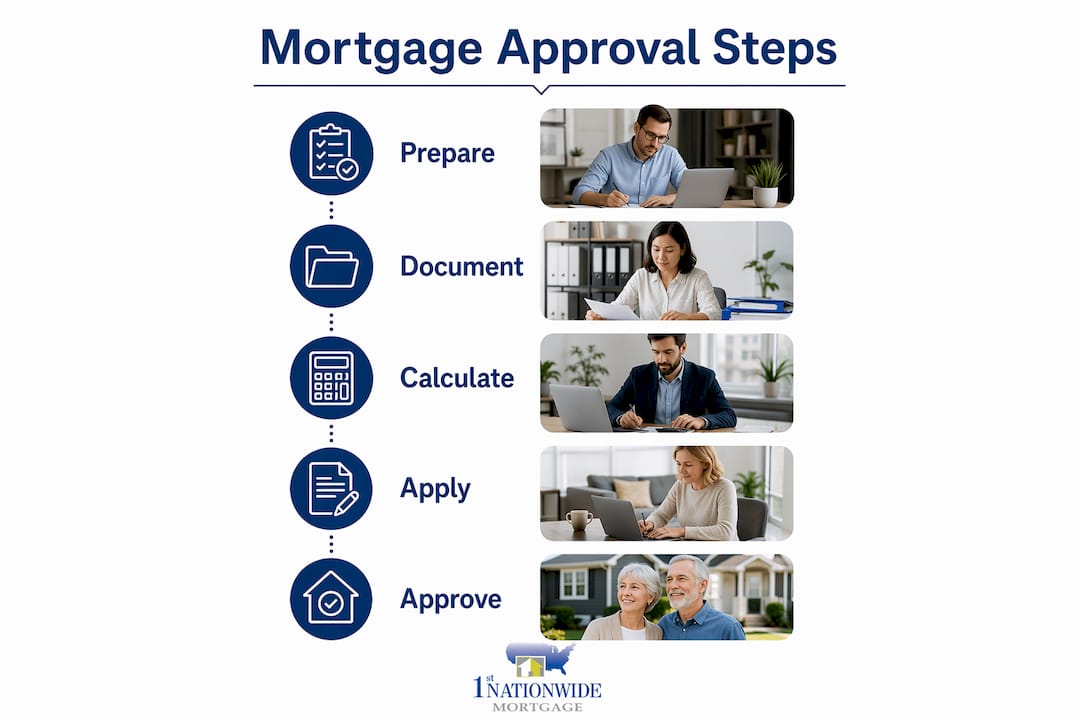
    Lenders require a specific set of documents to verify that your income is real, stable, and sufficient to cover a mortgage. The list is longer than what a salaried borrower submits, but every item serves a clear purpose in underwriting.

    The core documents you need to gather:

    • Two years of signed personal tax returns (Form 1040, including all schedules)
    • Two years of signed business tax returns (Form 1120S for S-corps, Form 1065 for partnerships, or Schedule C for sole proprietors)
    • Year-to-date profit and loss statement prepared and signed by a licensed CPA
    • 12–24 months of business bank statements to show deposit history and cash flow
    • 12–24 months of personal bank statements to verify assets and reserves
    • Business license or CPA letter confirming your business is active and ongoing

    Lenders typically require two years of signed tax returns to establish a stable income history. One year may be accepted in limited cases where your prior employment history matches your current business field.

    The CPA-prepared profit and loss statement deserves special attention. A lender-ready P&L is not the same as a QuickBooks export. It must be signed by a licensed accountant and reflect the current year’s activity. At 1st Nationwide Mortgage, a CPA-certified P&L can also reduce the expense factor applied to bank statement deposits from the standard 50% down to 35–40%, which directly increases your qualifying income.

    Pro Tip: Gather your tax documents at least 90 days before you plan to apply. If your returns are not yet filed, get an extension and use the prior two years. Submitting incomplete returns mid-application stalls the process.

    Document Purpose
    Personal tax returns (2 years) Establishes net income and income trend
    Business tax returns (2 years) Shows business profitability and structure
    CPA-prepared P&L statement Verifies current-year income outside of tax cycle
    Bank statements (12–24 months) Confirms deposit history and cash reserves
    Business license or CPA letter Proves business is active and legitimate

    How do lenders calculate qualifying income for self-employed borrowers?

    Qualifying income for self-employed borrowers is not your gross revenue. Lenders use your net income after business expenses, then add back certain non-cash deductions to arrive at a usable figure.

    The most common add-backs include:

    • Depreciation on business assets
    • Depletion for natural resource businesses
    • Business use of home deductions
    • Amortization of business startup costs
    • One-time non-recurring losses shown on the return

    After calculating adjusted income, most lenders average the two-year total. However, if income declined from Year 1 to Year 2, lenders typically use only the lower year’s figure rather than the average. That single rule eliminates the benefit of a strong prior year and catches many borrowers off guard.

    Business structure also changes the calculation. Sole proprietors report income on Schedule C, so the math is straightforward. S-corp owners must account for W-2 wages paid to themselves plus their share of business income or loss. Partnership income flows through Schedule K-1. Each structure requires a slightly different analysis, which is why a knowledgeable loan officer matters more for self-employed borrowers than for W-2 applicants.

    The tax write-off trap is the single biggest obstacle for self-employed borrowers. You spend years minimizing taxable income to reduce your IRS bill. Then you apply for a mortgage and discover that the same deductions have reduced your qualifying income below what you need. The lender sees the net profit on your return, not the cash actually flowing through your business. Understanding this dynamic before you apply gives you time to adjust your strategy.

    Income stability over two years matters more to lenders than a single exceptional year. A consistent upward trend signals lower risk. A sharp decline signals the opposite.

    What loan program options are available for self-employed buyers?

    Hands reviewing tax returns and financial statements

    Self-employed borrowers have more loan options than most realize. The right program depends on your credit score, down payment, income documentation, and business structure.

    Loan Type Income Verification Min. Credit Score Min. Down Payment
    Conventional 2 years tax returns 620–640 5–20%
    FHA 2 years tax returns 580 3.5%
    VA 2 years tax returns Varies by lender 0%
    Bank Statement 12–24 months deposits 620 10–20%

    Conventional loans follow Fannie Mae and Freddie Mac guidelines. They require two years of tax returns and offer competitive rates, but your net income after deductions must support the debt-to-income ratio.

    FHA loans require the same documentation as conventional loans but accept a credit score as low as 580 with 3.5% down. That makes FHA a practical path for self-employed buyers who have strong income but a thinner credit profile.

    Infographic comparing self-employed loan types

    VA loans allow eligible veterans to qualify using Fannie Mae income calculation guidelines with no down payment required. Self-employed veterans must still provide two years of business returns, but the zero-down benefit is significant.

    Bank statement loans are the most important alternative for borrowers whose tax write-offs reduce reported income below qualifying thresholds. These non-QM loans use 12–24 months of bank deposits instead of tax returns. The lender applies a standard 50% expense factor to gross deposits to estimate net income. They typically require 10–20% down and carry slightly higher rates than conventional loans. For borrowers whose real cash flow far exceeds their taxable income, this trade-off is worth it.

    Pro Tip: If your tax returns show low net income due to heavy deductions, ask about bank statement loan qualification before assuming you cannot qualify. Your deposit history may tell a very different story than your Schedule C.

    What strategies improve your chances of self-employed home loan approval?

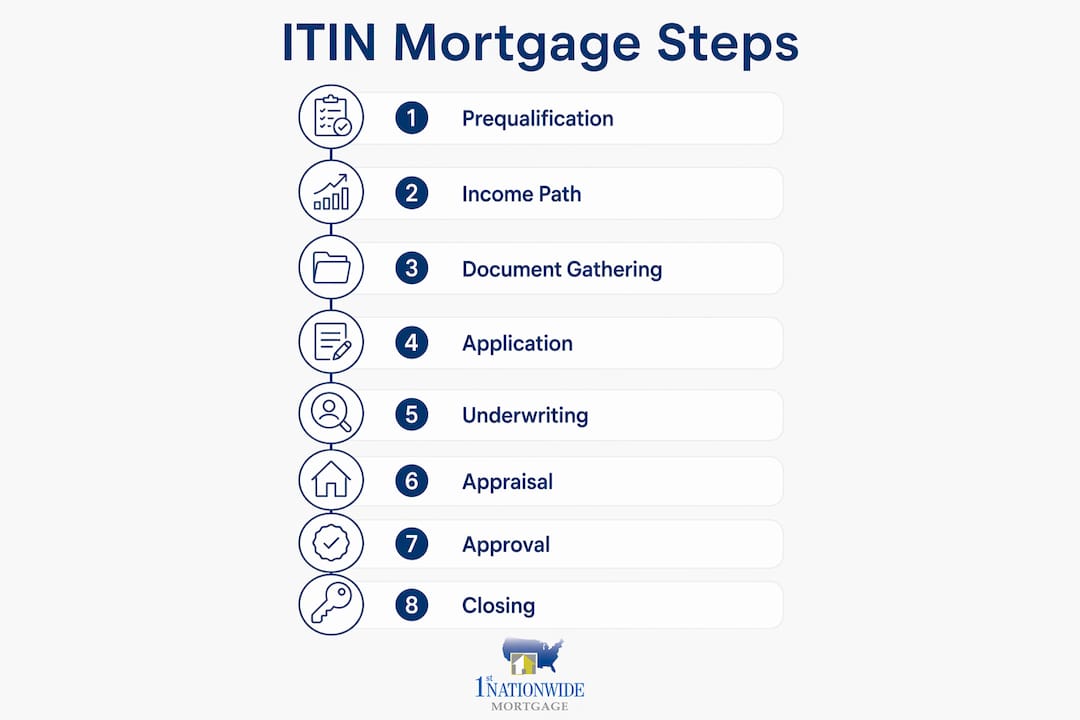
    Approval for a self-employed mortgage is not just about meeting minimum requirements. The borrowers who get approved at the best terms are the ones who prepare systematically, often 12–24 months before they apply.

    1. Show stable or growing income. Lenders reward consistency. Two years of steady or increasing net income signals lower risk than a single strong year following a weak one.
    2. Separate your finances. Keep personal and business bank accounts completely separate. Commingled accounts require explanation letters and raise underwriting questions that slow down or derail approvals.
    3. Build cash reserves. Self-employed borrowers typically need 6–12 months of mortgage payments in reserve. Reserves demonstrate financial stability when income fluctuates seasonally or between projects.
    4. Be selective about deductions before applying. Reducing deductions in the one to two years before you apply raises your reported net income. Work with your CPA to find the right balance between tax savings and qualifying income.
    5. Raise your credit score. Most conventional and bank statement programs require a minimum 620. Scores above 700 open better rate tiers. Pay down revolving balances and avoid opening new accounts in the six months before applying.
    6. Get pre-approved early. A pre-approval letter from a lender who understands self-employment income tells sellers you are a serious buyer. It also surfaces documentation gaps before you are under contract.

    Pro Tip: Work with a CPA and a mortgage loan officer together, not separately. Your CPA optimizes for taxes. Your loan officer optimizes for qualifying income. Those two goals sometimes conflict, and you need both perspectives before filing your returns.

    What common mistakes should self-employed borrowers avoid?

    Self-employed home loan mistakes often come from applying the same logic that works for tax planning to a mortgage application. The two processes reward opposite behaviors.

    • Applying during a low-income year. If your business had a rough year, wait. Lenders average two years, and a weak year pulls your qualifying income down significantly.
    • Mixing personal and business accounts. Underwriters flag commingled deposits immediately. Separating accounts before you apply is far easier than explaining mixed transactions after the fact.
    • Changing your business structure mid-application. Converting from a sole proprietorship to an LLC or S-corp during the loan process creates documentation gaps and restarts the income verification timeline.
    • Submitting a non-CPA P&L. A self-prepared profit and loss statement carries little weight with underwriters. A CPA-signed P&L is a lender requirement for most non-QM programs, including bank statement loans at 1st Nationwide Mortgage.
    • Shopping lenders outside the rate-shopping window. Multiple hard credit inquiries within a 45-day window count as a single inquiry for mortgage purposes under FICO scoring models. Spreading applications beyond that window can lower your score.
    Mistake Consequence
    Applying in a low-income year Lower qualifying income, possible denial
    Commingled bank accounts Underwriting delays and explanation requirements
    Non-CPA P&L statement Document rejected; application stalled
    Changing business structure mid-process Income verification reset; timeline extended

    Key Takeaways

    Effective self-employed home loan preparation requires clean financial records, two years of stable income documentation, and a loan program matched to your actual cash flow rather than your taxable income.

    Point Details
    25% ownership triggers self-employed status Any borrower owning 25% or more of a business must document income as self-employed.
    Two-year income average is standard Lenders average two years of net income, but use only the lower year if income declined.
    Tax write-offs reduce qualifying income Heavy deductions lower the net income lenders count, even when real cash flow is strong.
    Bank statement loans bypass tax returns Deposits over 12–24 months replace tax returns for borrowers with high write-offs.
    Reserves of 6–12 months strengthen approval Holding 6–12 months of mortgage payments in savings signals stability to underwriters.

    What I’ve learned after years of working with self-employed borrowers

    The most common frustration I hear from self-employed borrowers is this: “I make good money, so why can’t I get approved?” The answer almost always comes back to the tax write-off trap. You have spent years doing exactly what a good CPA tells you to do, which is minimize taxable income. Then you walk into a mortgage application and discover that the IRS and your lender are reading the same return in opposite ways.

    The fix is not complicated, but it requires planning ahead. I have seen borrowers turn a denial into an approval simply by filing two years of returns with slightly higher net income, which meant paying a bit more in taxes. That trade-off is worth running the numbers on. A few thousand dollars in additional tax liability can unlock a mortgage on a $500,000 home.

    The other thing I tell every self-employed borrower: timing matters more than most people realize. Apply after your two strongest consecutive income years, not after a recovery year that follows a weak one. Lenders do not care about your trajectory. They care about the numbers on the page. If Year 2 is lower than Year 1, your qualifying income drops to the lower figure regardless of how strong your business is today.

    Working with a direct lender who specializes in self-employed income, rather than a general retail bank, changes the experience significantly. At 1st Nationwide Mortgage, we review self-employed mortgage qualification with the same depth we apply to any complex income file. The goal is always to find the program that reflects your real financial picture, not just the one that fits a standard checklist.

    — Chris Arco, NMLS #1281

    How 1st Nationwide Mortgage helps self-employed buyers qualify

    Self-employed borrowers with strong cash flow but low reported income have a clear path forward through 1st Nationwide Mortgage. As a direct mortgage banker licensed in 18 states with a BBB A+ rating, 1st Nationwide Mortgage offers bank statement loan programs that use 12–24 months of deposits to calculate qualifying income, bypassing the tax return requirement entirely.

    https://1stnwm.com

    For borrowers who want to run the numbers before applying, the mortgage calculators on the 1st Nationwide Mortgage website help estimate payments, down payment requirements, and loan amounts based on your specific situation. If you are ready to talk through your income documentation and find the right program, contact 1st Nationwide Mortgage directly for a no-pressure review of your file.

    FAQ

    What does self-employed mean for mortgage purposes?

    A borrower who owns 25% or more of a business is classified as self-employed for underwriting purposes. This classification requires full business and personal income documentation rather than standard pay stubs.

    Can I get a mortgage with only one year of self-employment?

    One year of self-employment may be accepted by some lenders if your prior employment history is in the same field. Most conventional and FHA programs still prefer two years of returns to confirm income stability.

    What is a bank statement loan and who qualifies?

    A bank statement loan uses 12–24 months of business or personal deposits to calculate qualifying income instead of tax returns. It is designed for self-employed borrowers whose deductions reduce net income below conventional qualifying thresholds, with a minimum 620 credit score and 10–20% down.

    How do lenders handle declining self-employment income?

    If your income dropped from Year 1 to Year 2, lenders use only the lower year’s income for qualification rather than averaging the two years. This makes timing your application after two strong years a critical part of preparation.

    Do I need a CPA to apply for a self-employed mortgage?

    A CPA-prepared and signed profit and loss statement is required for most non-QM programs, including bank statement loans. A CPA letter confirming your business is active also strengthens conventional and FHA applications.

  • DSCR Loan Qualification Requirements: 2026 Guide

    DSCR Loan Qualification Requirements: 2026 Guide

    A DSCR loan is defined as a mortgage where the property’s rental income, not your personal income, determines whether you qualify. Lenders measure this through the Debt Service Coverage Ratio, which compares gross rental income to total monthly mortgage costs. Most lenders require a minimum DSCR between 1.0 and 1.25, meaning the property must generate at least as much rent as it costs to carry. Understanding the full set of DSCR loan qualification requirements before you apply saves time, protects your credit, and helps you choose the right property and loan structure from the start.

    1. Essential DSCR loan qualification criteria

    DSCR loans qualify you based on the property’s income, not your tax returns or W-2s. That single distinction makes them the preferred tool for self-employed investors and portfolio landlords who face roadblocks with conventional financing due to write-offs or the number of properties they already own.

    Here are the core criteria most lenders apply:

    • DSCR ratio: The standard minimum is 1.20, meaning rent covers 120% of mortgage costs. Some lenders accept ratios as low as 1.0, but expect stricter terms.
    • Credit score: 620 is the technical floor, but rates improve meaningfully above 680. Most investors see the best deal economics starting at 700 or higher.
    • Down payment: Expect a minimum of 20% for strong files. Weaker credit or a lower DSCR ratio typically pushes this to 25–30%.
    • Loan amount: Most DSCR programs have a minimum loan amount, often around $100,000, and maximum amounts that vary by lender and property type.
    • Property type: Single-family homes, 2–4 unit properties, condos, and short-term rentals generally qualify. Mixed-use and 9+ unit buildings typically do not.
    • Personal income documentation: Not required. DSCR loans do not require tax returns, W-2s, or employment verification. The property carries the qualification.

    Pro Tip: Run your DSCR calculation before you make an offer on a property. A ratio that looks strong at the asking price can fall below 1.0 after accounting for actual taxes and insurance.

    2. How lenders calculate DSCR for a rental property

    Hands calculating DSCR ratio with calculator

    The DSCR formula is straightforward: divide gross rental income by total monthly debt service. The complexity is in what counts as debt service.

    Lenders use PITIA, which stands for principal, interest, taxes, insurance, and association fees. This is the full monthly cost of owning the property, not just the loan payment. Using only principal and interest overestimates DSCR by 20–40%, which is one of the most common mistakes investors make when running numbers before applying.

    The three accepted rental income sources

    1. Signed lease agreement: The most straightforward method. The lender uses the current lease rate as gross income.
    2. Appraiser’s market rent schedule (Form 1007): Used when the property is vacant or the lease is below market. An appraiser estimates what the property would rent for in the current market.
    3. Short-term rental income: Accepted when properly documented through platform statements or validated third-party projections. Services like AirDNA provide market analyses that some lenders accept for new short-term rental properties.

    Why accurate tax figures matter

    Property tax reassessment at sale is a real risk. States like Florida, California, and Texas reassess property taxes at the time of sale, sometimes significantly. If you base your DSCR on the seller’s current tax bill, your calculation may be materially wrong. Always use the estimated post-sale tax figure when modeling your deal.

    Income Source Documentation Required Best Used When
    Signed lease Current executed lease Property is tenant-occupied
    Market rent schedule Appraiser Form 1007 Property is vacant or lease is below market
    Short-term rental history Platform statements or AirDNA STR property with income history

    Pro Tip: Ask your lender to run the DSCR using the actual tax and insurance quotes, not estimates. A $200 monthly difference in taxes can drop a 1.25 DSCR to 1.08, which changes your loan terms entirely.

    3. How credit scores affect your DSCR loan terms

    Credit score is the second biggest variable in DSCR loan pricing, right after the ratio itself. A 620 score gets you in the door, but the economics of the loan look very different at 680 versus 740.

    • 620–659: Minimum eligibility at most lenders. Expect the highest rates, larger down payment requirements, and stricter reserve demands.
    • 660–679: Slightly better pricing, but still below the threshold where deal economics improve meaningfully.
    • 680–719: Rates improve noticeably. This is the practical floor for investors who want competitive terms.
    • 720 and above: Best available pricing. Down payment requirements often stay at 20%, and reserve requirements are more flexible.

    A 0.50% rate increase from a lower credit score can add tens of thousands of dollars in interest over the life of a loan. That cost is invisible at closing but very real over a 30-year hold. Investors who treat credit improvement as part of their acquisition strategy consistently get better deal economics than those who apply with whatever score they have.

    A higher credit score reduces interest rates enough to meaningfully affect the profitability of a rental property investment. If your score is below 680, spending 60–90 days paying down revolving balances before applying can shift you into a better pricing tier. Use the DSCR loan calculator at 1st Nationwide Mortgage to model how a rate change affects your monthly cash flow.

    4. Documentation and reserves required for approval

    DSCR loans cut the paperwork significantly compared to conventional mortgages. You will not submit tax returns, W-2s, pay stubs, or employer verification letters. The file is built around the property, not you.

    What you do need to provide:

    • Property appraisal with a rental income schedule (Form 1007 for single-family)
    • Bank statements showing post-closing reserves
    • LLC or entity documents if taking title in a business name
    • Insurance quote for the subject property
    • Executed lease or rental market analysis

    What you do not need:

    • Federal tax returns (personal or business)
    • W-2s or 1099s
    • Pay stubs or employment verification
    • Debt-to-income ratio documentation

    Reserve requirements

    Lenders typically require 3–6 months of PITIA in reserves after closing. This is liquid cash or near-liquid assets, not equity in another property. Having the down payment alone is not enough. Reserves demonstrate that you can cover the mortgage through a vacancy period or unexpected repair without defaulting.

    Insufficient reserves are one of the top reasons DSCR loans get denied during underwriting, even when the ratio and credit score both qualify. Budget for reserves as a separate line item from your down payment and closing costs.

    5. Property types and situations that affect approval odds

    Not every property qualifies for a DSCR loan, and not every income situation is treated the same way.

    Eligible property types:

    • Single-family residential (1 unit)
    • 2–4 unit residential properties
    • Condominiums with HOA
    • Some multifamily properties (5–8 units, lender-dependent)
    • Short-term rentals with proper income documentation

    Generally ineligible:

    • 9+ unit apartment buildings (these fall under commercial lending)
    • Mixed-use properties (retail plus residential)
    • Raw land or properties in poor condition
    • Primary residences (DSCR is for investment properties only)

    Short-term rentals require extra attention during the qualification process. If the property has an operating history, lenders want to see platform statements showing actual income. For new short-term rental properties, lenders use third-party market analyses to project income. The appraisal also plays a direct role: a property in poor condition may not appraise at a value that supports the loan amount, and deferred maintenance can trigger repair requirements before closing.

    Pro Tip: If you are buying a short-term rental, get a market rent analysis from a service like AirDNA before you apply. Lenders who accept STR income want to see validated projections, not your personal estimates.

    Key takeaways

    DSCR loan approval depends on the property’s rental income covering its full monthly costs at a ratio of at least 1.0, with credit score, down payment, and reserves determining the final loan terms.

    Point Details
    DSCR ratio threshold Most lenders require a minimum ratio of 1.20; ratios below 1.0 rarely qualify.
    Credit score impact Scores above 680 unlock better rates; below 620 is typically ineligible.
    Down payment range Strong files start at 20% down; weaker credit or low DSCR pushes to 25–30%.
    Reserves required Budget 3–6 months of PITIA in liquid reserves separate from your down payment.
    No personal income docs Tax returns, W-2s, and pay stubs are not required for DSCR loan qualification.

    What I’ve learned from running DSCR loans for investors

    The single most common mistake I see is investors calculating DSCR using the seller’s property tax bill. In states like California and Texas, that number can jump significantly at the time of sale. I have seen deals that looked like a 1.30 DSCR on paper come in at 1.05 after the lender used the reassessed tax figure. That is the difference between smooth approval and a last-minute denial.

    Credit score matters more than most investors realize, and not just for approval. A 0.50% rate difference sounds small until you run it over 30 years on a $400,000 loan. The investors who build their credit before applying, rather than after getting denied, consistently close better deals. If your score is sitting at 665, a few months of balance reduction can move you into a meaningfully better pricing tier.

    Reserves are the other area where I see investors underprepared. They budget for the down payment and closing costs, then show up to underwriting with nothing left. Lenders want to see 3–6 months of PITIA sitting in a liquid account after closing. That is not negotiable at most programs.

    My advice: run a conservative DSCR calculation using actual post-sale tax estimates, get your credit in order before you apply, and treat reserves as a non-negotiable budget line. Talk to your lender early in the process, before you make an offer, so you know exactly what the program requires for the specific property type you are targeting.

    — Chris Arco, NMLS #1281

    Ready to qualify your rental property with 1st Nationwide Mortgage

    1st Nationwide Mortgage is a direct mortgage banker, not a broker, licensed in 18 states and rated A+ by the BBB. DSCR loans are a core program, built specifically for investors who qualify on rental income without submitting tax returns or personal income documents.

    https://1stnwm.com

    If you are evaluating a rental property purchase or refinance, the investment property mortgage page at 1st Nationwide Mortgage covers current program details, eligible property types, and how to get started. You can also review the full range of loan programs available, including DSCR, bank statement, and other non-QM options. Contact 1st Nationwide Mortgage directly to get a qualification review based on your specific property and credit profile.

    FAQ

    What is the minimum DSCR ratio to qualify for a loan?

    Most lenders require a minimum DSCR of 1.0, with the standard threshold around 1.20. A ratio below 1.0 means the property does not generate enough rent to cover its mortgage costs, which disqualifies most applications.

    Do DSCR loans require tax returns or proof of income?

    No. DSCR loans do not require tax returns, W-2s, pay stubs, or employment verification. Qualification is based entirely on the property’s rental income relative to its monthly mortgage costs.

    How much do I need for a down payment on a DSCR loan?

    Minimum down payments typically start at 20% for strong credit and DSCR profiles. Weaker credit scores or lower DSCR ratios generally push the requirement to 25–30%.

    Can I use short-term rental income to qualify for a DSCR loan?

    Yes. Short-term rental income qualifies when documented through platform statements or validated third-party market analyses. Lenders use actual income history when available and approved projections for new short-term rental properties.

    What credit score do I need for a DSCR loan?

    The technical minimum is 620, but deal economics improve meaningfully above 680. Investors with scores at 720 or higher typically access the best rates and the most flexible down payment requirements.

  • Why Self-Employed Borrowers Get Denied Mortgages

    Why Self-Employed Borrowers Get Denied Mortgages

    Self-employed mortgage denial is defined as a lender’s refusal to approve a home loan because the borrower cannot document stable, verifiable income through standard tax returns and financial statements. This is the core problem for millions of freelancers, consultants, and business owners: your business may be thriving, but your tax return tells a different story. Mortgage underwriting focuses on documented income from tax transcripts, not on cash flow or strong deposit months. Understanding why self-employed borrowers are denied mortgages is the first step toward fixing the problem. The industry term for this challenge is “non-traditional income verification,” and it affects a significant share of self-employed mortgage applicants every year.

    Why self-employed borrowers get denied mortgages: the income documentation gap

    The root cause of most self-employed mortgage denials is a mismatch between how you earn money and how lenders are required to measure it. Underwriters do not evaluate your business potential or your best revenue months. They evaluate the “income story” told by your tax returns, and that story is often incomplete.

    Fannie Mae typically mandates two years of signed personal tax returns and a detailed cash flow analysis to assess income stability and business viability. That two-year requirement exists because lenders need to see a pattern, not a snapshot. One strong year followed by a weaker year raises immediate red flags in underwriting.

    Accountant preparing profit and loss statement documents

    The gap between gross revenue and qualifying income is where most self-employed borrowers lose their approval. A freelance designer earning $180,000 in gross revenue might show only $62,000 in net income after legitimate business deductions. Lenders use that $62,000 figure, not the $180,000, to calculate your debt-to-income ratio. That ratio determines how large a mortgage you can carry.

    Income stability is assessed using year-to-year trends in gross income, expenses, and taxable income. Increasing or stable income trends support approval. Declining income or growing expenses cause underwriters to question whether the business can sustain the mortgage payment long-term.

    Infographic on reasons for self-employed mortgage denial

    How lenders assess self-employed income

    Lenders follow a structured process when reviewing self-employed applications. Knowing each step helps you prepare the right documents before you apply.

    • Personal tax returns (two years). Underwriters review Schedule C for sole proprietors and Schedule K-1 for partners or S-corporation shareholders. These forms show net income after all deductions.
    • Business tax returns. Lenders often request business returns alongside personal returns to verify that the business income reported is consistent across both documents.
    • Add-backs. Certain non-cash expenses, such as depreciation and depletion, are added back to your net income because they reduce taxable income without reducing actual cash flow. This can increase your qualifying income meaningfully.
    • IRS IVES verification. The IRS Income Verification Express Service allows lenders to pull verified tax transcripts directly from the IRS with your consent. This step confirms that the returns you submitted match what the IRS has on file, reducing fraud risk and speeding up underwriting.
    • Year-over-year income trend. Lenders calculate a monthly average income using the two-year average, or the lower of the two years if income has declined. A declining trend almost always results in the lower figure being used.
    • Business viability assessment. Underwriters may review business licenses, client contracts, or accountant letters to confirm the business is active and likely to continue generating income.

    Pro Tip: Ask your CPA to prepare a year-to-date profit and loss statement before you apply. Lenders cannot use it as the sole qualifying document under conventional guidelines, but it provides context that can support your application during underwriting review.

    Common reasons self-employed mortgage applications are denied

    Most denials trace back to a handful of specific, predictable problems. Recognizing them early gives you time to address them before submitting an application.

    1. Low taxable income after write-offs. Aggressive deductions reduce reported income below the threshold needed to qualify for the loan amount you want. The same write-offs that save you money on taxes work against you in underwriting.

    2. Declining income trend. If your 2024 net income was lower than your 2023 net income, lenders use the lower figure. A downward trend signals risk, even if your business has since recovered.

    3. Incomplete or missing tax returns. Unfiled returns, amended returns still in process, or returns with extensions that have not been completed will stop an application immediately. Lenders cannot verify income that has not been filed.

    4. Inconsistencies between documents. A mismatch between your personal return and your business return, or between your bank deposits and your reported income, triggers additional scrutiny and often results in denial.

    5. Large withdrawals from business accounts. Lenders scrutinize business cash flow for sustainability. A large withdrawal shortly before closing raises questions about whether the income used for qualifying is actually available to service the debt.

    6. Insufficient business history. Most conventional lenders require at least two years of self-employment in the same field. Less than two years of documented history typically results in denial under standard guidelines.

    Pro Tip: If your income declined in one year due to a specific, documented event (a major client loss, a medical issue, a business pivot), ask your loan officer whether a written explanation letter with supporting documentation can be submitted to underwriting. Some lenders will consider it.

    Alternative income verification methods that can prevent denial

    When traditional tax return documentation causes a denial, non-QM loan products offer a different path. These products use alternative income documentation to derive qualifying income without relying on tax returns.

    Documentation method How income is calculated Best suited for
    12-month bank statement loan Deposits totaled, then multiplied by an expense factor (typically 50%) Business owners with consistent monthly deposits
    24-month bank statement loan Longer deposit average for more stable income picture Borrowers with variable monthly revenue
    CPA-certified P&L statement Expense factor reduced to 35–40%, increasing qualifying income Borrowers with a CPA who can certify business expenses
    1099-only income Income averaged from 1099 forms without full tax return review Independent contractors with clean 1099 history

    Bank statement loans allow self-employed borrowers to qualify using 12–24 months of bank deposits instead of tax returns. These non-QM products apply an expense ratio to total deposits to estimate net income. The trade-off is real: these loans typically carry higher interest rates and require 10–20% down compared to conventional products.

    CPA-prepared profit and loss statements improve approval chances by providing objective financial clarity that raw deposits alone cannot offer. When a licensed CPA certifies the expense ratio, lenders at 1st Nationwide Mortgage can reduce the standard 50% expense factor to 35–40%, which directly increases your qualifying income and the loan amount you can access.

    Pro Tip: Keep your personal and business bank accounts completely separate. Lenders using bank statement programs need clean deposit records. Commingled accounts create ambiguity about which deposits represent business income, which can reduce your qualifying income or trigger a denial.

    Steps to improve your mortgage approval chances

    Preparation before you apply is the single most effective way to avoid a denial. These steps address the most common failure points directly.

    • File all tax returns on time. Two years of complete, filed returns are the baseline requirement for conventional approval. Extensions are acceptable only if the return has been filed and accepted.
    • Work with a CPA before applying. A CPA can review your last two returns and project your qualifying income under conventional guidelines. If the number is too low, they can advise on which deductions to reduce in the current tax year to improve your income picture for next year’s application.
    • Avoid large business withdrawals in the 60 days before application. Lenders review recent bank statements closely. Unusual withdrawals raise questions about business sustainability and available cash reserves.
    • Get a pre-underwriting review. A full credit and income review before you submit a formal application identifies obstacles early. This is different from a pre-qualification, which is based only on stated information.
    • Understand your loan product options. Conventional loans, FHA loans, and bank statement mortgage programs each have different income documentation requirements. Knowing which product fits your documentation before you apply prevents wasted time and unnecessary credit inquiries.
    • Maintain consistent income trends. If you have flexibility in how you structure client contracts or invoice timing, keeping income consistent across months and years strengthens your approval profile significantly.

    Key Takeaways

    Self-employed mortgage denial almost always comes down to a documentation problem, not a business performance problem. The fix is matching your income documentation to the right loan product.

    Point Details
    Tax returns are the primary income source Lenders use net income from returns, not gross revenue or bank deposits, for conventional loans.
    Declining income triggers lower qualifying figures Underwriters use the lower of two years if income has dropped, reducing the loan amount available.
    Bank statement loans offer a real alternative 12–24 months of deposits, with a CPA-certified P&L, can replace tax returns for qualifying income.
    Large withdrawals and inconsistencies cause denials Keep business accounts clean and consistent in the months before and during your application.
    Pre-underwriting review prevents surprises A full review before formal application identifies income gaps before they become denials.

    What I’ve learned after years of working with self-employed borrowers

    The most common mistake I see is self-employed borrowers applying to conventional lenders without understanding how their tax returns will be read. They walk in confident because their business is doing well. Then underwriting comes back with a qualifying income that is half of what they expected, and the deal falls apart.

    The denial is not a judgment on the business. It is a documentation mismatch. Underwriters are not evaluating whether your business is good. They are evaluating whether the income story on paper meets a specific numerical threshold. Those are two completely different questions.

    What I tell every self-employed borrower I work with: talk to a loan officer who specializes in self-employed mortgage qualification before you talk to a CPA about your taxes. The sequence matters. If you optimize your taxes first and then apply for a mortgage, you may have minimized your qualifying income for the next two years. If you understand the mortgage picture first, your CPA can make informed decisions about which deductions to take and which to defer.

    The psychological weight of a denial is real. Borrowers often feel like the system is working against them. My honest view is that the system was built for W-2 employees, and self-employed borrowers need a different set of tools. Bank statement loans, CPA-certified P&L programs, and non-QM products exist precisely because the conventional system does not fit every borrower. The goal is finding the right product for your actual financial picture, not forcing your financial picture into a product that was never designed for you.

    — Chris Arco, NMLS #1281

    1st Nationwide Mortgage loan programs for self-employed borrowers

    Self-employed borrowers who have been denied through conventional channels have real options. 1st Nationwide Mortgage is a direct mortgage banker, not a broker, which means underwriting decisions happen in-house and loan officers have direct access to the guidelines that determine approval.

    https://1stnwm.com

    The bank statement loan programs at 1st Nationwide Mortgage use 12 or 24 months of personal or business bank deposits to derive qualifying income, with a standard expense factor of 50% on business accounts that can drop to 35–40% with a CPA-certified profit and loss statement. Minimum credit score is 620, with 10–20% down depending on the loan structure. A full overview of available loan programs is available on the 1st Nationwide Mortgage website, including conventional, FHA, VA, and non-QM options. Contact the team directly for a pre-underwriting review before you apply elsewhere.

    FAQ

    Why do self-employed borrowers get denied more often?

    Self-employed borrowers are denied more often because their taxable income after deductions is frequently lower than their actual cash flow. Lenders use tax return income, not gross revenue, to calculate debt-to-income ratios.

    What is a bank statement loan and how does it help?

    A bank statement loan uses 12–24 months of bank deposits instead of tax returns to calculate qualifying income. It is designed for self-employed borrowers whose write-offs reduce their reported income below conventional approval thresholds.

    How many years of tax returns do lenders require for self-employed borrowers?

    Most lenders, following Fannie Mae guidelines, require two years of signed personal tax returns and sometimes business returns to verify stable, consistent income.

    Can a CPA letter improve my mortgage approval chances?

    A CPA-prepared profit and loss statement or certified expense ratio can directly increase your qualifying income on a bank statement loan by reducing the expense factor applied to your deposits from 50% to as low as 35–40%.

    What is the IRS IVES program and why do lenders use it?

    The IRS IVES program allows lenders to pull verified tax transcripts directly from the IRS with your consent. It confirms that the returns you submitted match IRS records, which reduces fraud risk and speeds up the underwriting process.

  • Bank Statement Loan Benefits for Freelancers in 2026

    Bank Statement Loan Benefits for Freelancers in 2026

    A bank statement loan is defined as a mortgage that qualifies borrowers based on their actual bank deposit history rather than tax returns or W-2s. For freelancers, this distinction is critical. Traditional lenders reject self-employed applicants whose taxable income looks low on paper, even when real cash flow is strong. The bank statement loan benefits freelancers most by measuring what actually hits your account each month. As self-employment continues to grow across the US economy, this loan type has become one of the most practical financing solutions available to independent workers.

    1. How bank statement loans work for freelancers

    Bank statement loans replace conventional income documentation with a review of your deposit history. Instead of submitting W-2s or tax returns, you provide 12 or 24 months of bank statements. The lender then averages your monthly deposits to calculate qualifying income.

    The income calculation depends on your account type. Lenders use 50–100% of deposits depending on whether the account is personal or business. For business accounts, lenders typically apply a 50–65% expense factor, meaning they count only that portion of deposits as income. Personal accounts can qualify at up to 100% of deposits. At 1st Nationwide Mortgage, the standard expense factor on business accounts is 50%, but that can drop to 35–40% when you provide a CPA-certified Profit & Loss statement.

    Hands calculating freelancer income from bank statements

    Lenders verify your statements through several methods. Verification tools like Plaid or Finicity allow direct API access to your bank data, which speeds up the review. Some lenders also use a Verification of Deposit, which is a direct lender-to-bank communication that confirms account details without relying on borrower-submitted PDFs. Initial verification typically takes 1–3 business days, with full mortgage underwriting running 3–10 business days overall.

    Additional requirements include:

    • Credit score: Minimum 620 at 1st Nationwide Mortgage; industry norms typically sit at 660–680 minimum
    • Down payment: Generally 10–20% depending on loan size and credit profile
    • Reserves: Lenders often require 3–12 months of mortgage payments held in reserve
    • Loan-to-value: Usually capped at 90% for owner-occupied properties
    • Documentation: Business license, CPA letter, or other proof of self-employment

    Pro Tip: If you use a business account for deposits, get a CPA-certified P&L before you apply. It can lower your expense factor and meaningfully increase your qualifying income.

    2. What are the key benefits of bank statement loans for freelancers?

    Bank statement loans are built for freelancers, gig workers, consultants, and 1099 income earners who cannot document income the way a salaried employee can. The core advantage is that your actual cash flow determines your loan eligibility, not your taxable income after deductions.

    Here are the primary freelancer loan advantages this program delivers:

    1. No W-2s or tax returns required. You qualify entirely on deposit history. This removes the biggest barrier most freelancers face with conventional lenders.
    2. Your real income counts. Freelancers often write off significant business expenses, which reduces taxable income. Bank statements reflect stronger cash flow than tax returns show, giving you a more accurate financial picture.
    3. Higher loan amounts become possible. When your qualifying income is based on gross deposits rather than net taxable income, you may qualify for a larger loan than conventional underwriting would allow.
    4. Irregular income is acceptable. Freelancers rarely earn the same amount each month. Lenders average deposits over 12 or 24 months, which smooths out seasonal dips and project-based spikes.
    5. Faster digital verification. Third-party APIs like Plaid connect directly to your bank, reducing the time spent gathering and submitting paper documents.
    6. Broad borrower eligibility. The program covers freelancers, independent contractors, sole proprietors, and small business owners. It is not limited to one type of self-employed professional.

    “The bank statement mortgage program has opened homeownership opportunities for thousands previously excluded from conventional loans due to complex income structures. For freelancers, it is often the only path to qualifying for a purchase mortgage without restructuring their entire tax strategy.”

    3. What challenges or limitations should freelancers consider?

    Bank statement loans carry real trade-offs. Understanding them before you apply puts you in a stronger position.

    • Higher interest rates. Bank statement loans typically carry slightly higher rates than conventional loans. Lenders price in the added risk of non-traditional income documentation.
    • Stricter down payment requirements. Most programs require at least 10% down, and some lenders push that to 20% for borrowers with lower credit scores or higher loan amounts.
    • Credit score thresholds. Industry minimums generally fall between 660 and 680. A score below that range limits your options significantly.
    • Consistent record-keeping is required. You need 12–24 months of clean, unaltered bank statements. Gaps, large unexplained deposits, or frequent transfers between accounts raise red flags during underwriting.
    • Not every lender offers this program. Bank statement loans are a non-QM (non-qualified mortgage) product. Fewer lenders originate them compared to conventional or FHA loans.
    • Reserves matter. Many programs require you to hold 3–12 months of mortgage payments in liquid savings after closing.

    Pro Tip: Large one-time deposits, like a single client payment for a big project, can distort your average monthly income. If a deposit is unusual, document its source with a client invoice or contract before submitting your statements.

    4. How to prepare your bank statements for a loan application

    Strong preparation separates approved applications from delayed or denied ones. Lenders look for consistency, clarity, and authenticity in your financial records.

    Follow these steps before you apply:

    • Cover the full period. Gather all pages of 12 or 24 months of statements. Missing pages trigger underwriting delays.
    • Keep business and personal accounts separate. Mixing funds makes income calculation harder and can reduce the percentage of deposits the lender counts.
    • Get a CPA letter ready. A letter from your accountant confirming your business type, ownership percentage, and length of operation satisfies a common underwriting requirement.
    • Avoid large unexplained transfers. Transfers between your own accounts do not count as income and can inflate your apparent deposit total. Underwriters are trained to spot them.
    • Show consistent deposit patterns. Steady monthly deposits, even if the amounts vary, demonstrate reliable cash flow. Erratic patterns with long gaps raise questions.
    • Use only real deposits. Do not move money between accounts to inflate your balance before applying. Lenders cross-reference statements and flag circular transfers.

    The alternative income documentation guide from 1st Nationwide Mortgage covers additional document types that can strengthen your application, including Profit & Loss statements and asset verification letters.

    Pro Tip: Ask your CPA to prepare a 12-month P&L that matches your bank deposit totals. When the two documents align, underwriters move faster and with more confidence.

    5. Alternatives and complementary options for freelancers seeking loans

    Bank statement loans are the most common path for freelancers, but they are not the only one. Your financial profile determines which option fits best.

    Loan Type Income Documentation Best For
    Bank statement loan 12–24 months of bank deposits Freelancers with strong cash flow but low taxable income
    Conventional loan W-2s and tax returns Self-employed borrowers with 2+ years of strong tax returns
    CPA letter or P&L loan Accountant-prepared income statement Borrowers with organized business financials
    Asset-based loan Liquid assets as income proxy High-net-worth borrowers with significant savings
    No income verification loan No income documentation required Foreign nationals or borrowers with no documentable income

    Alternate documentation methods like CPA letters and Profit & Loss statements work well alongside bank statement loans. Some lenders accept a P&L in place of full statements if it is prepared and signed by a licensed CPA. Asset-based loans count your investment or savings balances as a proxy for income, which suits freelancers who have accumulated significant assets but show low monthly deposits.

    At 1st Nationwide Mortgage, the NONI program serves borrowers who have no documentable income at all, including foreign nationals. For freelancers who also invest in real estate, DSCR loans qualify based on the rental property’s income rather than the borrower’s personal earnings. Reviewing bank statement loan lender examples can help you understand how different lenders structure these programs before you commit to one.

    Key Takeaways

    Bank statement loans are the most direct path to mortgage qualification for freelancers whose tax returns understate their actual income.

    Point Details
    Income is based on deposits Lenders average 12–24 months of bank deposits, not taxable income from returns.
    Expense factor affects qualification Business accounts use 50–65% of deposits; a CPA P&L can lower that factor to 35–40%.
    Credit and reserves still matter Most programs require a 660–680 minimum credit score and 3–12 months of reserves.
    Higher rates are the trade-off Bank statement loans carry slightly higher interest rates than conventional loans.
    Preparation determines approval speed Clean, consistent statements with separate business and personal accounts move through underwriting faster.

    What I’ve learned working with freelancers on bank statement loans

    By Chris Arco, NMLS #1281

    The freelancer economy has grown faster than mortgage underwriting has adapted. I have worked with graphic designers, software consultants, real estate photographers, and online educators who all had the same problem: their tax returns made them look broke, but their bank accounts told a completely different story.

    The most common mistake I see is freelancers waiting too long to separate their business and personal finances. When every deposit, client payment, and personal transfer flows through one account, it becomes nearly impossible to calculate a clean qualifying income. Lenders will either discount a large portion of your deposits or ask for months of additional documentation.

    The second mistake is assuming a higher credit score automatically compensates for messy bank records. It does not. Underwriters evaluate the quality of your documentation independently from your credit profile. Both have to be solid.

    My honest view is that the bank statement loan is not a workaround. It is a legitimate product built for a legitimate segment of the workforce. Freelancers who maintain organized finances, keep their accounts clean, and work with a lender who actually understands non-QM underwriting will find this process far less complicated than they expect. The bank statement loan requirements guide at 1st Nationwide Mortgage walks through exactly what underwriters look for, which removes most of the guesswork before you ever submit an application.

    — Chris Arco, NMLS #1281

    Bank statement loan programs at 1st Nationwide Mortgage

    1st Nationwide Mortgage is a direct mortgage banker, not a broker, founded and operated by Christopher Arco, NMLS #1281. That distinction matters because decisions are made in-house, not passed to a third party for approval.

    https://1stnwm.com

    Freelancers and self-employed borrowers can access bank statement loans, DSCR loans for investment properties, and no income verification programs through a single lender licensed in 18 states. The bank statement program at 1st Nationwide Mortgage accepts a minimum 620 credit score, requires 10–20% down, and applies a 50% expense factor on business accounts that can be reduced with a CPA-certified P&L. To review all available programs and find the right fit for your financial profile, visit the full loan programs page or contact 1st Nationwide Mortgage directly for a consultation.

    FAQ

    What is a bank statement loan for freelancers?

    A bank statement loan qualifies borrowers using 12 or 24 months of bank deposit history instead of tax returns or W-2s. It is designed for freelancers and self-employed borrowers whose taxable income is reduced by business deductions.

    How do lenders calculate income from bank statements?

    Lenders average your monthly deposits over the statement period and apply an expense factor. Business accounts typically use 50–65% of deposits as qualifying income; personal accounts can count up to 100%.

    What credit score do I need for a bank statement loan?

    Most bank statement loan programs require a minimum credit score of 660–680. At 1st Nationwide Mortgage, the minimum is 620, with better terms available for higher scores.

    Are bank statement loans more expensive than conventional loans?

    Bank statement loans typically carry slightly higher interest rates than conventional loans. The trade-off is access to financing that would otherwise be unavailable to freelancers with complex income.

    Can I use both a CPA letter and bank statements to qualify?

    A CPA-certified Profit & Loss statement can complement your bank statements and may lower the expense factor a lender applies, which increases your qualifying income. Many lenders accept both documents together.

  • Why Tax Returns Hurt Self-Employed Borrowers

    Why Tax Returns Hurt Self-Employed Borrowers

    Tax returns hurt self-employed borrowers because mortgage lenders base qualifying income on taxable net profit, not actual cash flow. A freelance consultant who deposits $180,000 a year but writes off $90,000 in business expenses looks like a $90,000 earner to an underwriter. That gap is the core problem. Understanding why tax returns hurt self-employed borrowers, and what you can do about it, is the first step toward getting approved for the home you can actually afford.

    Why tax returns hurt self-employed borrowers

    Mortgage underwriting is built around one question: can this borrower reliably repay the loan? For W-2 employees, the answer is simple. For self-employed borrowers, lenders turn to two years of tax returns to verify income, averaging the net profit across both years. That two-year average becomes your qualifying income, not your bank balance.

    Underwriters rely on IRS forms like Schedule C for sole proprietors and Schedule K-1 for business partners. These forms report taxable income after deductions. The lender then applies a set of adjustments, adding back certain non-cash expenses to arrive at a final qualifying figure. The process follows guidelines set by Fannie Mae, Freddie Mac, FHA, and VA, so there is very little room for interpretation.

    Here is where the problem compounds. If your income in year two is lower than year one, underwriters may disregard the older year entirely and use only the lower figure. A single bad tax year can cut your qualifying income significantly, even if your business is growing.

    • Schedule C: Reports net profit for sole proprietors after all business deductions.
    • Schedule K-1: Reports your share of income or loss from a partnership or S-corp.
    • Add-backs: Non-cash deductions like depreciation and amortization are added back to increase qualifying income.
    • Two-year average: Lenders average income over 24 months, or use the lower year if income is declining.

    Pro Tip: Before your lender pulls your tax returns, ask them to run a preliminary income calculation. Knowing your qualifying income early prevents surprises at the pre-approval stage.

    How deductions reduce your qualifying income

    The tax code rewards self-employed borrowers for running lean businesses. Every deductible expense, from home office costs to vehicle mileage to software subscriptions, reduces your taxable income. That is great for your April tax bill. It is not great when you apply for a mortgage.

    Hands organizing receipts and invoices on table

    Lenders are required to use tax return figures, which means aggressive deductions directly reduce your qualifying income. A graphic designer who earns $120,000 in gross revenue but deducts $60,000 in legitimate business expenses shows $60,000 in net profit on Schedule C. The lender qualifies that borrower on $60,000, not $120,000. The mortgage amount drops accordingly.

    Non-cash deductions are a partial exception. Depreciation and Section 179 expensing are considered one-time or non-cash items, so underwriters add them back to qualifying income under Fannie Mae, Freddie Mac, FHA, and VA guidelines. But cash expenses like rent, payroll, and supplies are not added back. They stay as deductions.

    Here is the sequence that trips up most self-employed borrowers:

    1. Maximize deductions to lower the tax bill for the current year.
    2. Apply for a mortgage the following spring using those same returns.
    3. Receive a lower pre-approval than expected because qualifying income reflects the deducted figure.
    4. Lose the purchase or settle for a smaller loan than the business cash flow could support.

    Pro Tip: Coordinate with your CPA at least 12 months before you plan to apply for a mortgage. Reducing discretionary write-offs in the tax year before your application can raise your qualifying income without triggering any compliance issues.

    What are the alternatives to tax return income verification?

    Non-QM (non-qualified mortgage) loans exist specifically for borrowers whose tax returns understate their real income. These are not the stated-income loans of the early 2000s. Alternative documentation loans require rigorous verification, just using different documents. The goal is the same: prove you can repay the loan.

    Infographic comparing tax returns and alternatives

    The two most practical options for self-employed borrowers are bank statement loans and CPA-prepared profit and loss statement loans.

    Bank statement loans

    Bank statement loans use 12–24 months of deposits to calculate qualifying income. The lender applies an expense factor to the total deposits to estimate net income. At 1st Nationwide Mortgage, the standard expense factor on business accounts is 50%, which can drop to 35–40% when a CPA-certified profit and loss statement accompanies the application. A borrower depositing $200,000 over 12 months qualifies on $100,000 at the 50% factor, or up to $130,000 with a CPA letter. Minimum credit score is 620, with 10–20% down.

    CPA-prepared profit and loss statement loans

    A CPA-prepared profit and loss statement, covering the most recent 12–24 months, gives lenders a current picture of business performance. This works well for borrowers whose tax returns are one or two years old and whose income has grown since filing. The CPA certifies the figures, which gives the lender confidence in the numbers without requiring IRS transcripts.

    Documentation type Income source used Best for
    Conventional (tax return) IRS net profit, two-year average Borrowers with low deductions
    Bank statement loan 12–24 months of deposits, expense factor applied High-deduction borrowers with strong cash flow
    CPA profit and loss loan CPA-certified recent financials Borrowers with growing income post-filing

    You can also review a mortgage without tax returns guide to see which documentation path fits your situation before speaking with a lender.

    Strategies to improve loan eligibility before you apply

    Preparation separates borrowers who get approved from those who get surprised. The most effective moves happen 12–24 months before you submit a loan application.

    • Reduce discretionary write-offs. Work with your CPA to identify deductions that are optional rather than necessary. Cutting them in the year before your application raises your net profit on paper.
    • Document add-backs clearly. Gather depreciation schedules and Section 179 records so your loan officer can add them back accurately. Depreciation add-backs under Fannie Mae and FHA guidelines can meaningfully increase your qualifying income.
    • Keep business and personal accounts separate. Clean bank statements with no commingled funds make underwriting faster and reduce the chance of a conditional approval requiring additional explanation.
    • Build two years of consistent income history. Lenders reward stability. If your income is growing, a two-year average works in your favor. If it is declining, consider waiting until you have a stronger recent year on record.
    • Get a pre-qualification before filing. A loan officer can run your numbers before you file your next return, showing you exactly how different deduction levels affect your qualifying income. Learn more about how lenders verify income to set realistic expectations.

    What to expect during underwriting as a self-employed borrower

    Self-employed files take longer to process than W-2 files. The volume and complexity of documentation means underwriters spend more time reviewing your file, and conditional approvals are common. A conditional approval is not a denial. It means the underwriter needs more information before issuing a final decision.

    Common conditions for self-employed borrowers include requests for a year-to-date profit and loss statement, a letter of explanation for income fluctuations, or additional bank statements. Responding quickly and completely to these requests keeps the file moving. Delays almost always come from the borrower’s side, not the lender’s.

    Build at least 45–60 days into your timeline for underwriting if you are self-employed. If you are using a bank statement loan or a CPA profit and loss loan, the timeline may be similar, but the documentation checklist is different. Ask your loan officer for the full list upfront so nothing catches you off guard. You can also review the two-year self-employment requirement to understand why lenders ask for what they ask for.

    Key Takeaways

    Tax returns hurt self-employed borrowers because lenders use taxable net profit, not cash flow, to calculate qualifying income, but bank statement loans and CPA-certified profit and loss statements offer documented alternatives.

    Point Details
    Tax returns show net profit, not cash flow Lenders qualify you on IRS-reported income, which deductions can cut significantly.
    Add-backs help but have limits Depreciation and Section 179 are added back; cash business expenses are not.
    Bank statement loans bypass tax returns 12–24 months of deposits, with an expense factor applied, replace IRS transcripts.
    Timing your deductions matters Reducing write-offs in the year before applying raises your qualifying income on paper.
    Self-employed underwriting takes longer Plan for 45–60 days and respond to conditions quickly to avoid delays.

    What I’ve learned working with self-employed borrowers

    The most common mistake I see is borrowers who did everything right from a tax perspective and then walked into a lender’s office expecting credit for it. They ran lean, wrote off everything they legally could, and paid almost nothing in taxes. Then they were shocked when the lender offered them a loan amount that felt insulting relative to their actual income.

    The tax code and the mortgage underwriting system are not aligned. They serve different purposes. The IRS wants to tax your net income. The lender wants to confirm you can repay a debt. Those two goals pull in opposite directions for self-employed borrowers, and nobody warns you about it until you are sitting in front of an underwriter.

    What I tell every self-employed borrower I work with: think about your mortgage two years before you need it. That is not an exaggeration. The returns you file this year are the returns a lender will use when you apply next year. If you plan to buy in 2027, the decisions you make on your 2025 and 2026 returns matter right now.

    The good news is that the mortgage industry has genuinely evolved. Bank statement loans are not a workaround. They are a legitimate, well-documented product built for exactly this situation. If your tax returns understate your income, there is a real path forward. You just need a lender who knows how to use it.

    — Chris Arco, NMLS #1281

    How 1st Nationwide Mortgage helps self-employed borrowers qualify

    Self-employed borrowers with strong cash flow but low reported income have real options at 1st Nationwide Mortgage. As a direct mortgage banker licensed in 18 states with a BBB A+ rating, 1st Nationwide Mortgage offers bank statement loans for self-employed borrowers using 12–24 months of deposits instead of tax returns. The expense factor can drop to 35–40% with a CPA-certified profit and loss statement, which meaningfully increases your qualifying income.

    https://1stnwm.com

    Use the bank statement income calculator to estimate your qualifying income before you apply. It takes two minutes and gives you a realistic number to work with. If you have questions about which program fits your situation, contact 1st Nationwide Mortgage directly for a no-pressure consultation with Christopher Arco, NMLS #1281.

    FAQ

    Why do tax returns hurt self-employed borrowers applying for mortgages?

    Lenders use taxable net profit from IRS returns to calculate qualifying income. Business deductions reduce that figure, so borrowers with aggressive write-offs qualify for less than their actual cash flow would support.

    What is a bank statement loan and how does it help?

    A bank statement loan uses 12–24 months of bank deposits, with an expense factor applied, to calculate income instead of tax returns. It is designed for self-employed borrowers whose deductions lower their reported income below what conventional lenders accept.

    Can depreciation deductions be added back for mortgage qualification?

    Yes. Non-cash deductions like depreciation and Section 179 expensing are added back to qualifying income under Fannie Mae, Freddie Mac, FHA, and VA guidelines, which can raise your qualifying income.

    How far in advance should self-employed borrowers plan for a mortgage?

    Plan at least 12–24 months ahead. Coordinating with your CPA before filing lets you balance tax savings against mortgage qualifying income before the returns are locked in.

    How long does underwriting take for self-employed borrowers?

    Self-employed files typically take longer than W-2 files due to documentation complexity. Build at least 45–60 days into your timeline and respond to any underwriter conditions quickly to avoid further delays.

  • Why Self-Employed Need Alternative Loans to Qualify

    Why Self-Employed Need Alternative Loans to Qualify

    Alternative loans are specialized mortgage products that qualify self-employed borrowers based on actual cash flow rather than tax-reduced net income. The core problem is structural: mortgage underwriting prioritizes standardized, salary-based income that does not reflect how self-employed people actually earn and spend. A freelance designer pulling $180,000 in gross revenue may report $60,000 in taxable income after legitimate deductions. That gap is exactly why self-employed need alternative loans. Non-QM products like bank statement loans and DSCR loans exist to close that gap by reading your finances the way they actually work.

    Why traditional income verification fails self-employed borrowers

    Standard mortgage underwriting was built around the W-2 employee. The system works cleanly when a borrower has a single employer, a fixed salary, and a predictable pay stub. Self-employed borrowers do not fit that mold, and the friction is by design, not by accident.

    Underwriters use two years of tax returns, including personal Form 1040s and business returns, to calculate qualifying income. They add back non-cash deductions like depreciation, but the net figure still reflects tax-optimized reporting rather than real cash flow. Income calculations average the two years or favor the most recent year if it shows an upward trend. That sounds fair until you realize most self-employed borrowers have intentionally minimized that number.

    The deeper issue is the deduction paradox. Aggressive tax deductions reduce qualifying income dollar for dollar, even when actual business cash flow and lifestyle spending are far higher. A borrower with $200,000 in gross revenue who writes off $130,000 in expenses has only $70,000 in qualifying income. That borrower is not struggling financially. The tax code is working exactly as intended. But the underwriting system reads that $70,000 and limits the loan accordingly.

    Self-employed income is also fragmented. Income verification gaps appear because self-employment income is spread across 1099 forms, profit and loss statements, tax returns, and bank records. Each document tells part of the story. No single form captures the full picture the way a W-2 does. Underwriters must reconcile all of them, and any inconsistency creates delays or denials.

    Common pitfalls self-employed applicants face include:

    • Declining income trend. If year two shows lower net income than year one, underwriters may use the lower figure or deny the application entirely.
    • Business age. Most conventional programs require at least two years of self-employment history, verified by tax returns and business licenses.
    • Commingled accounts. Mixing personal and business deposits in one account makes it harder to document income cleanly.
    • Large unexplained deposits. Underwriters flag irregular large deposits and require written explanations, slowing the process.

    Pro Tip: Before applying for any mortgage, ask your accountant to run a “qualifying income analysis” using your last two tax returns. This tells you exactly what an underwriter will see before you ever submit an application.

    Why self-employed borrowers need alternative financing options

    The case for alternative financing is not about borrowers with weak finances. It is about borrowers whose finances look weak on paper because the tax code rewards them for making them look that way. That is the central paradox driving demand for non-QM and alternative loan programs.

    Here is how the paradox plays out in practice:

    1. You earn strong gross revenue. Your business generates $250,000 per year in deposits.
    2. You deduct aggressively. Your accountant writes off $160,000 in legitimate business expenses, reducing taxable income to $90,000.
    3. You apply for a conventional loan. The underwriter calculates qualifying income at $90,000, which may not support the loan amount you need.
    4. You get denied or offered far less. The lender sees a borrower earning $90,000, not the business owner depositing $250,000.
    5. An alternative loan reads the deposits. A bank statement loan uses 12–24 months of deposits, applies an expense factor, and arrives at a qualifying income that reflects your actual cash flow.

    Alternative loan programs use bank statements, profit and loss statements, or rental income for qualification rather than tax returns. This flexible underwriting is not a loophole. It is a purpose-built solution for borrowers whose income is real but documented differently.

    The situations where conventional loans fail self-employed applicants are predictable. A consultant who incorporated two years ago, a freelancer with multiple income streams, a real estate investor whose personal income is minimal but whose properties cash flow well. All three have the financial capacity to repay a loan. None of them qualify cleanly under conventional guidelines.

    Hands exchanging loan documents in office

    Pro Tip: If you are planning to buy a home in the next 12–18 months, talk to a loan officer who specializes in self-employed mortgage qualification before you file your next tax return. The decisions you make on your return this year directly affect what you qualify for next year.

    What types of alternative loans work for self-employed borrowers?

    Several non-QM loan structures address the income documentation gap. Each one uses a different qualifying method, and the right choice depends on your business structure, credit profile, and financial goals.

    Infographic comparing conventional and alternative loans

    Bank statement loans

    Bank statement loans qualify applicants based on 12–24 months of bank deposits rather than tax returns. The lender applies an expense factor to the total deposits to estimate net income. At 1st Nationwide Mortgage, the standard expense factor is 50% on business accounts. That factor drops to 35–40% when a CPA-certified profit and loss statement supports a lower expense ratio. The minimum credit score is 620, and down payments typically run 10–20%.

    This structure works well for consultants, freelancers, and small business owners who deposit consistently but write off heavily. The loan reads your bank account, not your tax return.

    DSCR loans

    DSCR loans allow qualification based on rental property cash flow, with no personal income verification required. The Debt-Service Coverage Ratio measures whether the property’s rental income covers its mortgage payment. A DSCR of 1.0 means the property breaks even. Some lenders accept a DSCR as low as 0.8 with strong credit. At 1st Nationwide Mortgage, DSCR loans work for LLCs, with no limit on the number of financed properties.

    This product is the primary tool for self-employed real estate investors who hold properties in business entities and have minimal personal income on paper.

    No income verification loans

    No income, no asset (NONI) loans require neither income documentation nor asset verification. These products serve foreign nationals and borrowers with no documentable income. They carry stricter equity and credit requirements to offset the documentation gap.

    Loan type Qualifying method Typical down payment Best for
    Bank statement loan 12–24 months of deposits 10–20% Freelancers, consultants, small business owners
    DSCR loan Rental property cash flow 20–25% Real estate investors, LLC borrowers
    NONI loan No income or asset docs 30%+ Foreign nationals, no-doc borrowers
    Conventional loan 2 years of tax returns 3–20% W-2 employees, salaried borrowers

    The key distinction across all alternative loan types is that they measure financial capacity differently. None of them ignore risk. They simply use a different lens to assess it.

    How to prepare and qualify for an alternative loan

    Preparation separates borrowers who close quickly from those who get stuck in documentation requests. The process is manageable when you know what lenders are looking for.

    • Organize 12–24 months of bank statements. Use separate business and personal accounts. Commingled accounts complicate the income calculation and raise flags.
    • Get a CPA-certified profit and loss statement. A certified P&L can lower the expense factor a lender applies to your deposits, which directly increases your qualifying income.
    • Reconcile your books before applying. Discrepancies between IRS-reported income and business bank statements are a leading cause of loan denial. Underwriters compare these documents closely, and mismatches trigger documentation requests or outright denials.
    • Check your credit score. Alternative loans typically require a minimum 620 credit score. A score above 700 gives you access to better pricing and lower down payment options.
    • Understand your debt-to-income ratio. Even with alternative income documentation, lenders calculate a debt-to-income ratio. Know your monthly obligations before you apply.
    • Consult a loan officer who specializes in non-QM lending. General mortgage brokers often lack the product knowledge to structure an alternative loan correctly. A specialist knows which program fits your income profile.

    Many self-employed borrowers mistakenly believe they must eliminate all tax deductions to qualify for a mortgage. Reducing discretionary write-offs in the one to two years before applying can increase qualifying income without losing all tax benefits. This nuanced approach preserves borrowing capacity while maintaining some tax savings.

    Pro Tip: Ask your lender how they verify self-employed income before you submit documents. Different lenders apply different expense factors and use different averaging methods. Knowing the formula in advance lets you present your financials in the most favorable, accurate light.

    Key Takeaways

    Self-employed borrowers need alternative loans because conventional underwriting reads tax-optimized income, not actual cash flow, making non-QM products the most direct path to qualification.

    Point Details
    Tax deductions create the gap Aggressive write-offs reduce qualifying income even when real cash flow is strong.
    Bank statement loans solve the core problem Lenders use 12–24 months of deposits, not tax returns, to calculate income.
    DSCR loans bypass personal income entirely Rental property cash flow qualifies the loan, making them ideal for investors.
    Clean documentation prevents denial Reconciled bank statements and tax returns reduce the risk of underwriter flags.
    Strategic deduction planning helps Reducing discretionary write-offs one to two years before applying raises qualifying income.

    What I have learned after years of working with self-employed borrowers

    The most common frustration I hear from self-employed borrowers is that they feel penalized for running their business well. They followed their accountant’s advice, minimized their tax bill, and then walked into a mortgage application expecting the same result a salaried colleague gets. The system surprised them.

    What I have found is that the problem is rarely the borrower’s finances. It is the mismatch between how the tax code rewards self-employment and how conventional underwriting measures it. These two systems were not designed to work together. Alternative loans exist precisely because that mismatch is structural, not situational.

    The borrowers who close successfully are the ones who plan ahead. They talk to a loan officer before they file their taxes, not after. They understand that the return they file in april shapes what they qualify for in september. That timing awareness is the single biggest advantage a self-employed borrower can have.

    One thing I push back on is the idea that alternative loans are a last resort. For a self-employed borrower with strong deposits and a solid credit profile, a bank statement loan is often the right loan, not a fallback. It reads your finances accurately. A conventional loan, in that situation, would actually misrepresent your capacity.

    The other misconception I see regularly is that non-QM means high risk. DSCR loans, for example, are underwritten on the property’s cash flow. That is a disciplined, asset-based qualification method. It is not looser than conventional underwriting. It is just different.

    — Chris Arco, NMLS #1281

    Alternative loan programs for self-employed borrowers at 1st Nationwide Mortgage

    Self-employed borrowers who have been turned away by conventional lenders often find that the right loan program was available all along. 1st Nationwide Mortgage is a direct mortgage banker, not a broker, licensed in 18 states and rated BBB A+.

    https://1stnwm.com

    The bank statement loan program at 1st Nationwide Mortgage uses 12–24 months of deposits to calculate qualifying income, with expense factors as low as 35% when supported by a CPA-certified P&L. For real estate investors, the DSCR loan program qualifies based on rental property cash flow with no personal income documentation required. Use the mortgage calculators to run your numbers before you apply, or contact a loan specialist directly to review your income profile and identify the right program.

    FAQ

    What is a bank statement loan for self-employed borrowers?

    A bank statement loan qualifies borrowers using 12–24 months of bank deposits rather than tax returns. It is designed for self-employed individuals whose tax deductions reduce reported income below what conventional lenders accept.

    Why do tax deductions hurt mortgage qualification?

    Tax deductions reduce qualifying income dollar for dollar under conventional underwriting. A borrower with $200,000 in gross revenue and $130,000 in deductions qualifies on only $70,000 in income, regardless of actual cash flow.

    What credit score do I need for an alternative loan?

    Most bank statement and DSCR loan programs require a minimum 620 credit score. A score above 700 typically unlocks better rates and lower down payment requirements.

    Can I qualify for a mortgage without showing tax returns?

    Yes. Bank statement loans, DSCR loans, and NONI programs all offer no-tax-return mortgage options that use alternative documentation. The qualifying method depends on your income type and property goals.

    How do I avoid loan denial as a self-employed borrower?

    Reconcile your bank statements and tax returns before applying, since discrepancies between these documents are a leading cause of denial. A CPA-certified profit and loss statement and clean, separated business accounts significantly reduce underwriter friction.

  • Self-Certified Mortgage Explained: 2026 Complete Guide

    Self-Certified Mortgage Explained: 2026 Complete Guide

    A self-certified mortgage is a loan where the borrower declares their income without providing traditional documentation like tax returns or W-2s. True self-cert mortgages are now illegal for primary residences under the Dodd-Frank Act’s Ability-to-Repay rule, which took effect after the 2008 financial crisis. That legal shift matters if you are self-employed, a freelancer, or a real estate investor searching for flexible qualification options. The good news: legal alternatives like bank statement loans and DSCR loans now serve the same borrowers with real income verification and real buyer protections. Understanding what is a self-certified mortgage explained correctly means knowing both what existed and what replaced it.

    What is a self-certified mortgage, and why did it change?

    A self-certified mortgage, also called a stated income loan, let borrowers declare their income on a loan application with no third-party verification. Lenders accepted the number at face value. That approach worked for some borrowers with legitimate but hard-to-document income, but it created a serious systemic problem.

    Stated income loans became widespread before 2008 because they were fast and easy to originate. Lenders had little incentive to verify accuracy when rising home prices masked default risk. The result was a wave of inflated applications.

    About 30% of stated-income borrowers before the 2008 crisis overstated their income by more than 50%. That level of misrepresentation contributed directly to the mortgage meltdown and the foreclosures that followed.

    That statistic explains why regulators acted decisively. The Dodd-Frank Act, signed in 2010, introduced the Ability-to-Repay rule, which requires lenders to verify a borrower’s capacity to repay before approving any mortgage on a primary residence. The rule ended blind self-certification for most borrowers. Lenders who ignore it face legal liability and loan buyback risk. The term “liar loans,” which critics used to describe pre-crisis stated income products, reflects how badly the system was abused.

    What are the modern alternatives to self-certified mortgages?

    Professionals discussing mortgage regulations

    The legal successors to self-cert mortgages are called alternative documentation loans, or Alt-Doc loans. They fall under the broader category of non-QM (non-qualified mortgage) products. These loans verify income, but they use sources other than tax returns.

    The most common types available in 2026 include:

    • Bank statement loans: Lenders review 12–24 months of personal or business bank deposits to calculate qualifying income. This works well for self-employed borrowers whose tax write-offs reduce their reported income below what conventional lenders accept.
    • Asset depletion loans: Lenders divide a borrower’s total liquid assets by the loan term to derive a monthly income figure. No employment required.
    • DSCR loans (Debt Service Coverage Ratio): Used for investment properties. The property’s rental income qualifies the loan, not the borrower’s personal income. This works for LLCs and investors with multiple financed properties.
    • NONI loans (No Income, No Asset): Designed for foreign nationals and borrowers with no documentable income in the U.S. system.

    Modern Alt-Doc loans carry regulated minimum credit scores around 620–660 and require higher down payments and cash reserves than conventional loans. That structure protects both the lender and the borrower. These products comply fully with Dodd-Frank because income is verified, just through a different method than a W-2 or tax return.

    Self-employed borrowers often underreport taxable income due to business deductions but may have strong actual cash flow. Alt-Doc loans are built precisely for that gap between reported income and real earnings.

    Infographic comparing alt-doc and self-certified mortgages

    How does self-certification work in practice today?

    True no-doc self-certification is illegal for primary residences under the Ability-to-Repay rule. What exists today is structured alternative verification, not a blank check for borrowers to state any number they choose.

    Here is how the process works for a bank statement loan, the most common Alt-Doc product:

    1. Submit 12–24 months of bank statements. Business accounts are standard. Personal accounts are accepted by some lenders.
    2. Lender applies an expense factor. The standard is 50% on business deposits. That means $20,000 in monthly deposits becomes $10,000 in qualifying income. A CPA-certified profit and loss statement can reduce that factor to 35–40%, increasing qualifying income.
    3. Lender calculates debt-to-income ratio. The derived income figure is used to measure how much of your monthly income goes toward debt payments.
    4. Credit and down payment review. Most bank statement programs require a minimum 620 credit score and 10–20% down.
    5. Underwriting and approval. The file goes through full underwriting, including property appraisal and title review.

    For investment properties, DSCR loans skip personal income entirely. The lender calculates whether the property’s rental income covers the mortgage payment. A DSCR of 1.0 means rent equals the payment. Most lenders prefer 1.1 or higher.

    Pro Tip: If you use a business bank account, keep personal and business expenses separate for at least 12 months before applying. Clean deposits with minimal non-business transactions make underwriting faster and your qualifying income higher.

    Investment properties and secondary homes face different standards than primary residences. Some limited no-doc structures remain available for those property types, but they require substantial down payments and carry higher interest rates. Borrowers who qualify for these products typically have significant equity or assets.

    What are the benefits and risks of alternative documentation mortgages?

    Alt-Doc loans solve a real problem for non-traditional income earners. They also carry trade-offs that borrowers must understand before committing.

    Factor Benefit Risk
    Qualification Accessible for self-employed, freelancers, and investors Stricter credit and reserve requirements than conventional loans
    Documentation No tax returns required Bank statements must show consistent, clean deposits
    Processing Fewer documents can mean faster review Underwriting is still thorough; errors delay closing
    Cost Access to homeownership otherwise unavailable Higher interest rates than conventional or FHA loans
    Property use Works for investment properties and primary residences No-doc loans are four times more likely to default than standard mortgages

    The higher default risk on no-doc products is not a coincidence. It reflects the reduced verification. That is why lenders price these loans with higher rates and require larger down payments. The rate premium compensates for the added uncertainty in the income picture.

    No-doc and low-doc loans carry higher interest rates and risk profiles than conventional loans. Borrowers must weigh the benefit of qualifying against the long-term cost of a higher rate. On a $400,000 loan, even a 1% rate difference adds up to tens of thousands of dollars over 30 years.

    Pro Tip: Build at least 6–12 months of mortgage payment reserves before applying for an Alt-Doc loan. Lenders require it, and it protects you if income dips after closing.

    The historic reputation of these products as “liar loans” is worth acknowledging directly. Modern Alt-Doc loans are not that. Bank statement loans involve active mathematical underwriting where lenders apply expense factors to deposits, versus old stated income loans that accepted unverifiable borrower claims. The safeguards are real.

    What are the typical self-certified mortgage requirements in 2026?

    Alt-Doc loan requirements vary by lender and loan type, but the following benchmarks apply across most programs in 2026.

    Credit score minimums:

    • Bank statement loans: 620 minimum, with better rates above 680
    • DSCR loans: typically 620–660 minimum
    • Asset depletion loans: often 680 or higher
    • Stated income products for self-employed borrowers commonly require 680 or higher with 20% or more down

    Down payment requirements:

    • Bank statement loans: 10–20% for primary residences
    • DSCR loans: typically 20–25%
    • No-doc or limited-doc products: often 30% or more

    Cash reserves:

    • Most Alt-Doc programs require 6–12 months of mortgage payments in liquid reserves after closing
    • DSCR loans may require additional reserves based on the number of financed properties

    Documentation typically required:

    • 12–24 months of business or personal bank statements
    • Proof of business ownership (business license, CPA letter, or articles of incorporation)
    • For DSCR loans: a signed lease or market rent analysis
    • Government-issued ID and property appraisal

    Eligible property types:

    • Primary residences: bank statement loans and asset depletion loans apply
    • Investment properties: DSCR loans are the primary tool
    • Secondary homes: most Alt-Doc programs apply with standard requirements

    Alternative-documentation loans are available for a wide range of property types, but the income verification method must match the property’s purpose. A DSCR loan on a primary residence, for example, is not a standard product. Matching the right loan type to your property and income situation is the first step toward a successful application.

    You can review a full breakdown of how these programs work for self-employed borrowers in this alternative income documentation guide from 1st Nationwide Mortgage.

    Key Takeaways

    Self-certified mortgages no longer exist in their original form. Legal Alt-Doc loans now verify income through bank statements, assets, or rental cash flow instead of tax returns.

    Point Details
    Self-cert loans are illegal for primary residences The Dodd-Frank Ability-to-Repay rule bans true no-doc mortgages on primary homes.
    Bank statement loans are the main alternative Lenders use 12–24 months of deposits with a 50% expense factor to calculate qualifying income.
    DSCR loans work for investors Rental income qualifies the loan; personal income is not required.
    Credit and reserves matter more here Most Alt-Doc programs require a 620+ credit score and 6–12 months of cash reserves.
    Higher rates reflect higher risk Alt-Doc loans cost more than conventional loans; borrowers must calculate the long-term trade-off.

    What I’ve learned from 15 years of Alt-Doc lending

    I have worked with hundreds of self-employed borrowers who came to me frustrated after being turned down by conventional lenders. The most common story: a business owner with $200,000 in annual deposits, a 720 credit score, and a tax return showing $40,000 in net income after deductions. Conventional underwriting sees $40,000. A bank statement loan sees the actual cash flow.

    What I want borrowers to understand is that the end of true self-certification was not a loss. The pre-2008 system was broken. Borrowers were approved for loans they could not afford, and the documentation that should have protected them was never collected. The foreclosure wave that followed hurt real families.

    The Alt-Doc products available today are genuinely better. They verify income through a different lens, but they verify it. That verification protects you as much as it protects the lender. If your income cannot support the payment under any reasonable calculation, you should not be in that loan.

    My honest advice: before you apply for any Alt-Doc product, run your own numbers. Add up 12 months of business deposits, cut them in half, and see if the resulting income figure supports the mortgage payment you are targeting. If it does, you are likely in good shape. If it does not, you may need a larger down payment, a less expensive property, or more time to build your deposit history.

    The self-employed mortgage qualification process is more transparent than most borrowers expect. The lenders who do this well are not looking for reasons to deny you. They are looking for a clear picture of your financial reality.

    — Chris Arco, NMLS #1281

    Alt-Doc mortgage programs at 1st Nationwide Mortgage

    1st Nationwide Mortgage is a direct mortgage banker, not a broker, licensed in 18 states and rated A+ by the BBB. For borrowers who cannot qualify through conventional income documentation, 1st Nationwide Mortgage offers bank statement loans, DSCR loans, and NONI programs built specifically for self-employed borrowers, freelancers, and real estate investors.

    https://1stnwm.com

    The bank statement loan program accepts 12 or 24 months of deposits and applies a structured expense factor to derive qualifying income, no tax returns required. The DSCR loan program qualifies investment properties based on rental cash flow, with no limit on the number of financed properties and full LLC eligibility. Use the mortgage calculators to estimate payments and run DSCR scenarios before you apply. When you are ready to talk through your specific situation, the team at 1st Nationwide Mortgage is available to walk you through which program fits your income profile.

    FAQ

    What is a self-certified mortgage in simple terms?

    A self-certified mortgage is a loan where the borrower states their income without providing tax returns or pay stubs. True self-cert loans are now illegal for primary residences in the U.S. under the Dodd-Frank Act.

    Are self-certified mortgages still available in 2026?

    True no-doc self-cert mortgages are not available for primary residences. Legal alternatives like bank statement loans and DSCR loans serve the same borrowers with compliant income verification methods.

    Who qualifies for an alternative documentation mortgage?

    Self-employed borrowers, freelancers, gig workers, and real estate investors with non-traditional income are the primary candidates. Most programs require a minimum 620 credit score and 10–25% down.

    How does a bank statement loan verify income?

    Lenders review 12–24 months of bank deposits and apply a 50% expense factor to calculate net qualifying income. A CPA-certified profit and loss statement can reduce that factor to 35–40%.

    What is the difference between a DSCR loan and a bank statement loan?

    A bank statement loan uses the borrower’s personal or business deposits to qualify. A DSCR loan uses the investment property’s rental income to qualify, with no personal income documentation required.