
Category: Uncategorized

  • Business Income vs Personal Income Mortgage: Self-Employed Guide

    Business Income vs Personal Income Mortgage: Self-Employed Guide

    Yes, lenders can use your business income to qualify you for a mortgage — but they won’t take your revenue at face value. Underwriters convert your reported business results into qualifying income by applying add-backs, trend analysis, and distribution rules before a single dollar counts toward your debt-to-income ratio. The core difference between business income and personal income in a mortgage context is documentation depth: personal W-2 income is verified in minutes, while business income requires a structured analysis of two years of tax returns and supporting financials before underwriters can confirm it’s stable enough to service a loan.

    Here’s what you need to know at a glance:

    • Business income counts when it’s recurring, consistently distributed to you as the owner, and documented across at least two tax years.
    • Business income doesn’t count when it’s a one-time gain, retained inside the company without distribution, or declining year over year.
    • Your immediate next step: Gather two years of personal tax returns (Form 1040), two years of business tax returns (Schedule C, Form 1120S, or Form 1065), and a year-to-date profit-and-loss statement signed by your CPA.

    If your tax write-offs reduce your reported income below what you actually live on, alternative programs like bank-statement loans and DSCR loans offer a different path—one that doesn’t rely on your tax returns at all.


    Table of Contents

    How lenders calculate qualifying income from business vs personal income

    Underwriters aren’t trying to measure your business’s total revenue. They’re trying to answer one specific question: how much recurring cash flow is reliably available to you, the borrower, to make a mortgage payment every month?

    That distinction matters because business revenue and personal qualifying income are rarely the same number. A sole proprietor earning $200,000 in gross receipts might show $60,000 in net profit after deductions. An S-corp owner drawing a $70,000 salary might have an additional $80,000 in K-1 distributions — some of which lenders will count and some of which they won’t.

    The two-year averaging rule

    Fannie Mae requires lenders to determine the amount of stable and continuous income available to the borrower and to prepare a written evaluation when self-employment income is used for qualifying. In practice, that means lenders average your adjusted business income over two years to smooth out volatility. If your income is trending upward, some lenders will use the most recent year’s figure instead of the average. If income is declining, expect the lower year to carry more weight — or for the lender to question whether the income is stable enough to count at all.

    Infographic comparing business income and qualifying income methods

    Income calculation by business structure

    Schedule C (sole proprietor / single-member LLC): Your net profit flows directly to your personal Form 1040. Lenders start there and add back noncash deductions like depreciation and amortization. The problem: every dollar you deduct to reduce your tax bill also reduces your qualifying income. Aggressive write-offs that make sense for taxes often work against you in underwriting.

    S-corp or C-corp (Form 1120S / corporate return): Lenders look at two income streams separately. Your W-2 salary from the business is straightforward. Distributions shown on your K-1 may also count, but only after underwriters verify business liquidity — the business must be able to sustain those distributions without harming operations. Profit sitting inside the corporation that hasn’t been distributed to you typically doesn’t count.

    Hands holding business tax return forms

    Partnership (Form 1065 / K-1): Similar logic applies. Your share of business income on the K-1 may count, but lenders will analyze whether distributions have actually been taken and whether the business can continue supporting them.

    Pro Tip: Underwriters care far more about consistent, documented owner draws than about a single high-revenue year. If you’ve been taking irregular distributions, start establishing a regular draw pattern at least 12 months before you apply.

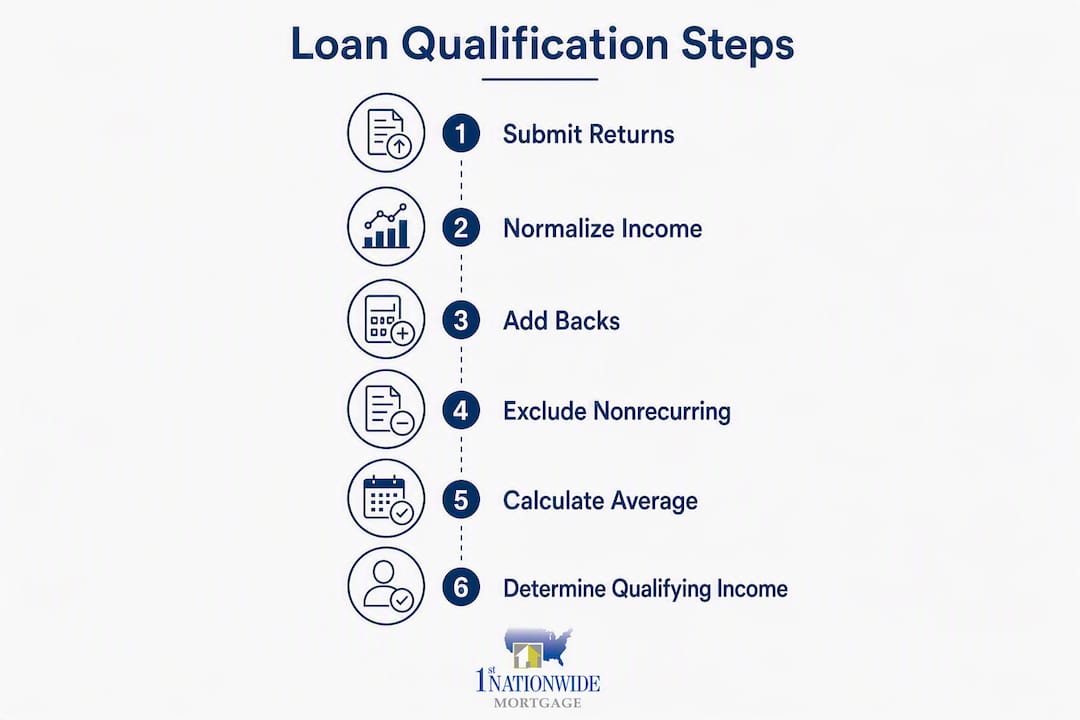
    The Schedule Analysis Method (SAM) and tools like Fannie Mae’s Comparative Income Analysis (Form 1088) are the standard frameworks lenders use to convert tax-return figures into a reliable cash-flow estimate. SAM systematically adds back noncash items and removes nonrecurring events, giving underwriters a normalized monthly income figure they can use with confidence.


    What documents lenders will ask you to provide

    A complete file moves faster and qualifies more cleanly. Here’s what lenders typically request and why each item matters:

    • Two years of personal tax returns (Form 1040 with all schedules): The starting point for income analysis. Underwriters trace your reported income, deductions, and business activity from here.
    • Two years of business tax returns (Schedule C, Form 1120S, or Form 1065): Reveals business-level income, expenses, depreciation, and distributions. Required for any entity beyond a sole proprietor.
    • K-1 forms (all years requested): Documents your share of partnership or S-corp income and distributions. Lenders cross-reference K-1s against the business return to confirm consistency.
    • 1099 forms: Useful for 1099 contractors and freelancers to corroborate income reported on Schedule C. A 1099 contractor mortgage application typically relies heavily on these.
    • Year-to-date profit-and-loss statement (CPA-signed): Bridges the gap between your last filed tax return and today. Lenders accept CPA-prepared YTD P&Ls and business bank statements as supplemental documentation to explain tax-year discrepancies.
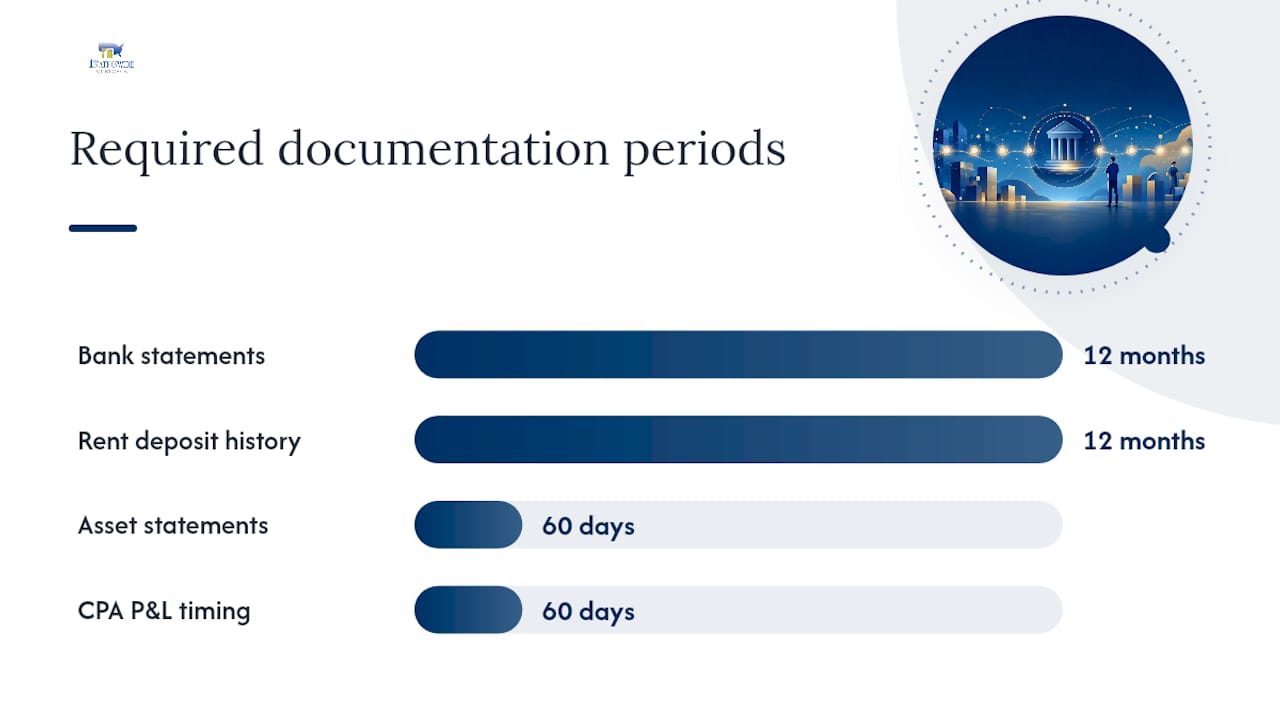
    • 12–24 months of business and personal bank statements: Confirms cash flow, owner draws, and that business deposits match what’s reported on tax returns.
    • Payroll records (if applicable): Required for S-corp or C-corp owners drawing a W-2 salary from their own company.

    Additional documents that strengthen your file:

    • CPA letter summarizing normalized income: Explains add-backs and one-time adjustments in plain language for the underwriter.
    • Accounts receivable aging report: Demonstrates ongoing business activity and future cash flow.
    • Articles of Organization or Incorporation: Confirms business structure and your ownership percentage.
    • Evidence of separate business and personal accounts: Mixing personal and business accounts is one of the most common underwriting red flags for self-employed borrowers. Separate accounts create an auditable record of owner draws.

    How tax deductions affect your qualifying income

    The deductions that lower your tax bill often lower your qualifying income by the same amount. Understanding which ones lenders adjust — and in which direction — lets you anticipate what your qualifying income will look like before you apply.

    Common Deduction Typical Lender Action Reason
    Depreciation Added back Noncash expense; doesn’t reduce actual cash flow
    Amortization Added back Noncash; same logic as depreciation
    Depletion Added back Noncash charge on natural resources
    One-time business loss Removed from calculation Nonrecurring; doesn’t reflect ongoing operations
    Home-office expense Sometimes adjusted Lender may question personal vs. business use split
    Excessive owner compensation to related parties May reduce qualifying income Inflated expenses can mask true cash flow
    Ongoing operating losses Reduces qualifying income Signals business instability
    Mileage and vehicle expenses Reviewed case by case Partially noncash; lender may add back depreciation component

    The Schedule Analysis Method is the standard tool for this process. It systematically adds noncash expenses back to taxable income and removes nonrecurring items, producing a normalized cash-flow figure. Underwriters typically add back noncash charges and adjust for recurring versus nonrecurring income to arrive at a qualifying number.

    Pro Tip: When you submit your file, include the supporting schedules and depreciation worksheets from your tax return. A CPA note that explains each add-back in plain language reduces back-and-forth with the underwriter and speeds up approval.


    Alternative qualifying paths when tax returns understate your income

    Tax returns are the default, but they’re not the only road. When write-offs reduce your reported income below what you actually earn, two programs offer a different approach: bank-statement loans and DSCR loans.

    Bank-statement loans

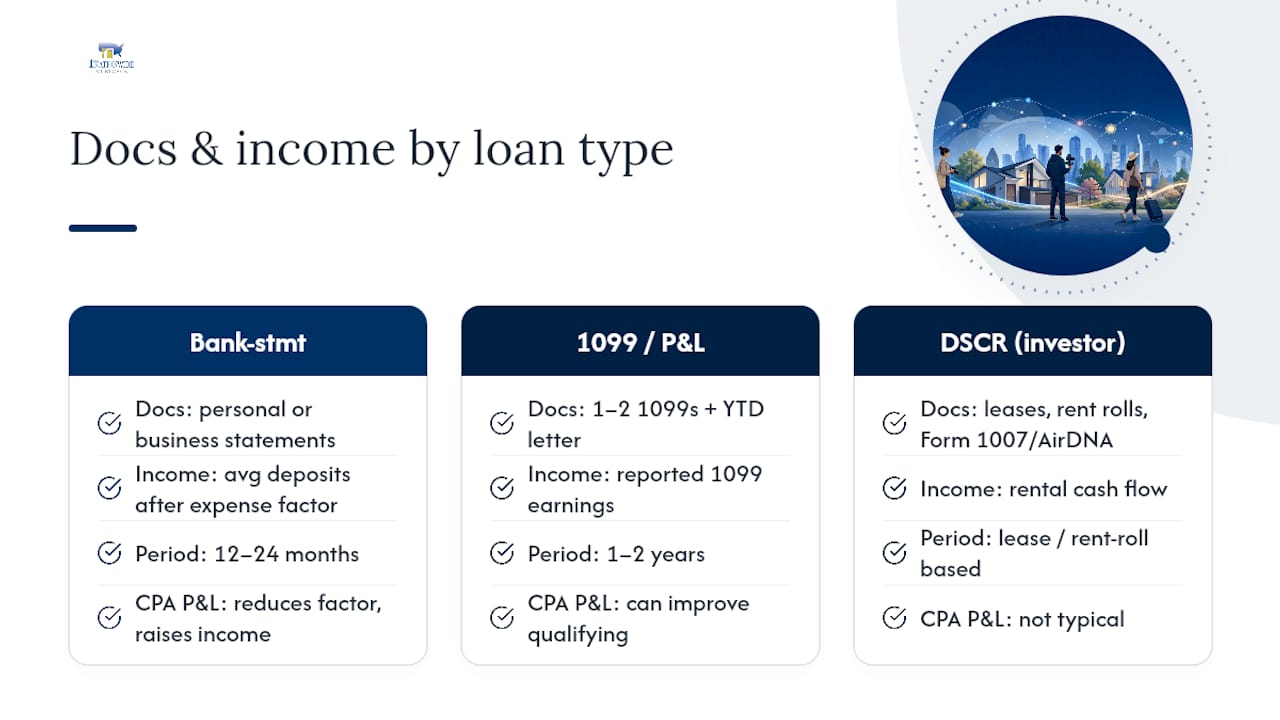
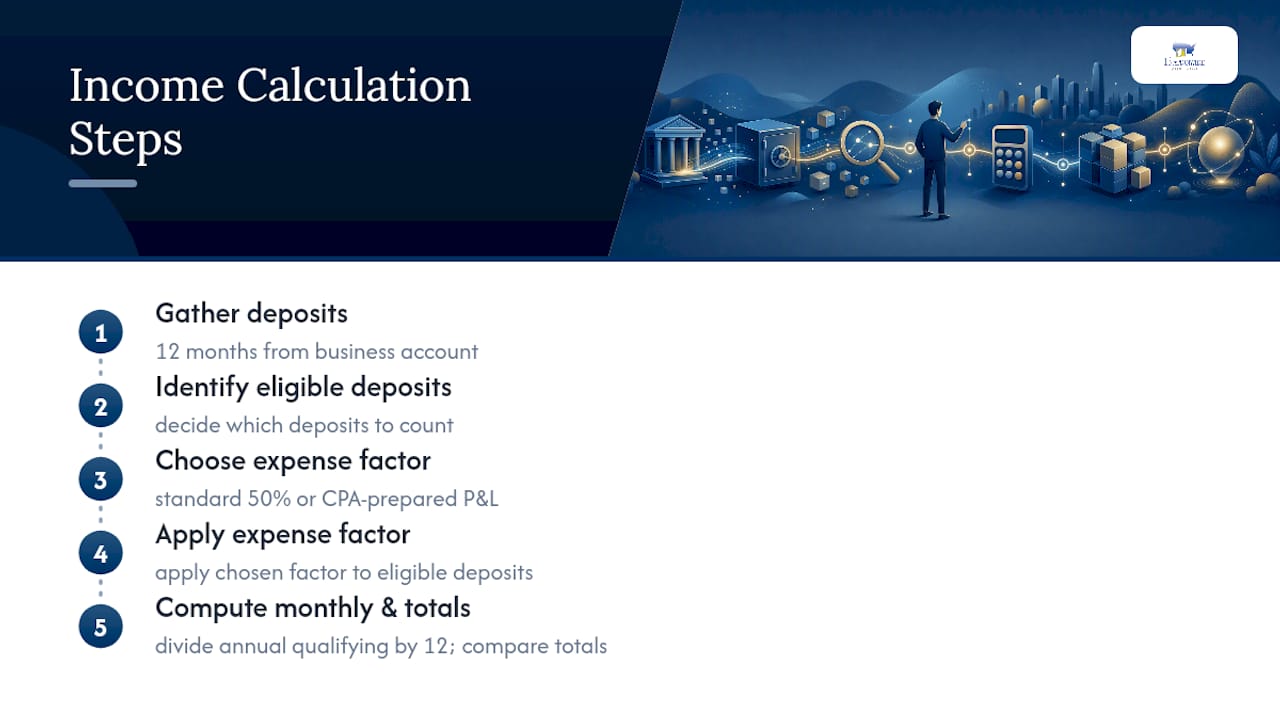
    Bank-statement programs let self-employed borrowers qualify using 12–24 months of personal or business bank deposits instead of tax returns. The lender totals your deposits over the statement period, applies an expense factor to estimate business costs, and arrives at a monthly qualifying income figure.

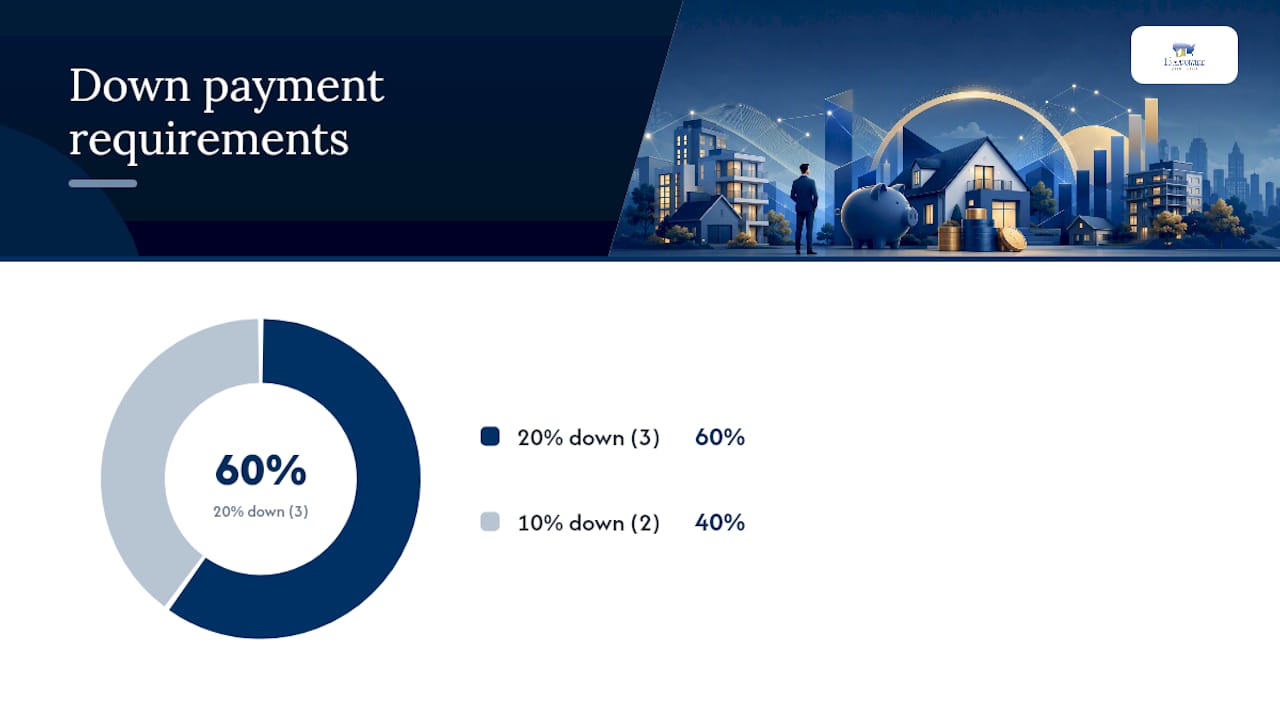
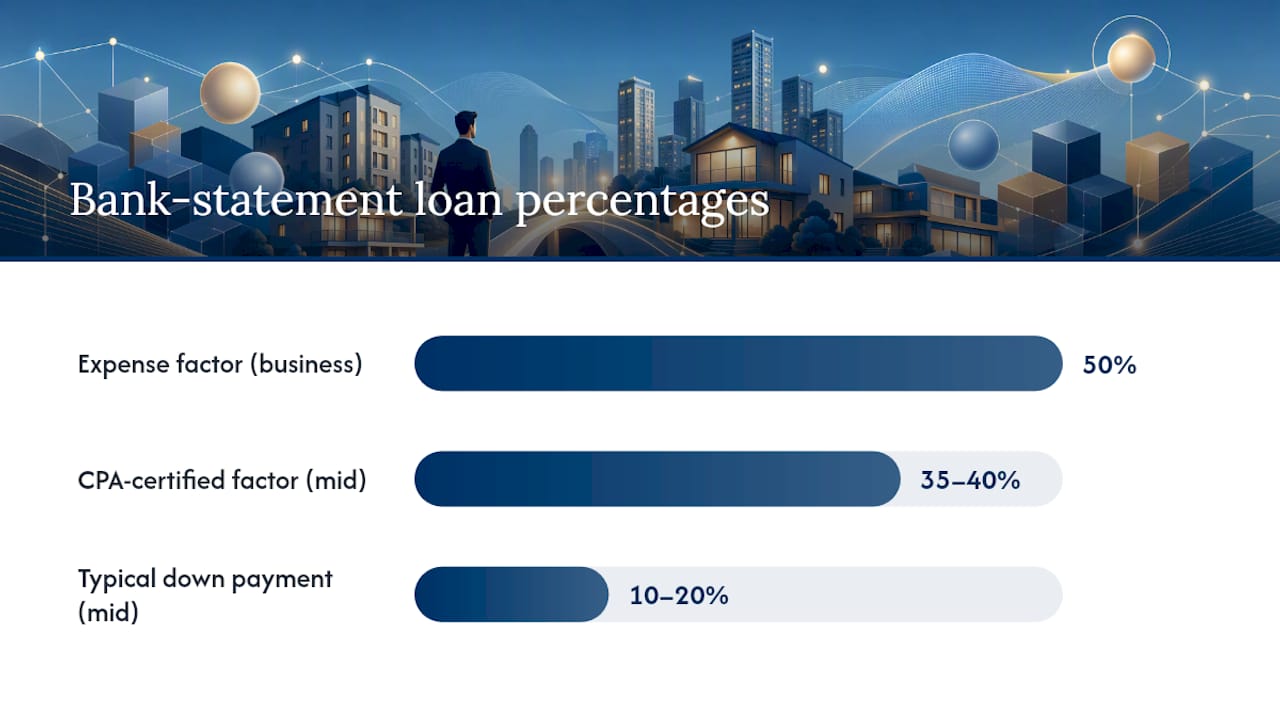
    At 1st Nationwide Mortgage, the standard expense factor on business accounts is 50% — meaning half of your total deposits are treated as business expenses, and the remaining half counts as qualifying income. That factor can drop to 35–40% if you provide a CPA-certified profit-and-loss statement showing your actual expense ratio is lower. The program requires a minimum 620 credit score and typically 10–20% down.

    Bank-statement loans are built for one specific problem: your tax return shows $55,000 in net income because you wrote off $120,000 in legitimate business expenses, but your bank deposits show $175,000 flowing through your accounts. The loan program uses the deposit history — not the tax return — to measure your real cash flow. That’s the core difference between this program and a conventional mortgage.

    You can estimate your qualifying income before you apply using the bank-statement loan calculator at 1st Nationwide Mortgage.

    DSCR loans for real estate investors

    Man reviewing bank statements on tablet in café

    Debt-Service Coverage Ratio (DSCR) loans remove personal income from the equation entirely. Qualifying is based on whether the rental income from the property covers the mortgage payment. If the property generates enough rent to service the debt, you qualify — regardless of what your personal tax return shows.

    This program works well for LLC-held properties and investors who have multiple financed properties. There’s no limit on the number of financed properties, and the loan can close in the LLC’s name. For investors whose personal income is thin on paper but whose portfolio generates strong rental cash flow, DSCR is often the cleaner path. See the DSCR loan program details or run the numbers with the DSCR loan calculator.

    Choosing between programs

    Use conventional underwriting when your tax returns show two years of stable, growing income and your net profit after deductions still supports your debt-to-income ratio. Choose a bank-statement loan when write-offs have reduced your reported income significantly but your deposits tell a different story. Choose DSCR when you’re financing an investment property and the rental income covers the payment, regardless of your personal income situation.


    Practical steps to improve your qualifying income before you apply

    Most self-employed borrowers can meaningfully improve their qualifying income with some preparation. The key is timing: some changes take effect quickly, while others require a full tax cycle to show up in underwriting.

    Immediate steps (within 30–90 days):

    • Open dedicated business checking and savings accounts if you haven’t already. Strict separation of business and personal accounts is the single most common advice mortgage professionals give self-employed borrowers — it creates a clean, auditable record of owner draws.
    • Ask your CPA to prepare a current year-to-date P&L and balance sheet. This document can supplement your tax returns and explain income that hasn’t yet appeared on a filed return.
    • Establish a consistent, documented owner draw or payroll schedule. Irregular distributions are harder for underwriters to verify and count.

    Medium-term steps (3–12 months before applying):

    1. Stop large discretionary write-offs that reduce net income without reflecting real business costs. Talk to your CPA about which deductions are worth keeping versus which ones hurt your qualifying income more than they save in taxes.
    2. Build cash reserves in both your business and personal accounts. Lenders look at reserves as a sign of financial stability, and stronger reserves can offset other risk factors.
    3. If you operate as an S-corp, ask your CPA whether establishing formal W-2 payroll from the business helps your qualifying picture. A documented salary is easier for underwriters to count than irregular distributions.
    4. Review your self-employed home loan preparation checklist at least six months before you plan to apply.

    Longer-term steps (two years before applying):

    • For tax-return-based qualifying, two full years of filed returns showing stable or growing income is the gold standard. If your income has been declining, address the underlying business issue before applying — lenders will see the trend and factor it in.
    • If you recently transitioned from W-2 employment to self-employment, plan for a two-year wait before conventional lenders will count your business income. Some non-QM programs have shorter seasoning requirements.

    Questions to ask your CPA and lender:

    • Which of my current deductions can be documented as add-backs for underwriting purposes?
    • Would switching to S-corp payroll improve my qualifying income, and how long before it shows up in my file?
    • Does my current draw history support the income level I need to qualify?

    Understanding why self-employed borrowers get denied is as useful as knowing what to do right — the two sides of the same preparation.


    Worked examples: converting business figures into qualifying income

    These examples use simplified numbers to show the calculation logic. Your actual qualifying income will depend on your specific tax returns, business structure, and lender guidelines.

    Example 1: Schedule C sole proprietor

    Example 2: S-corp owner (W-2 salary + K-1 distributions)

    Income Component Amount
    W-2 salary from S-corp (Year 1 + Year 2 average) $60,000/year

    Note: The K-1 income counts only after the lender confirms the business has sufficient liquidity to sustain distributions. Retained earnings that haven’t been distributed typically don’t count.

    Example 3: Bank-statement loan (12 months of deposits)

    Line Item Amount
    Less: standard expense factor (50%) ($120,000)
    Qualifying income (annual) $120,000

    The difference between a 50% and 35% expense factor in this example is $3,000 per month in qualifying income — which can be the difference between approval and denial at a given purchase price.

    Documents needed for each example:

    • Schedule C: Form 1040 (both years), Schedule C with depreciation worksheets, CPA add-back letter
    • S-corp: Form 1040, Form 1120S, K-1s (both years), W-2 from the business, business bank statements
    • Bank-statement: 12–24 months of business bank statements, CPA-signed YTD P&L (to reduce expense factor)

    Key Takeaways

    Lenders convert business income into qualifying mortgage income through a structured analysis of tax returns, add-backs, and distribution history — and alternative programs exist when that process undervalues your real cash flow.

    Point Details
    Two-year averaging is standard Lenders average adjusted business income over two years; a positive trend may allow use of the most recent year only.
    Add-backs increase qualifying income Noncash deductions like depreciation are added back to net profit, raising the income figure underwriters use.
    Distributions, not profits, count Retained corporate profit doesn’t qualify; only income actually distributed to you and verified as sustainable counts.
    Bank-statement loans bypass tax returns Qualifying income is derived from 12–24 months of deposits; a CPA-certified P&L can reduce the expense factor from 50% to 35–40%.
    1st Nationwide Mortgage offers both paths Bank-statement and DSCR loan programs are available for self-employed borrowers and investors who don’t qualify through conventional underwriting.

    What most self-employed borrowers get wrong about qualifying

    The conventional wisdom says self-employment makes mortgages harder. That’s only partially true. What actually makes mortgages harder is undocumented self-employment income — and those are two very different problems.

    The borrowers who struggle most aren’t the ones with complex business structures. They’re the ones who’ve spent years minimizing taxable income without thinking about what that looks like to an underwriter. A tax return showing $45,000 in net income after $130,000 in deductions is a legitimate tax strategy. It’s also a qualifying-income problem. The solution isn’t to stop deducting — it’s to understand which deductions are add-backs in underwriting, and to build a documentation trail that tells the full story.

    The other mistake I see regularly: borrowers who assume that because their business is profitable, they’ll qualify easily. Profit on paper doesn’t equal qualifying cash flow. An underwriter’s job is to determine whether the business can sustain distributions to you over the life of the loan without harming operations. That’s a higher bar than “the business made money last year.”

    If your tax returns understate your real income, bank-statement and DSCR programs exist precisely for that situation. They’re not workarounds or last resorts — they’re purpose-built products for borrowers whose financial reality doesn’t fit a W-2 template. The key is knowing which program fits your situation before you apply, not after a conventional lender declines you.


    How 1st Nationwide Mortgage works with self-employed borrowers

    Self-employed borrowers whose write-offs reduce their reported income often qualify for more than a conventional lender’s tax-return analysis suggests. 1st Nationwide Mortgage is a direct mortgage banker — not a broker — that specializes in exactly this gap.

    1st Nationwide Mortgage

    Two programs are particularly relevant here. The bank-statement mortgage program uses 12 or 24 months of business or personal deposits to derive qualifying income, with a standard 50% expense factor that drops to 35–40% when you provide a CPA-certified P&L. Minimum 620 credit score, 10–20% down. The investment property DSCR program qualifies on rental cash flow rather than personal income — useful for investors holding properties in an LLC or those with thin personal income on paper.

    1st Nationwide Mortgage is licensed in 18 states. Christopher Arco, NMLS #1281, founded and operates the company. To check program eligibility or estimate your qualifying income from bank deposits, use the bank-statement income calculator or review the full loan programs page. This article is general information, not financial or legal advice — confirm current program guidelines and your specific eligibility with a licensed loan originator before applying.


    Useful sources and further reading

  • Sole Proprietor Mortgage Approval: How to Qualify

    Sole Proprietor Mortgage Approval: How to Qualify

    Yes, sole proprietors can get mortgages. The path depends on how you document income, how long you’ve been in business, and which loan program fits your financial picture. Three primary qualifying routes exist: tax-return-based qualification using Schedule C net profit, bank-statement programs that average 12–24 months of deposits, and CPA-prepared profit-and-loss statements paired with alternative documentation. The underwriting levers that matter most are your two-year income history, credit score, debt-to-income ratio (DTI), liquid reserves, and documentation consistency across every form you submit.

    The sole proprietor mortgage approval process is more demanding than a W-2 application, but it’s far from impossible. Lenders want to see stable, verifiable income. Your job is to show them exactly that, in the format they expect.

    • Qualifying route 1: Tax-return-based (Schedule C net profit, averaged over two years)
    • Qualifying route 2: Bank-statement program (deposits averaged, expense ratio applied)
    • Qualifying route 3: CPA-prepared P&L with supporting alternative documentation

    Table of Contents

    Can you qualify for a mortgage as a sole proprietor?

    Lenders define you as self-employed when you own 25% or more of a business. Sole proprietors file Schedule C on their personal Form 1040, which means your business income and personal income are one and the same thing in the lender’s eyes. That simplifies some things and complicates others.

    Fannie Mae requires two years of signed personal federal tax returns as the standard for verifying self-employment income. A narrow exception exists: if you’ve owned the business for five or more years and the business has been stable or growing, some lenders may accept one year of returns. Treat that as the exception, not the plan.

    Typical baseline thresholds most lenders apply:

    • Credit score: 620 minimum for most programs; 680+ opens more options and better pricing
    • DTI: 43% or below for conventional loans; non-QM programs can go higher with compensating factors
    • Business history: Two years operating as a sole proprietor, evidenced by tax returns and business records (the two-year returns requirement is the standard for Fannie Mae; a five-year ownership exception may permit one year in limited cases)
    • Reserves: Two to six months of mortgage payments in liquid assets, depending on the program

    Two scenarios illustrate how these rules play out. A sole proprietor with two consecutive Schedule C years showing steady or rising net profit is in the strongest position for conventional approval. A business owner in year one, even with strong deposits, will find conventional options limited and should look at non-QM programs instead. Lenders view sole proprietorships as higher underwriting risk partly because there’s no legal separation between personal and business assets, which means cash-flow reviews are more rigorous than for incorporated borrowers.


    Infographic showing mortgage approval steps

    How lenders verify your self-employed income

    Income verification is where most self-employed mortgage applications succeed or stall. The method you use determines your qualifying income number, and that number determines your loan size.

    The four main verification methods

    • Schedule C / tax-return method: Underwriters pull net profit from Schedule C, add back allowable non-cash items like depreciation, then average the two-year total and divide by 24 to get monthly qualifying income. Fannie Mae requires a written cash-flow analysis (Form 1084 or equivalent) in the loan file.
    • Bank-statement programs: Lenders average 12–24 months of deposits and apply an expense ratio to estimate net income. Standard expense factor on business accounts is 50%; a CPA-certified P&L can reduce that to 35–40%, increasing your qualifying income.
    • CPA-prepared P&L with CPA letter: A year-to-date profit-and-loss statement signed by a licensed CPA, paired with a letter confirming the business’s financial condition, can supplement or replace certain return requirements depending on the program.
    • 1099s and invoices: Useful as supporting documentation, especially for 1099 contractors. Lenders rarely use these alone but they strengthen the overall file.

    Sample qualifying income calculation (Schedule C method)

    1. Year 1 Schedule C net profit: $72,000
    2. Year 2 Schedule C net profit: $84,000
    3. Add depreciation add-back (Year 1: $3,000 / Year 2: $4,000): total add-backs $7,000
    4. Combined adjusted income: $163,000
    5. Divide by 24 months: $6,791/month qualifying income

    Underwriters add back depreciation because it’s a non-cash expense. Cash expenses, including supplies, travel, and contractor payments, stay subtracted. That distinction matters when you’re deciding which deductions to take in the year before you apply.

    Pro Tip: Keep business and personal bank accounts completely separate. Commingled accounts and inconsistent names across 1099s, Schedule C, and bank deposits are among the most common triggers for underwriter documentation requests, and they slow closings significantly.

    Underwriter checking tax documents at desk


    What documents do you need to apply?

    Assembling a lender-ready file before you apply is the single most effective way to reduce underwriting delays. Here’s what to gather, grouped by category.

    Personal documentation

    • Two years of signed personal federal tax returns (Form 1040) with all schedules, including Schedule C
    • W-2s or 1099s from all income sources for the past two years
    • Two months of personal bank statements (all pages)
    • Government-issued photo ID
    • Social Security number for credit authorization

    Business documentation

    • Business license or DBA registration
    • Proof of business existence (state registration, professional license, or business insurance)
    • Year-to-date profit-and-loss statement, CPA-signed
    • CPA letter confirming business viability and ownership percentage
    • Two months of business bank statements (all pages, all accounts)
    • List of business debts and liabilities

    Alternative documentation (bank-statement programs)

    • More than a year of business or personal bank statements
    • CPA-prepared expense ratio letter (reduces the standard 50% expense factor)
    • Explanation letters for large or irregular deposits

    For sole proprietors, personal returns verify business income directly, since there are no separate business returns to file. Lenders may waive business tax returns in narrow cases when reserves and ownership history meet strict criteria, but personal returns are always required.

    If you plan to use business funds for your down payment or closing costs, expect additional scrutiny. Lenders will request a business cash-flow analysis and current balance sheets to confirm the withdrawal won’t impair business operations.

    Document Purpose Notes
    Form 1040 (2 years, signed) Primary income verification Include all schedules, especially Schedule C
    Schedule C Net profit calculation Lender uses this to calculate qualifying income
    Business bank statements Deposit verification 12–24 months for bank-statement programs
    CPA-signed P&L Income supplement/alternative Year-to-date; required for expense ratio reduction
    IRS tax transcripts Lender verification Order early — transcript processing can add days to underwriting
    Business license / DBA Business existence proof State registration or professional license acceptable
    1099s Supporting income documentation Strengthens file; rarely used alone

    Which loan programs work best for sole proprietors?

    Not every program fits every borrower. The right choice depends on how your income is documented and what your Schedule C shows after deductions.

    Program Best for Key documentation Rate/cost note
    Conventional (Fannie/Freddie) Strong Schedule C income, 2+ years returns 2 years personal returns, Form 1084 Lowest rates when you qualify
    FHA Lower credit scores, higher DTI 2 years returns, 3.5% down minimum Mortgage insurance adds cost
    VA Eligible veterans with self-employment income 2 years returns, COE No down payment; funding fee applies
    Bank-statement (non-QM) High deposits, low Schedule C net profit Extensive bank statements, CPA P&L Higher rate than conventional; more flexibility
    DSCR Real estate investors Rental income documentation; no personal income required Qualification based on property cash flow
    NONI Foreign nationals, no documentable income Asset documentation Specialty program; limited availability

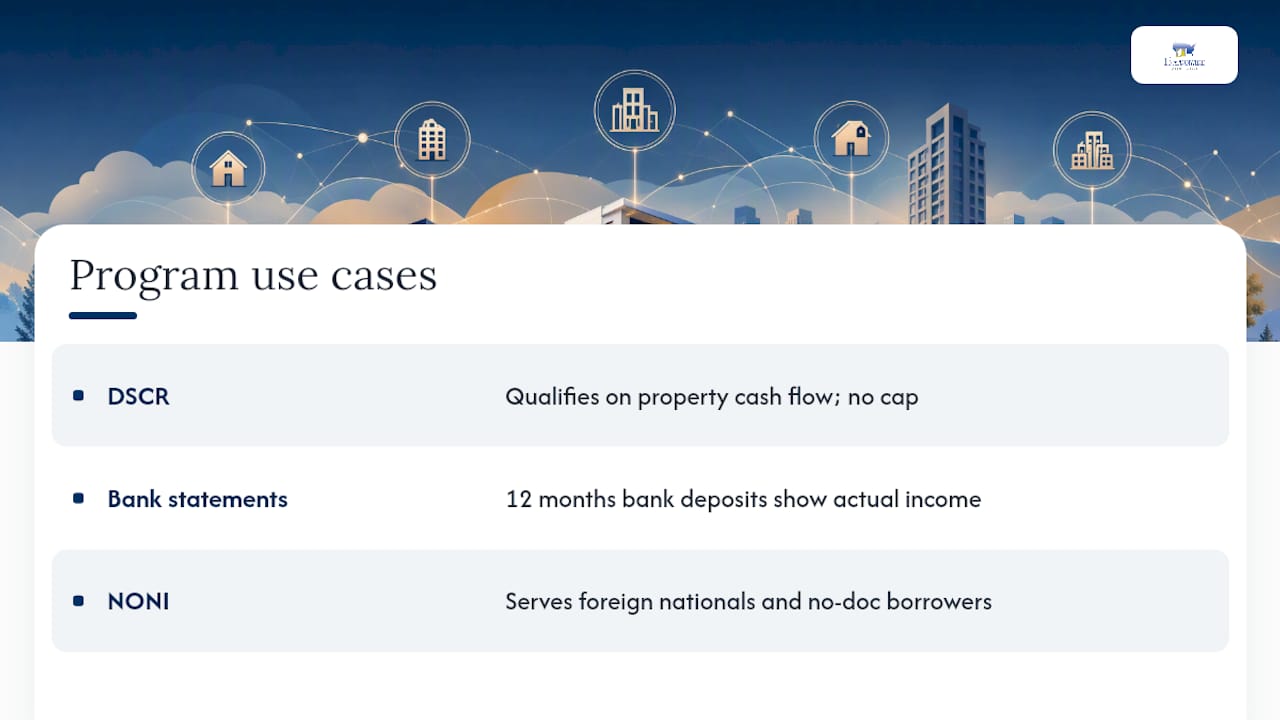
    Non-QM programs including bank-statement loans, DSCR, and NONI exist specifically for borrowers whose tax returns don’t reflect their true financial capacity. Bank-statement loans are the most common path for sole proprietors with strong revenue but aggressive deductions. DSCR loans work when you’re buying investment property and want the rental income to carry the qualification entirely. For 1099 contractors and consultants, a dedicated 1099 mortgage program can use contractor income documentation without requiring full Schedule C analysis.


    What does the mortgage approval process look like, step by step?

    The self-employed mortgage approval process follows the same general stages as any mortgage, but each stage tends to take longer because of the additional documentation review.

    1. Prequalification (1–3 days): You provide income estimates, credit authorization, and a summary of assets. The lender gives you a rough loan range. No documents verified yet.

    2. Preapproval (3–7 days): You submit your full documentation package. The lender pulls credit, reviews two years of returns, and issues a preapproval letter. Self-employed borrowers often receive conditional preapprovals with a list of additional items needed.

    3. Application and property selection (varies): Once you’re under contract, you complete the formal loan application (Uniform Residential Loan Application). The lender issues a Loan Estimate within three business days.

    4. Underwriting (10–21 days for self-employed borrowers): This is where the detailed cash-flow analysis happens. The underwriter completes Form 1084 or an equivalent written analysis, verifies IRS transcripts against your returns, and may request a CPA letter or updated P&L. Expect at least one round of conditions.

    5. Clear to close (1–3 days after final conditions): All conditions are satisfied. The lender issues a Closing Disclosure at least three business days before closing.

    6. Closing (1–2 hours): You sign final documents, funds are disbursed, and you receive keys.

    Self-employed borrowers should budget 30–45 days from application to closing under normal conditions, compared to 21–30 days for W-2 borrowers. Complex files or missing documents can push that to 60 days.

    Pro Tip: Order your IRS tax transcripts and a CPA-prepared year-to-date P&L before you start the preapproval process. Transcript processing can add unexpected days to underwriting, and having the P&L ready reduces the most common conditional request.

    Couple discussing mortgage steps with banker outdoors


    How can you improve your approval odds?

    A strong application doesn’t happen at the last minute. These steps, taken in the right order, give you the best chance of a smooth approval.

    Before you apply (3–12 months out):

    • Pull your credit reports from all three bureaus and dispute any errors
    • Pay down revolving balances to reduce your DTI and improve your credit utilization ratio
    • Separate business and personal bank accounts if you haven’t already
    • Build liquid reserves equal to at least three to six months of the target mortgage payment
    • Consult a CPA about which deductions affect qualifying income and whether a bridge year makes sense

    In the weeks before application:

    • Gather two full years of signed tax returns and confirm they match your IRS transcripts
    • Request a year-to-date P&L from your CPA and have a CPA letter ready
    • Prepare written explanations for any large deposits, business losses, or income fluctuations
    • Avoid opening new credit accounts or making large purchases

    Common underwriting red flags and how to address them:

    • Low Schedule C net income: Consider a bank-statement program or reduce deductions in the prior year. Document that income is stable or growing.
    • Large one-time deductions: Prepare a written explanation and supporting documentation showing the expense was non-recurring.
    • Commingled accounts: Open a dedicated business account immediately and maintain it for at least 12 months before applying.
    • Thin reserves: Delay the application until reserves reach the program minimum; some programs accept gift funds or business assets with additional documentation.

    If you need to explain a large deposit, keep it simple and factual. A one-paragraph letter stating the source, the date, and why it’s not recurring income is usually sufficient. Attach supporting documentation such as a contract, invoice, or transfer record.


    Tax strategy vs. borrowing power: what sole proprietors need to plan for

    The most common financial tension sole proprietors face before applying is this: the same deductions that reduce your tax bill also reduce your qualifying income. A CPA who optimizes your taxes without considering your mortgage timeline can inadvertently shrink your loan eligibility.

    Underwriters add back non-cash expenses like depreciation, but cash-paid deductions, including supplies, subcontractors, and vehicle expenses, stay subtracted from qualifying income. Knowing which expenses are reversible before you file is the key planning insight most borrowers miss.

    The “bridge year” tactic addresses this directly. In the tax year before you plan to apply, you intentionally minimize certain discretionary deductions to increase your Schedule C net profit. That higher net profit then appears in the returns you submit to the lender. The tradeoff is a higher tax bill for that year, but the increase in qualifying income often justifies it when you’re targeting a specific loan amount.

    Fannie Mae’s underwriting guidelines and a CPA-prepared P&L together give you a clear picture of what your qualifying income will look like before you apply. Run the numbers with both your CPA and your mortgage banker before filing returns or changing your deduction strategy.

    Pro Tip: Do not change your business entity structure in the year before you apply. Converting from a sole proprietorship to an LLC or S-corp triggers lender scrutiny about business continuity and can require additional documentation that delays underwriting significantly.


    Key Takeaways

    Sole proprietors who prepare their documentation, understand their qualifying income, and choose the right loan program have informed pathways to mortgage approval.

    Point Details
    You can qualify Sole proprietors qualify via Schedule C returns, bank-statement programs, or CPA-prepared P&L documentation.
    Two years is the standard Fannie Mae requires two years of signed personal federal tax returns to verify self-employment income. The five-year ownership exception may allow one year of returns in limited cases, when the business and ownership history meet strict criteria.
    Deductions reduce qualifying income Cash expenses stay subtracted; only non-cash items like depreciation are added back by underwriters.
    Separate accounts matter Commingled business and personal accounts are a leading cause of underwriting delays and documentation requests.
    1st Nationwide Mortgage Offers bank-statement, DSCR, and NONI programs for sole proprietors whose Schedule C income doesn’t reflect their full financial picture.

    What most mortgage advice gets wrong about sole proprietors

    Most articles frame the self-employed mortgage problem as a documentation problem. It’s not. It’s a planning problem. The borrowers who struggle most aren’t disorganized; they’re borrowers who made perfectly rational tax decisions without accounting for how those decisions would look to an underwriter 12 months later.

    The bridge year concept is underused because most CPAs aren’t thinking about mortgage qualification when they advise on deductions. That’s not a criticism; it’s a scope issue. Your CPA’s job is to minimize your tax liability. Your mortgage banker’s job is to maximize your qualifying income. Those two goals can conflict, and the only way to resolve the conflict is to have both professionals in the same conversation before you file your returns.

    The other thing borrowers underestimate is how much the choice of lender matters. A conventional bank underwriter who has never seen a bank-statement loan file will treat your application very differently than a direct lender who works with self-employed borrowers every week. The program you apply to and the lender you choose are as important as the documents you submit.


    How 1st Nationwide Mortgage works with sole proprietors

    If your Schedule C net income doesn’t reflect what you actually earn, you have real options. 1st Nationwide Mortgage is a direct mortgage banker, not a broker, which means your file is underwritten in-house by a team that works with self-employed borrowers regularly.

    1st Nationwide Mortgage

    For sole proprietors with strong deposits but low reported income, the bank-statement loan program uses 12–24 months of deposits to calculate qualifying income, with a standard 50% expense factor that drops to 35–40% when you provide a CPA-certified P&L. Minimum 620 credit score, 10–20% down. For real estate investors, the DSCR loan program qualifies the property on rental cash flow alone; your personal income isn’t part of the equation. NONI programs are available for borrowers with no documentable income.

    1st Nationwide Mortgage also offers conventional, FHA, VA, and jumbo programs in its licensed states. To find out which program fits your situation, contact 1st Nationwide Mortgage for a confidential eligibility review. There’s no obligation, and the conversation will tell you exactly where you stand before you start gathering documents.

    This article is general information, not professional financial or legal advice. Confirm current program guidelines and eligibility requirements with a qualified mortgage professional for your specific situation.


    Authoritative sources and further reading

    The sources below are the most relevant for sole proprietors preparing a mortgage application. Use them to verify program rules, understand your consumer rights, and prepare documentation.

    Primary and regulatory sources:

    • IRS Self-Employed Tax Center: The authoritative source for Schedule C filing, allowable deductions, and self-employment tax obligations. Review this before discussing deduction strategy with your CPA.
    • CFPB: What to do if your mortgage application is denied: Explains your rights under ECOA and HMDA, including the right to a written explanation of denial.
    • Fannie Mae Selling Guide: Self-Employed Borrower Documentation: The underwriting standard most conventional lenders follow. Read the cash-flow analysis and documentation sections before you apply.

    Publisher resources:

  • Property Cash Flow Mortgage Approval: Investor’s 2026 Guide

    Property Cash Flow Mortgage Approval: Investor’s 2026 Guide

    Yes, you can get mortgage approval based primarily on a rental property’s cash flow. DSCR loans (Debt Service Coverage Ratio loans) qualify you on what the property earns, not what you report on a W-2 or tax return. Most lenders require a minimum DSCR of 1.00–1.25, a credit score floor, and documented reserves. You can often satisfy income requirements with leases, market-rent appraisals, or bank statements alone.

    Here is what you need to move forward:

    • Run a quick DSCR check: Divide annual gross rent by annual debt service (principal + interest + taxes + insurance). A result at or above 1.00 means the property covers its own payment.
    • Gather your documents: Current leases or a market-rent appraisal, 2–3 months of bank statements, entity paperwork if you hold the property in an LLC.
    • Use a DSCR loan calculator to model how rent, rate, and loan size interact before you contact a lender.

    A fast screen: multiply monthly rent by 50%, then subtract the estimated mortgage payment. If the result is positive, the deal is worth underwriting in full.


    Table of Contents

    What is a DSCR loan and how does it differ from a traditional mortgage?

    A DSCR loan is a non-QM (non-qualified mortgage) product designed specifically for real estate investors. The lender’s primary qualification metric is the property’s net operating income (NOI) divided by its annual debt service. Your personal income, employment history, and debt-to-income ratio are not part of the approval equation.

    The core idea: if the property generates enough rent to cover its own mortgage, taxes, and insurance, the loan can close — regardless of how many properties you already own or how your personal tax returns look.

    Traditional mortgage underwriting works the opposite way. Lenders calculate your DTI by stacking all your monthly debt obligations against your documented gross income from W-2s or tax returns. For investors with multiple properties and aggressive depreciation write-offs, that DTI calculation often disqualifies them even when their portfolio is profitable. DSCR underwriting sidesteps that entirely.

    The trade-offs are real. DSCR loans typically carry interest rates 1–2 percentage points higher than conventional investor pricing, plus origination costs and reserve requirements that exceed what most primary-residence buyers expect. Prepayment penalties, often structured on a 5-4-3-2-1 declining schedule, are common. For investors who need to scale without hitting personal income ceilings, those costs are usually worth it.

    Infographic comparing DSCR and traditional loans


    How lenders underwrite property cash flow mortgage approval

    The DSCR formula is straightforward:

    DSCR = NOI ÷ Annual Debt Service

    • NOI (Net Operating Income): Gross rent minus operating expenses (taxes, insurance, management, maintenance, vacancy allowance). Does not include the mortgage payment itself.
    • Annual Debt Service: Total principal, interest, taxes, and insurance (PITI) paid over 12 months.

    A DSCR of 1.00 means the property breaks even. A DSCR of 1.25 means it generates 25% more income than its debt obligation. Most lenders want to see at least 1.00, and many prefer 1.20–1.25 for better pricing.

    What counts as income varies by program:

    • Active leases: A signed lease is the cleanest income document. The lender uses the lower of the lease rent or the appraised market rent.
    • Market-rent appraisal: When there is no lease or the property is between tenants, an appraiser determines market rent. Lenders often use this appraised figure to set the income number, which can reduce the loan size if the appraised rent comes in below what you expected.
    • Short-term rental (STR) history: Some lenders accept Airbnb or Vrbo platform data, though they typically require 12–24 months of booking history and apply a conservative occupancy discount.
    • Bank-statement deposits: Certain cash-flow programs allow 12–24 months of deposits to support income, particularly for self-employed investors.

    Documents lenders typically request:

    • Current signed lease(s) or rent roll
    • Full appraisal with market-rent addendum (Form 1007 or 1025)
    • 2–3 months of bank statements (personal and/or entity)
    • LLC operating agreement and articles of organization (if applicable)
    • Proof of reserves (bank or investment account statements)
    • Property insurance declarations page

    Pro Tip: Order a local rent comp or appraisal before you apply. If the appraised market rent comes in lower than your lease, the lender will resize the loan to match the lower figure, and you will need to bring more cash to closing.


    Who qualifies for a cash-flow or DSCR loan?

    DSCR loans were built for three investor profiles that traditional banks struggle to serve.

    Active investors with LLCs are the most common applicants. Because DSCR underwriting ignores personal DTI, there is no limit on the number of financed properties. An LLC can hold the asset, which provides liability separation and cleaner entity documentation for the lender.

    Self-employed owners whose tax returns show low net income due to depreciation and write-offs often qualify through bank-statement programs. Twelve to 24 months of deposits replace tax returns as the income source.

    Foreign nationals with no U.S. income documentation can use NONI (No Income, No Asset) programs, which underwrite entirely on the property’s cash flow and asset position.

    Baseline thresholds to expect: Most DSCR lenders require a minimum credit score in the 620–680 range, a down payment of 20%–25% (LTV of 75%–80%), and 6–12 months of PITI reserves. The 3-3-3 rule’s suggestion of three months of mortgage reserves is well below what DSCR lenders actually require — plan for at least six.

    The same deal can underwrite very differently from one lender to another. Lender overlays on minimum DSCR, eligible property types, and reserve calculations vary enough that a file declined at one shop may close cleanly at another. That is why working with a direct lender who knows non-QM guidelines matters more than shopping on rate alone.


    Which property types and loan terms qualify for cash-flow-based underwriting?

    Property Type Typically Eligible Common LTV Cap Notes
    Single-family rental (1 unit) Yes 75%–80% Most widely accepted
    Small multifamily (2–4 units) Yes 65%–70% Rent roll required for all units
    Condos Often, with restrictions 65%–70% Warrantability and HOA review required
    Short-term rentals Lender-dependent 65%–75% Platform history and STR appraisal required
    5+ unit / commercial Select lenders only 65%–70% Commercial DSCR rules apply

    Loan terms typically run 30 years fixed, though 5/1 and 7/1 ARMs are available and can improve DSCR at origination by lowering the initial payment. Fixed-rate products carry higher rates but eliminate rate-reset risk, which matters when you are modeling long-term cash flow. Down payment requirements generally increase as property complexity rises: a single-family rental at 20% down is standard, while a short-term rental or mixed-use property may require 25%–30%.

    Short-term rental policies deserve special attention. Many lenders require a specialized STR appraisal rather than a standard Form 1007, and some cap STR loans at 65% LTV regardless of DSCR. If your portfolio is primarily Airbnb properties, confirm the lender’s STR overlay before you invest time in an application.


    How to calculate property cash flow and DSCR

    Real estate cash flow has four layers. Skipping any one of them produces a number that looks better than reality.

    1. Gross Rent: Total scheduled rent at 100% occupancy.
    2. Effective Gross Income (EGI): Gross rent minus vacancy allowance (typically 5%–10%).
    3. NOI: EGI minus operating expenses (management, taxes, insurance, maintenance, CapEx reserve).
    4. Cash Flow: NOI minus annual debt service (PITI).

    The 50% Rule as a fast screen: Operating expenses typically consume 35%–50% of gross rent, not including the mortgage. Using 50% is the conservative quick-check that avoids optimistic bias.

    Worked example:

    • Monthly rent: $2,000 ($24,000/year)
    • Vacancy (5%): $1,200/year
    • EGI: $22,800/year
    • Operating expenses (50% of gross rent): $12,000/year
    • NOI: $10,800/year
    • Annual PITI (on a $200,000 loan at 8%): approximately $18,000/year
    • DSCR: $10,800 ÷ $18,000 = 0.60 — this deal does not qualify at standard thresholds.

    Now adjust: if the property costs $160,000 with the same rent, annual PITI drops to roughly $14,400, and DSCR rises to 0.75. Still below 1.00. To hit a 1.00 DSCR, you need NOI to equal or exceed the full debt service. That is why professional investors now target a 1.1%–1.2% rent-to-price ratio rather than the old 1% rule, which no longer reliably produces positive cash flow at current rates.


    How to improve your odds of DSCR loan approval

    Most DSCR declines are preventable. The issues that kill deals fall into a short list: low DSCR, thin reserves, credit score just below the floor, or entity paperwork that is not lender-ready.

    Before you apply:

    • Increase the down payment if DSCR is borderline. A larger down payment reduces debt service, which directly improves the ratio.
    • Lock in leases before application. A signed lease at market rent is stronger than a verbal agreement or a vacant unit.
    • Order rent comps early. If the appraiser’s market-rent figure comes in below your lease, the lender will use the lower number. Knowing this in advance lets you price the deal correctly.
    • Clean up credit. Pay down revolving balances to below 30% utilization. Even a 20-point credit score improvement can move you into a better rate tier.
    • Show reserves. Six months of PITI in a verifiable account is a baseline; 12 months puts the file in a stronger position.
    • Prepare entity documents. If you are buying in an LLC, have the operating agreement, articles of organization, and EIN letter ready before the application.

    Pro Tip: Model your deal with a 10% vacancy rate and 50% operating expenses before you submit. If the DSCR still clears 1.20 under those conservative inputs, the file is unlikely to surprise you at underwriting.

    A common mistake newer investors make is submitting a deal with a DSCR of exactly 1.00 and expecting smooth approval. Lenders price risk into the rate at that threshold, and any appraisal variance can push the ratio below the minimum. Target 1.20 or above before you apply. For a deeper look at lender overlays and document checklists, the DSCR loan qualification guide at 1st Nationwide Mortgage covers current requirements in detail.

    Hands reviewing DSCR loan worksheet on tablet


    What does the timeline and cost look like from application to close?

    Typical timeline:

    • Pre-qualification: 1–3 business days. Lender reviews rent, estimated value, credit, and reserves to give a preliminary approval range.
    • Underwriting and appraisal: 10–30 days. The appraisal is usually the longest step, particularly in markets where STR appraisers are limited.
    • Clear-to-close to funding: 7–14 days after conditions are satisfied.

    Total time from application to funded loan: 21–45 days in most markets, though complex files or appraisal delays can extend that.

    Fees and costs to budget:

    • Origination: typically 1–2 points on DSCR loans
    • Appraisal: $500–$800 for single-family; more for multifamily or STR-specific appraisals
    • Underwriting and processing fees: vary by lender
    • Prepayment penalty: often a 5-4-3-2-1 step-down structure (5% of loan balance in year one, declining by 1% per year)

    Reserve requirements: DSCR lenders commonly require 6–12 months of PITI reserves, held in liquid accounts after closing. On a $200,000 loan with $1,500/month PITI, that means $9,000–$18,000 sitting in reserve after your down payment and closing costs. Budget for this separately from your acquisition capital.


    The hidden expenses investors miss in cash-flow math

    DSCR alone does not tell the full story. A property can show a DSCR of 1.10 and still produce negative actual cash flow once you account for all operating costs.

    Industry analysts recommend budgeting 35%–50% of gross rent for operating expenses as a conservative quick-check for cash flow. That range covers the line items most investors undercount:

    Expense Category Typical % of Gross Rent
    Property management 8%–12%
    Maintenance and repairs 5%–10%
    CapEx reserve 5%–10%
    Vacancy allowance 5%–10%
    Property taxes and insurance 10%
    Total operating expenses 35%–50%

    The DSCR calculation a lender runs often uses a simplified NOI that may not capture full CapEx reserves or management fees at market rates. That is why a deal that clears the lender’s DSCR threshold can still underperform in your actual portfolio.

    A good cash-on-cash return benchmark for 2026 is 8%–12%. Returns below 6% rarely justify the operational demands of owning rental property. Run your own full-expense model before you rely on the lender’s DSCR calculation as a proxy for profitability. Avoiding common value investing mistakes applies directly here: optimistic assumptions at acquisition are the single most common reason rental portfolios underperform.


    Key Takeaways

    DSCR loans qualify investors on rental income alone, making property cash flow mortgage approval accessible without W-2s, tax returns, or personal DTI calculations.

    Point Details
    DSCR threshold to target Aim for 1.20 or above; 1.00 is the floor, but better pricing starts at 1.20–1.25.
    Operating expense reality Budget 35%–50% of gross rent for operating costs before calculating true cash flow.
    Reserve requirement Plan for 6–12 months of PITI in liquid reserves after closing, not the 3-month rule.
    Key documents Signed leases, market-rent appraisal, bank statements, entity docs, and reserve proof.
    1st Nationwide Mortgage Direct DSCR lender offering investor loans with no personal income docs required.

    What most investors get wrong about DSCR underwriting

    The most common misconception I see is treating DSCR as a pass/fail checkbox rather than a pricing lever. Investors submit files at 1.00 DSCR and expect the same terms as a file at 1.30. They are not the same deal. Rate, reserve requirement, and lender appetite all shift meaningfully between those two numbers.

    The second issue is appraisal surprise. Investors negotiate a lease at above-market rent, build their DSCR model on that number, and then discover at appraisal that the market supports something lower. The lender uses the appraised figure, not the lease, when the two diverge downward. Order a rent comp before you finalize your offer price, not after you are in underwriting.

    Finally, the reserve requirement catches people off guard. Six to twelve months of PITI is a real number. On a $300,000 loan, that is $12,000–$24,000 sitting in an account after closing. Investors who plan their capital around the down payment and closing costs alone often find themselves short. Model the full cash requirement before you commit to a purchase price.

    1st Nationwide Mortgage is licensed in 18 states and operates as a direct lender, NMLS #1281, with a BBB A+ rating. If you want to run the numbers on a specific deal, the DSCR loan calculator gives you an instant read on how rent, rate, and loan size interact.


    How 1st Nationwide Mortgage structures DSCR and investor loans

    Qualifying on rental income rather than personal tax returns is exactly what 1st Nationwide Mortgage was built for. As a direct lender, not a broker, the firm underwrites DSCR loans in-house, which means faster decisions and no middleman adding conditions to your file.

    1st Nationwide Mortgage

    The core programs for investors: DSCR loans that qualify on property income with no personal income docs required, bank-statement loans for self-employed investors who need to document income through deposits rather than tax returns, and NONI loans for foreign nationals or borrowers with no documentable U.S. income. LLCs are accepted, and there is no cap on the number of financed properties.

    The simplest next step is to run your deal through the DSCR loan calculator, then submit a short pre-qualification request. The team can model conservative cash-flow scenarios, including full operating expense loads, so you know exactly where your file stands before you go under contract. 1st Nationwide Mortgage is licensed in 18 states; check the states served page to confirm coverage for your market, or go directly to the investment property mortgage page to get started.

    This article is general educational information, not financial or legal advice. Confirm current program guidelines and eligibility with a licensed mortgage professional for your specific situation.


    Useful sources and tools

    • DSCR Loan Calculator — 1st Nationwide Mortgage: Run instant DSCR checks and model how rent, rate, and loan size affect qualification.
    • DSCR Loans for Investors — 1st Nationwide Mortgage: Program details, eligibility highlights, and a direct contact path for investor borrowers.
    • DSCR Loan Qualification Requirements: 2026 Guide: Detailed breakdown of lender overlays, reserve calculations, and document checklists.
    • How to Calculate Rental Property Cash Flow — ARVCalc: Step-by-step cash-flow formula with the 50% Rule explained.
    • 5 Numbers That Tell You If a Rental Is Worth Buying — Canopy Press: Operating expense benchmarks, rent-to-price thresholds, and cash-on-cash return targets.
    • What Is the Downside of a DSCR Loan? — Nicholas Davis Realtor: Honest breakdown of DSCR trade-offs including rate premiums and appraisal risk.
  • ITIN Mortgage Application Steps for Non-QM Borrowers

    ITIN Mortgage Application Steps for Non-QM Borrowers

    Applying for an ITIN mortgage follows eight steps: prequalify → choose your income-verification program → gather documents → submit a full application → move through underwriting → complete the appraisal → receive clear to close → close. The core application workflow mirrors a standard mortgage, but the documentation load is heavier and every stage runs through manual underwriting.

    Minimum documents at application:

    1. ITIN assignment letter or IRS-issued ITIN documentation
    2. Passport or government-issued photo ID (USA PATRIOT Act requirement)
    3. several months of bank statements or signed lease agreements (DSCR) or asset statements (NONI)
    4. CPA-prepared profit and loss statement (bank-statement route)
    5. Proof of reserves (typically 3–6 months of PITI)
    6. Credit report authorization

    Typical total timeline: several weeks. Underwriting and appraisal consume the most time, often several weeks combined.


    Table of Contents

    Who qualifies and how to get prequalified for an ITIN loan

    ITIN loans are non-QM or portfolio loans, which means lenders set their own eligibility rules rather than following agency guidelines. Generally, you need a valid ITIN (most lenders want at least two years of filing history), an acceptable photo ID, and evidence of consistent income or cash flow. Credit minimums vary by program: bank-statement loans at 1st Nationwide Mortgage start at 620, while NONI programs for foreign nationals or asset-rich borrowers may have different thresholds.

    Loan officer discussing prequalification with couple

    At the prequalification call, have these ready: estimated purchase price, planned down payment amount, property type (primary, investment, or second home), and your preferred income-verification path. Lenders use that information to match you to the right program before pulling credit.

    Pro Tip: If your credit file is thin, gather 12 months of on-time utility, rent, and telecom payment records. Alternative credit references can substitute for a traditional score at lender discretion, and presenting them upfront signals you are a prepared borrower.

    Infographic illustrating ITIN mortgage application steps


    Step-by-step ITIN mortgage application workflow

    The steps below are sequential. Skipping or reordering them is the most common cause of delays.

    1. Prequalify. Share income path, purchase price, and down payment with a direct lender. Get a program match in writing.
    2. Choose your income-verification method. Bank statements, DSCR, or NONI — each has a different document set (see the next section).
    3. Gather and organize documents. Use the checklist in Section 5. Submit PDFs, one document per file.
    4. Submit the full application. Sign the loan application (Form 1003) and authorize credit.
    5. Receive the Loan Estimate. You have three business days to review it and sign your intent to proceed.
    6. Order appraisal and title. The lender orders these after you proceed. Do not make large deposits or new credit inquiries at this stage.
    7. Underwriting. The underwriter reviews your file manually. Expect conditions — written requests for additional documents.
    8. Clear to close. All conditions are satisfied. Final numbers are locked.
    9. Closing. Sign documents, wire funds, receive keys.
    Stage Typical Duration Common Delay
    Prequalification 1–3 days Missing program info
    Full application 2–5 days Incomplete documents
    Underwriting 10–20 days Sourcing large deposits
    Appraisal 7 days Scheduling, value disputes
    Clear to close 2–5 days Outstanding conditions
    Closing 1 day Wire timing

    How lenders verify income for ITIN loans: bank statements, DSCR, and NONI

    Three income routes cover the majority of ITIN non-QM borrowers. Each has a different qualifying logic, and choosing the wrong one early wastes weeks.

    Bank Statement Loans fit self-employed borrowers whose tax write-offs reduce reported income below what conventional lenders accept. Lenders calculate qualifying income by totaling 12–24 months of deposits, then applying an expense ratio. The standard ratio is 50% on business accounts, meaning half of gross deposits become qualifying income. A CPA-certified profit and loss statement can lower that ratio to 35–40%, which increases qualifying income. Personal accounts typically use a lower expense ratio. The tax-return problem for self-employed borrowers is exactly why this route exists.

    DSCR Loans are built for real estate investors. The property’s rental income, not your personal income, drives qualification. Lenders compute the debt-service coverage ratio by dividing gross rental income by the total monthly payment (principal, interest, taxes, insurance, and HOA). A DSCR at or above 1.0 means the property covers its own debt. DSCR underwriting works for LLCs and imposes no limit on the number of financed properties.

    NONI (No Income, No Asset) programs serve foreign nationals and borrowers with no documentable income or assets. Qualification relies on other compensating factors set by the lender.

    Method Best For Qualifying Basis Key Documents
    Bank Statement Self-employed 12–24 months deposits × expense ratio Bank statements, CPA P&L
    DSCR Rental investors Rental income ÷ PITI Lease agreements, rent schedule
    NONI Foreign nationals, no-income Lender-specific compensating factors Passport, ITIN, asset statements

    Exact documents to gather before you apply

    ITIN mortgage files are document-heavy by design. Organize everything before you contact a lender.

    Identity:

    • ITIN assignment letter or IRS CP565 notice
    • Passport, driver’s license, or consular ID (photo ID required under USA PATRIOT Act)

    Income (by program):

    • Bank statement: 12–24 months of business or personal bank statements; CPA-prepared P&L if you want a lower expense ratio
    • DSCR: Signed lease agreements, rent roll, property operating statement
    • NONI: Asset statements, title documents, or lender-specified compensating documents

    Assets and reserves:

    • Two months of asset statements showing reserves (checking, savings, investment accounts)
    • Gift letters if any portion of the down payment is gifted

    Credit:

    • Authorization to pull credit; if thin file, 12 months of utility/rent payment records

    Pro Tip: Name every PDF with a clear convention: LastName_BankStmt_Jan2025.pdf. Underwriters process dozens of files simultaneously, and a clearly labeled package moves faster through the queue than a folder of unnamed scans.


    What underwriters actually check and realistic timelines

    ITIN loans are portfolio programs with no agency secondary market, so underwriting is fully manual and more intensive than a conventional file. Expect the underwriter to scrutinize every deposit, verify business ownership, and confirm identity under USA PATRIOT Act standards.

    Specific items underwriters focus on:

    • Deposit consistency: Month-to-month swings raise questions. Explain any outlier months in writing before they ask.
    • Large deposit sourcing: Any deposit outside your normal pattern needs a paper trail — wire confirmation, sale receipt, or transfer record.
    • Business ownership proof: Articles of incorporation, business license, or CPA letter confirming ownership percentage.
    • Reserves: Funds must be seasoned (typically 60 days in the account) and liquid.
    • Undisclosed debts: Underwriters pull a final credit check before closing. New credit lines opened during the process can kill an approval.
    • Identity verification: Lenders cross-check ITIN against photo ID and may request additional documentation.

    The limited secondary market for ITIN loans means lenders carry these loans on their own books, which is why they set stricter thresholds and spend more time on each file.


    What to expect for credit, down payment, and reserves

    ITIN non-QM pricing reflects program risk, not ITIN status alone. Rates run higher than conventional loans, and down payment requirements are larger because lenders hold these loans in portfolio rather than selling them to the secondary market.

    Typical thresholds by program — and if you need options for combining purchase with renovation or construction, see our custom home construction financing options — are:

    • Bank Statement Loans: Minimum credit score; down payment starting in the low double digits; several months of reserves
    • DSCR Loans: Credit minimums vary; down payment often 20–25% for investment properties; reserves tied to property count
    • NONI: Lender-specific; generally requires larger down payment and significant compensating factors

    Pro Tip: A larger down payment does more than reduce your loan amount. It signals lower risk to the portfolio lender and can improve your rate tier. If you are on the edge of a credit or LTV threshold, adding reserves or increasing your down payment by 5% can shift your pricing meaningfully.


    Common mistakes that delay or derail ITIN loan applications

    The top red flags underwriters flag most often are inconsistent deposits, commingled accounts, missing source documentation for large deposits, undisclosed debts, and weak asset seasoning. Most are avoidable with preparation.

    • Commingled accounts: Mixing personal and business deposits forces the underwriter to treat the account as a business account or request extensive sourcing. Separate accounts before you apply.
    • Unexplained large deposits: Any deposit that breaks your normal pattern needs documentation. Prepare a brief letter of explanation with supporting records.
    • Unresolved credit disputes: Active disputes freeze the tradeline and can distort your score. Resolve them before applying.
    • New credit during the process: Opening a credit card or auto loan after application can change your debt-to-income ratio and trigger a re-underwrite.
    • Weak reserve seasoning: Funds moved into your account in the last 30 days may not count. Move reserves early.

    Red flag in practice: A borrower submits 12 months of bank statements showing $15,000 average monthly deposits, but three months show $40,000 spikes with no explanation. The underwriter issues a condition requesting sourcing for each spike. The file stalls for two weeks while the borrower locates wire records and drafts explanation letters. The fix: document abnormal deposits before submitting the file.


    How 1st Nationwide Mortgage supports ITIN applicants

    1st Nationwide Mortgage, founded and operated by Chris Arco (NMLS #1281), is a direct mortgage banker, not a broker, offering Bank Statement Loans, DSCR Loans, and NONI programs to ITIN borrowers. As a direct lender with a BBB A+ rating, the company underwrites and funds loans in-house across 18 licensed states.

    Program highlights:

    • Bank Statement Loans: 12 or 24 months of deposits; 50% standard expense ratio, dropping to 35–40% with a CPA-certified P&L; minimum 620 credit; 10–20% down
    • DSCR Loans: Rental income qualifies; works for LLCs; no cap on financed properties; explore the investment property program for details
    • NONI: Designed for foreign nationals and borrowers with no documentable income or assets; see the NONI loan guide for qualifying mechanics

    Pro Tip: Before your first call with 1st Nationwide Mortgage, have your ITIN documentation, 12 months of bank statements, and your target purchase price ready. That 10-minute preparation cuts the prequalification call in half and gets you a program match the same day.


    Key Takeaways

    An ITIN mortgage is a non-QM, portfolio-held loan requiring manual underwriting, alternative income verification, and larger down payments than conventional programs.

    Point Details
    Eight-step process Prequalify, choose income path, gather docs, apply, underwrite, appraise, clear to close, close.
    Three income routes Bank statements (self-employed), DSCR (investors), NONI (no-income/foreign nationals) each require different documents.
    Timeline: 30–60 days Underwriting and appraisal take the longest; prepare documents before applying to avoid delays.
    Credit and down payment Bank Statement Loans start at 620 credit and 10–20% down; DSCR and NONI thresholds vary by program.

    The part most ITIN borrowers underestimate

    Most borrowers focus on whether they qualify. The harder question is whether their documentation tells a clean, consistent story. An ITIN file that qualifies on paper can still stall for weeks if deposits are erratic, accounts are commingled, or reserves appeared last month. Underwriters are not looking for perfection. They are looking for a pattern they can defend to the portfolio committee.

    The other thing worth saying plainly: ITIN status does not make a loan harder to get in isolation. What makes it harder is the combination of non-QM program rules, manual underwriting, and the limited secondary market that pushes lenders toward stricter thresholds. A borrower with two years of clean bank statements, a 680 credit score, and 20% down is a strong file regardless of whether they have an SSN or an ITIN. Prepare the file as if you are making the underwriter’s job easy, because you are.

    This article is educational and does not constitute a rate quote, loan commitment, or approval guarantee. Program availability and thresholds vary by state and lender. Confirm current requirements with a licensed mortgage professional for your specific situation.


    Ready to start your ITIN mortgage application?

    1st Nationwide Mortgage works directly with ITIN borrowers across 18 states as a direct lender, not a broker, which means your file stays in-house from application through funding. No middlemen, no handoffs.

    1st Nationwide Mortgage

    If you are self-employed, the bank statement mortgage program lets you qualify on 12–24 months of deposits without tax returns. Real estate investors can use the investment property DSCR program to qualify on rental income alone. Call or submit an inquiry online to speak with Chris Arco (NMLS #1281) directly. Have your ITIN documentation, bank statements, and target purchase price ready, and you can get a program match on the first call.


    Useful sources and further reading

    The claims in this article draw on the following authoritative sources. Consult a licensed mortgage professional before making program-specific decisions.

    • ITIN Mortgages — Urban Institute: Best for policy context, secondary-market constraints, and underwriting intensity. The primary research brief on ITIN mortgage program structure.
    • ITIN Loans: How to Get a Mortgage as a Non-U.S. Citizen — Yahoo Finance: Practical overview of application steps, documentation requirements, and alternative credit options.
    • What Are ITIN Loans? — Business Insider: Accessible explainer on ITIN loan basics, lender requirements, and credit score expectations.
    • Simple Access ITIN Bank Statement Program PDF: Sample program guidelines showing expense ratio methods and bank-statement calculation mechanics.
    • Investment Property Mortgage — 1st Nationwide Mortgage: Program details for DSCR loans and rental-income qualification.

    Program thresholds, rates, and availability change. Always verify current guidelines directly with a licensed lender in your state.

  • Investment Property Loan Without W2: Investor’s Guide

    Investment Property Loan Without W2: Investor’s Guide

    Four loan programs let you finance an investment property without a W-2: DSCR loans, bank-statement loans, NONI (No Income, No Asset) loans, and private or portfolio lending. Each qualifies you on a different metric, so the right choice depends on your income profile and investment strategy.

    Here is the quick breakdown:

    • DSCR loans qualify the property, not you. If the rental income covers about the monthly PITIA (principal, interest, taxes, insurance, and HOA) by an amount lenders generally require, you can close without any personal income docs. Best for investors scaling a portfolio.
    • Bank-statement loans qualify you on 12–24 months of deposits instead of tax returns. Best for self-employed borrowers whose write-offs make their taxable income look smaller than their real cash flow.
    • NONI loans require no income and no asset documentation at all. Best for foreign nationals, high-asset retirees, or borrowers in unusual financial situations.
    • Private and portfolio loans offer the most flexibility but typically carry the highest rates and shortest terms.

    DSCR Authority publishes calculators and weekly rate tables that let you test any property before you apply. 1st Nationwide Mortgage Corporation originates all three non-QM programs and is a direct mortgage banker, not a broker, licensed in 18 states with a BBB A+ rating.


    Table of Contents

    Which no-W2 loan fits your profile?

    Your borrower profile determines the program. Three questions narrow it down fast.

    Two investors discussing property loan options

    Do you own rental properties or are you buying your first investment property? If you already have rentals or are buying one purely as an investment, DSCR is usually the cleanest path. The lender looks at the property’s rent-to-PITIA ratio and ignores your personal income entirely. LLCs are welcome, and there is no cap on the number of financed properties.

    Are you self-employed with strong bank deposits but low taxable income? A bank-statement loan solves the tax-deduction problem. Your write-offs reduce your W-2 equivalent on paper, but your deposits tell the real story. Lenders apply an expense factor (typically 50% on business accounts, dropping to 35–40% with a CPA-certified profit-and-loss statement) to calculate qualifying income.

    Infographic comparing DSCR and Bank Statement loans

    Can you document neither income nor assets in a standard way? NONI is the niche answer. It carries a larger down payment requirement and a rate premium, but it works when no other program will.

    Pro Tip: If you are self-employed AND buying a rental property, you can often choose between DSCR and a bank-statement loan. Run both scenarios. DSCR wins when the property cash flows well; bank-statement wins when the property’s rent barely covers PITIA but your deposits are strong.


    How DSCR loans work and the exact numbers you must check first

    DSCR underwriting is property-first. The lender calculates your Debt Service Coverage Ratio using one formula:

    DSCR = Monthly Market Rent ÷ Monthly PITIA

    PITIA stands for principal, interest, taxes, insurance, and HOA dues. If a property rents for $2,200 per month and the PITIA is $1,800, the DSCR is 1.22, which clears the standard threshold.

    Standard DSCR programs require a minimum ratio around one to one and a quarter. Some lenders accept a DSCR below 1.00 at a reduced loan-to-value, meaning you bring more cash to closing in exchange for the weaker cash flow. Typical LTV caps run from low seventy percents to eighty percent on purchases, which translates to a down payment generally between one-fifth and one-quarter. Credit score minimums generally start in the low 600s, though better scores unlock higher LTV tiers.

    Rate expectations matter too. 30-year fixed DSCR rates on standard 1–4 unit rentals have run approximately 6.375%–7.625% for top-tier credit and LTV assumptions, reflecting the non-QM premium over conforming products.

    Pro Tip: Before you make an offer, pull three to five comparable active rentals in the same zip code to establish market rent. For short-term rentals, lenders often apply a haircut to projected Airbnb income, using a stabilized long-term rent figure instead. Know which number your lender will use before you bid.


    Bank-statement loans: how lenders derive qualifying income from deposits

    Bank-statement programs solve a specific problem: your tax returns show low income because you deduct everything legally available to you, but your bank account tells a different story. Lenders accept 12–24 months of bank deposits in place of W-2s or tax returns.

    The income calculation works like this:

    1. Add up total deposits over the statement window (12 or 24 months).
    2. Divide by the number of months to get monthly gross deposits.
    3. Apply the expense factor. Business accounts typically use 50%, meaning half of deposits count as qualifying income. A CPA-certified P&L can reduce that factor to 35–40%, increasing your qualifying income without changing your deposits.
    4. The resulting monthly income figure goes into the debt-to-income calculation.

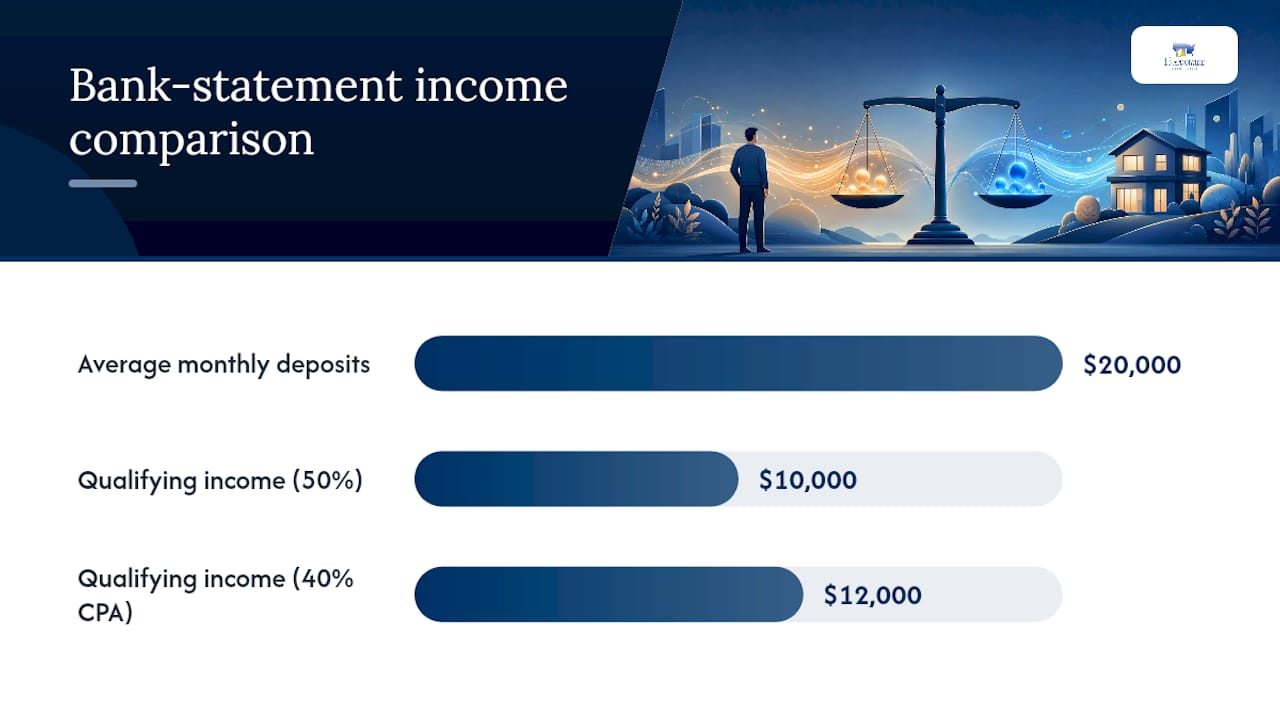
    Example: $20,000 per month in business deposits × 50% expense factor = $10,000 qualifying monthly income. With a CPA P&L showing a lower actual expense ratio, the same deposits might yield $12,000–$13,000 in qualifying income.

    Down payment expectations typically range from about one-tenth to one-quarter, and rates generally carry a premium over conforming loans. The bank-statement income calculator at 1st Nationwide Mortgage lets you run your own numbers before you apply.

    • Minimum credit score is typically in the low 600s.

    • Statement windows accepted: 12 months or 24 months
    • Personal or business accounts: both accepted, different expense factors apply
    • CPA P&L: reduces expense factor and increases qualifying income

    Pro Tip: Keep business and personal deposits in separate accounts. Commingled accounts force lenders to apply the more conservative business expense factor across the board, which reduces your qualifying income unnecessarily.


    NONI and other niche no-W2 routes

    NONI loans require no income documentation and no asset verification. They exist for borrowers who genuinely cannot document income through any standard channel: foreign nationals without U.S. tax history, high-net-worth retirees whose wealth is held in structures that do not produce easily documented income, or investors in complex financial situations.

    The trade-off is straightforward. Less documentation means more risk for the lender, which means a larger down payment and a higher rate. NONI programs typically require a large down payment and carry meaningful rate premiums over DSCR or bank-statement products.

    Other niche paths worth knowing:

    • Foreign-national programs: Designed for non-U.S. residents purchasing U.S. investment property. Qualifying often relies on foreign credit references, a larger down payment, and sometimes asset verification in lieu of income docs.
    • Portfolio loans: Held on a lender’s own books rather than sold to the secondary market. Underwriting criteria are set by the lender, so flexibility is higher, but rates and terms vary widely.
    • Private money: Asset-based lending from private investors or funds. Closes fast, often in days, but rates are typically double digits and terms are short (12–24 months). Best used as a bridge, not a long-term hold strategy.
    • Seller financing: The seller acts as the lender. No bank underwriting, no W-2 required. Terms are negotiated directly. Works when the seller owns the property free and clear or is willing to carry a second lien.
    Program Typical Down Payment Rate vs. Conforming Best For
    NONI Larger down payment Significant premium Foreign nationals, no-doc situations
    Portfolio loan Moderate down payment Moderate premium Complex borrower profiles
    Private money High down payment High rates Fast closes, short-term holds
    Seller financing Negotiable Negotiable Off-market deals, motivated sellers

    For high-net-worth borrowers exploring strategic asset monetization as a qualification path, asset-depletion programs are a fourth option worth discussing with your lender.


    How to prepare your application without W-2s

    You can apply for a DSCR, bank-statement, or NONI loan without W-2s, but a clean file still matters. Disorganized documentation is the most common reason non-QM loans slow down or fall apart.

    By program, here is what lenders expect:

    1. DSCR: Executed lease agreement (or market rent appraisal if vacant), property insurance quote, HOA statement if applicable, purchase contract, and a credit report pull. No personal income docs.
    2. Bank-statement: 12–24 months of complete bank statements (all pages, no gaps), CPA-certified P&L if you want the lower expense factor, business license or CPA letter confirming self-employment for two or more years.
    3. NONI: Passport or government-issued ID, purchase contract, property appraisal. Asset documentation if the program requires it.

    Universal documents for all programs:

    • Government-issued photo ID
    • Entity documents if purchasing in an LLC (articles of organization, operating agreement, EIN)
    • Proof of reserves (typically 3–6 months of PITIA in liquid accounts)
    • Credit authorization
    • Appraisal (ordered by the lender after application)

    Pro Tip: For bank-statement loans, download statements directly from your bank’s portal as PDFs rather than printing screenshots. Lenders require complete statements with the bank’s header on every page. A missing page from month 14 can delay closing by a week.


    Calculate DSCR and test a property before you bid

    Run the math before you make an offer. The DSCR loan calculator at 1st Nationwide Mortgage lets you input rent and PITIA estimates to check qualification in minutes.

    The formula: DSCR = Market Rent ÷ PITIA

    Property Type Monthly Rent Monthly PITIA DSCR Result
    Single-family rental $2,200 Qualifies (standard program)
    Duplex (combined rent) Qualifies (most programs)
    Short-term rental (haircut applied) $2,800 projected → $2,100 stabilized 1.05 Qualifies at reduced LTV

    The short-term rental row illustrates a critical point: lenders typically apply a stabilized rent haircut to Airbnb or VRBO income, using a long-term equivalent rather than peak projections. A property that looks like a 1.40 DSCR on Airbnb revenue might clear only 1.05 after the lender’s adjustment.

    DSCR Authority operates as a neutral lender-matching service with state-by-state coverage and weekly-updated rate tables, useful for comparing program math across multiple lenders before you commit.


    How to choose a lender for a no-W2 investment loan

    The right lender for a DSCR or bank-statement loan is not the same as the right lender for a conventional mortgage. Non-QM underwriting varies significantly from one lender to the next, and the wrong match costs you time and money.

    Questions to ask every lender:

    • Are you a direct lender or a broker? (Direct lenders control underwriting; brokers add a layer.)
    • Are you licensed in my state?
    • What is your minimum DSCR, and do you offer sub-1.00 programs?
    • What expense factor do you apply to business bank statements?
    • Do you lend to LLCs, and are there seasoning requirements?
    • What are your reserve requirements?
    • What is your typical time from application to clear-to-close?

    Red flags to watch for:

    1. Vague answers about underwriting criteria or rate tiers.
    2. No state licensing verifiable through the NMLS Consumer Access database.
    3. “Guaranteed approval” language. No legitimate lender guarantees approval before underwriting.
    4. Unclear fee structures or fees that appear only at closing.
    5. No experience with the specific program you need (DSCR, bank-statement, or NONI).

    Ask for a program letter or term sheet in writing before you pay for an appraisal. A legitimate lender will provide one.


    Next steps: move from research to pre-approval

    Pick your program first, then build your file around it.

    • DSCR: Run the rent ÷ PITIA calculation on your target property using the DSCR loan calculator. Confirm the DSCR clears 1.00–1.25 before you make an offer.
    • Bank-statement: Pull 12–24 months of complete statements now. Calculate your monthly average deposits and apply the 50% expense factor to estimate qualifying income.
    • NONI/private: Confirm your down payment capacity (typically around one-third to two-fifths for NONI) and have your ID and entity documents ready.

    Universal pre-approval checklist:

    • Check your credit score and dispute any errors (target 640+ for standard programs, 700+ for best LTV tiers)
    • Confirm liquid reserves covering 3–6 months of PITIA
    • Assemble entity documents if using an LLC
    • Request a program letter from your lender before ordering an appraisal
    • Budget for appraisal ($500–$800 for standard residential, higher for multifamily), underwriting fees, and lender origination costs

    Typical timelines for non-QM loans generally run a few weeks from complete application to closing, longer if documentation gaps require follow-up.


    Key Takeaways

    DSCR loans are a scalable no-W2 option for portfolio investors because the property’s rent, not your personal income, drives qualification at the usual coverage threshold.

    Point Details
    DSCR qualification metric Lenders divide monthly rent by PITIA; a ratio of 1.00–1.25x clears standard programs.
    Bank-statement income math Deposits over 12–24 months × expense factor (50%, or 35–40% with CPA P&L) = qualifying income.
    Down payment ranges DSCR: about one-fifth to one-quarter; bank-statement: low double digits to one-quarter; NONI: larger down payments.
    Lender vetting priority Confirm direct-lender status, state licensing via NMLS, and program-specific experience before paying for an appraisal.
    1st Nationwide Mortgage Originates DSCR, bank-statement, and NONI loans as a direct mortgage banker licensed in 18 states (BBB A+).

    What most investors get wrong about no-W2 lending

    The conventional wisdom says non-QM loans are a last resort for borrowers who cannot qualify elsewhere. That framing misses the point entirely.

    DSCR lending was not designed as a workaround. It was designed for a specific type of borrower: the investor whose wealth is in properties, not paychecks. A landlord with eight rentals generating $15,000 a month in gross rent may show $40,000 in taxable income after depreciation and expenses. A conventional lender sees a marginal borrower. A DSCR lender sees a portfolio that services its own debt.

    The same logic applies to bank-statement loans. A business owner who writes off $200,000 in legitimate expenses is not hiding income; they are running their business correctly. The tax code rewards that behavior. Non-QM lending acknowledges it.

    Where I see borrowers make mistakes is in treating these programs as interchangeable. DSCR is the right tool when the property cash flows. Bank-statement is the right tool when your deposits are strong but the property’s rent barely covers PITIA. Using the wrong program for your profile means a higher rate, a larger down payment, or a denial that a different program would have approved.

    The other mistake: waiting until you have a property under contract to start the documentation process. Assemble your statements, entity docs, and reserves before you start making offers. A clean, pre-assembled file is what separates investors who close in 21 days from those who lose deals to better-prepared buyers.


    1st Nationwide Mortgage originates no-W2 investment loans directly

    Qualifying for an investment property mortgage without a W-2 is straightforward when you work with a lender who actually underwrites these programs in-house. 1st Nationwide Mortgage is a direct mortgage banker, not a broker, which means your file does not get passed to a third party for approval decisions.

    1st Nationwide Mortgage

    The programs available include DSCR loans for investors (no personal income docs, LLC-friendly, no limit on financed properties), bank-statement loans for self-employed borrowers (12 or 24-month options with a built-in income calculator), and NONI loans for foreign nationals and no-doc situations. 1st Nationwide is licensed in 18 states and holds a BBB A+ rating. Use the DSCR loan calculator to test your target property’s cash flow, or run your bank-statement income through the bank-statement qualifier before you apply. When you are ready to move forward, request a program letter directly from the team at 1st Nationwide Mortgage.

    This article is general information, not professional financial or legal advice. Confirm current program guidelines and eligibility with a licensed mortgage professional for your specific situation.


    Useful sources and tools

    • DSCR Loan Calculator — 1st Nationwide Mortgage: Input rent and PITIA to calculate DSCR and test property eligibility before making an offer.
    • Bank Statement Income Calculator — 1st Nationwide Mortgage: Estimate qualifying income from 12 or 24 months of deposits using the expense-factor method.
    • DSCR Loans Program Page — 1st Nationwide Mortgage: Full program rules, state-specific pages, and underwriting criteria for DSCR financing.
    • Bank Statement Mortgage Program — 1st Nationwide Mortgage: Program details for self-employed borrowers qualifying on deposits instead of tax returns.
    • NONI / No-Doc Mortgage — 1st Nationwide Mortgage: Program page for no-income, no-asset loan options for foreign nationals and special situations.
    • DSCR Authority: Neutral editorial resource with a DSCR calculator, state-by-state lender matching, and weekly-updated rate tables. Use this to compare program math across multiple lenders.
    • Non-QM Loan Guide — The Lenders Network: Overview of bank-statement, DSCR, and asset-depletion programs with qualification benchmarks and rate comparisons.
  • Reverse Mortgage for Seniors: What You Need to Know

    Reverse Mortgage for Seniors: What You Need to Know

    What is a reverse mortgage?

    Infographic showing key reverse mortgage steps

    A reverse mortgage lets homeowners aged 62 or older borrow against their home equity without making monthly mortgage payments. Instead of you paying the lender each month, the lender pays you — drawing against the value you’ve built in your home over the years. You keep the title, stay in your home, and repayment is deferred until you sell, move out permanently, or pass away.

    Three main types exist:

    • Home Equity Conversion Mortgage (HECM): The most common option, insured by the FHA through HUD. Available to borrowers 62+, usable for any purpose, and comes with mandatory counseling and federal consumer protections.
    • Proprietary reverse mortgages: Private loans not backed by FHA, sometimes allowing higher loan limits on higher-value homes but with fewer built-in protections.
    • Single-purpose reverse mortgages: Offered by some state agencies and nonprofits, restricted to one approved use (such as home repairs or property taxes), and typically lower cost.

    Loan proceeds can arrive as a lump sum, fixed monthly payments, a line of credit, or a combination. One notable HECM feature: an unused line of credit can grow over time, increasing your available funds — something a traditional home equity line does not offer.

    Table of Contents

    How does a reverse mortgage work and get repaid?

    The lender advances funds based on your home equity, your age, current interest rates, and your home’s appraised value. Older borrowers generally qualify for larger amounts because the expected loan duration is shorter.

    Key mechanics to understand:

    • Interest accrues monthly. Unlike a traditional mortgage where your balance shrinks, interest and fees add to your loan balance over time, reducing your remaining equity.
    • Disbursement options: Tenure payments (monthly for life in the home), term payments (fixed period), lump sum, line of credit, or a modified combination.
    • Repayment triggers: The loan becomes due when you sell the home, move out for more than 12 months, or die. Heirs typically have a limited time to repay the balance, sell the home, or walk away.
    • Non-recourse protection: Neither you nor your estate will owe more than the home’s value at repayment. If the loan balance exceeds the sale price, FHA insurance covers the lender’s shortfall on HECMs.

    Proceeds are loan advances, not income. They are generally non-taxable and do not affect Social Security or Medicare. Keeping large amounts in a bank account, however, could affect SSI or Medicaid eligibility — worth discussing with a benefits counselor before you draw funds.

    Borrower obligations you must meet to avoid foreclosure

    Senior woman calculating finances indoors

    This is where many seniors get caught off guard. A reverse mortgage does not mean you can walk away from home-related expenses. Failure to meet these obligations can trigger foreclosure even though you’re making no monthly mortgage payments.

    Your ongoing responsibilities:

    • Pay property taxes on time, every year
    • Maintain homeowner’s insurance continuously
    • Keep the home in good repair and condition
    • Pay HOA fees if your property requires them
    • Live in the home as your primary residence — if you’re away in a medical facility for more than 12 consecutive months, the loan becomes due

    The youngest borrower’s age also matters for non-borrowing spouses. If your spouse is under 62 and not on the loan, their ability to remain in the home after your death depends on specific protections negotiated at closing.

    Pro Tip: Budget a realistic monthly amount for taxes, insurance, and maintenance before you close. Treating a reverse mortgage as “set it and forget it” is the most common mistake counselors see — and it’s the one most likely to end in foreclosure.

    Senior budgeting home maintenance expenses

    What does a reverse mortgage actually cost?

    Upfront costs are real and can be significant, especially if you plan to stay in the home only a few years. Closing costs and fees make reverse mortgages less efficient for short-term situations — compare them carefully against alternatives like a HELOC or downsizing.

    Typical costs include:

    • Origination fee: Capped for HECMs based on home value
    • FHA mortgage insurance premium (MIP): An upfront charge plus an annual premium added to your balance
    • Appraisal fee: Required to establish home value
    • Title insurance and closing costs: Similar to a traditional mortgage
    • Servicing fees: Ongoing monthly charges some lenders add

    Most of these can be rolled into the loan, meaning you pay little out of pocket at closing — but they reduce your net principal limit and compound over time. Understanding why closing costs vary by lender helps you shop more effectively.

    Who qualifies and who should consider a reverse mortgage?

    HECM eligibility requirements are specific: you must be 62 or older, own the home as your primary residence, have sufficient equity, and demonstrate the financial ability to cover ongoing property expenses.

    Additional requirements:

    • The property must be a single-family home, HUD-approved condo, or qualifying multi-unit property (up to four units, with one unit owner-occupied)
    • You must complete HUD-approved counseling before applying — this is mandatory, not optional
    • Proprietary loans may serve borrowers with higher-value homes or those who don’t meet HECM criteria, but they carry fewer federal protections

    A reverse mortgage tends to fit best when you plan to stay in the home long-term, need to supplement retirement income, and don’t have strong goals around leaving home equity to heirs. If passing on the property matters to your family, consider a retirement income bucket strategy or other equity alternatives first.

    Your rights and protections as a borrower

    Federal law gives you meaningful safeguards. Some reverse mortgage ads overstate benefits and downplay conditions — knowing your rights helps you cut through the noise.

    Core protections include:

    • Right of rescission: You have three business days after closing to cancel without penalty. Cancellation must be in writing, and the lender must return any fees paid.
    • Non-recourse clause: Your estate cannot owe more than the home’s appraised value at repayment.
    • Mandatory counseling: HUD-approved counselors must explain costs, implications, and alternatives before you sign anything.
    • CFPB oversight: The Consumer Financial Protection Bureau monitors reverse mortgage lenders and handles complaints — a resource worth knowing about if something feels off.

    Working with 1st Nationwide Mortgage on a reverse mortgage

    1stnwm

    If you’ve read this far, you’re approaching this decision the right way: with clear eyes and real questions. 1st Nationwide Mortgage is a direct mortgage banker — not a broker — founded by Christopher Arco (NMLS #1281) and licensed in 18 states. The team works directly with seniors 62+ who want a straightforward path to understanding whether a reverse mortgage fits their retirement picture.

    There’s no pressure, no vague promises of “income for life.” What you get is a direct conversation with an experienced lender who can walk through your equity position, your obligations, and your real options — including whether a HELOC or another home equity product might serve you better. BBB A+ rated. Ready when you are.

    Key Takeaways

    A reverse mortgage is a loan, not free money — and managing it well requires ongoing attention to taxes, insurance, and occupancy requirements.

    Point Details
    Age and equity requirements You must be 62 or older with sufficient home equity and the ability to cover ongoing property expenses.
    Loan balance grows over time Interest and fees accrue monthly, reducing your equity rather than building it.
    Foreclosure risk is real Failing to pay property taxes, maintain insurance, or occupy the home can trigger foreclosure.
    Non-recourse protection applies Neither you nor your estate will owe more than the home’s value at repayment on a HECM.
    1st Nationwide Mortgage A direct lender offering reverse mortgage guidance for seniors 62+, licensed in 18 states, BBB A+.
  • How Does a Reverse Mortgage Work for Homeowners 62+

    How Does a Reverse Mortgage Work for Homeowners 62+

    A reverse mortgage lets homeowners aged 62 and older borrow against their home’s equity without making monthly principal or interest payments. The loan balance grows over time, and repayment is triggered by a specific event: you sell the home, move out permanently, or pass away. The only reverse mortgage insured by the U.S. federal government is the Home Equity Conversion Mortgage (HECM), available exclusively through FHA-approved lenders. You can receive funds as a lump sum, a line of credit, fixed monthly payments, or a combination of those options.

    Key facts at a glance:

    • The HECM is the most widely used reverse mortgage product in the United States.
    • At least one borrower must be 62 or older, and the home must be a primary residence.
    • No monthly mortgage payments are required, but you remain responsible for property taxes, homeowner’s insurance, and home maintenance.
    • The loan amount depends on the youngest borrower’s age, current interest rates, and the lesser of the appraised home value or the FHA loan limit.
    • A non-recourse feature protects you and your heirs from ever owing more than the home is worth at repayment.

    Table of Contents

    How does a reverse mortgage work when it comes time to repay?

    Repayment is not triggered by a calendar date, a fact explained in detail by the best first time mortgages providers, who clarify reverse mortgage maturity events and repayment timelines. Instead, the loan becomes due and payable upon a maturity event: the borrower’s death, sale of the home, or moving away for more than 12 consecutive months. Failing to pay property taxes, homeowner’s insurance, or keep the home in reasonable condition also qualifies as a maturity event.

    A maturity event does not mean immediate foreclosure. Lenders issue a demand letter giving borrowers or their estates time to repay the balance, sell the home, or pursue another resolution. Heirs who want to keep the property can pay off the loan balance or purchase the home at 95% of its appraised value if they qualify for financing. They can also simply sell the home and use the proceeds to satisfy the debt.

    • Loan becomes due upon death, sale, or 12-month absence from the home.
    • Property tax or insurance default also triggers repayment.
    • Borrowers may arrange repayment plans with the servicer to avoid foreclosure.
    • The non-recourse feature means neither you nor your heirs owe more than the home’s appraised value at the time of repayment, even if the loan balance exceeds it.

    Do you qualify for a reverse mortgage?

    HECM eligibility requires at least one borrower to be 62 or older, the home to serve as a primary residence, and the borrower to complete a session with a HUD-approved housing counselor before the loan closes. That counseling is not optional. It covers loan mechanics, costs, alternatives, and your obligations as a borrower.

    Beyond age and residency, lenders conduct a financial assessment to confirm you can sustain property taxes, insurance, and basic upkeep over the life of the loan. Borrowers with delinquent federal debt or unpaid property charges may not qualify until those issues are resolved.

    • Age: at least one borrower must be 62 or older.
    • Residence: the home must be your primary residence, not a vacation or investment property.
    • Counseling: HUD-approved counseling is mandatory before loan approval.
    • Financial assessment: lenders verify your ability to maintain ongoing property charges.
    • No delinquent federal debt or outstanding property tax liens at closing.

    What does a reverse mortgage actually cost?

    HECM fees are specific and regulated. The upfront mortgage insurance premium is 2% of the maximum claim amount. The annual mortgage insurance premium is 0.5% of the outstanding loan balance. Origination fees are capped at $6,000. Standard closing costs, including appraisal, title search, and recording fees, also apply.

    Infographic outlining reverse mortgage application steps

    Most of these costs can be financed into the loan rather than paid out of pocket at closing, which is why many borrowers do not feel the expense immediately. That convenience has a real cost: financing fees increases the loan balance from day one, which compounds over time. Fixed-rate HECMs typically offer a single lump-sum disbursement, while adjustable-rate HECMs allow more flexible access through a line of credit or monthly payments.

    Pro Tip: Use a mortgage calculator to model how financed fees affect your total loan balance over 5, 10, and 15 years before you commit.

    Risks to know and scams to avoid

    The most common reason reverse mortgages go into default is not fraud or misunderstanding. It is unpaid property taxes and insurance. HECM defaults rose from 2% to 18% between 2014 and 2018, driven almost entirely by property-charge failures. HUD responded by tightening financial assessments, but the underlying risk remains real for borrowers on fixed incomes.

    Scams targeting seniors are a separate concern. Common tactics include contractors who pressure homeowners to take out a reverse mortgage to fund repairs, or strangers who offer to help with paperwork in exchange for a share of the proceeds. Protect yourself by verifying any lender’s credentials through the NMLS Consumer Access database and never signing documents you have not reviewed with your HUD-approved counselor.

    • Default risk: unpaid property taxes, insurance, or deferred maintenance are the leading causes.
    • Contractor scams: unscrupulous contractors push reverse mortgages as a way to fund inflated repair bills.
    • Identity scams: fraudsters pose as lenders or counselors to collect personal and financial information.
    • Verify credentials: confirm your lender is FHA-approved and check their NMLS license number.
    • Never share Social Security numbers or bank account details with anyone who contacts you unsolicited.

    Pro Tip: If you receive a notice of default or a demand letter, contact your loan servicer immediately. Proactive communication often opens repayment plan options that prevent foreclosure.

    What recent research and expert experience reveal

    The GAO’s analysis of the HECM program found that reverse mortgages deliver the most value to borrowers who are older, plan to stay in their homes long-term, and need to supplement cash flow rather than preserve an inheritance. That profile matters because the loan’s cost structure, compounding interest and insurance premiums, works against borrowers who move out within a few years of origination.

    Statistic callout: HECM defaults climbed from 2% to 18% between 2014 and 2018, with property-charge failures driving the vast majority of those cases. HUD’s subsequent financial assessment requirements were designed specifically to screen out borrowers unlikely to sustain those ongoing obligations.

    Misconceptions about heirs are also common. Heirs are not forced into an immediate sale. They have structured options, including refinancing or buying the home at 95% of appraised value, and lenders must issue demand letters before any foreclosure process begins. Foreclosure is avoidable when families communicate with the servicer early and understand the timeline.

    How does a reverse mortgage affect your taxes and government benefits?

    Reverse mortgage proceeds are generally tax-free because the IRS treats them as loan advances, not income. You will not owe federal income tax on funds you receive, regardless of whether you take a lump sum or monthly payments. That said, consult a tax advisor about your specific situation, particularly if you have other income sources that could affect your tax bracket.

    Senior hands using calculator with tax documents

    The impact on government benefits depends on which programs you receive. Social Security and Medicare are not affected by reverse mortgage proceeds. Medicaid and Supplemental Security Income (SSI) are means-tested, meaning a large lump-sum disbursement that sits in your bank account beyond the month you receive it could count as an asset and affect your eligibility. Spending proceeds in the same month you receive them generally avoids this issue, but the rules are program-specific.

    What happens to your heirs and your estate?

    Your heirs inherit the home subject to the loan balance. They are not personally liable for any amount beyond the home’s value, thanks to the non-recourse protection built into every FHA-insured HECM. If the loan balance exceeds the home’s appraised value at the time of repayment, FHA’s mortgage insurance covers the difference.

    Heirs typically have several months after the borrower’s death to decide how to proceed. Selling the home and paying off the balance is the most straightforward path. Keeping the home requires either paying the full loan balance or, if they qualify for a mortgage, purchasing it at 95% of appraised value. Estate attorneys and HUD-approved housing counselors can both help families navigate this process without unnecessary urgency.

    Alternatives worth considering before you decide

    A reverse mortgage is not the only way to access home equity in retirement. A home equity loan or a home equity line of credit (HELOC) can provide similar access to funds, often at lower total cost, but both require monthly payments and sufficient income to qualify. If your income is limited, those options may not be available.

    Downsizing is another path. Selling your current home and purchasing a smaller, less expensive property frees up equity as cash while eliminating the compounding loan balance a reverse mortgage creates. For homeowners who need only modest additional income, a cash-out refinance on a conventional or FHA loan may accomplish the goal with a cleaner cost structure. The right choice depends on your age, health, income, and how long you realistically plan to stay in the home.

    How your loan amount is calculated

    Three factors determine how much you can borrow: the age of the youngest borrower, the current interest rate, and the lesser of the home’s appraised value or the FHA loan limit. Older borrowers qualify for a higher percentage of their home’s value because the loan is statistically likely to be outstanding for fewer years. Lower interest rates also increase the available principal limit.

    Financial advisor explaining reverse mortgage to seniors

    The FHA sets a maximum claim amount each year, which caps the home value used in the calculation regardless of actual appraised value. If your home is worth more than the FHA limit, a proprietary reverse mortgage from a private lender may allow you to access a larger portion of that equity, though without FHA insurance protections. You can get a rough estimate of your potential proceeds using a reverse mortgage calculator before speaking with a lender.

    Ready to explore your reverse mortgage options?

    1stnwm

    Seniors who want to stay in their homes and need to strengthen monthly cash flow often find that a reverse mortgage is the most practical tool available. Getting the right guidance from a direct lender who understands the full picture makes a real difference in whether the loan serves you well over time.

    1st Nationwide Mortgage is a direct mortgage banker, not a broker, licensed in 18 states and rated A+ by the Better Business Bureau. Founded by Christopher Arco (NMLS #1281), the firm works directly with borrowers on reverse mortgage programs for homeowners 62 and older, as well as FHA, conventional, and non-QM loans for borrowers whose situations do not fit traditional bank criteria. There are no middlemen and no broker fees layered into the transaction.

    If you are ready to see what you may qualify for, review the full loan programs available through 1st Nationwide Mortgage and reach out directly to get a clear, no-pressure assessment of your options.

    Key Takeaways

    A reverse mortgage converts home equity into accessible funds for borrowers 62 and older, with repayment triggered by death, sale, or a 12-month absence, not a monthly payment schedule.

    Point Details
    Repayment triggers The loan becomes due upon death, home sale, 12-month absence, or failure to pay property taxes and insurance.
    Non-recourse protection Borrowers and heirs never owe more than the home’s appraised value at repayment, per FHA HECM rules.
    HECM costs Upfront mortgage insurance is 2% of the maximum claim amount; annual insurance is 0.5% of the outstanding balance; origination fees are capped at $6,000.
    Default risk HECM defaults increased significantly between 2014 and 2018, driven mainly by unpaid property taxes and insurance.
    1st Nationwide Mortgage A direct lender (not a broker) offering reverse mortgage programs for homeowners 62+, licensed in 18 states, BBB A+.
  • Florida Investor Mortgage Guide: Loan Types and Requirements

    Florida Investor Mortgage Guide: Loan Types and Requirements

    Florida is one of the top states for real estate investment financing, and the right investor mortgage in Florida can make or break your deal before you even close. The core distinction to understand upfront: investment property loans carry stricter terms than primary residence mortgages, including higher down payments, elevated rates, and tighter reserve requirements. Investment property rates in Florida are higher than primary residence loans, with conventional and DSCR loans priced at a premium compared to standard mortgage rates. The loan type you choose depends on how you earn income, how many properties you already own, and what the property will be used for.

    Here is what every Florida investor needs to know at a glance:

    • Property intent matters legally. Declaring a rental property as a second home is mortgage fraud. Be transparent with your lender from day one.
    • **Down payments vary depending on loan type and property configuration, and are generally higher than for primary residences.
    • Credit score minimums start at 620, though 740+ unlocks the best pricing on conventional loans.
    • DSCR loans qualify on rental income only, with no personal income documentation required.
    • Bank Statement loans use 12–24 months of deposits instead of tax returns, ideal for self-employed investors.
    • NONI loans serve foreign nationals and investors with no documentable income.
    • Reserves of six months or more in liquid assets are typically required after closing.

    What are the down payment and qualification requirements for Florida investor mortgages?

    Down payment requirements for Florida investment property loans vary by loan type and property size. Single-family investment properties require a minimum down payment under conventional guidelines, with multi-unit properties requiring a higher amount. DSCR and hard money loans have their own typical down payment ranges, with rates increasing as down payments decrease.

    Credit score requirements depend on the loan type and vary from moderate to higher thresholds for best pricing. Hard money lenders tend to focus more on the property than credit scores.

    Close-up of hands reviewing credit score and financial papers

    Reserve requirements are where many investors get caught off guard. Most lenders require several months of PITI (principal, interest, taxes, and insurance) in liquid assets after closing. That figure applies per property for investors with multiple financed properties, which adds up fast.

    Infographic comparing Florida investor mortgage loan types

    Rental income counts toward qualification for conventional loans using the 75% rule: lenders apply 75% of documented or projected rent to offset the property’s debt obligations in your debt-to-income ratio. DSCR loans go further, making rental income the only qualifying metric.

    Loan Type Min. Down Rate Range (2026) Credit Min. Qualifies On
    Conventional 15%–25% 620 (740+ best) Personal income + DTI
    DSCR 20%–25% 620–740+ Rental income only
    Hard Money 10%–15% 10%–14% Property value / ARV
    Portfolio 20%–30% Lender-specific Flexible, lender-set
    Bank Statement 10%–20% Varies 620 12–24 months deposits

    Key qualification hurdles to prepare for:

    • Full income documentation (W-2s, tax returns, pay stubs) for conventional loans
    • Lease agreements or appraiser’s market rent analysis for rental income credit
    • Debt-to-income ratio under 45% for conventional programs
    • No personal income docs required for DSCR or NONI loans
    • LLC ownership is accepted on DSCR programs

    What types of investor mortgage loans are available in Florida?

    Florida real estate investor financing covers a wider range of products than most investors realize. Each loan type serves a different borrower profile and investment strategy.

    Conventional investment property loans follow Fannie Mae and Freddie Mac guidelines. They offer the lowest rates of any investment product but require full income documentation, a DTI under 45%, and cap financing at 10 properties per borrower. They work best for W-2 earners with clean tax returns and fewer than five financed properties.

    DSCR loans have become the dominant product for active Florida investors since 2022. They qualify you based on the property’s rental income rather than your personal income, which eliminates the DTI problem entirely. A DSCR ratio of 1.0 to 1.25 is the standard requirement among Florida lenders, meaning rent must cover at least 100%–125% of the full monthly payment including taxes, insurance, and HOA. These loans work for LLCs, have no cap on financed properties, and accept short-term rental income from platforms like Airbnb with proper documentation.

    Fix and Flip loans (hard money) are short-term, asset-based loans that close in 7–14 business days versus 30–45 days for conventional financing. Hard money loans typically have higher interest rates and shorter terms designed for quick repayment. The lender focuses on the property’s as-is and after-repair value, not your credit score or income. They are expensive by design, built to be paid off quickly once the flip sells.

    Bank Statement loans replace tax returns with 12–24 months of bank deposits to derive qualifying income. Self-employed investors whose write-offs reduce reported income below what conventional lenders accept use these regularly. The standard expense factor is 50% on business accounts, dropping to 35%–40% with a CPA-certified profit and loss statement.

    NONI (No Income, No Asset) loans serve foreign nationals and investors with no documentable income. They require no income verification and no asset documentation, making them the primary path for international buyers purchasing Florida investment properties.

    Portfolio loans are held by the lender rather than sold to the secondary market, which gives lenders flexibility on terms. They suit investors with more than 10 financed properties, unique asset types, or recent credit events that disqualify them from conventional programs.

    Key features by loan category:

    • DSCR: no personal income docs, LLC-eligible, no property cap, prepayment penalties common
    • Bank Statement: 620 minimum credit, 10%–20% down, 12–24 months deposits required
    • Hard money: 65%–75% LTV on as-is value, 2–4 origination points, no prepayment penalty
    • NONI: designed for foreign nationals, larger down payments, higher rates
    • Portfolio: flexible DTI and reserve requirements, community bank or credit union sourced

    Why do Florida’s market conditions make specialized investor loans worth using?

    Florida’s investment environment is genuinely favorable for rental property owners, and the right loan structure amplifies those advantages. The state has no state income tax and landlord-friendly laws, including no rent control, no just-cause eviction requirement, and a summary eviction process that typically resolves in 3–6 weeks. DSCR lenders recognize this and apply more favorable vacancy factors to Florida properties compared to tenant-protective states.

    Group discussing rental property details outdoors in Florida

    For out-of-state investors, the tax math is particularly compelling. A $2,500 monthly rent in Tampa generates materially more after-tax yield than the same rent in a state with income tax, which directly improves net operating income and DSCR ratios.

    DSCR and Bank Statement loans remove the biggest barrier most active investors face: tax returns that show low income due to depreciation and Schedule E deductions. Your actual cash flow may be strong, but your reported income looks weak on paper. These loan structures bypass that problem entirely.

    Foreign nationals gain access through NONI and portfolio programs, opening Florida’s market to international buyers who cannot qualify for conventional Fannie Mae or Freddie Mac financing. Investment properties also generate deductible expenses including mortgage interest, property taxes, insurance, and depreciation, which reduces taxable income from the property itself.

    Benefits specific to Florida investor financing:

    • DSCR loans accept LLC ownership, protecting personal assets
    • No cap on financed properties under DSCR programs
    • Many DSCR lenders accept short-term rental income with proper documentation
    • Mortgage interest is deductible as a business expense on investment properties
    • Bank Statement loans accommodate self-employed investors without penalizing write-offs

    How do you apply for a Florida investment property mortgage?

    The application process for a Florida investor mortgage starts with one critical decision: be transparent about how you intend to use the property. Lenders classify properties strictly by occupancy intent, and misrepresenting a rental property as a second home constitutes mortgage fraud. If you plan to rent the property at all, declare it as an investment property from the start.

    Document preparation varies by loan type. Conventional loans require W-2s, two years of tax returns, pay stubs, and six months of bank statements. DSCR loans need a lease agreement or appraiser’s market rent analysis, a property insurance quote, and proof of reserves. Bank Statement loans require 12–24 months of personal or business bank statements. NONI loans require minimal documentation by design.

    Timelines differ significantly across products. Conventional and DSCR loans typically close in 21–45 days. Hard money loans close in 7–14 business days. Portfolio loans vary by lender but generally fall in the 30–45 day range.

    For condo purchases, Florida’s Senate Bill 4-D reserve funding requirements now affect underwriting directly. Most DSCR lenders require a completed condo questionnaire confirming the association has conducted a structural integrity reserve study, is current on reserve funding, and has no pending special assessments above a set threshold.

    Step-by-step application guidance:

    • Confirm property intent and choose the correct loan type before applying
    • Pull your credit report and address any errors or derogatory marks
    • Gather reserves documentation: bank statements showing liquid assets after closing
    • Obtain a binding property insurance quote before underwriting begins
    • For DSCR loans, request a market rent analysis from a licensed appraiser
    • Verify HOA and condo association compliance with reserve study requirements
    • Submit a complete application to avoid delays from missing documents

    Pro Tip: On DSCR loans, secure your insurance quote before locking a rate. Florida coastal properties can carry high insurance premiums, which directly reduce your DSCR ratios and may sometimes impact loan approval.


    What 1st Nationwide Mortgage knows about Florida investor lending

    Christopher Arco, NMLS #1281, founded 1st Nationwide Mortgage Corporation as a direct mortgage banker, not a broker. That distinction matters for investors: as a direct lender licensed in 18 states, 1st Nationwide controls its own underwriting decisions, which means faster turnaround and more flexibility on non-standard scenarios.

    The three programs most relevant to Florida investors are DSCR, Bank Statement, and NONI loans. DSCR loans at 1st Nationwide qualify on rental income only, accept LLC ownership, and carry no limit on financed properties. Bank Statement loans use 12–24 months of deposits with a 50% expense factor on business accounts, dropping to 35%–40% with a CPA-certified P&L. NONI loans serve foreign nationals and investors with no documentable income, with loan amounts up to $3.5M.

    Common pitfalls 1st Nationwide sees among Florida investors include underestimating insurance costs on coastal properties, failing to verify condo reserve compliance before making an offer, and attempting to use second-home financing for properties they intend to rent. The first two affect DSCR ratios and approval eligibility. The third is a compliance issue with serious financial consequences, including loan reclassification and financial penalties.

    Understanding the risk of misclassification is part of responsible investing. Resources covering mortgage compliance risks can help investors understand what lenders look for when scrutinizing occupancy intent.


    How does property location within Florida affect your mortgage options?

    Where a property sits within Florida has a direct impact on underwriting, rate pricing, and which loan programs will approve it. The effect is most pronounced in three areas: insurance costs, short-term rental income treatment, and condo compliance.

    Coastal properties in Miami-Dade, Broward, Pinellas, and Collier counties face the highest insurance premiums. Florida’s private homeowners insurance market has seen significant carrier exits since 2021, and remaining policies on coastal properties routinely run $4,000–$12,000 per year for a single-family home. Because DSCR is calculated as gross rent divided by PITIA, a high insurance premium reduces your ratio dollar-for-dollar. A coastal property with $8,000 per year in insurance costs can lower a borrower’s DSCR by 0.15–0.25 points compared to an identical inland property.

    Short-term rental markets like Orlando, Kissimmee, and Panama City Beach present a different challenge. Lenders underwriting STR properties often rely on conservative long-term market rents from a standard 1007 appraisal rather than actual Airbnb or VRBO earnings. That can significantly understate income on high-performing vacation rentals. Always confirm your lender’s STR income policy before locking a purchase price.

    Property tax rates also vary by county. Miami-Dade, Broward, and Palm Beach County effective rates frequently land between 1.0%–1.3% of market value, and Florida’s Save Our Homes assessment cap does not apply to investor-owned properties. A newly purchased investment property is assessed at close to full market value immediately, which affects DSCR calculations from day one.

    Inland markets like Jacksonville, Tampa, and Orlando’s suburban corridors tend to carry lower insurance costs, more predictable long-term rental income, and fewer condo compliance complications. For investors focused on Florida DSCR loans, these markets often produce cleaner ratios and smoother approvals.


    1st Nationwide Mortgage: direct lending for Florida real estate investors

    Florida investors who need financing that fits their actual situation, not a W-2 template, have a direct path through 1st Nationwide Mortgage. As a direct mortgage banker with a BBB A+ rating, 1st Nationwide makes its own underwriting decisions on DSCR, Bank Statement, and NONI loans, which means no middleman slowing down your approval and no broker markups on your rate.

    1stnwm

    For investors qualifying on rental income, the DSCR loan program at 1st Nationwide requires no personal income documentation, accepts LLC ownership, and places no cap on the number of financed properties. Self-employed investors can use the Bank Statement program, which qualifies on 12–24 months of deposits rather than tax returns. Foreign nationals and investors without documentable income have access to NONI loans up to $3.5M. Use the DSCR loan calculator to model your rental income against projected payments before you apply.

    Ready to move forward? Visit the investment property mortgage page at 1st Nationwide Mortgage to review your loan options and start your application.


    Key Takeaways

    Florida investment property financing in 2026 requires choosing the right loan structure for your income type, property location, and portfolio size.

    Point Details
    Down payment ranges Conventional loans require 15%–25% down (15% for select single-family homes, 25% for multi-unit); DSCR loans require 20%–25%; hard money may allow 10%–15%.
    Rate premium over primary Investment property rates run 0.5%–1.5% higher than primary residence loans, with conventional at — and DSCR at — in 2026.
    DSCR qualification DSCR loans qualify on rental income only, with no personal income docs required and no cap on financed properties.
    Location impact Coastal Florida insurance costs of $4,000–$12,000 per year can reduce a borrower’s DSCR by 0.15–0.25 points, directly affecting approval.
    1st Nationwide Mortgage Offers DSCR, Bank Statement, and NONI loans as a direct lender with no broker layer, accepting LLC ownership and self-employed income structures.
  • Reverse Mortgage Pros and Cons: What Seniors Must Know

    Reverse Mortgage Pros and Cons: What Seniors Must Know

    A reverse mortgage gives homeowners 62 and older a way to convert home equity into cash without making monthly mortgage payments. The most common version is the Home Equity Conversion Mortgage (HECM), insured by the Federal Housing Administration and administered through HUD. Here is the honest picture before you go further:

    Key benefits at a glance:

    • No monthly mortgage payments required while you live in the home
    • Loan proceeds are generally tax-free and do not affect Social Security or Medicare eligibility
    • You retain the title and can stay in your home
    • Flexible payout options: lump sum, line of credit, or monthly payments
    • The 95% rule protects heirs from owing more than the home’s appraised market value

    Key drawbacks at a glance:

    • The loan balance grows every month as interest and fees accumulate
    • You remain responsible for property taxes, homeowners insurance, and maintenance
    • Upfront costs can be steep, often reaching a significant portion of the loan amount
    • Home equity erodes over time, reducing what you leave to heirs
    • Moving out permanently triggers full repayment

    The right decision depends on your financial situation, how long you plan to stay in the home, and whether you have a realistic plan for ongoing property costs.


    What are the real pros of a reverse mortgage?

    The most compelling advantage is straightforward: you stop making monthly mortgage payments while continuing to live in your home. For retirees on a fixed income, that freed-up cash can cover medical bills, home repairs, or simply day-to-day expenses without touching retirement savings.

    Disbursement flexibility is another genuine strength. You can take proceeds as a lump sum, set up a line of credit that grows over time, receive fixed monthly payments, or combine these options. The line of credit option is particularly useful because the unused portion typically grows at the same rate as the loan’s interest rate, giving you more borrowing power the longer you wait to draw on it.

    Woman reading reverse mortgage documents in living room

    The tax treatment is favorable. Reverse mortgage proceeds are loan advances, not income, so the IRS does not treat them as taxable income. They also do not count against the income thresholds that determine Social Security taxation or Medicare premium surcharges. If you are managing a tight retirement budget, that distinction matters in a practical, dollar-for-dollar way.

    Pro Tip: If your goal is to preserve the line of credit as a financial safety net rather than spend it immediately, opening a HECM line of credit early, while your home value is higher and interest rates are lower, can maximize the credit available to you later.

    • Proceeds can cover large, one-time expenses like home modifications for aging in place
    • A line of credit can serve as a backup fund for unexpected medical costs
    • Monthly payment option can supplement Social Security or pension income predictably
    • No repayment required until you die, sell, or permanently move out
    • Suze Orman notes that reverse mortgage proceeds first pay off any existing mortgage balance, so your net available funds reflect clearing that prior debt

    What are the real cons of a reverse mortgage?

    The loan balance only moves in one direction: up. Every month, interest and fees are added to what you owe, and your home equity shrinks by the same amount. This is not a flaw in the fine print; it is the fundamental structure of the product. Over a decade or two, the compounding effect can consume a large portion of your equity.

    Upfront costs are significant. A standard HECM can carry closing costs reaching approximately 10% of the loan amount, covering origination fees, FHA mortgage insurance premiums, appraisal, title, and other closing costs. An annual mortgage insurance premium of around 1.25% of the outstanding loan balance continues throughout the life of the loan, adding to the balance each year.

    Foreclosure is a real risk. A 2019 GAO report found that HECM defaults rose from 2% of loan terminations in 2014 to 18% in 2018, mostly because borrowers failed to pay property taxes, homeowners insurance, or meet occupancy requirements.

    Ongoing obligations do not disappear just because monthly mortgage payments do. You must keep paying property taxes and homeowners insurance, maintain the home in good condition, and live there as your primary residence. Financial expert Suze Orman has described reverse mortgages as a last-resort emergency fund precisely because borrowers who cannot sustain those ongoing costs face foreclosure.

    Pro Tip: Before applying, run a realistic budget that includes property taxes, insurance, and routine maintenance. If those costs strain your income today, a reverse mortgage will not fix that problem and may accelerate it.

    • Loan balance growth reduces the inheritance you leave to children or other heirs
    • Short-term use is costly because high upfront fees cannot be recouped if you move within a few years
    • FHA appraisals for HECMs are stricter than conventional loans; deferred maintenance must be repaired at your expense before the loan closes
    • If you leave the home for more than 12 consecutive months, even for a nursing facility, the loan becomes due
    • Borrowers with insufficient equity to cover existing mortgage balances and closing costs must bring cash to closing, which disqualifies many applicants

    What you need to know about counseling, eligibility, and consumer protections

    Every HECM applicant must complete a session with a HUD-approved counselor before the loan can proceed. This is not optional, and it is not a formality. The counselor walks you through how the loan works, what your obligations are, how it affects your heirs, and what alternatives exist, including downsizing, a home equity line of credit, or other retirement income strategies.

    Eligibility requirements are specific. You must be at least 62 years old, own the home outright or have enough equity to pay off the existing mortgage at closing, live in the home as your primary residence, and demonstrate the financial capacity to keep up with property taxes, insurance, and maintenance. If your equity falls short of covering the existing mortgage balance plus closing costs, you would need to bring cash to the table.

    The 95% rule is one of the most important consumer protections in the program. When the loan matures, heirs who want to keep the home pay the lower of the outstanding loan balance or 95% of the home’s current appraised value. This means they are never on the hook for more than the home is worth. However, heirs must have proper probate documentation, such as Letters Testamentary or Letters of Administration, before a lender will discuss payoff or settlement options.

    Pro Tip: Go into your HUD counseling session with a written list of questions: your current home value, your existing mortgage balance, your monthly property tax and insurance costs, and your expected timeline in the home. The more specific your inputs, the more useful the counselor’s analysis will be.

    • You also have a three-day right of rescission after closing to cancel the loan without penalty
    • The CFPB recommends consulting a financial advisor in addition to the required HUD counselor
    • Interest rates directly affect how much you can borrow; lower rates generally increase your available proceeds
    • The home must be your primary residence; vacation homes and investment properties do not qualify
    • FHA requires the property to meet safety and habitability standards before loan approval

    When does a reverse mortgage actually make sense, and when does it not?

    A reverse mortgage works best for homeowners who plan to stay in the home for many years, have substantial equity, and need a reliable way to supplement retirement income without selling. A retiree who owns a paid-off home, faces rising medical costs, and has no other liquid assets is a reasonable candidate. The same applies to someone who wants to delay drawing Social Security by using reverse mortgage proceeds as a bridge, allowing their monthly benefit to grow.

    It also fits homeowners who want to fund aging-in-place modifications, such as wheelchair ramps, walk-in showers, or stair lifts, without depleting savings. Using a line of credit for these targeted expenses keeps the loan balance lower than a lump-sum draw and preserves more equity for later.

    The product is a poor fit in several clear situations. If you plan to move within five years, the upfront costs alone make it financially inefficient. If your income is already too tight to cover property taxes and insurance reliably, the foreclosure risk is real and serious. If preserving the home for heirs is a priority, the steady erosion of equity works directly against that goal. Exploring alternative income options for seniors, such as life settlements or other asset-based strategies, may be worth comparing before committing.

    Couples should pay close attention to how both spouses are listed on the loan. If only one spouse is the borrower and that person dies or moves to a care facility, the surviving spouse may face repayment demands unless they are also named as a borrower or meet specific non-borrowing spouse protections under current FHA rules.


    How much does a reverse mortgage actually cost?

    The cost structure has two layers: upfront fees paid at closing and ongoing costs that accumulate throughout the life of the loan.

    Upfront costs typically include:

    • FHA mortgage insurance premium (MIP): 2% of the home’s appraised value or the FHA lending limit, whichever is lower, paid at closing
    • Origination fee: Lender-charged, capped by FHA rules based on home value
    • Appraisal fee: Required FHA appraisal to establish the home’s current market value
    • Title insurance and closing costs: Similar to a conventional mortgage closing
    • Counseling fee: Paid to the HUD-approved counselor, typically modest

    Total upfront costs on a standard HECM can reach approximately 10% of the loan amount, which is why short-term use rarely makes financial sense.

    Ongoing costs include:

    • Annual MIP: Approximately 1.25% of the outstanding loan balance each year, added to the balance monthly
    • Loan servicing fees: Charged by the servicer and added to the balance
    • Accruing interest: Compounds on the growing balance, not just the original principal

    To put this in concrete terms: if you borrow $200,000 at closing, the annual MIP alone adds $2,500 to your balance in the first year, before interest. Over ten years, the compounding of interest plus MIP can push the balance well above the original draw, depending on the rate environment. Understanding current interest rates is critical because they directly affect both your borrowing power and how fast the balance grows.


    Key Takeaways

    A reverse mortgage can provide real financial relief for the right homeowner, but the loan balance grows every month, and the ongoing obligations for taxes, insurance, and maintenance never go away.

    Point Details
    Loan balance always grows Interest and fees add to the balance monthly, steadily reducing your home equity over time.
    Upfront costs are steep A standard HECM can cost approximately 10% of the loan amount at closing, making short-term use inefficient.
    Ongoing obligations remain You must pay property taxes, insurance, and maintenance or risk foreclosure, as defaults rose to 18% of terminations by 2018.
    The 95% rule protects heirs Heirs pay the lower of the loan balance or 95% of appraised value, but need probate documentation to apply it.
    Best for long-term stay Homeowners planning to remain in the home for many years with substantial equity get the most benefit from this product.

    Ready to see whether a reverse mortgage fits your retirement plan? The team at 1st Nationwide Mortgage works directly with homeowners 62 and older to walk through the numbers honestly, without pressure. As a direct mortgage banker, not a broker, 1st Nationwide Mortgage handles your file from application through closing.

    https://1stnwm.com

    Talk to 1st Nationwide Mortgage about your reverse mortgage options or use the mortgage calculators to estimate costs and loan amounts before your first conversation.

  • NONI Loans for Real Estate Investors: 2026 Guide

    NONI Loans for Real Estate Investors: 2026 Guide

    A NONI loan, short for Non-Owner No-Income, is a business-purpose mortgage for 1–4 unit residential investment properties that requires no income documentation and no owner occupancy. The underwriting skips your tax returns, pay stubs, and debt-to-income ratio entirely. What qualifies you instead is the property’s cash flow, measured through the debt service coverage ratio (DSCR).

    These loans are built for a specific borrower profile:

    • Real estate investors who own properties through an LLC
    • Business borrowers whose reported income doesn’t reflect their actual financial position
    • Foreign nationals who lack U.S. income documentation
    • Investors scaling a portfolio who can’t or won’t document personal income

    NONI loans are business purpose loans for 1–4 unit residential properties, meaning they fall outside the consumer mortgage rules that govern owner-occupied financing. That distinction matters for both underwriting speed and documentation requirements.

    What NONI loan options are available in 2026?

    Six programs currently serve this market, each targeting a different borrower scenario. The product line from theLender, developed over four years and informed by over $5 billion in non-QM submissions, covers the widest range of DSCR situations.

    Loan officer discussing NONI loan options with investors

    Product Loan Type Max Loan Amount Min FICO Max LTV DSCR Requirement Units Allowed Foreign National Cash Out
    theNONI NONI Purchase/Refi $3.5M 620 85% (purchase) ≥ 1.0 1–4 Yes Yes
    superNONI NONI Cash Out $3.5M 660 75% ≥ 1.0 1–4 Yes Yes (no seasoning)
    nearNONI NONI Sub-1.0 DSCR $3M 660 75% 0.75–0.99 1–4 Yes Yes
    theBLANKET Portfolio/Multi-property Varies 620 Varies ≥ 1.0 Multiple Yes Yes
    HomeFi Digital NONI Not publicly listed Not publicly listed Not publicly listed Not publicly listed 1–4
    1st Nationwide Mortgage Corporation Direct Lender NONI $3.5M 620 85% ≥ 1.0 1–4 Yes Yes

    Investor calculating NONI loan numbers on desk

    theNONI is the standard entry point. It requires a DSCR at or above 1.0, accepts FICO scores as low as 620, and goes up to $3.5M. Purchase transactions can reach 85% LTV with a 700+ FICO, and rate/term refinances go to 80% LTV at the same credit threshold.

    superNONI targets investors who want cash out without ownership seasoning requirements. It’s the right tier when you’ve recently acquired a property and want to pull equity before a standard seasoning clock expires.

    nearNONI is the most flexible tier for properties with cash flow challenges. It accepts DSCRs between 0.75 and 0.99, provided the borrower offsets the lower coverage with compensating factors like reduced LTV or higher reserves. Loans go up to $3M with a 660 minimum FICO.

    theBLANKET bundles multiple properties under a single loan structure. For investors managing several rentals, consolidating into one loan simplifies servicing and can free up individual property equity.

    Infographic comparing NONI loan programs and key features

    HomeFi offers a digital-first application process focused on investment property niches. Specific program terms are not publicly listed on its site, so direct inquiry is required before comparing it against the other tiers.

    1st Nationwide Mortgage operates as a direct lender, not a broker, which means your file doesn’t pass through an intermediary. Licensed in 18 states, BBB A+ rated, and founded by Christopher Arco (NMLS #1281), it offers NONI loans up to $3.5M with the same core parameters as theNONI program. For investors who want a single point of contact with direct underwriting authority, this is the strongest fit.

    How do you qualify for a NONI loan?

    Qualifying centers on the property, not your personal income. Here’s the process in order:

    1. Confirm business purpose. The property must be a non-owner-occupied 1–4 unit residential investment. Owner occupancy disqualifies the loan.
    2. Calculate your DSCR. Divide the property’s gross monthly rent by the total monthly debt service (principal, interest, taxes, insurance, and HOA if applicable). A result at or above 1.0 qualifies for theNONI. A result between 0.75 and 0.99 may qualify under nearNONI with compensating factors. Use a DSCR calculator to run this before applying.
    3. Check your credit score. Minimum 620 FICO for theNONI and theBLANKET; minimum 660 for nearNONI and cash-out transactions.
    4. Verify LLC eligibility. NONI loans accommodate LLC ownership, which is standard for investors who hold properties in a business entity.
    5. Confirm foreign national status if applicable. Foreign nationals qualify under the same program terms, making NONI one of the few residential investment loan structures accessible without U.S. citizenship or permanent residency.
    6. Gather property documentation. You’ll need a lease agreement or market rent appraisal, property insurance, and a title commitment. No tax returns, W-2s, or pay stubs are required.
    7. Submit and underwrite. Because no income verification is required, underwriting focuses on DSCR, credit, and property value. This typically shortens the approval timeline compared to conventional investment loans.

    How does DSCR work in NONI loan underwriting?

    DSCR measures whether a property generates enough rent to cover its own debt payments. A DSCR of 1.0 means rent exactly equals the monthly payment. A DSCR of 1.25 means the property earns 25% more than the payment requires.

    For NONI loans, the standard threshold is 1.0. That’s a meaningful difference from conventional investment loans, which layer in personal income, DTI ratios, and reserve requirements on top of property cash flow. NONI underwriting strips that out entirely.

    When a property falls below 1.0 DSCR, nearNONI provides a path forward. The program accepts DSCRs as low as 0.75, provided the borrower applies compensating factors. The two most common are a lower LTV (more equity in the deal) and higher cash reserves held after closing. Experienced investors use this tier strategically for high-appreciation properties with temporarily low cash flow, accepting tighter LTV terms to get the deal funded.

    • A property with a 0.85 DSCR and 35% equity may qualify under nearNONI where theNONI would decline it.
    • Cash-out proceeds can count as reserves under nearNONI, which creates flexibility when structuring the deal.

    Pro Tip: If your target property has a DSCR just below 1.0, run the numbers on a larger down payment before assuming the deal won’t work. Dropping from 75% to 65% LTV often satisfies the compensating factor requirement for nearNONI approval.

    What are the specific loan limits, FICO floors, and LTV caps?

    The credit and LTV structure varies by transaction type. For purchase transactions, theNONI goes to 85% LTV with a 700+ FICO and to 75% LTV with a 660+ FICO. Rate/term refinances follow a similar pattern: 80% LTV at 700+ and 75% LTV at 660+. Cash-out refinances are capped at 75% LTV with a 700 minimum and 70% LTV with a 660+ FICO.

    Loan amounts reach $3.5M for theNONI and 1st Nationwide Mortgage’s program, and $3M for nearNONI. There are no LTV restrictions on 2–4 unit properties under theNONI, and recently listed properties are allowed with a minimum one-year prepayment requirement.

    What program features set NONI loans apart?

    Several features distinguish NONI from both conventional and standard non-QM investment loans:

    • No reserves required on standard theNONI transactions (nearNONI may require reserves as a compensating factor)
    • Gift funds allowed for down payment and closing costs
    • TRID exempt status: Business purpose loans like NONI are generally exempt from TRID disclosure requirements, which simplifies the closing process
    • No ownership seasoning on cash-out transactions under theNONI and superNONI
    • LLC ownership accepted without requiring personal guarantee structures that conventional lenders impose
    • Unlimited cash out available under theNONI program

    These features collectively reduce friction at every stage, from application through closing, making whole life insurance a strategic complement in your investment portfolio as explained in Whole Life Insurance in Your Real Estate Portfolio.

    What do interest rates and fees typically look like?

    NONI loans carry higher rates than conventional investment loans because they are non-QM products with no income documentation. Specific rate quotes depend on FICO score, LTV, DSCR, loan amount, and current market conditions. No publicly listed rate sheet applies universally across programs.

    Origination fees typically range from low single-digit points, consistent with non-QM lending generally. Prepayment penalties are common and often structured on a step-down schedule over several years. Recently listed properties under theNONI require a minimum one-year prepayment period.

    What payment terms and amortization options apply?

    Most NONI loans are structured as 30-year amortizing loans, though interest-only periods are available on select programs. A 30-year fixed rate structure provides the lowest monthly payment, which directly improves DSCR calculations and can make the difference between qualifying and not qualifying at a given loan amount.

    Adjustable-rate options exist but are less common in the NONI space, where investors generally prefer payment predictability for cash flow modeling.

    What does a NONI loan cost to close?

    Closing costs on NONI loans typically include lender origination fees (1–2 points), title insurance, appraisal, and standard third-party fees. Because NONI loans are business purpose and generally TRID exempt, some standard consumer disclosure fees don’t apply, which can modestly reduce the cost stack.

    Prepayment penalties are a real cost to model. If you plan to sell or refinance within three years, factor the step-down penalty into your exit analysis. On a high-value loan with a first-year penalty, the payoff cost can be significant.

    What should you ask a NONI lender before committing?

    • Are you a direct lender or a broker? A direct lender controls underwriting decisions; a broker adds a layer between you and the decision-maker.
    • Which states are you licensed in? NONI programs are not available in every state.
    • What is your minimum DSCR, and do you offer a sub-1.0 tier?
    • What are your prepayment penalty terms?
    • Do you allow LLC vesting and foreign national borrowers?
    • What is your typical time from application to clear-to-close?

    1st Nationwide Mortgage offers direct NONI lending with no intermediary

    For investors who want direct underwriting access on NONI investment loans up to $3.5M, 1st Nationwide Mortgage operates as a mortgage banker, not a broker. Christopher Arco (NMLS #1281) founded and runs the company, which holds a BBB A+ rating and is licensed in 18 states. The loan programs cover NONI, DSCR, and bank statement loans for self-employed borrowers, all under one roof.

    https://1stnwm.com

    You can use the mortgage calculators on the 1st Nationwide Mortgage site to model DSCR and payment scenarios before you apply. State-specific programs are available for markets including New York and Hawaii. If your scenario involves a foreign national, the foreign national NONI guide walks through the underwriting specifics in detail.

    Key Takeaways

    NONI loans qualify investors on property cash flow, not personal income, making them one of the most accessible non-traditional loan structures for residential investment properties in the U.S.

    Point Details
    No income docs required NONI loans use DSCR, not tax returns or pay stubs, to qualify borrowers.
    DSCR thresholds vary by tier Standard theNONI requires DSCR ≥ 1.0; nearNONI accepts 0.75–0.99 with compensating factors.
    Loan amounts reach $3.5M theNONI and 1st Nationwide Mortgage both lend up to $3.5M with FICO as low as 620.
    LLCs and foreign nationals qualify NONI loans accept LLC ownership and foreign national borrowers under standard program terms.
    1st Nationwide Mortgage is a direct lender Licensed in 18 states, BBB A+ rated, with NONI loans up to $3.5M and no broker intermediary.